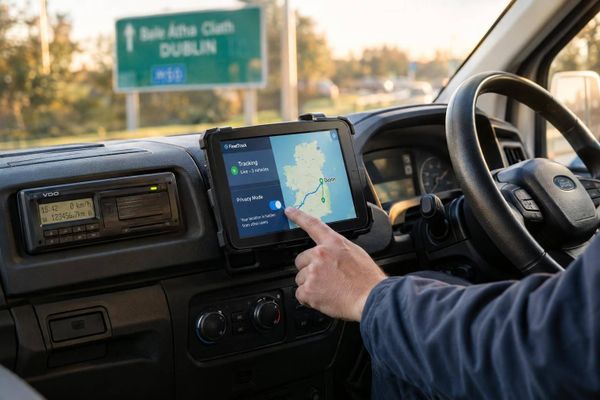
How IoT Gateways Improve Fleet Connectivity
IoT gateways standardise vehicle sensor data, enable real-time tracking, predictive maintenance and secure remote fleet management.
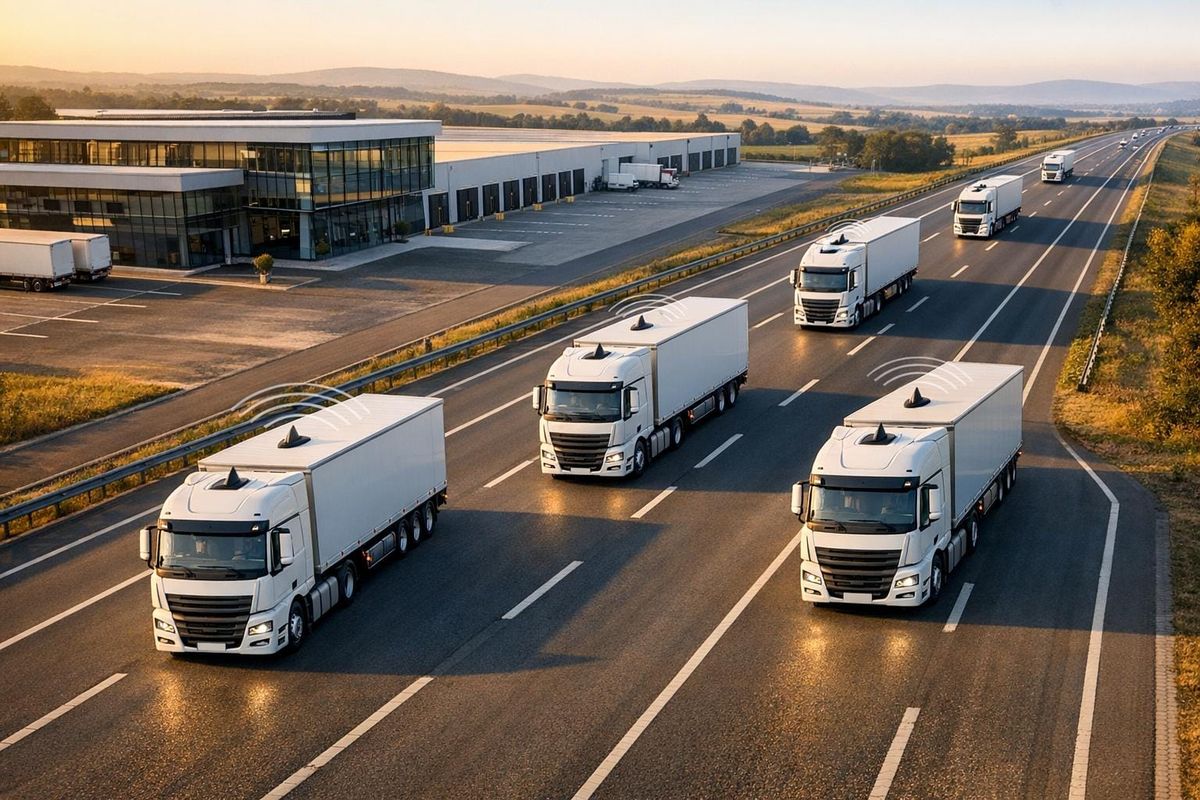
IoT gateways are the backbone of modern fleet management, ensuring vehicles stay connected and data flows smoothly. These devices collect, process, and securely transmit data from vehicle sensors to cloud platforms, enabling real-time tracking, proactive maintenance, and improved safety. Here's what you need to know:
- Data Handling: Gateways convert diverse sensor data into a standardised format for seamless integration with telematics platforms.
- Real-Time Insights: They enable van tracking solutions, driver behaviour monitoring, and automated workflows to streamline operations.
- Maintenance and Safety: Continuous monitoring helps predict breakdowns, reducing downtime by 25–40%, and improves compliance with driving regulations.
- Theft Prevention: Advanced GPS and geofencing features achieve recovery rates of up to 95% for stolen vehicles.
- Remote Management: Over-the-air updates and centralised control ensure smooth operations across large fleets.
IoT gateways are transforming fleet management by reducing costs, improving safety, and boosting efficiency - keeping vehicles connected no matter where they are.
IoT Gateway Benefits for Fleet Management: Key Statistics and ROI
How IoT Powers Fleet Management
sbb-itb-499a7f0
What IoT Gateways Do in Fleet Operations
An IoT gateway acts as the nerve centre of a vehicle, connecting various data sources and making them work together seamlessly. Installed directly in your fleet vehicles, it collects, processes, and transmits data from devices like GPS trackers, BLE sensors, and vehicle systems. By converting this data into a unified format, it ensures compatibility with your fleet management platform. Impressively, modern telematics gateways can process data from over 1,000 different IoT and telematics devices, regardless of the manufacturer. Here’s a closer look at their key roles: data collection, protocol translation, and secure data transmission.
Collecting and Processing Data from Vehicle Sensors
IoT gateways gather telemetry data from a range of sources, such as GPS trackers, BLE sensors, beacons, and OEM cloud platforms. Instead of simply passing raw data to your systems, the gateway processes it first. This involves aggregating and enriching the data, ensuring that only meaningful and actionable information is transmitted. By doing this, the gateway reduces the workload on your cloud systems, making your fleet management platform more efficient.
Translating Communication Protocols
Fleet operations often rely on a variety of hardware, each using its own communication protocol. IoT gateways solve this challenge by standardising these diverse protocols into a single JSON format with uniform parameters. This standardisation is essential because it allows your fleet management platform to handle data from thousands of devices through a single API. Without this, you’d need custom integrations for each device type, which would be a logistical nightmare.
Transmitting Data Securely and Efficiently
After collecting and normalising the data, the gateway transmits it securely to cloud platforms like Microsoft Azure, Google Cloud, or Amazon Web Services using REST or MQTT APIs. This method ensures minimal latency and reduces bandwidth usage by sending only processed, relevant data instead of raw outputs. Additionally, the gateway manages secure connections even as vehicles move between different network areas, ensuring reliable data delivery during transitions between cell towers. This reliability is critical for maintaining uninterrupted fleet operations.
Connecting IoT Gateways with Telematics Platforms
Once vehicle data is standardised, the next step is connecting the IoT gateway to your telematics platform. This connection transforms raw data into practical insights that can improve fleet operations. The IoT gateway acts as a bridge, linking various vehicle systems - some relying on older CAN bus protocols, others using Bluetooth or cellular connections - with modern, cloud-based telematics platforms. This setup ensures smooth data flow, enabling real-time tracking, automation, and seamless integration with transport management systems. It’s the backbone for efficient fleet monitoring and management.
Real-Time Tracking and Automated Workflows
IoT gateways play a vital role in real-time tracking by constantly gathering GPS and sensor data from vehicles and transmitting it to telematics platforms with minimal delay. This capability supports automation, reducing the need for manual intervention. For instance:
- Location-based alerts notify managers when vehicles enter or leave specific zones.
- Geofencing features automatically log driver arrivals at job sites.
- Sensors detecting issues like overheating can instantly alert managers, preventing costly breakdowns.
These automated workflows shift fleet management from being reactive to proactive, allowing potential issues to be resolved before they escalate. Additionally, consistent data formatting ensures that management dashboards present clear and actionable information.
Standardising Data for Dashboard Display
For fleet managers, having consistent data across dashboards is crucial. IoT gateways handle this by converting varied sensor inputs into unified metrics, making fleet-wide comparisons straightforward. For example, one vehicle might report fuel efficiency in litres per 100 kilometres, while another uses miles per gallon. The gateway standardises these figures (e.g., to litres per 100 kilometres for UK operations) and applies validation rules to filter out inaccurate readings. It then structures the data according to predefined schemas.
This process ensures that fleet managers can easily spot trends and outliers across their operations. By presenting standardised, validated data, the gateway simplifies decision-making and enhances the visibility of fleet performance metrics.
Working with Transport Management Systems
Integrating IoT gateways with transport management systems (TMS) unlocks even greater efficiency. For example, when a delivery job comes in, the TMS can query the telematics system to locate the nearest available vehicle. Based on this information, the system can automatically assign the job and provide the driver with an optimised route.
The gateway also enables two-way communication, allowing the TMS to send updated instructions directly to the driver’s in-cab display. If a vehicle experiences a breakdown, the TMS can quickly reassign its tasks to nearby vehicles, ensuring minimal disruption. This integration keeps fleet operations running smoothly and helps maintain customer satisfaction.
Solutions like GRS Fleet Telematics demonstrate how these capabilities can provide real-time, effective van tracker systems across the UK. By combining automation, real-time insights, and seamless communication, these systems ensure vehicles stay on the move efficiently and effectively.
Improving Fleet Safety and Performance with IoT Gateways
IoT gateways are transforming fleet management by enhancing both safety and efficiency. These devices process sensor data in real-time, enabling fleets to adopt proactive measures for safer driving and better vehicle performance.
Monitoring Driver Behaviour and Compliance
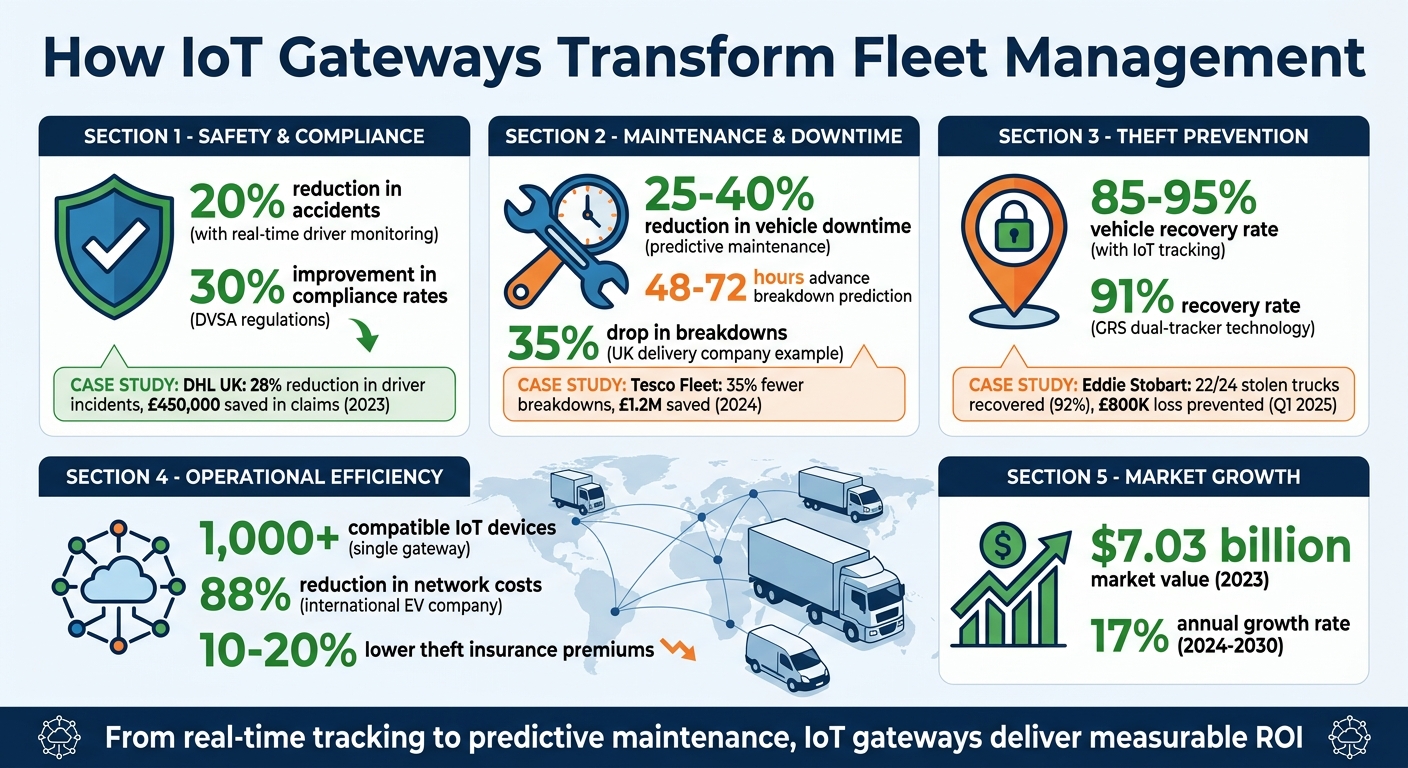
IoT gateways gather data from accelerometers, GPS modules, and speedometers to monitor driving habits in real-time. For example, when a driver brakes harshly, accelerates too quickly, or exceeds speed limits, the gateway processes this data locally and issues in-cab alerts. This immediate feedback helps drivers correct risky behaviours on the spot. Studies show that such real-time monitoring can reduce accidents by up to 20%.
In the UK, these gateways also help ensure compliance with DVSA regulations by tracking tachometer data, idle times, and driver hours. They automatically flag issues like exceeding the 10-hour daily driving limit and generate compliance reports that integrate seamlessly with HGV driver cards. This automation has led to a 30% improvement in compliance rates, thanks to proactive coaching and better tracking.
An impressive example comes from DHL UK, which integrated IoT gateways into its telematics platform in 2023. Over 12 months, this reduced driver-related incidents by 28%, supported by harsh braking alerts and a gamified driver app. Led by Fleet Safety Director Mark Jenkins, the programme saved £450,000 in claims [DHL Sustainability Report 2023].
Preventing Breakdowns Through Continuous Monitoring
IoT gateways also play a critical role in vehicle maintenance by continuously monitoring key metrics like engine temperature (°C), oil pressure, tyre pressure (bar), and vibration levels. Using edge analytics, these gateways detect anomalies early, predicting potential breakdowns 48–72 hours in advance. This approach has been shown to reduce downtime by 25–40%.
The financial benefits are clear. A UK delivery company using telematics to monitor alternator output and transmission temperatures reported a 35% drop in breakdowns, resulting in £45,000 annual savings in repair costs and lost productivity. By focusing on indicators like brake pad wear and drops in fuel efficiency, fleets can avoid repair costs that typically range from £500 to £2,000 per incident, plus towing fees of £150 per hour.
Tesco Fleet provides a compelling example. In 2024, they rolled out predictive maintenance across 4,000 vehicles, cutting breakdowns by 35% in just nine months. This reduced their utilisation rate from 12% to 7.8%, saving £1.2 million. Operations Lead Anna Patel led the initiative, which used oil and brake data to schedule pre-emptive services [Tesco Logistics Case Study, Fleet Europe 2025].
Preventing Theft and Recovering Stolen Vehicles
Beyond maintenance, IoT gateways also protect fleets from theft. These devices use multi-GNSS GPS tracking, accurate to within 5 metres, and support dual-tracker systems with both visible and concealed units. Motion sensors trigger silent alerts for unauthorised movement, while 4G/5G networks relay location data to enable quick recovery. Despite a 5% rise in UK vehicle thefts in 2024, fleets equipped with advanced IoT systems achieved 85-95% recovery rates [Fleet News UK, 2025].
GRS Fleet Telematics showcases this with its dual-tracker technology, achieving a 91% recovery rate for stolen vans at a cost of just £7.99 per month. Their system includes tamper-proof installations, real-time tracking across the UK, and integration with police AVSS for fast response.
Eddie Stobart Logistics also highlights the effectiveness of IoT gateways. In Q1 2025, they recovered 22 out of 24 stolen trucks (92% recovery rate) using GPS and geofencing. Even when primary trackers were disabled, hidden backup units continued transmitting location data. This initiative, led by Security Manager Tom Reilly, prevented £800,000 in losses [Logistics Manager UK, April 2025].
Fleet managers can further enhance security by setting up geofence alerts around depots, remotely activating engine immobilisers, and using AI to detect unusual routes. Centralised dashboards make it easy to lock down stolen vehicles with a single click, improving recovery rates and reducing theft insurance premiums by 10-20%.
Managing IoT Gateways Across Large Fleets
Scaling up to manage hundreds or even thousands of vehicles introduces a significant challenge: a single misconfigured gateway can disrupt the entire fleet. Outdated firmware can also create vulnerabilities that ripple across operations. Building on earlier discussions about data transmission and integration, managing gateways at such a scale requires unified remote control, strong security measures, and centralised monitoring. Let’s break down how these elements - remote updates, secure operations, and centralised control - work together to keep fleets running smoothly.
Remote Configuration and Software Updates
Over-the-air (OTA) updates are a must for keeping gateways functional across large fleets. These updates allow fleet managers to remotely push firmware updates, security patches, and configuration changes. A phased approach, where updates are tested on smaller groups before being rolled out fleet-wide, helps ensure stability and minimises risks.
"A common failure is what teams often call 'frozen gateways' - without a robust Over-The-Air (OTA) approach, versions silently diverge, and production teams lose confidence in pushing patches."
– Brendan Wood, Foundries.io
Fleet management platforms often rely on a declarative configuration model. In this setup, gateways automatically adjust to a pre-defined "desired state" instead of receiving one-off commands. For fleets operating in areas with unreliable connectivity, gateways can use an asynchronous polling model. This allows them to check in with a central service for updates whenever a connection is available. Security frameworks like The Update Framework (TUF) protect against malicious software and freeze attacks, while maintaining a Software Bill of Materials (SBOM) helps managers pinpoint vulnerabilities in specific software components deployed across the fleet.
Maintaining Security and Reliability
Once remote updates are applied, ensuring the security of each gateway becomes the next priority. From the moment they are activated, gateways should use cryptographic credentials and mTLS (mutual TLS) to secure communication. This identity-based approach supports future key rotations and prevents unauthorised devices from infiltrating the network.
"If an adversary can tamper with update content or metadata, the mechanism intended to deliver patches can become a distribution vector for malicious software."
– Brendan Wood, Foundries.io
Gateways should also include safeguards like exponential backoff to limit reconnection attempts and prevent network congestion. A "known good state" should be defined for each gateway, allowing it to recover if an update fails or if power is lost during critical operations. This ensures vehicles remain operational even in challenging scenarios. For remote access, time-limited, authenticated channels (such as WireGuard) are far safer than permanently exposed SSH connections.
Centralised Control and Monitoring
Centralised platforms provide real-time oversight for managing thousands of gateways. These platforms enable operators to handle tasks like activating or deactivating SIMs, setting data caps, monitoring cellular connectivity, and keeping track of software versions - all from a single dashboard.
"When you manage hundreds of thousands of SIMs, you can't look at every SIM. You need a platform that looks for you."
– 1oT
Automation through APIs is key to scaling operations without needing to expand the team proportionally. By integrating gateway management into existing Transport Management Systems (TMS) or CI/CD workflows, fleet operators can automate provisioning, updates, and compliance reporting. For instance, automated workflows can deactivate a SIM if an unexpected IMEI change suggests potential theft.
These platforms also support eSIM (eUICC) management, allowing remote carrier profile updates without having to replace physical SIM cards. Role-based access control (RBAC) ensures that different teams - like finance, operations, and security - can access only the features they need, preserving system integrity.
Even with limited cellular bandwidth, gateways should send lightweight telemetry data - such as storage status, software version, and last update results. This helps identify potential issues, like configuration drift, before they escalate into larger problems. With this session-level monitoring, operators can quickly determine whether a vehicle is simply parked or experiencing connectivity issues.
Conclusion
IoT gateways play a central role in modern fleet management, as highlighted by their ability to standardise data collection, secure transmissions, and enable remote management. These devices act as a bridge, connecting various sensors within vehicles to cloud platforms in real time. They translate multiple communication protocols, ensuring seamless data flow while maintaining security - even under the demanding conditions of vehicles in motion. Without them, fleet managers would miss out on vital real-time insights needed for efficient routing, maintenance, and safety.
The global IoT fleet management market was valued at approximately $7.03 billion in 2023 and is expected to grow at an impressive annual rate of 17.0% from 2024 to 2030. This rapid growth underscores the importance of connected technologies in reducing operational costs and improving safety standards. For example, one international electric vehicle company managed to cut its monthly per-car network costs in Europe by an impressive 88%.
As previously discussed, IoT gateways bring a host of advantages, including predictive maintenance, compliance tracking, and proactive security measures. They help prevent expensive vehicle downtime, automate compliance monitoring to keep drivers within legal limits, and provide tools for centralised fleet management. Whether it's a small business or a large-scale operation, remote configuration and monitoring make it easier to manage fleets effectively.
In the UK, businesses are already benefiting from IoT-driven solutions. GRS Fleet Telematics, for instance, offers white-label van tracking solutions designed around robust IoT gateway principles. Their dual-tracker technology delivers a 91% recovery rate for stolen vehicles, and with pricing starting at just £7.99 per month, they provide a cost-effective way to enhance security and tracking. Whether you’re overseeing a few vans or an extensive fleet, the right telematics system can revolutionise how you manage, protect, and optimise your operations.
FAQs
Do I need an IoT gateway if I already use GPS trackers?
An IoT gateway isn't always required, but it can play a big role in improving fleet connectivity. By gathering data from various sources, it allows for remote device management and facilitates real-time data sharing between systems. These capabilities can offer a more streamlined and effective way to oversee your fleet.
How does an IoT gateway keep fleet data secure while vehicles move between networks?
An IoT gateway protects fleet data during network transitions by employing advanced encryption techniques. For stored data, it uses AES-256 encryption, while data in transit is secured with TLS 1.3 protocols. Additionally, it relies on hardware security modules (HSMs) and trusted platform modules (TPMs) for secure key management, adding an extra layer of defence against potential breaches.
What should I look for in OTA updates and remote management for a large fleet?
To ensure your fleet operates smoothly, it's crucial to emphasise efficiency, security, and scalability. Key features to look for include:
- Compatibility with diverse vehicle types: This ensures the system works seamlessly across your entire fleet, regardless of make or model.
- Robust data protection: Measures like encryption and compliance with UK GDPR regulations safeguard sensitive information.
- Real-time remote management: This minimises downtime by allowing for instant updates and issue resolution.
Additionally, the system should buffer data during connectivity interruptions, ensuring no information is lost. Supporting vehicle health monitoring is another essential aspect, enabling proactive updates and maintenance to prevent unexpected breakdowns. By prioritising these elements, you can keep your fleet secure, compliant, and running efficiently.