Edge Computing vs. Cloud in AI Van Tracking
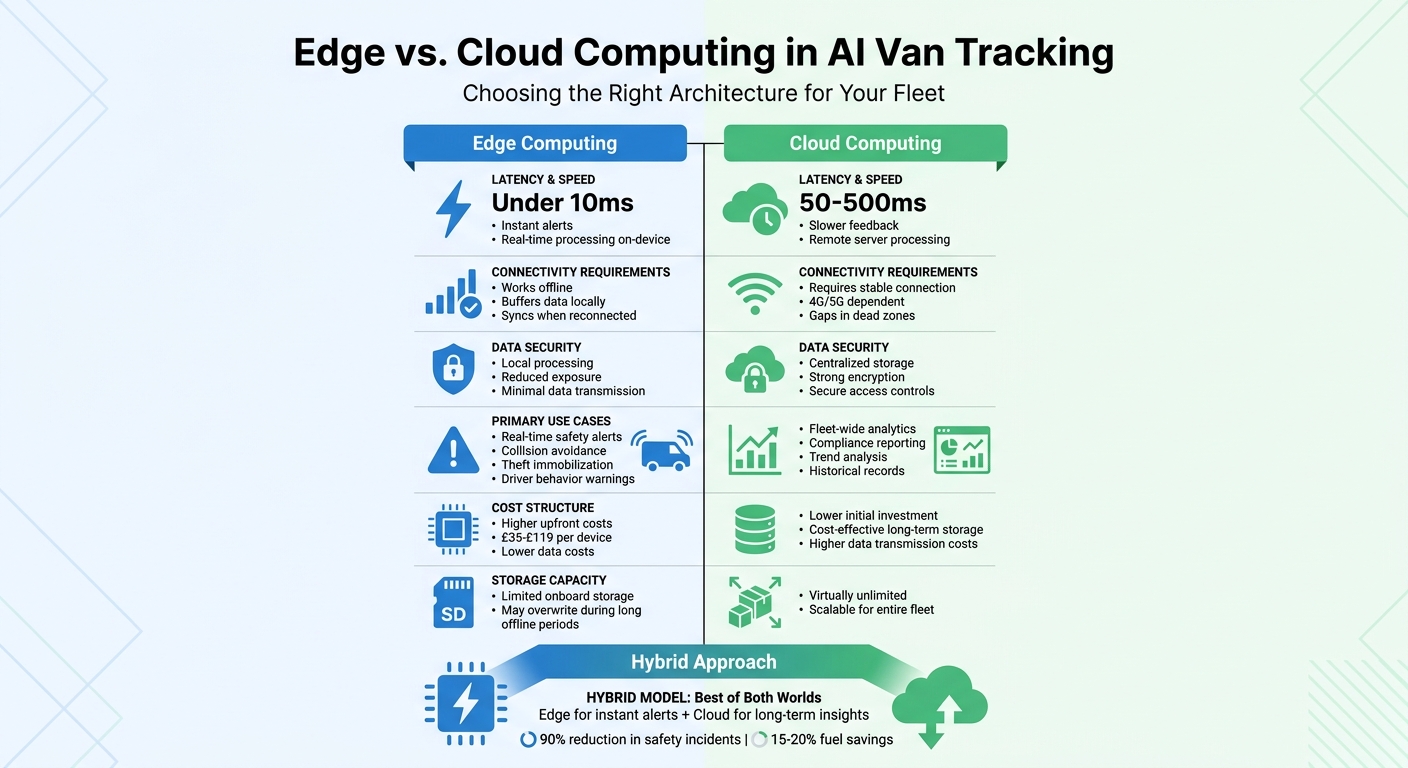
Edge vs cloud for AI van tracking: edge gives instant, offline safety alerts; cloud provides fleet-wide analytics, storage and compliance.
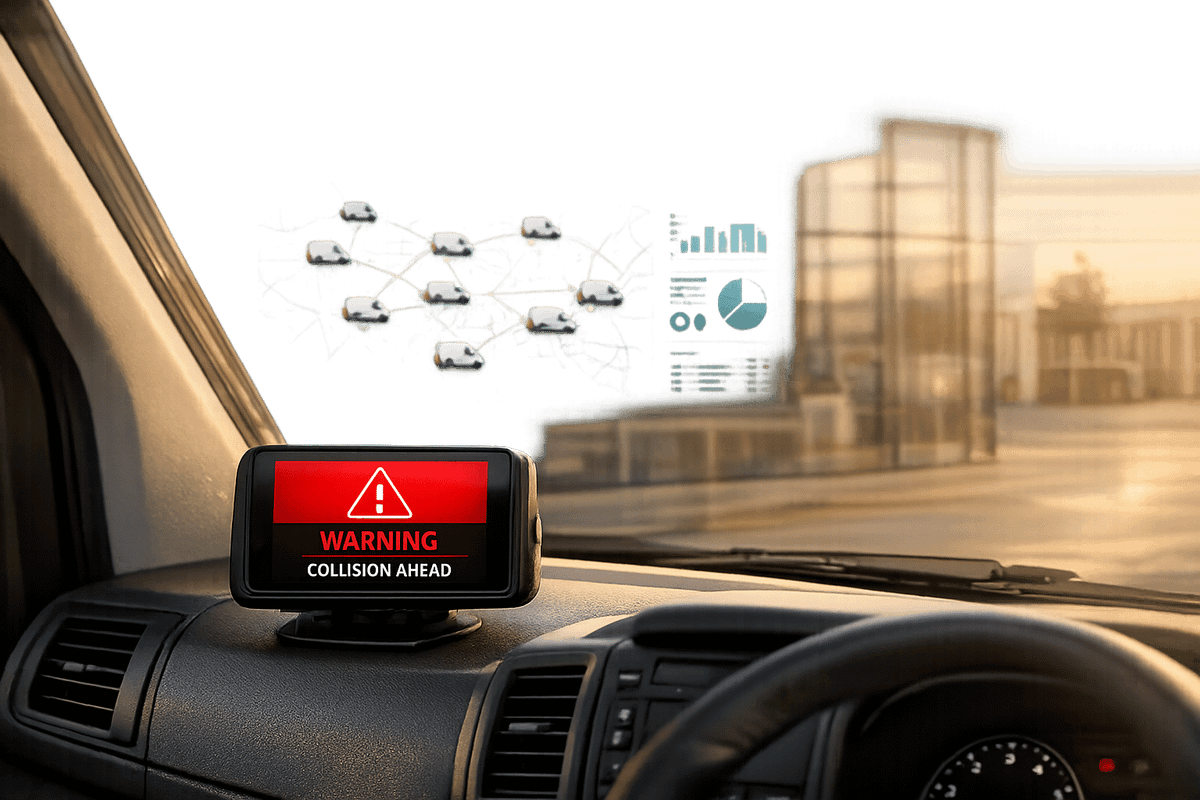
Edge computing processes data directly on vehicles for instant alerts, while cloud computing uses remote servers for broader analytics. Both have strengths, but their suitability depends on your specific van tracking solutions and fleet needs.
- Edge Computing: Ideal for real-time safety tasks like driver alerts. Works offline, ensuring reliability in areas with poor connectivity. However, it has higher hardware costs and limited storage capacity.
- Cloud Computing: Best for fleet-wide insights, compliance records, and long-term data storage. Requires stable connectivity and has slower response times for immediate actions.
Quick Comparison
| Feature | Edge Computing | Cloud Computing |
|---|---|---|
| Latency | Under 10ms (instant alerts) | 50–500ms (slower feedback) |
| Connectivity | Works offline; buffers data | Requires stable connection |
| Data Security | Local processing, less exposure | Centralised storage, encrypted |
| Use Case | Real-time safety interventions | Fleet-wide trend analysis |
| Cost | Higher upfront hardware costs | Cost-effective for long-term data |
Fleet managers often choose a hybrid model, combining edge for immediate actions and cloud for long-term insights. This approach balances speed, reliability, and comprehensive analytics.
Edge vs Cloud Computing in AI Van Tracking: Speed, Reliability & Cost Comparison
[ToloMEO webinar] AI on Edge in Fleet Management
sbb-itb-499a7f0
Edge Computing in AI Van Tracking
Edge computing allows AI analysis to happen directly on-board, bypassing the need to send data to distant servers. This capability is particularly useful for van tracking across different industries, where split-second decisions can mean the difference between avoiding an accident or recovering a stolen vehicle. For providers looking to offer these capabilities under their own brand, white-label van tracking solutions are available.
Real-Time Processing for Instant Alerts
With edge computing, data is processed directly on the device. For example, AI dash cams can detect issues like tailgating in milliseconds and deliver immediate in-cab alerts to drivers. This localised processing also ensures that only critical alerts, such as geofence breaches or harsh braking events, are sent to fleet managers, reducing cellular data costs while keeping managers informed.
This approach not only speeds up response times but also ensures data integrity during connectivity outages, as the system can continue functioning without relying on a constant network connection.
Reliability in Remote Areas
Edge devices excel in maintaining operations in areas with poor connectivity. They store telemetry data locally during network drops, ensuring that a complete timeline is preserved even in tunnels, rural areas, or remote depots. Once the network is restored, the device synchronises this buffered data, filling in gaps for events like location tracking, ignition activity, harsh driving incidents, or temperature changes.
This local storage also creates tamper-resistant audit trails for compliance with safety regulations, driver hours, and temperature-controlled cargo requirements, even during extended offline periods.
James Harrington, Senior Fleet Telematics Editor, explains: "In low-connectivity fleets, the best telematics device is not the one with the flashiest live map. It is the one that can keep a complete, tamper-resistant record through every dead zone, tunnel, and rural gap".
Pros and Cons of Edge Computing
| Advantages | Disadvantages |
|---|---|
| Ultra-low latency for instant alerts | Higher initial hardware costs compared to basic GPS trackers |
| Operates offline with local data storage | Limited onboard storage can lead to overwriting during long offline periods |
| Reduces bandwidth usage through local filtering | Requires reliable synchronisation for cloud uploads |
| Enables immediate safety actions like geofencing and theft alerts | Data remains on-device until the network reconnects |
| Maintains complete audit trails in connectivity dead zones | Dependent on stable vehicle power for consistent operation |
Next, we’ll explore how cloud computing tackles van tracking challenges.
Cloud Computing in AI Van Tracking
Cloud computing shifts the heavy lifting of data processing from individual van tracker systems to centralised servers, creating what’s often referred to as an "enterprise control plane". While edge computing focuses on immediate, on-board decisions, the cloud takes a broader approach. It collects and analyses data from an entire fleet, uncovering patterns and insights that a single vehicle simply couldn’t identify on its own.
Scalability for Fleet-Wide Analysis
One of the cloud’s standout strengths is its ability to handle massive datasets from multiple vehicles at the same time. By combining vehicle telemetry with systems like ERP, payroll, and maintenance schedules, it generates insights that edge computing alone can’t achieve. For example, fleet managers can use cloud-powered dashboards to monitor fuel efficiency across dozens of vans, compare driver performance between locations, and pinpoint cost-saving opportunities through long-term trend analysis.
This centralised approach turns raw data - such as harsh braking, idling, or route deviations - into actionable reports. Consider Domino’s Pizza: in early 2026, the company saved over £100,000 annually on insurance by adopting AI-driven scorecard solutions. These solutions analysed driver behaviour across their fleet, helping them benchmark performance, identify training gaps, and demonstrate improved safety standards to insurers.
"The cloud is the right place for long-term analysis, leadership dashboards, trend discovery, and audit-ready record keeping", says Daniel Mercer, Fleet Tech Strategist.
Cloud storage also solves the problem of limited on-device storage. While devices in vehicles can quickly run out of space, the cloud provides virtually unlimited capacity for storing compliance records, temperature logs, and journey histories. This makes it invaluable for regulatory audits, insurance claims, and historical reporting. However, this expansive capability does come with challenges, particularly around latency and connectivity.
Latency and Connectivity Challenges
The trade-off for the cloud’s scalability is speed. Processing data in the cloud involves uploading it via cellular networks to remote servers, which typically adds 50–200 milliseconds of latency. This delay can be critical in real-time safety scenarios, where immediate feedback is essential. As experts note, such delays can cause drivers to miss the "coachable moment".
Connectivity is another hurdle. Cloud-based tracking relies on a stable network connection, which isn’t always guaranteed, especially in rural areas, coastal zones, or industrial estates across the UK. Signal drops lasting minutes or even hours can lead to gaps in route history, inaccurate stop durations, and missing compliance evidence. These limitations highlight the trade-offs involved in relying solely on cloud computing for van tracking.
Pros and Cons of Cloud Computing
| Advantages | Disadvantages |
|---|---|
| Handles large datasets from multiple vehicles simultaneously | Latency (50–200 ms) can delay time-sensitive feedback |
| Virtually unlimited storage for historical records | Requires a stable network connection, which can fail in signal dead zones |
| Integrates with ERP, payroll, and maintenance systems | Reactive rather than proactive for urgent safety scenarios |
| Cost-effective for long-term data retention | Continuous uploads may increase cellular data costs |
| Enables fleet-wide benchmarking and trend analysis | Risk of data loss during network outages |
Comparing Edge and Cloud: Speed, Reliability, and Data Security
When deciding between edge and cloud computing for van tracking, three key aspects come into play: response speed, functionality in remote areas, and data protection. Each system tackles these challenges differently, so knowing the trade-offs can help align the technology with your fleet's specific needs.
Building on the earlier discussion of how edge and cloud systems work, this section compares their performance in terms of speed, connectivity resilience, and data security.
Speed: Real-Time vs. Batch Processing
Edge computing processes data directly on the device, bypassing remote servers, and delivers alerts in under 10 milliseconds. For instance, if a driver gets distracted by their phone, an in-cab alert is triggered almost instantly. In contrast, cloud computing requires transmitting data via cellular networks to remote servers for analysis, then sending feedback back to the vehicle. This process typically takes 340 milliseconds or more, depending on network conditions.
This difference in latency makes edge computing the go-to choice for safety-critical tasks where immediate action is necessary, like correcting unsafe driving habits. On the other hand, cloud systems shine in less time-sensitive applications, such as generating weekly utilisation reports or analysing fuel trends, where a slight delay is acceptable.
"Edge AI processes data directly on the device, enabling immediate in-cab alerts and proactive risk prevention, unlike the delayed feedback of Cloud AI." - Christine Beaton, Content Manager, Geotab
Reliability in Network-Dependent Scenarios
Edge devices are designed to buffer critical data and synchronise it with the cloud once connectivity is restored, ensuring no essential records are lost during signal outages. Cloud-only systems, however, rely on a constant connection. This dependency can lead to gaps in route history, inaccurate stop durations, and missing compliance records in areas with poor connectivity, such as rural locations, valleys, or tunnels across the UK.
For fleets operating in regions with unreliable networks, edge-first devices offer a clear advantage. They continue to function offline, recording and encrypting data locally even during signal loss or tampering attempts. While cloud systems are excellent for fleet-wide analytics, they falter when connectivity drops, leaving managers with incomplete data and drivers without real-time assistance.
Data Security Considerations
Edge computing minimises security risks by processing sensitive data locally. Raw footage and driver monitoring information are handled on the device, with only selected, high-value clips sent to the cloud. This limits data exposure during transmission and avoids creating large, unanalysed video archives that could be vulnerable to breaches.
Cloud computing, on the other hand, relies on robust encryption for stored data and centralised access controls. It is particularly suited for maintaining long-term compliance records, audit-ready reports, and fleet-wide benchmarks. However, transmitting more data over potentially insecure networks increases the risk of exposure during transit.
| Metric | Edge Computing | Cloud Computing |
|---|---|---|
| Latency | Ultra-low (under 10ms) | Moderate to high (50–500ms) |
| Uptime/Reliability | High (independent of network) | Dependent on stable connectivity |
| Primary Security Measure | Localised processing; reduced exposure | Strong encryption; centralised access |
| Connectivity Dependency | Low (buffers data offline) | High (requires stable 4G/5G) |
| Typical Use Case | Real-time alerts (e.g., tailgating, phone use) | Fleet-wide trend analysis & compliance |
These comparisons highlight why many fleet managers are adopting a hybrid approach, combining the immediate safety benefits of edge computing with the broader analytics capabilities of cloud systems. By balancing these strengths, fleets can optimise both real-time responses and long-term operational insights.
The Hybrid Approach: Combining Edge and Cloud for AI Van Tracking
Fleet operators are increasingly turning to a hybrid model that blends the capabilities of edge and cloud computing. With this setup, edge devices handle urgent tasks locally, while the cloud takes care of storing curated events and generating periodic summaries for long-term insights. This smart division of responsibilities ensures vehicles can react quickly on the road, while the back office maintains a clear, comprehensive view of operations.
"The right answer is usually not a single architecture but a deliberate composition of all three [edge, cloud, and on-device storage]." - Daniel Mercer, Senior Fleet Tech Strategist
Real-Time Alerts with Edge
Edge computing shines when it comes to managing tasks that demand immediate attention. For instance, when a geofence is breached or harsh braking is detected, the on-device processor reacts in milliseconds. It might trigger an in-cab warning, send a theft immobilisation command, or alert the control centre. These edge devices also use local flash memory to log critical safety events, such as crash alerts or refrigeration alarms. This ensures that essential data is preserved, even during connectivity issues. The cloud then steps in to complement this by managing data over the longer term.
Data Storage and Analysis with Cloud
While edge devices focus on real-time events, the cloud provides a platform for deeper analysis and secure storage. Historical data is consolidated in the cloud, enabling fleet-wide evaluations that can train AI models for improved efficiency. This layer supports insights into areas like fuel usage, driver behaviour, and compliance. By batching updates, the cloud also helps minimise data costs and reduce bandwidth consumption.
"The cheapest architecture is not the one that stores the least data; it is the one that stores the right data in the right place for the right amount of time." - Daniel Mercer, Senior SEO Editor & Fleet Tech Strategist
GRS Fleet Telematics Solutions for a Hybrid Model
GRS Fleet Telematics demonstrates how the hybrid approach works in practice, offering advanced tracking solutions through a cost-effective subscription model. For just £7.99 per vehicle each month, customers can choose from a range of hardware options:
- Essential: A single-wired tracker starting at £35, designed for real-time tracking.
- Enhanced: Priced at £79, this dual-tracker option includes a primary hardwired GPS and a hidden Bluetooth backup tracker.
- Ultimate: At £119, this premium option features remote immobilisation to block engine starts and deter theft.
Conclusion
Edge and cloud computing each bring unique advantages to AI van tracking, as highlighted in the comparisons above. Edge computing stands out for its ultra-low latency, enabling immediate actions like collision avoidance and theft alerts. On the other hand, cloud computing shines in fleet-wide analytics and tasks like compliance reporting.
"The right fleet data architecture is not cloud-first or local-first; it is purpose-first." - Daniel Mercer, Senior Fleet Tech Strategist
Different operations demand tailored connectivity solutions. Urban fleets may benefit from cloud-heavy systems, while rural routes, construction sites, or coastal areas often require edge processing to handle connectivity dead zones. A hybrid approach combines the strengths of both, using edge devices for instant alerts and local buffering, while the cloud focuses on long-term trends and integration with external systems like payroll or maintenance.
To optimise performance, fleets should map routes to identify connectivity gaps, prioritise events by urgency, and ensure offline data sync preserves integrity. It's also essential to understand how vendors handle data during signal outages, ensuring queued data is securely transmitted when reconnected.
With intelligent AI systems helping organisations achieve a 90% reduction in safety incidents within six months and 15–20% fuel savings, choosing the right data architecture can lead to significant benefits. The key lies in ensuring data is stored appropriately - by type, urgency, and duration.
FAQs
When should a fleet choose edge over cloud for alerts?
Edge computing shines in situations where instant, low-latency responses are essential, especially in safety-critical environments or locations with unreliable connectivity. By handling data directly within vehicles, edge AI can deliver immediate alerts for hazards or system faults without needing an internet connection. This allows for real-time reactions and seamless operation, which is crucial in scenarios where even slight delays could jeopardise safety or performance.
How is tracking affected by 4G/5G blackspots?
When vehicles pass through 4G/5G blackspots, low connectivity can interfere with real-time tracking, disrupting data transmission and fleet visibility. But there's a solution: edge computing. This technology processes and stores data locally, enabling tracking to function offline. Once the connection is back, the stored data syncs seamlessly, ensuring no gaps in fleet monitoring.
What data should stay on the vehicle vs go to the cloud?
In AI-powered van tracking, immediate data - like engine alerts, route adjustments, driver behaviour, and collision warnings - needs to be processed directly on the vehicle. This ensures quick responses and minimal delays. On the other hand, non-urgent information - such as past routes, fuel consumption, and driver logs - is better suited for cloud storage. The cloud enables detailed analysis and reporting. This blend of on-vehicle and cloud processing strikes a balance between real-time efficiency and long-term data insights.