Best Practices for Low-Latency IoT Fleets
Combine edge processing with 4G/5G and LPWAN to achieve real-time safety, lower data costs and resilient fleet tracking in low-coverage areas.

Low-latency IoT systems are crucial for reliable fleet management solutions, especially in areas with poor connectivity. Here's what you need to know:
- Edge computing processes data locally, ensuring faster responses (5–30ms) and reliable performance in dead zones like tunnels or rural areas.
- Cloud processing offers large-scale analytics but depends on uninterrupted network connections, risking data loss during outages.
- 5G networks provide ultra-low latency (1ms) and high speeds but may not yet have complete coverage in the UK.
- 4G/LTE is a dependable choice for most fleets, balancing cost and nationwide availability.
- LPWAN technologies (e.g., NB-IoT) are ideal for low-power, infrequent data needs like asset tracking.
Key takeaway: Combine edge computing for immediate decisions with cloud systems for broader insights. Use 4G or 5G for connectivity and LPWAN for basic sensors. This hybrid approach ensures resilience, cost efficiency, and reliable fleet operations across industries.
IoT Performance Optimization: Latency, Throughput & Efficiency Techniques
sbb-itb-499a7f0
1. Edge Computing vs Cloud Processing
For fleet operations dealing with unreliable connectivity, selecting the right system architecture can make all the difference. Edge computing handles data processing directly on van tracker systems or local gateways, whereas cloud processing depends on remote data centres. The main challenge in fleet telematics isn't CPU speed but network delays. For example, when a van passes through tunnels or rural areas, cloud-only systems may lose visibility, but edge systems remain functional and reliable.
Latency Performance
Where data is processed has a huge impact on latency. Edge computing achieves latency of 5–30ms locally, compared to the 30–150ms typical of cloud processing. This difference is critical for time-sensitive safety alerts, such as harsh braking or collision warnings. As TheLinuxCode puts it, "If I have to make a decision in under 50ms, I assume the cloud is too far away unless I'm already inside the same metro area and using dedicated connectivity". Edge computing is built for immediate action, while the cloud is better suited for long-term analytics and broader decision-making.
Cost Efficiency
Aside from improved latency, edge computing can also cut operational costs by reducing the amount of data sent to the cloud. Cloud platforms typically charge about £0.06–£0.07 per GB for data egress, which can quickly add up with frequent GPS updates. Edge systems filter out unnecessary data locally, often lowering bandwidth usage by 50% to 90%. While edge solutions require a larger initial investment in hardware for onboard processing and storage, they can significantly reduce ongoing cellular data costs.
Reliability
Edge-first systems are designed with connectivity issues in mind. They store critical data - like geofence breaches, tamper alerts, or refrigeration failures - locally and synchronise it in the correct order once the connection is restored. On the other hand, cloud-only systems risk missing data during outages. As Daniel Mercer, Senior Fleet Tech Strategist, explains, "The nearer the decision, the closer the data should stay". For fleets operating in areas with inconsistent 4G coverage, this local autonomy is crucial. Hybrid models offer the best of both worlds, using edge computing for immediate decisions and the cloud for fleet-wide dashboards and compliance reporting.
2. 5G Networks vs 4G/LPWAN Connectivity
When deciding on the best network technology for your fleet, your specific needs play a huge role. 5G delivers ultra-low latency of around 1 millisecond and peak speeds of up to 20 Gbps, making it perfect for time-sensitive applications like autonomous vehicles and real-time vehicle-to-everything (V2X) communication. In contrast, 4G LTE offers a latency of about 10 milliseconds and speeds up to 1 Gbps, which works well for standard telematics, video streaming, and cloud-based fleet management. Meanwhile, LPWAN technologies such as NB-IoT and LTE-M are tailored for low-power, infrequent data transmissions, making them ideal for asset tracking or smart metering, though they come with lower speeds and higher latency. These differences highlight how network technology and hardware choices go hand in hand to reduce latency.
Latency Performance
The gap in latency across these technologies is striking. 5G's latency of around 1 millisecond is nearly ten times faster than 4G's 10 milliseconds, while LPWAN technologies can experience delays measured in seconds. For many fleet-related tasks like GPS tracking, geofencing, and monitoring driver behaviour with white-label van tracking solutions, 4G's performance is more than enough. As Telecom Trainer notes, "5G makes way for a hyper-connected, low-latency, and scalable digital world", though not all fleet operations require the sub-10 millisecond responsiveness that 5G offers.
Cost Efficiency
Speed isn’t the only consideration - cost matters too. LPWAN provides an affordable entry point, with providers like 1NCE offering a one-off fee of €12 (around £10) for 10 years of connectivity and up to 500 MB of data for basic sensors. In contrast, IoT SIMs for 4G typically cost between £1 and £5 per month per device for moderate data use, while high-bandwidth needs like video streaming can push costs to £5–£20 or more per month. For example, the UK’s Data Communications Company, which oversees over 30 million smart meters, is transitioning to 4G hubs through a 15-year agreement with Vodafone, ensuring the network remains robust as older 2G and 3G systems are phased out by 2033. This demonstrates how 4G infrastructure offers a reliable and scalable solution without the higher costs tied to 5G hardware and subscriptions.
Scalability
5G can handle up to 1,000,000 devices per square kilometre, compared to 100,000 for 4G, making it ideal for densely populated urban areas. However, 4G’s well-established, nationwide coverage ensures immediate scalability, which is advantageous while 5G networks are still being rolled out. LPWAN technologies are well-suited for "Massive IoT" scenarios involving large numbers of low-power sensors. For instance, Engie Vianeo used BICS cellular IoT SIMs to connect 50,000 EV charge points, enabling real-time payments and diagnostics. Choosing the right technology depends on the asset: LTE-M supports seamless handovers between cell towers for vehicles in motion, while NB-IoT is better for stationary setups.
Reliability
Scalability is only valuable if the network performs consistently. UK cellular networks typically achieve over 99% availability, though actual reliability can vary depending on the fleet's routes. Urban fleets benefit from dense coverage, whereas rural operations may face connectivity challenges. As IoT Portal puts it, "Connectivity is not a feature. It is the entire foundation". For fleets operating in tunnels, remote areas, or other locations with unreliable coverage, edge-first hardware that stores data locally and syncs it once a stable connection is available becomes essential. For example, FatFace Retail uses multi-network IoT SIMs from KeySIM, which automatically switch to a backup cellular network if the primary broadband fails. This kind of redundancy can often be more critical than simply opting for the fastest network, ensuring reliable performance even in unpredictable environments.
Pros and Cons
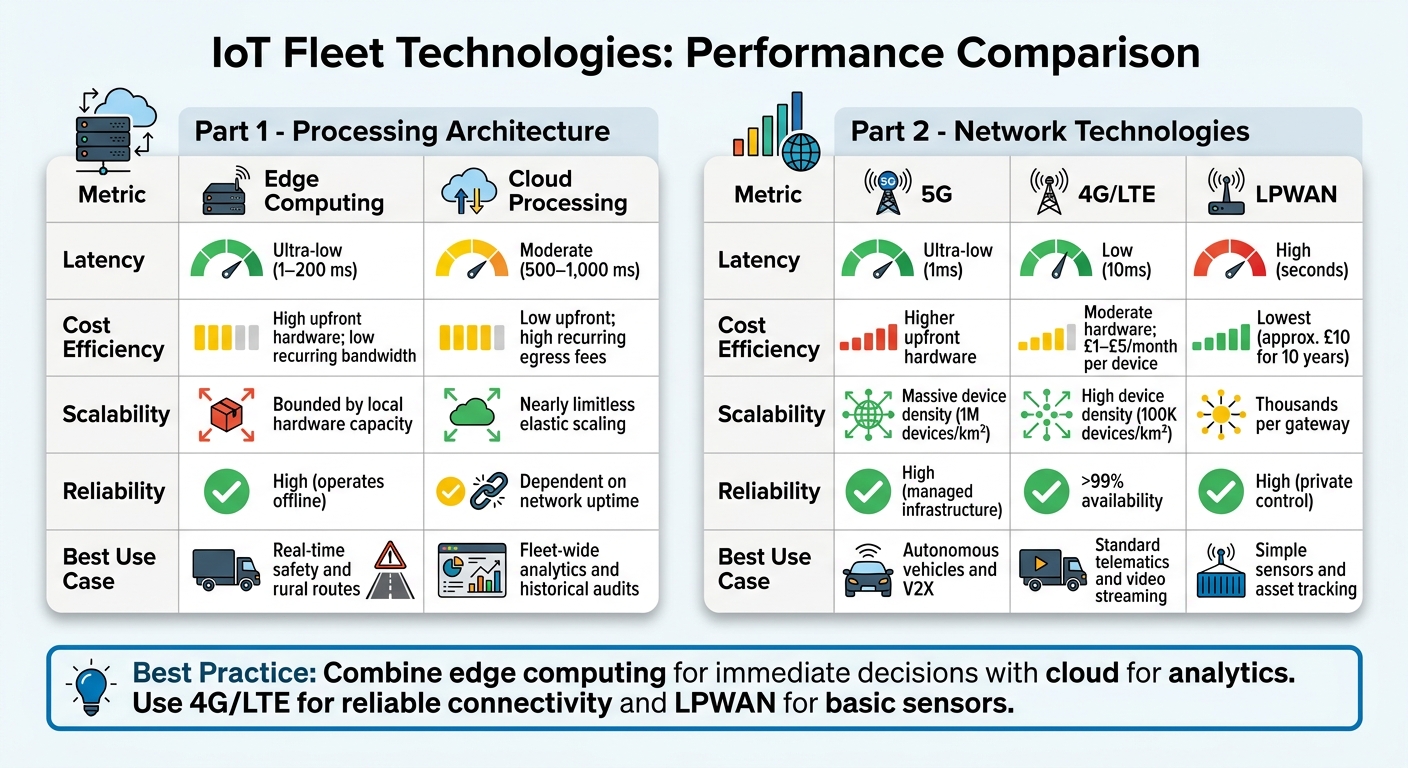
IoT Fleet Technologies Comparison: Edge vs Cloud and 5G vs 4G vs LPWAN
This section breaks down the advantages and trade-offs of different network technologies and processing architectures, focusing on key performance factors like latency, cost, scalability, and reliability. By weighing these metrics, you can decide on the best combination for your needs.
| Metric | Edge Computing | Cloud Processing | 5G | 4G/LTE | LPWAN |
|---|---|---|---|---|---|
| Latency | Ultra-low (1–200 ms) | Moderate (500–1,000 ms) | Ultra-low | Low | High (seconds) |
| Cost Efficiency | High upfront hardware; low recurring bandwidth | Low upfront; high recurring egress fees | Higher upfront hardware | Moderate hardware; £1–£5/month per device | Lowest (approx. £10 for 10 years) |
| Scalability | Bounded by local hardware capacity | Nearly limitless elastic scaling | Massive device density | High device density | Thousands per gateway |
| Reliability | High (operates offline) | Dependent on network uptime | High (managed infrastructure) | >99% availability | High (private control) |
| Best Use Case | Real-time safety and rural routes | Fleet-wide analytics and historical audits | Autonomous vehicles and V2X | Standard telematics and video streaming | Simple sensors and asset tracking |
How These Metrics Impact Fleet Operations
Edge computing stands out for its resilience and efficiency. By filtering data locally, it can cut transmission needs by 50–90%. However, the trade-off is the higher initial cost of installing hardware at each site or vehicle. For applications like collision avoidance or harsh braking alerts, where milliseconds matter, edge processing is indispensable. As Kaushal Patel from ENQCODE puts it:
"Why are our models in the cloud when the decisions need to happen on the line?"
Cloud processing, on the other hand, shines in scalability. It offers nearly infinite capacity for fleet-wide analytics and historical data audits. While the upfront costs are lower, recurring data egress fees can add up over time.
5G brings high-speed, low-latency connectivity and supports dense device networks, making it ideal for urban fleets and advanced use cases like autonomous vehicles. However, 4G/LTE remains the more practical choice for most UK fleets, offering reliable nationwide coverage and over 99% service availability.
LPWAN is perfect for simpler, low-data needs like tracking fuel levels or monitoring temperatures. With costs as low as £10 for a decade of service, it’s a budget-friendly option for infrequent data transmissions.
A Balanced Approach
The best strategy often blends these technologies. For example, edge computing can handle immediate safety decisions, while 4G or 5G provides reliable connectivity for real-time updates. Meanwhile, cloud processing can manage broader analytics, and LPWAN can take care of low-priority data. By integrating these technologies, fleets can achieve a balance of cost, reliability, and scalability across various operational scenarios.
Conclusion
Our analysis reveals key strategies for achieving reliable, low-latency communication in fleet operations. The effectiveness of these operations hinges on selecting the right mix of technologies to meet specific requirements.
Edge computing is ideal for critical, safety-focused actions due to its ultra-low latency. Cloud processing supports long-term data analysis and centralised intelligence. Meanwhile, 5G provides sub-10ms responses for advanced applications, and 4G/LTE remains a dependable choice for nationwide connectivity.
The best results come from combining these technologies thoughtfully. As Daniel Mercer, Fleet Tech Strategist, puts it:
"The nearer the decision, the closer the data should stay".
This principle emphasises using edge computing for immediate actions while relying on cloud systems for comprehensive oversight. For UK fleet managers, this hybrid "fast local, smart cloud" model ensures a balance between real-time responsiveness and strategic long-term planning.
Before rolling out any solution, it's crucial to evaluate route connectivity. Identify potential dead zones in rural areas, valleys, or industrial estates rather than assuming consistent 4G/5G coverage. Testing offline capture capabilities is equally important. This ensures devices can store and later sync critical events - such as refrigeration alarms or crash notifications - when simulating signal loss. Edge-first tracking helps recover data in these dead zones.
For fleets focusing on theft prevention and dependable tracking, GRS Fleet Telematics offers a robust solution. Their dual-tracker technology, equipped with edge-based storage, ensures vehicle data remains intact even during signal disruptions or jamming attempts. With subscriptions starting at £7.99 per vehicle monthly and boasting a 91% recovery rate, this system showcases how combining local processing with cloud analytics delivers both rapid responses and comprehensive visibility.
Ultimately, fleet managers should align connectivity and processing choices with their operational priorities - whether that's real-time safety, cost-effectiveness, or resilience in low-coverage areas. This tailored, integrated approach ensures UK fleets remain agile, efficient, and dependable.
FAQs
When do I need edge computing instead of cloud processing?
Edge computing shines in situations where real-time, safety-critical tasks require ultra-low latency, the ability to function offline, or operation in remote areas with limited connectivity. It allows for quicker decision-making, enhances data privacy, and ensures systems remain resilient, even when cloud processing isn’t an option.
How do I choose between 4G, 5G, LTE-M, and NB-IoT for my fleet?
When selecting a network for your fleet, it's important to weigh factors like latency, data throughput, device density, and coverage. Here's a breakdown of the options:
- 4G: A dependable choice for general tracking needs, offering latency in the range of 50-100ms. It's well-suited for most standard applications.
- LTE-M/NB-IoT: These are great low-power solutions for sensors. LTE-M is better for mobile devices due to its lower latency and support for movement, while NB-IoT excels with static devices, especially in hard-to-reach areas.
- 5G: Designed for cutting-edge operations, it provides ultra-low latency (less than 1ms) and high-speed connectivity. It's ideal for real-time tracking and tasks that demand significant data processing.
Each option has its strengths, so aligning your choice with your fleet's specific requirements is key.
What should my trackers do when the vehicle loses signal or gets jammed?
When a vehicle encounters signal loss or jamming, its onboard storage can step in to temporarily save data locally. Once the connection is back, the stored data seamlessly syncs with the cloud. This ensures that fleet monitoring remains consistent and reliable, even in areas with poor connectivity.