API Data for Driver Safety Scoring
APIs convert high‑frequency telematics into real‑time driver safety scores that cut accidents, fuel use and insurance costs for fleets.

Driver safety scoring systems powered by APIs are transforming fleet management in the UK. By analysing telematics data like harsh braking, speeding, and rapid acceleration, these systems assign safety scores (0–100) to drivers, helping fleet managers reduce risks, cut costs, and improve compliance with safety regulations.
Key Takeaways:
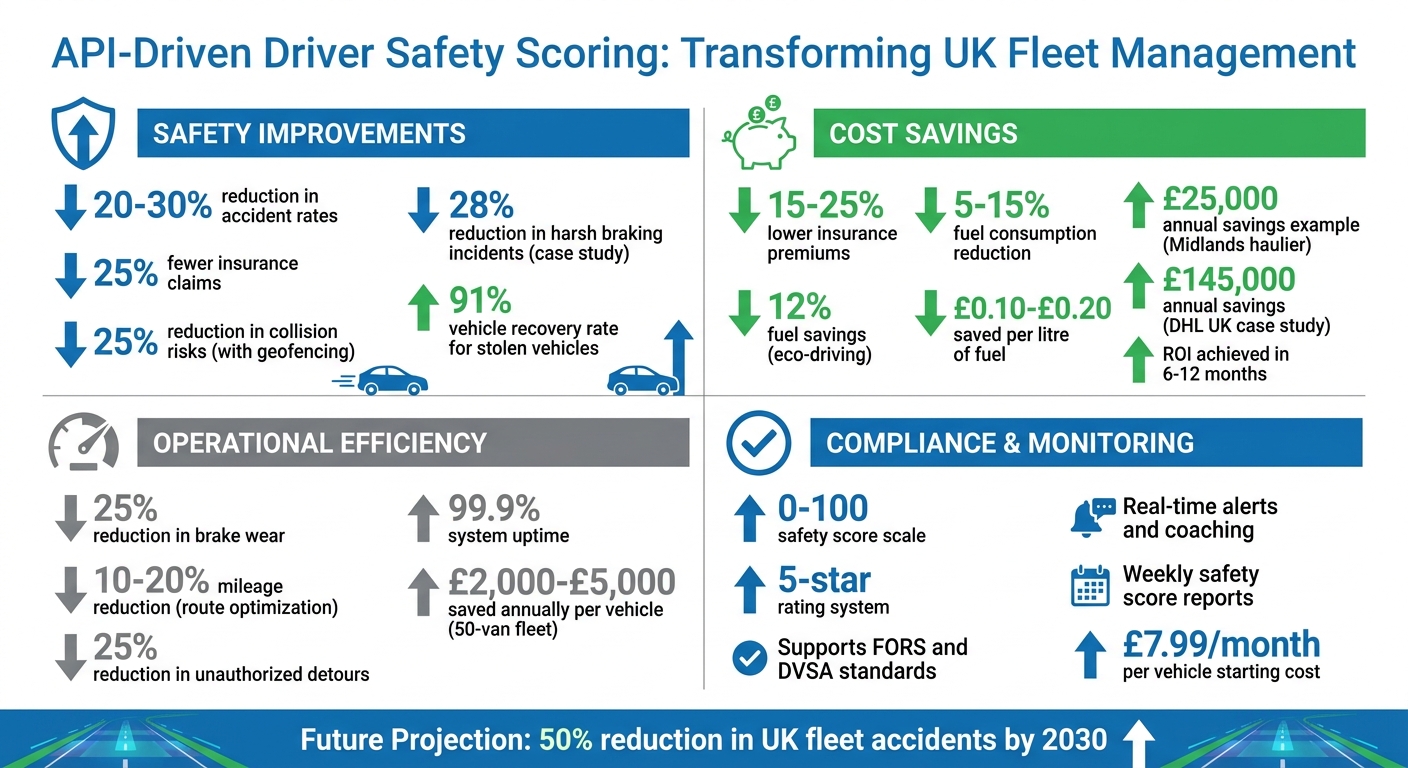
- Cost Savings: Fleets using API-driven scoring report 25% fewer insurance claims, 15–25% lower premiums, and up to 12% fuel savings.
- Improved Safety: Accident rates drop by 20–30%, with real-time alerts and coaching reducing risky behaviours like harsh braking and speeding.
- Compliance: Supports adherence to UK standards like FORS and DVSA, avoiding fines and ensuring accreditation.
- Eco-Driving Insights: Reduces fuel use, emissions, and maintenance costs, with ROI typically within 6–12 months.
APIs gather high-frequency data from vehicle sensors, process it with advanced algorithms, and deliver real-time insights via dashboards or apps. Systems like GRS Fleet Telematics integrate these insights with geofencing, dual-tracker hardware, and eco-driving analytics to maximise fleet efficiency and safety. By adopting API-driven solutions, fleets can achieve measurable improvements in safety, compliance, and cost management.
API-Driven Fleet Safety Scoring: Key Benefits and Cost Savings for UK Fleets
GreenZone® Score by Netradyne | Fleet Safety Redefined
sbb-itb-499a7f0
How APIs Collect and Process Safety Data
APIs gather raw telematics data from various sensors installed in vehicles. For example, GPS modules track location and speed at a rate of 1Hz, while inertial measurement units (IMUs) - which include gyroscopes, magnetometers, and accelerometers - capture movement data at a much higher frequency of 60Hz. This high-frequency data collection ensures that even brief, sharp driving events are recorded.
Advanced algorithms then process this raw data to identify specific driving events. For instance, acceleration events are flagged when a vehicle accelerates at more than 3 m/s², and braking events are recorded when deceleration exceeds 3.2 m/s². Similarly, cornering events are triggered by perpendicular acceleration exceeding 4.2 m/s², provided the event lasts at least 0.6 seconds to filter out irrelevant noise.
Speeding is detected by comparing GPS speed data against external speed limit databases, such as those from Google or HERE. An event is logged when the vehicle surpasses the speed limit for more than 3 seconds. Distracted driving, particularly phone use, is identified through machine learning models that analyse factors like device lock status, screen activity, and sensor data. If phone usage events occur within 20 seconds of each other, they are combined into a single event for analysis.
Key Metrics for Driver Safety Scoring
Once driving events are identified, they are translated into safety scores that help improve fleet safety. These scores are calculated on a 100-point scale using modern "3rd Generation" scoring models. Unlike earlier methods that simply counted incidents, these models assign penalty points based on the severity of each event. For example, harsh braking on a motorway is weighted more heavily than gentle braking in a car park. The total score is a weighted sum of these penalty points, adjusted for the distance driven to ensure fairness.
Star ratings are derived from this scoring system: a perfect score of 100 earns 5 stars, 90 or above gets 4 stars, 80 or above receives 3 stars, 70 or above results in 2 stars, and anything below 70 is rated 1 star. While telematics systems can assess a driver’s style within about a month, a longer monitoring period of 3–4 months is typically needed to stabilise the scoring model and account for annual mileage and long-term driving behaviour.
Data Collection and Real-Time Insights
These weighted metrics enable real-time insights, allowing fleet managers to address risky behaviour as it happens. The real strength of API-driven safety scoring lies in its ability to process and deliver data immediately. For example, as soon as a driving event occurs, the information is made available through dashboards or mobile apps. This immediacy allows managers to take prompt action, whether it's coaching a driver displaying risky habits or recognising and rewarding safe drivers.
Benefits of API-Driven Safety Scoring for Fleet Operators
Improved Driver Behaviour Monitoring
API-driven safety scoring systems bring notable advantages to fleet operators, especially in tracking and improving driver behaviour. By processing telematics data, these systems create feedback loops that influence driving habits. For instance, fleets using API-integrated monitoring have seen unsafe behaviours decline by 20–30%, as drivers receive instant alerts via mobile apps, promoting smoother and more efficient driving techniques.
In one trial, driver behaviour scores improved by 25% through tools like leaderboards and coaching reports, offering actionable safety metrics. Similarly, London-based delivery fleets used API alerts to identify that 15% of drivers were idling excessively. This insight enabled focused training, which not only reduced emissions but also ensured better compliance with UK road safety standards. Beyond individual improvements, these systems contribute to lowering overall safety risks for fleets.
Reduced Fleet Safety Risks
By incorporating predictive analytics, API safety scoring systems significantly reduce accident rates and associated costs. These systems aggregate data on risks like fatigue and distraction, helping fleets cut accident risks by 15–40%, as noted by Road Haulage Association benchmarks. Such reductions often lead to financial benefits, with UK operators achieving 10–20% discounts on insurance premiums through telematics-based policies offered by insurers like Aviva, who value the verified compliance data these APIs provide.
Data from the Freight Transport Association highlights a 22% drop in reportable accidents for fleets monitored by APIs. Geofencing features further enhance safety, as shown in UK van operator trials, where enforcing speed limits in urban areas led to an 18% decrease in collision risks. Additionally, these systems ensure adherence to UK Hours of Service rules by logging tachograph data and generating audit-ready reports, helping fleets meet DVSA requirements while improving safety standards overall.
Cost Savings Through Operational Efficiency
The operational benefits of API-driven systems translate into significant cost savings. For example, API feedback reduces fuel consumption by 5–15%, saving £0.10–£0.20 per litre based on projected 2026 diesel prices of around £1.50 per litre. A Midlands haulier demonstrated this by saving £25,000 annually, thanks to API eco-driving scores that helped drivers cut acceleration events by 30%.
Maintenance costs also see a decline, as APIs analyse safety and GPS data to pinpoint behaviours causing excessive wear. Fleets report 25% reductions in brake wear when harsh braking events are minimised. Integration with route optimisation tools further reduces mileage by 10–20%, leading to yearly savings of £5,000–£15,000 per 20 vehicles on tyre and engine repairs. Mid-sized fleets typically achieve overall savings of 10–25%, with returns on investment often realised within 6–12 months through combined fuel savings, lower insurance costs, and reduced downtime.
Integration of API Data with GRS Fleet Telematics
Integrating API data with GRS Fleet Telematics enhances driver safety scoring while improving overall fleet management. The system pulls data from telematics devices to monitor driver behaviour in real time. Key metrics include harsh acceleration (over 3 m/s²), harsh braking (over 4 m/s²), speeding (exceeding limits by more than 10%), and idling (longer than 5 minutes). Using this data, the platform generates weekly safety scores out of 100, helping fleet operators across the UK pinpoint risky driving habits and provide focused coaching. This same data also supports real-time tracking and geofencing features.
Driver Safety Monitoring and Eco-Driving Analytics
Eco-driving analytics use API-driven data to evaluate fuel efficiency (litres per 100 km), CO₂ emissions per trip, and smooth driving scores. For example, a logistics firm in the Midlands reduced fuel consumption by 12% after six months of coaching informed by API data. This led to annual savings of £200 to £500 per van. These analytics not only align with the UK's net-zero goals but also typically deliver a return on investment within nine months, with a subscription cost of just £7.99 per month per tracker.
Real-Time Tracking and Geofencing
GRS Fleet Telematics offers real-time GPS tracking with updates every five seconds, thanks to its API integration. The geofencing feature creates virtual boundaries around UK locations. If a van crosses one of these zones, the system sends alerts in under 10 seconds, capturing details like arrival times, driver information, and route deviations. This functionality has been shown to reduce unauthorised detours by around 25%.
The dynamic geofencing options allow operators to set customised boundaries ranging from 50 metres to 5 kilometres. Speed limits can also be enforced within these zones, and the system integrates with vehicle immobilisers for instant lockdown in case of breaches. Additionally, the system’s capability to share live location data with the UK’s NCARRS system has led to a 91% recovery rate for stolen vehicles, improving both security and compliance with fleet insurance requirements.
Dual-Tracker Hardware Compatibility
The dual-tracker hardware ensures continuous and reliable data collection. GRS Fleet Telematics uses a combination of a hardwired OBD-II device and a magnetic GPS tracker, securely transmitting data via APIs with OAuth2 authentication. This setup guarantees uninterrupted data flow, with location updates every 10 seconds and event-based uploads, such as crash detection for impacts exceeding 5g. Even if one tracker is compromised, the other continues to provide data.
In early 2025, DHL UK integrated GRS Fleet Telematics into its 500-van fleet under the supervision of Fleet Manager Tom Hargreaves. This integration led to a 28% reduction in harsh braking incidents (from 15% to 10.8% of trips) and an 18% drop in fuel consumption, saving £145,000 annually. During two theft incidents, the vehicle recovery rate increased to 92%. The dual-tracker system maintained 99.9% uptime, proving especially reliable for vans operating in high-risk areas like the M25.
Conclusion
API data transforms telematics into actionable driver safety scores. By analysing real-time data – like harsh braking, rapid acceleration, speeding, and aggressive cornering – fleet operators can measure driver behaviour objectively and take preventative steps to avoid incidents. Studies reveal that API-powered scoring can lower accident rates by 20–30% in commercial fleets, cut fuel costs by 5–10%, save £2,000–£5,000 annually per vehicle in a 50-van fleet, and reduce insurance premiums by 15–20%.
GRS Fleet Telematics provides a comprehensive solution featuring dual-tracker hardware that delivers weekly safety scores, eco-driving insights, and real-time geofencing, all starting at just £7.99 per vehicle per month. With 99.9% uptime and a 91% recovery rate for stolen vehicles, the system ensures uninterrupted data flow and robust fleet security. Customisable dashboards display safety scores, fuel economy, and CO₂ emissions, simplifying driver training and compliance with regulations. This integration offers clear, measurable improvements in safety and cost management.
Fleet managers can quickly identify risky behaviours and receive instant alerts for geofence breaches, helping to cut collision rates by 25% and achieve a return on investment in under six months. With experts predicting that API-driven scoring could reduce UK fleet accidents by 50% by 2030, adopting this technology early gives operators a competitive edge as safety standards evolve.
For businesses focused on fleet safety and operational efficiency, API data is a game-changer. GRS Fleet Telematics combines affordable hardware, scalable software, and 24/7 recovery support to turn raw data into meaningful safety and cost benefits.
FAQs
What data do APIs use to score driver safety?
APIs evaluate a range of driver behaviour metrics to determine safety scores. These include factors like speeding, harsh braking, rapid acceleration, and seatbelt usage. Real-time alerts for actions such as sharp cornering and engine idling allow fleet managers to monitor and assess driver performance more effectively. Metrics like emergency response times and phone use while driving add further depth to the safety profile, helping managers implement targeted coaching and raise overall safety standards for their fleets.
How long does it take for safety scores to become reliable?
Safety scores tend to stabilise and provide reliable insights after a monitoring period of about 3 to 4 months. Typically, around 3 months is enough to observe consistent and steady outcomes.
How can GRS Fleet Telematics turn safety scores into cost savings?
GRS Fleet Telematics leverages driver scorecards and real-time data to pinpoint risky driving habits. This approach allows for focused coaching, which plays a key role in cutting down accidents, reducing fuel usage, and keeping maintenance expenses in check. By helping drivers perform better, businesses can save money while boosting fleet safety across the board.