Fleet-Wide EV Data Integration: Key Strategies
Compare telematics and AI load-management for UK EV fleets — costs, scalability and charging optimisation.

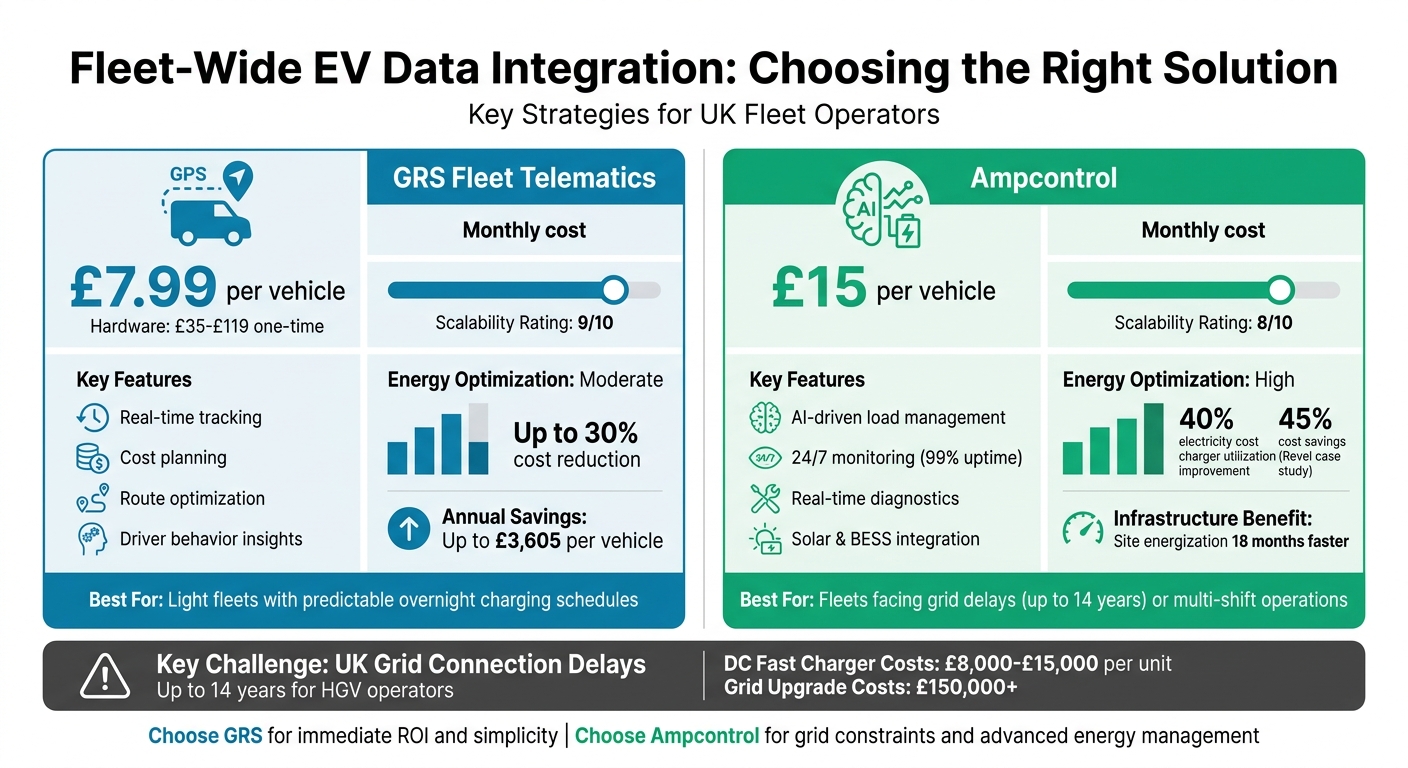
Integrating EV data across fleets in the UK is complex, with challenges like grid connection delays (up to 14 years for some HGV operators) and high infrastructure costs. However, smart solutions can significantly reduce costs and improve efficiency. Two standout options are GRS Fleet Telematics and Ampcontrol, offering different approaches to addressing these issues.
- GRS Fleet Telematics: Affordable at £7.99 per vehicle monthly, it provides real-time tracking and helps optimise charging during idle periods. Ideal for light fleets with predictable schedules.
- Ampcontrol: Priced at £15 monthly, it uses AI to cut electricity costs by 40% and improve charger utilisation by 38%. Best for fleets facing grid delays or requiring advanced energy management.
Both solutions help manage costs and improve fleet reliability, but choosing the right one depends on specific fleet needs.
Quick Comparison:
| Solution | Cost (per vehicle/month) | Focus Areas | Best For |
|---|---|---|---|
| GRS Fleet Telematics | £7.99 | Real-time tracking, cost planning | Light fleets with predictable schedules |
| Ampcontrol | £15 | AI-driven load management, scalability | Fleets with grid delays or high demand |
GRS Fleet Telematics vs Ampcontrol: EV Fleet Management Comparison
1. GRS Fleet Telematics
Implementation Cost
GRS Fleet Telematics keeps things simple with a pricing structure of £7.99 per vehicle per month. This fee covers SIM/data, access to the platform, and a dedicated account manager. Hardware costs vary, starting at £35 for the Essential single wired tracker and going up to £119 for the Ultimate package, which includes immobilisation features. This straightforward approach makes it easier for fleet operators to plan their budgets effectively, avoiding the guesswork that often comes with EV infrastructure projects. A crucial part of this process is creating a solid Total Cost of Ownership (TCO) case for charging infrastructure and electrical upgrades. Success in cost management depends heavily on having precise operational data.
Data Accuracy
The platform provides real-time tracking, delivering highly accurate data on vehicle location, battery levels, and usage patterns. This level of detail is critical when calculating energy needs. For instance, a fleet of 20 vans covering 60 miles daily at 2.5 miles/kWh would consume about 480 kWh per day. Metrics like miles per kilowatt-hour help identify inefficient driving behaviours that can drive up energy costs. Additionally, analysing daily travel patterns can prevent unnecessary spending on DC fast chargers when overnight AC charging would suffice. This precision ensures that solutions remain practical and cost-effective.
Scalability
Scalability relies on accurate data and careful cost planning. GRS Fleet Telematics helps fleets grow by identifying idle periods - such as overnight stops or lunch breaks - so that charging can align with these natural downtimes. The platform also works with Energy Management Systems (EMS) to enable dynamic load balancing, avoiding site overloads and delaying the need for expensive grid upgrades. For example, PepsiCo's Sacramento site managed to cut demand charges by 40% by using managed charging software for its fleet of 21 Tesla Semis. To future-proof installations, fleet managers are advised to oversize cabling and switchgear upfront, reducing the risk of costly retrofits later.
Energy Use Optimisation
With precise real-time data and scalable infrastructure in place, smart load management becomes a key tool for improving efficiency. This approach fine-tunes charging strategies, potentially cutting operational costs by up to 30%. By using telematics data to understand dwell times, shift schedules, and grid limitations, fleet managers can make well-informed decisions about where and what type of chargers to install. This ensures energy is used efficiently across the operation, keeping costs under control and maximising productivity.
sbb-itb-499a7f0
Exploring Telematics - a data driven approach to EV fleets
2. Ampcontrol

Ampcontrol brings together EV fleet data with a focus on reducing costs and ensuring reliability.
Implementation Cost
Ampcontrol helps fleets sidestep hefty infrastructure expenses. Installing a single 50 kW DC fast charger can cost anywhere from £8,000 to £15,000, and grid upgrades can soar past £150,000. By optimising strategies, the platform helps avoid these significant costs. For instance, Revel, a rideshare provider based in New York, cut its costs by as much as 45% using Ampcontrol's AI-driven smart charging, which adjusts based on time-of-use rates and real-time vehicle demand. Hart Uhl, Revel's Senior Charging Operations Manager, highlighted:
A key feature we rely on heavily is Ampcontrol's load management functionalities, which we use to control the costs of recharging our fleet.
Data Accuracy
Ampcontrol integrates a range of data, including vehicle telematics, energy pricing, site baseload, and real-time charger diagnostics, to deliver precise operational insights. This detailed view covers battery state of charge, GPS location, and energy consumption patterns, ensuring vehicles are ready for use while keeping energy costs low. The platform also aims for 99% charger uptime through 24/7 monitoring and remote diagnostics. Gabriela Favaron, Director of EV Infrastructure at 7Gen, shared:
Ampcontrol is our reporting and monitoring platform for the day-to-day use of charging stations and vehicles in lease.
This level of precision supports efficient and scalable fleet operations.
Scalability
The AmpEdge controller by Ampcontrol helps fleets avoid delays caused by grid upgrades - a common issue in the UK, where connection delays for high-capacity sites can range from 18 months to an astonishing 14 years. With AmpEdge, fleets can bring sites online up to 18 months sooner. The platform is designed to work with various vehicle types and charger systems, while scalable APIs and secure standards ensure it meets the needs of large operations like distribution centres and transit depots. These features enable flexible and efficient energy management.
Energy Use Optimisation
Ampcontrol uses AI modules to fine-tune charging schedules based on factors like time-of-use rates, site baseload, and vehicle needs. This reduces costs while maintaining smart charging, even during internet outages. The system also integrates with solar panels and battery energy storage systems (BESS) to optimise energy flow in real time. Kevin Kushman, CEO of Electrada, explained:
Ampcontrol equips us with a dynamic tool to optimally plan capacity and manage energy demand to help our customers realise reliable electric fuel service whose price is lower on a cost-per-mile basis than what they currently pay for liquid fuel.
Advantages and Disadvantages
When considering fleet-wide EV data integration, it's crucial to weigh operational efficiency against the readiness of your infrastructure. Both GRS Fleet Telematics and Ampcontrol bring distinct benefits to the table, catering to different fleet priorities.
GRS Fleet Telematics stands out for its affordability, starting at just £7.99 per vehicle per month. This makes it a great fit for fleets focused on cost-effective tracking and driver behaviour insights. With features like efficient route management, GRS helps reduce costs and is rated 9/10 for scalability. It’s particularly effective for light vehicle fleets that use overnight Level 2 charging and are not immediately impacted by grid capacity issues.
On the other hand, Ampcontrol, priced at around £15 per month, requires a higher investment but offers advanced features like precise data accuracy through simulation tools and real-time diagnostics. Its AI-driven load management can cut electricity costs by up to 40% and improve charger utilisation by 38%. Rated 8/10 for scalability, Ampcontrol’s AmpEdge controller can accelerate site energisation by up to 18 months, bypassing grid upgrade delays. This is particularly valuable in the UK, where some HGV operators face grid connection delays of up to 14 years.
Here’s a side-by-side comparison to help visualise the differences:
| Solution | Implementation Cost | Data Accuracy | Scalability (1-10) | Energy Use Optimisation |
|---|---|---|---|---|
| GRS Fleet Telematics | Low (£7.99/month) | High | 9 | Moderate |
| Ampcontrol | Medium (£15/month) | Very High | 8 | High |
This comparison highlights the trade-offs between immediate savings and long-term infrastructure benefits. GRS offers a quick return on investment by lowering fuel and maintenance costs. In contrast, Ampcontrol is better suited for fleets dealing with grid constraints or multi-shift operations, as its energy management features can reduce demand charges by 40%.
"DC fast chargers are the most complex and costly type of EV charging station, requiring the most energy and added complexities for installation" - Tom Bowen, President of Qmerit Solutions
Ultimately, the decision comes down to your fleet’s specific needs. Fleets with predictable overnight charging schedules will find GRS’s simplicity appealing. Meanwhile, those facing grid challenges or requiring advanced energy optimisation will benefit more from Ampcontrol’s sophisticated approach.
Conclusion
Integrating EV data effectively is crucial for optimising modern fleets. GRS Fleet Telematics offers an affordable option at £7.99 per vehicle per month, providing real-time tracking, eco-driving insights, and route optimisation. These features can lead to savings of up to £3,605 per vehicle annually on fuel, tax, and maintenance costs.
On the other hand, Ampcontrol focuses on advanced energy management. Priced at £15 per month, it uses AI-driven load balancing to reduce electricity costs by 40% and improve charger utilisation by 38%. With UK grid connection delays sometimes stretching up to 14 years, efficient energy management has never been more important.
For UK fleet managers, analysing telematics data is essential to evaluate charging needs and select the right EV data integration solution. This approach helps refine charging strategies and speeds up fleet electrification. As Jaime Maqueda Alonso from Geotab explains:
By integrating your telematics, charge management software and infrastructure, field service fleets can make confident, data-driven decisions that accelerate the transition.
Interestingly, many operators have discovered that low-mileage vehicles often only need charging every two or three days instead of nightly, which helps ease overall power demand.
FAQs
What EV data should my fleet integrate first?
Fleet managers should focus on incorporating data related to battery health and charging behaviour into their operations. This kind of information offers a clearer picture of the state-of-charge, battery wear, and charging habits. By analysing this data, managers can improve vehicle performance, prolong battery lifespan, and cut down on operational expenses.
Moreover, monitoring real-time energy usage and charging activity helps manage energy consumption more effectively and aids in planning the necessary infrastructure. This essential data also plays a key role in implementing strategies like predictive maintenance and vehicle-to-grid (V2G) integration, paving the way for more efficient and sustainable adoption of electric vehicles.
How do I use telematics to size chargers and grid capacity?
To determine the right size for chargers and grid capacity, start by analysing telematics data related to EV charging behaviour. This includes information like battery levels, frequent charging locations, session costs, and energy consumption. These insights help uncover patterns, such as when demand tends to peak.
By combining this data with real-time telematics, you can make dynamic adjustments to infrastructure. This ensures energy demands are met efficiently, avoiding both over-provisioning and under-provisioning. The result? Lower costs and a reduced risk of grid overload.
When is smart load management worth the extra cost?
Smart load management justifies the extra expense by streamlining charging schedules, reducing energy costs, and preventing grid capacity problems. This is particularly useful for fleets with heavy charging requirements or those operating across multiple shifts, where efficient energy use and scaling infrastructure are essential.