Energy-Efficient Routes with Smart Grid Data
Smart-grid routing cuts fleet energy use and costs by optimising routes, charging times and renewable supply.
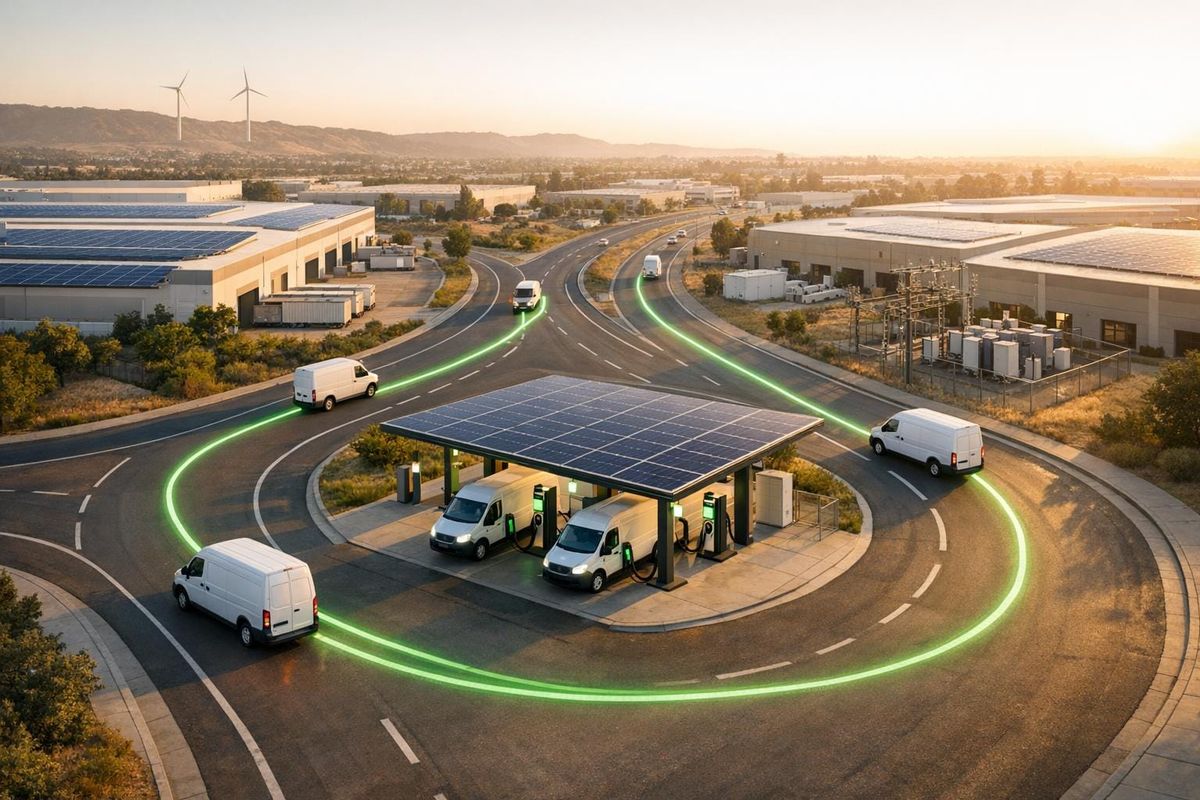
Fleets in the UK face rising pressure to cut emissions and manage costs, as road transport accounts for 27% of greenhouse gas emissions. While GPS systems like Google Maps prioritise the fastest or shortest routes, they often overlook factors like elevation, vehicle load, and charging needs - leading to higher energy use.
Smart grid-integrated routing offers a better solution. By combining GPS with real-time electricity grid data, fleets can optimise routes for energy savings, charge during off-peak times, and leverage renewable energy. Trials in the UK and EU have shown up to 22% energy savings and significant emission reductions in fleet operations.
Key Points:
- Limits of GPS: Focus on speed/distance, ignoring energy factors like gradients and load.
- Smart Grid Benefits: Routes consider energy prices, grid demand, and charging availability.
- Proven Results: UK studies show 15–25% energy savings; Manchester trials cut emissions by 28%.
Switching to smart grid data not only reduces costs but also helps fleets meet emission goals and adapt to electric vehicle demands.
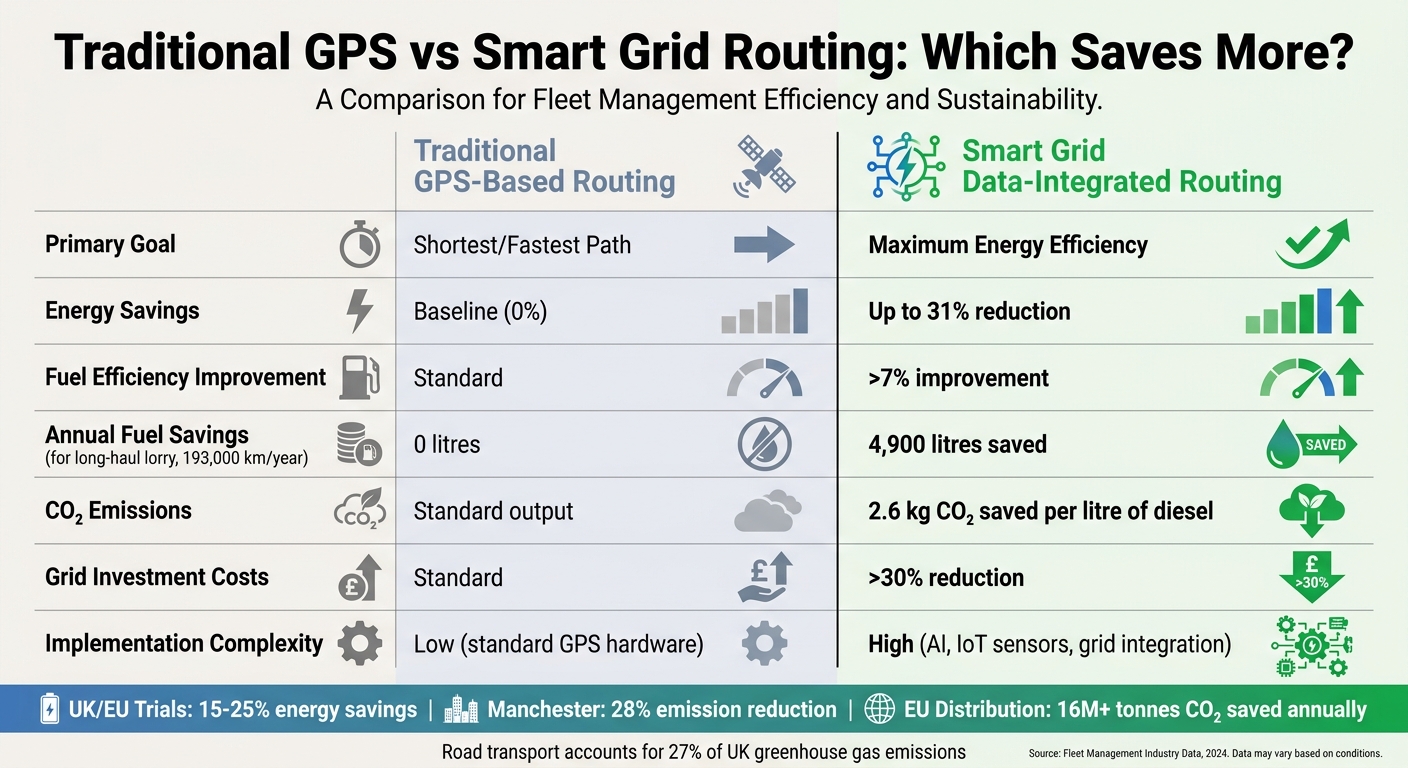
Traditional GPS vs Smart Grid Routing: Energy Efficiency Comparison
1. Traditional GPS-Based Routing
Traditional GPS-based routing has been the standard for fleet navigation, using static maps and basic navigation tools to guide vehicles from point A to point B. Tools like Google Maps and TomTom are excellent at finding the quickest or shortest routes while avoiding traffic jams. However, they fall short when it comes to factoring in elements that directly affect energy consumption, such as road gradients, elevation changes, vehicle weight, weather conditions, and driver habits.
Energy Efficiency
These systems focus on saving time and distance but often ignore the factors essential for energy-efficient travel. For example, a route that appears faster might include steep inclines or frequent stops, which can significantly increase fuel consumption.
Studies suggest that switching from conventional routing to energy-aware trajectory planning can enhance fuel efficiency by over 7%. For a long-haul lorry covering 193,000 kilometres annually, this could save nearly 1,300 gallons of fuel - or about 4,900 litres - each year. Even more impressively, eco-friendly routing algorithms have shown the potential to cut energy use by as much as 31% compared to traditional methods.
Fuel Cost Savings
Fuel expenses rank as the second-largest cost for fleets, just behind labour. Despite this, traditional GPS routing does little to minimise these costs. For example, the U.S. trucking sector consumes more than 136 billion litres of diesel every year. A 7% improvement in fuel efficiency across the industry could save over £7.6 billion annually.
Additionally, traditional systems lack the ability to optimise speed, acceleration, or timing for specific journey segments. Without access to real-time vehicle performance data or telematics, they can't guide drivers towards more fuel-efficient habits or help them avoid energy-draining actions like harsh braking or rapid acceleration. These inefficiencies not only increase costs but also contribute to greater environmental impact, as discussed below.
CO₂ Emissions Reduction
Reducing fuel consumption has a direct impact on lowering CO₂ emissions. For every gallon of diesel saved, around 22 pounds of CO₂ emissions are avoided. This translates to about 2.6 kg of CO₂ per litre of diesel saved. The inability of traditional routing systems to optimise energy-efficient paths means fleets often generate higher carbon emissions than necessary.
Lorries account for nearly 25% of all transport-related greenhouse gas emissions in the U.S., with similar trends observed in the UK. Research indicates that traditional routing methods often rely on basic or theoretical models that fail to capture the complexities of real-world traffic conditions. This leads to increased energy use and uncertainty in actual performance under real traffic scenarios.
Implementation Complexity
The simplicity of traditional GPS routing is its main advantage. These systems are easy to set up and don’t require integration with telematics systems, engine management systems, or external data sources like road grades or wind conditions. For fleets with limited budgets or technical capabilities, traditional GPS remains an accessible - albeit inefficient - choice.
sbb-itb-499a7f0
2. Smart Grid Data-Integrated Routing
Smart grid-integrated routing takes navigation to a new level by combining real-time grid data with vehicle telematics. Instead of just calculating the quickest route, these systems optimise for energy use, charging opportunities, and cost savings. By merging vehicle data with grid analytics, fleet operators can craft routes that balance energy efficiency with operational requirements. This approach tackles inefficiencies that traditional GPS systems often ignore.
Energy Efficiency
In September 2024, researchers Soomin Woo and Scott J. Moura demonstrated an eco-friendly routing and charging system in the San Francisco East Bay area. Their framework, which used predictive algorithms and vehicle data, reduced energy consumption by up to 31%. Unlike traditional systems that only promise such savings on paper, this study proved that similar results are achievable in real-world conditions. The key? Incorporating factors like battery charge levels, local usage patterns, and grid conditions - elements traditional GPS systems typically miss.
These advanced systems blend physical and digital data, sharing information among EV owners, traffic networks, grid operators, and charging providers. Digital twin technology is a game-changer here, offering real-time insights into grid bottlenecks and renewable energy availability. As GridData explains:
The GridData DigitalTwin digitally maps your physical medium and/or low-voltage grid and ensures full grid transparency with the help of intelligent algorithms using real data from smart meters, transformer stations, inverters, etc.
| Metric | Traditional Routing | Smart Grid-Integrated Routing |
|---|---|---|
| Primary Goal | Shortest/Fastest Path | Maximum Energy Efficiency |
| Energy Savings | Baseline | Up to 31% reduction |
| Grid Investment Costs | Standard | >30% reduction through optimised operation |
Fuel Cost Savings
Beyond energy efficiency, smart grid routing reshapes charging strategies into opportunities for cost savings. For electric delivery fleets, this means tracking electricity prices in real time and scheduling charging during off-peak hours when rates are lower. It also supports Vehicle-to-Grid (V2G) technology, where vehicles can discharge energy back to the grid during peak demand periods, earning revenue through V2G incentives.
The EV-GREEN framework highlights this potential. Using a hybrid method that combines Mixed Integer Linear Programming with algorithms like Dijkstra's and Ant Colony Optimisation, it ensures real-time adaptability. This system, designed to work with any vehicle type, has shown significant cost savings in both routing and V2G incentives. Operators can further cut energy use by loosening constraints on battery size or operation times.
CO₂ Emissions Reduction
The benefits of energy efficiency extend to environmental impact. Digital twin solutions help reduce CO₂ emissions from EU distribution grids by more than 16 million tonnes annually. Smart grid routing also supports compliance with environmental rules in urban "GreenZones", lowering local pollution levels. By considering battery levels, charging availability, and V2G tariffs, these systems align delivery operations with sustainability goals. The combination of telematics and digital twin technology enables fleets to adapt in real time to grid and environmental demands.
Implementation Complexity
Despite its advantages, implementing smart grid-integrated routing comes with challenges. Fleet operators must integrate data from multiple sources - such as smart meters, transformer stations, inverters, and vehicle telematics - into a single system. This requires coordination across EV data, traffic management, grid operations, and charging services. Predictive analytics further enhance this system, allowing fleets to adjust operations proactively and avoid grid stress events.
Pros and Cons
When it comes to energy-efficient routing, the choice between traditional GPS systems and smart grid integration boils down to simplicity versus enhanced efficiency. While traditional GPS routing is straightforward, it often ignores critical factors like fuel consumption and energy use. This trade-off highlights the balance between ease of use and the potential for long-term savings.
Smart grid-integrated routing, on the other hand, uses real-time data to optimise fuel efficiency. To put this into perspective, the U.S. trucking industry burns through over 36 billion gallons of diesel annually. By adopting smart routing methods, fuel efficiency can improve by more than 7%. That kind of improvement translates to saving nearly 4,900 litres of diesel, cutting costs significantly and reducing CO₂ emissions at the same time.
However, these benefits come with their own set of challenges. The integration of smart grid solutions is complex. Many fleet depots are not equipped to handle the high power demands of electric operations, and upgrading traditional grids can take years. Additionally, smart grid systems rely on advanced integration across various data sources, which adds another layer of complexity. As OurNet.Energy points out:
Running an electric fleet requires serious power, but most depots aren't built for it
Here's a quick comparison of the two approaches:
| Criteria | Traditional GPS-Based Routing | Smart Grid Data-Integrated Routing |
|---|---|---|
| Energy Efficiency | Low; focuses on distance and travel time | High; optimises based on vehicle consumption and grid status |
| Fuel Cost Savings | Baseline efficiency | Greater than 7% improvement |
| CO₂ Emissions | Standard output | Approximately 10 kg CO₂ saved per gallon |
| Implementation Complexity | Low; standard navigation tools | High; requires AI, IoT sensors, and infrastructure upgrades |
| Infrastructure Requirements | Minimal; standard GPS hardware | Significant; includes smart chargers, battery storage, and grid upgrades |
Interestingly, some smart grid providers now offer solutions with no upfront costs. Instead, they fund the installation themselves and charge only for the power consumed - often at rates lower than the standard grid. This approach is helping to remove some of the traditional barriers to fleet electrification, making the transition more accessible for many operators.
Conclusion
This analysis highlights that while both systems manage fleet navigation effectively, integrating smart grids offers a clear edge in energy efficiency. The ability of smart grids to provide real-time insights into grid conditions is something traditional GPS routing simply cannot replicate.
The advantages are not just operational but also financial and environmental. Digital twin technology, for example, delivers highly accurate grid data, cutting investment costs by over 30% and reducing CO₂ emissions by more than 16 million tonnes each year. For UK fleets, this means substantial cost savings without the need for costly infrastructure upgrades.
Switching to needs-based planning transforms fleet operations. By relying on real-time data from smart metres and transformer stations, operators can schedule charging during periods of low grid demand and optimise routes to align with renewable energy availability.
To truly maximise these benefits, fleet operators need to adopt digital twin models for dynamic grid mapping, moving away from outdated static consumption profiles. While implementing this technology may be more complex than traditional GPS systems, the gains in cost savings, energy efficiency, and environmental impact make it a strategic move. As shown by EU pilot projects and UK-specific studies, smart grid integration is the logical choice for UK delivery fleets looking to embrace electric and hybrid vehicles while staying ahead in a competitive market.
FAQs
What data does smart grid routing use?
Smart grid routing uses real-time data like traffic updates, weather conditions, delivery schedules, and energy consumption patterns. By analysing this information, it helps streamline delivery routes, improving efficiency and cutting down on energy usage.
How does it pick the best time and place to charge?
By analysing real-time data - like off-peak electricity rates, grid demand, and the vehicle's battery status - it identifies the ideal time and location for charging. This approach fine-tunes charging schedules, cutting costs and lowering emissions effectively.
What do fleets need to implement smart grid-integrated routing?
Fleets rely on real-time data collection through smart meters, sensors, and telematics systems. These tools play a key role in monitoring energy use and optimising routes. Additionally, workflows designed for energy management and compliance help streamline operations. Together, these technologies support the integration of smart grid routing, enhancing both efficiency and environmental responsibility.