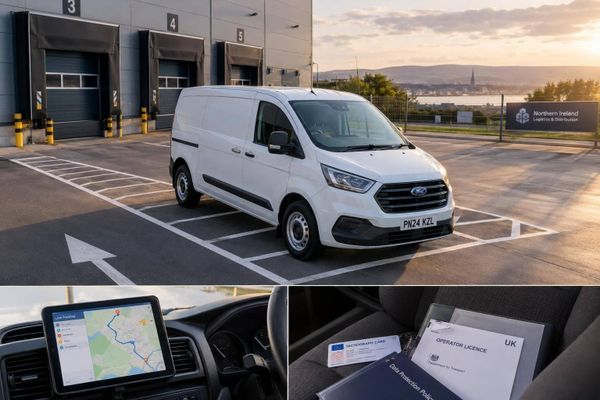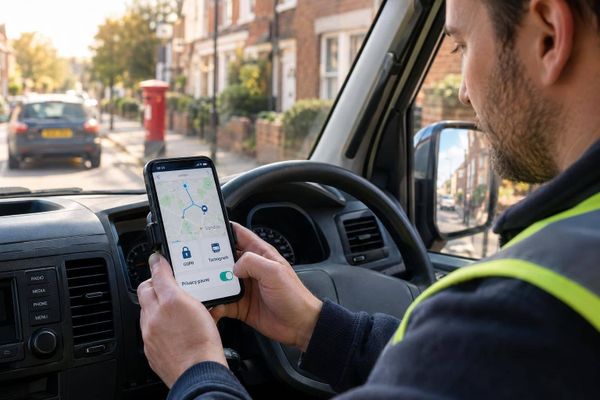
Fleet Tracking Regulations Explained: A Guide for Courier Businesses in Wales
Practical guide to fleet-tracking legal duties for Welsh couriers: GDPR, tachographs, retention, privacy and enforcement.

Jurisdiction Scope
Wales, under UK-wide Great Britain transport and data-protection rules
sbb-itb-499a7f0
Overview of Fleet Tracking Laws
Applicable Business Type
Courier businesses and delivery firms operating fleet vehicles in Wales
Country or Region
United Kingdom
A Wales-focused compliance guide for courier businesses using GPS, telematics, vehicle surveillance and, where applicable, tachographs. It explains that Welsh firms generally follow UK-wide data-protection, drivers’ hours, roadworthiness and operator-licensing rules, with practical requirements for lawful and proportionate monitoring, transparency, privacy safeguards, record keeping and operational compliance.
Legal Requirements Summary
Courier businesses in Wales may use fleet tracking, but identifiable driver and customer-location data must be processed under UK GDPR with a documented lawful basis, clear privacy information, data minimisation, proportionate monitoring, appropriate access controls and a justified retention schedule. Driver consent is generally not the correct workplace-monitoring mechanism. High-risk monitoring may require a DPIA, and vehicle surveillance should avoid unjustified private-use tracking and normally keep audio off. Separate UK transport obligations apply where vehicles fall within operator-licensing or drivers’-hours/tachograph rules, including downloads every 90 days for vehicle units and every 28 days for driver cards, and production of relevant records for 12 months.
Main Regulatory Topics
- UK GDPR and data privacy
- Lawful basis and transparency
- Driver monitoring and consent
- Data minimisation and proportionality
- DPIAs and privacy by design
- Private-use tracking and vehicle surveillance
- Audio recording restrictions
- Tachographs and drivers’ hours
- Record keeping and retention
- Operator licensing and roadworthiness
Key Compliance Obligations
- Document a lawful basis for processing location and telematics data and make monitoring necessary and proportionate.
- Give drivers and passengers clear privacy information, including the monitoring purpose, controller identity and how data-subject rights can be exercised; use appropriate vehicle signage where relevant.
- Carry out a Data Protection Impact Assessment before high-risk monitoring, such as continuous behaviour monitoring, cameras, audio or intrusive analytics.
- Limit tracking during private or non-working use and provide privacy-preserving controls where appropriate.
- Disable vehicle audio by default and use it only in exceptional circumstances with strong justification.
- For vehicles within tachograph rules, download vehicle-unit data at least every 90 days and driver-card data at least every 28 days.
- Maintain tachograph calibration, inspection, maintenance, driver training and lawful scheduling controls.
- Retain and produce applicable tachograph records for enforcement officers for 12 months; keep maintenance and working-time records for the applicable statutory periods.
- Keep operator-licensing and vehicle roadworthiness records up to date and available to the Traffic Commissioner when requested.
Driver Consent Requirement
Consent Rule: Prior driver consent is not normally required or the appropriate legal basis for workplace tracking because of the employer–worker power imbalance. Instead, the courier should identify and document an appropriate lawful basis, provide clear privacy information, and make monitoring necessary, proportionate and transparent. Consent may be used only where workers have a genuine choice and can withdraw it without detriment.
Data Retention Period
Minimum Retention: No universal minimum for ordinary GPS/telematics data under UK GDPR; retain only as long as necessary under a documented, reviewed schedule. Where tachograph rules apply, operators must be able to produce records for 12 months; related operator records include vehicle maintenance records kept for at least 15 months and working-time records for at least 24 months.
Enforcement Authorities
- Information Commissioner’s Office (ICO) — UK data-protection enforcement
- Driver and Vehicle Standards Agency (DVSA) — vehicle, operator-licensing and drivers’-hours enforcement
- Health and Safety Executive (HSE) — work-related road-risk oversight and guidance
- Traffic Commissioners — operator-licence regulatory decisions
Penalties for Non-Compliance
Data-protection failures can lead to ICO investigation, enforcement notices, restrictions on processing and administrative fines. The UK GDPR/DPA 2018 statutory maximum is £8.7 million or 2% of worldwide annual turnover for the standard tier, and £17.5 million or 4% of worldwide annual turnover for the higher tier, whichever is higher for an undertaking. Road-transport non-compliance can result in DVSA fixed-penalty or deposit notices, prosecution, vehicle immobilisation, operator-licence action and reputational or insurance consequences. Operating without the required international goods-vehicle operator licence can attract a DVSA fine and prosecution in relevant European countries.
Implementation Best Practices
Create a fleet-tracking policy and data map covering GPS location, speed, engine status, driver identifiers, dashcam data and sharing. Configure working-hours-only tracking and a private-use off switch where relevant; separate vehicle-security functions from employee-performance monitoring. Give drivers and passengers concise notices and vehicle signage, record policy acknowledgement, and make access requests and complaints easy. Complete a DPIA before behaviour scoring, cameras/audio or algorithmic analytics. Apply role-based access, encryption, retention deletion and vendor due diligence. Reconcile telematics with tachograph and operator-licence records, audit downloads and calibrations, and retain evidence of reviews, incidents and corrective actions.
Compliance Checklist
- Define a specific, lawful purpose for GPS or telematics monitoring and use the least intrusive method.
- Identify and document the UK GDPR lawful basis; do not rely routinely on employee consent where it is not genuinely freely given.
- Provide clear privacy information to drivers and passengers, including what is collected, why, who receives it, retention periods and monitoring times.
- Disable or suspend tracking during authorised private use wherever possible; private-use monitoring will rarely be justifiable.
- Complete and document a Data Protection Impact Assessment (DPIA) for driver-behaviour monitoring, in-vehicle cameras/audio, or analytics that infer or predict driver conduct.
- Use vehicle signage where vehicle surveillance or recording takes place.
- Restrict access to tracking data, secure it, set a documented retention schedule, and maintain processor/vendor contracts and audit trails.
- Consult workers about health and safety and assess lone-worker and delivery-driver risks.
- For applicable goods vehicles, fit and use tachographs; download vehicle-unit data at least every 90 days and driver-card data at least every 28 days.
- Keep drivers’ hours records for at least 12 months and working-time records for at least 24 months.
- Check operator-licensing requirements, vehicle weight, international routes, exemptions, tachograph calibration and speed-limiter requirements.
Industry-Specific Guidance
A Welsh courier business is not subject to a special Wales-only GPS regime: UK GDPR and the Data Protection Act 2018 apply, alongside UK road-transport and health-and-safety rules. GPS can support dispatch, proof of service, vehicle recovery, route planning and lone-worker safety, but continuous driver surveillance is not automatically lawful and there is no general requirement for every courier van to transmit real-time location. Treat identifiable location and telematics linked to a driver as personal data. Inform employed, agency and subcontracted drivers directly; do not assume a customer contract or a vehicle owner’s notice covers everyone monitored. If vans are used only domestically and fall outside tachograph/operator-licensing thresholds, ordinary fleet GPS obligations still remain under data protection law. Larger vehicles and particular operations can trigger operator licensing, tachographs and drivers’-hours rules. Cross-border courier work needs additional checks: GOV.UK states that vans over 2.5 tonnes up to 3.5 tonnes used for hire or reward in the EU require the appropriate standard international goods-vehicle operator licence.
Recent Legal Updates
A significant current change for courier operators is 1 July 2026: assimilated drivers’ hours and tachograph rules extend to light goods vehicles used on international transport or cabotage between the UK and EU where the vehicle and trailer maximum permissible mass exceeds 2.5 tonnes. Where the rules apply, the vehicle must have a tachograph and the driver must record driving, breaks, rest, other work and availability; exemptions may apply. The GOV.UK operator-licensing guidance also states that digital tachograph vehicle data must be downloaded at least every 90 days, driver-card data at least every 28 days, drivers’ hours records retained for 12 months and working-time records for 24 months. No source identified a new Wales-specific mandate requiring all courier fleets to use real-time GPS tracking; legal obligations remain purpose-, vehicle- and route-dependent.
Authoritative Resources
- Information Commissioner’s Office (ICO): worker and vehicle monitoring guidance
- GOV.UK: Goods vehicle operator licensing guide
- GOV.UK: Drivers’ hours and tachographs guidance
- Health and Safety Executive (HSE): driving and riding safely for work
Related Blog Posts
- Fleet Tracking Regulations Explained: A Guide for Delivery Firms in Wales
- Fleet Tracking Regulations Explained: A Guide for Van Rental Companies in Wales
- Fleet Tracking Regulations Explained: A Guide for Courier Businesses in the UK
- Fleet Tracking Regulations Explained: A Guide for Courier Businesses in England