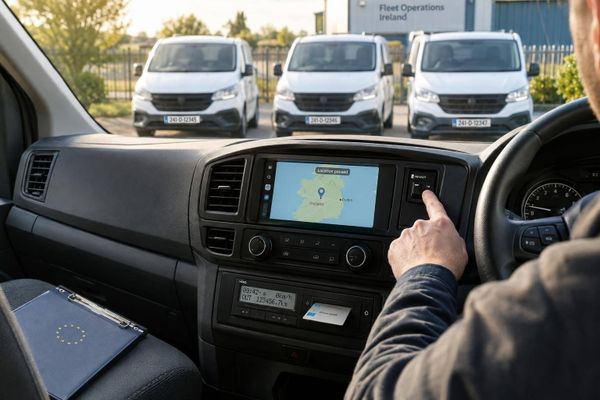
Fleet Tracking Regulations Explained: A Guide for Courier Businesses in England
Continuous GPS monitoring is highly intrusive; courier fleets must prioritise UK GDPR, driver privacy and tachograph compliance.
Jurisdiction Scope
England, under UK-wide data-protection law and Great Britain drivers’ hours/tachograph rules; the guidance is not limited to a particular English county or city.
sbb-itb-499a7f0
Overview of Fleet Tracking Laws
Applicable Business Type
Courier businesses and employers operating delivery fleets
Country or Region
United Kingdom (England-specific application)
A practical England-focused guide to fleet-tracking compliance for courier businesses. It covers UK GDPR and worker-monitoring requirements for GPS/location and in-vehicle surveillance, alongside tachograph and drivers’ hours duties that may apply to qualifying goods vehicles. It addresses lawful basis, transparency, proportionality, retention, access to records, compliant equipment, and operational controls.
Legal Requirements Summary
Courier operators in England must treat identifiable vehicle and driver location data as personal data and comply with UK GDPR principles: establish a lawful basis, provide transparent privacy information, monitor proportionately, control access, and delete data when the purpose ends. Driver consent is not a blanket prerequisite and is usually unsuitable as the employment lawful basis, but genuine consent may be used where workers have real choice. If the fleet falls within tachograph rules, operators must use compliant equipment, download vehicle and driver-card data on the required cycles, train and supervise drivers, and retain/provide compliance records for 12 months. Ordinary GPS tracking has no single statutory retention period; the business must justify a necessary period.
Main Regulatory Topics
- UK GDPR and data privacy
- Worker monitoring and driver transparency
- Lawful basis and driver consent
- Proportionality and private-use controls
- Data retention and deletion
- In-vehicle surveillance and audio
- Tachograph installation and calibration
- Driver-card and vehicle-unit downloads
- Drivers’ hours record-keeping
- Enforcement and production of records
Key Compliance Obligations
- Identify and document a lawful basis for GPS, location, dashcam, or other in-vehicle monitoring.
- Give drivers and passengers clear privacy information, including what is recorded, purposes, controller identity, and how rights can be exercised; use appropriate vehicle signage where relevant.
- Make monitoring necessary, proportionate, and appropriately risk-assessed; avoid continuous or out-of-hours tracking unless specifically justified.
- Keep monitoring data only for as long as necessary, maintain a retention schedule, review it, and securely delete data when no longer needed.
- Normally disable in-vehicle audio recording; continuous audio requires exceptional justification and documented assessment.
- For vehicles and journeys subject to tachograph rules, use properly installed, calibrated, inspected, and sealed equipment.
- Download vehicle-unit data at least every 90 days and driver-card data at least every 28 days, or sooner where necessary to prevent loss.
- Train drivers, schedule work lawfully, check tachograph records, and make required records available to enforcement officers for 12 months.
- Do not use delivery-speed or distance-based payment arrangements that encourage breaches of drivers’ hours rules.
Driver Consent Requirement
Consent Rule: Driver consent is not automatically required for employer GPS tracking and is generally not the preferred lawful basis in employment because of the imbalance of power. The courier must identify and document an appropriate lawful basis, provide clear privacy information, and use consent only where the worker has a genuine, freely given choice. Drivers and passengers should be informed when in-vehicle surveillance operates; private-use tracking should be carefully limited and justified.
Data Retention Period
Minimum Retention: No universal minimum period for ordinary GPS tracking data; retain only as long as necessary under a documented retention schedule. Where tachograph records apply, operators must be able to produce records to enforcement officers for 12 months.
Enforcement Authorities
- Driver and Vehicle Standards Agency (DVSA)
- Police forces in England and Wales
- Traffic Commissioners for Great Britain
- Information Commissioner’s Office (ICO) for UK data-protection compliance
Penalties for Non-Compliance
Drivers can receive fines of up to £300 for exceeding applicable daily driving limits. DVSA or police roadside checks may result in prohibitions preventing a vehicle from being driven until defects or other issues are remedied, fixed penalties, financial deposits or court proceedings. Graduated fixed penalties may be £50, £100, £200 or £300 depending on the offence and circumstances, with some offences carrying penalty points. Drivers’ hours or operator-compliance infringements may be referred to the Traffic Commissioner. Licence consequences can include refusal or variation refusal, added conditions, reduced vehicle authority, suspension, revocation and disqualification of an operator or transport manager. Separately, unlawful or disproportionate employee tracking creates UK GDPR enforcement, compensation and reputational risks; the ICO specifically identifies continuous location monitoring as potentially highly intrusive.
Implementation Best Practices
Begin with a documented purpose and necessity assessment for each tracking feature. Configure working-hours tracking separately from private use, provide a clear privacy notice to drivers and passengers, and use the least intrusive settings that achieve the operational objective. Maintain a processing record, lawful-basis assessment, DPIA where monitoring is high risk, access controls, retention/deletion rules, incident procedures and supplier contracts. Reconcile telematics with tachograph and working-time records without treating ordinary GPS data as a substitute for legally required tachograph records. Train courier staff and managers, review alerts and permissions regularly, and test that privacy mode, signage and audit logs work as documented.
Compliance Checklist
- Identify the vehicle weight, use, route and whether domestic or assimilated/AETR drivers’ hours rules apply.
- Determine whether an approved tachograph is legally required; vehicles over 3.5 tonnes carrying parcels or letters on postal services must use tachographs, subject to the applicable rules and exemptions.
- For vans used for business driving for more than 4 hours per day, comply with the applicable Great Britain domestic drivers’ hours limits and breaks.
- Comply with mobile-worker working-time rules, including the 48-hour average weekly limit, 60-hour maximum in a single week, night-work limits and required breaks.
- Keep required working-time records for two years; retain and manage tachograph records in accordance with the relevant tachograph rules.
- Provide drivers and passengers with clear privacy information before vehicle tracking; explain the purposes, data collected, controller identity, retention and rights.
- Use a lawful basis under UK GDPR and ensure tracking is necessary and proportionate to the stated business purpose.
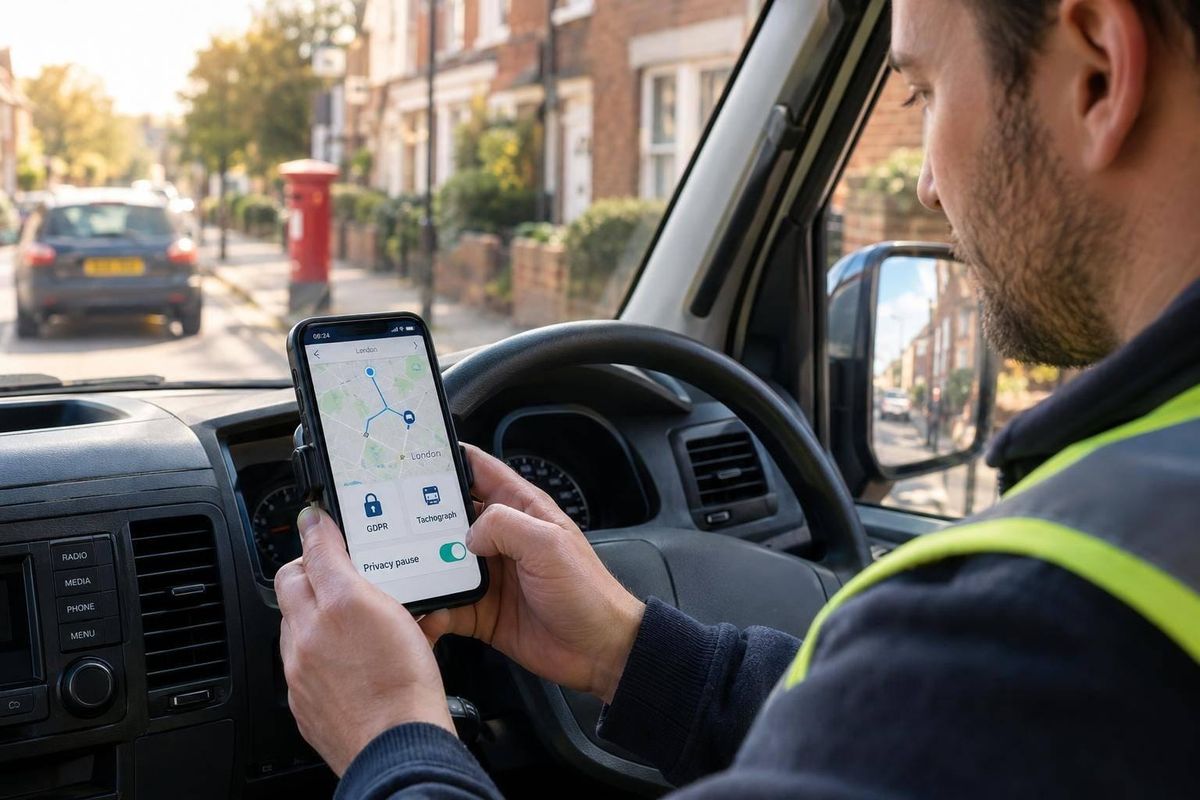
- Do not track during private use unless justified; provide a driver-controlled privacy mode or disable tracking where appropriate.
- Carry out and document a Data Protection Impact Assessment for high-risk monitoring, behavioural analytics, cameras, audio or similarly intrusive processing.
- Restrict access to telematics data, set a documented retention period, secure the system and use the data only for specified purposes.
- Check whether an operator licence is required and comply with licence undertakings, vehicle roadworthiness, maintenance and drivers’ hours obligations.
- Train drivers and managers, audit device configuration and records periodically, and prepare for DVSA roadside or premises inspections.
Industry-Specific Guidance
Courier businesses typically combine route planning, proof-of-delivery, driver-safety monitoring and customer updates, so location data will often be personal data. Drivers and passengers must be informed, and continuous monitoring during personal use is difficult to justify. A courier using cars or light vans may mainly fall under Great Britain domestic drivers’ hours rules, while heavier vehicles, certain cross-border journeys or vehicles carrying postal articles may trigger assimilated/AETR rules and tachograph obligations. The legal position depends on vehicle weight, trailer, route and service—not simply on the fact that the business makes deliveries. Operator-licensing, vehicle-maintenance and driver-hours compliance should therefore be assessed fleet by fleet. DVSA and police can conduct roadside checks, and failures can affect both individual drivers and the operator’s licence.
Recent Legal Updates
The current official material reviewed does not identify a courier-specific England fleet-tracking law or a new 2026 deadline. The controlling framework remains technology-neutral: UK GDPR and ICO worker-monitoring guidance apply to telematics, while drivers’ hours, tachograph, working-time and operator-licensing rules depend on vehicle and operation. The ICO’s 2024 finding concerning continuous GPS monitoring emphasises that intrusive location collection requires strong justification and appropriate safeguards. Businesses should recheck GOV.UK, DVSA, Traffic Commissioner and ICO guidance before deployment because rules and enforcement policies can change.
Authoritative Resources
- Information Commissioner’s Office (ICO): worker monitoring and vehicle-surveillance guidance
- GOV.UK: Driving a van
- GOV.UK: Drivers’ hours and tachographs: goods vehicles
- GOV.UK: Goods vehicle operator licensing guide
- Driver and Vehicle Standards Agency (DVSA) roadside-check and enforcement guidance
- Traffic Commissioners for Great Britain