How to Use EV Incentives for Fleet Upgrades
Which UK grants, tax reliefs and telematics will reduce costs when switching your fleet to EVs — eligibility, application steps and savings before 31 March 2026.
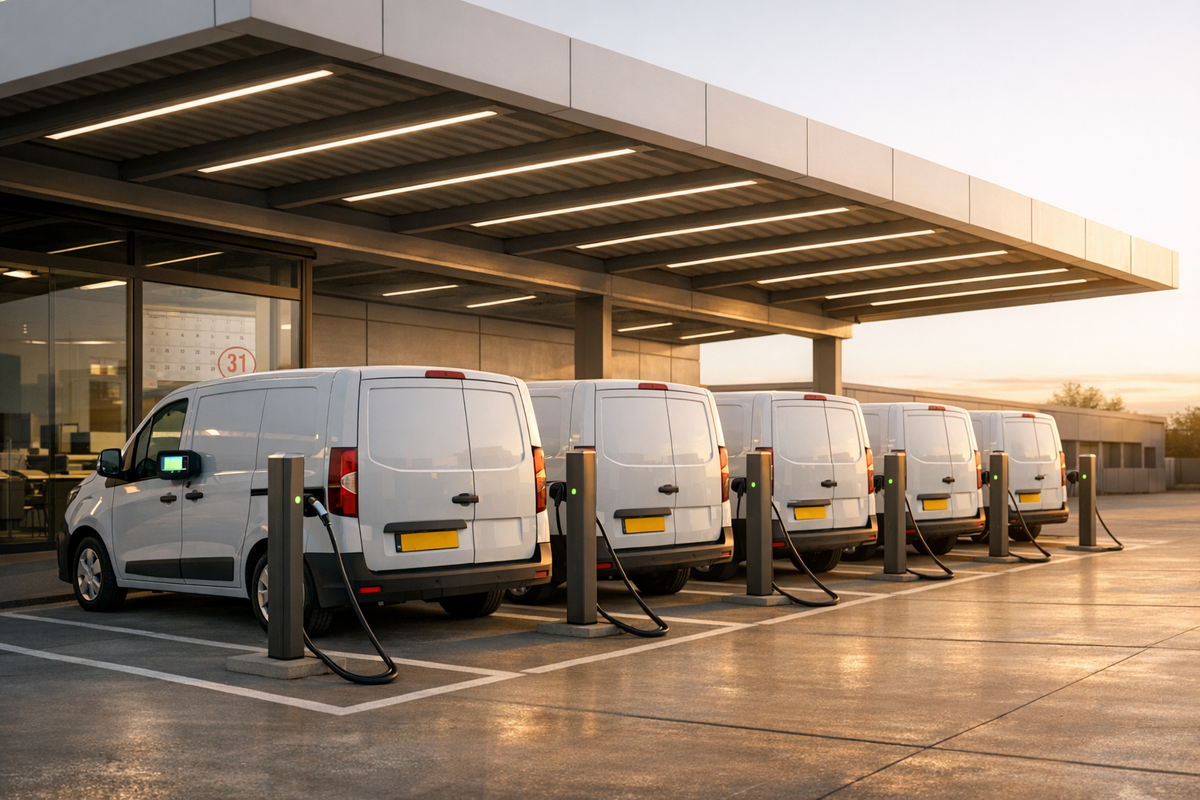
Switching your fleet to electric vehicles (EVs) in 2026 can save you money through government grants, tax breaks, and reduced operational costs. Here’s what you need to know:
- Grants: The Plug-in Van Grant offers up to £5,000 per vehicle, and the Workplace Charging Scheme provides £350 per charging socket for up to 40 sockets. The EV Infrastructure Grant covers up to £15,000 per site for SMEs.
- Tax Benefits: Claim 100% first-year capital allowances on EV purchases and charging equipment until March 2027. EV company car tax rates are as low as 4% for 2026/27.
- Cost Savings: EVs have up to 43% lower maintenance costs, cheaper charging compared to fuel, and can avoid ULEZ charges, saving around £1,300 per vehicle annually.
- Eligibility: SMEs with 249 or fewer employees, valid VAT registration, and off-street parking can apply. Grants require pre-approval and compliance with OZEV standards.
Act now, as many schemes end by 31 March 2026. Use tools like GRS Fleet Telematics to monitor EV performance, optimise routes, and enhance fleet security.
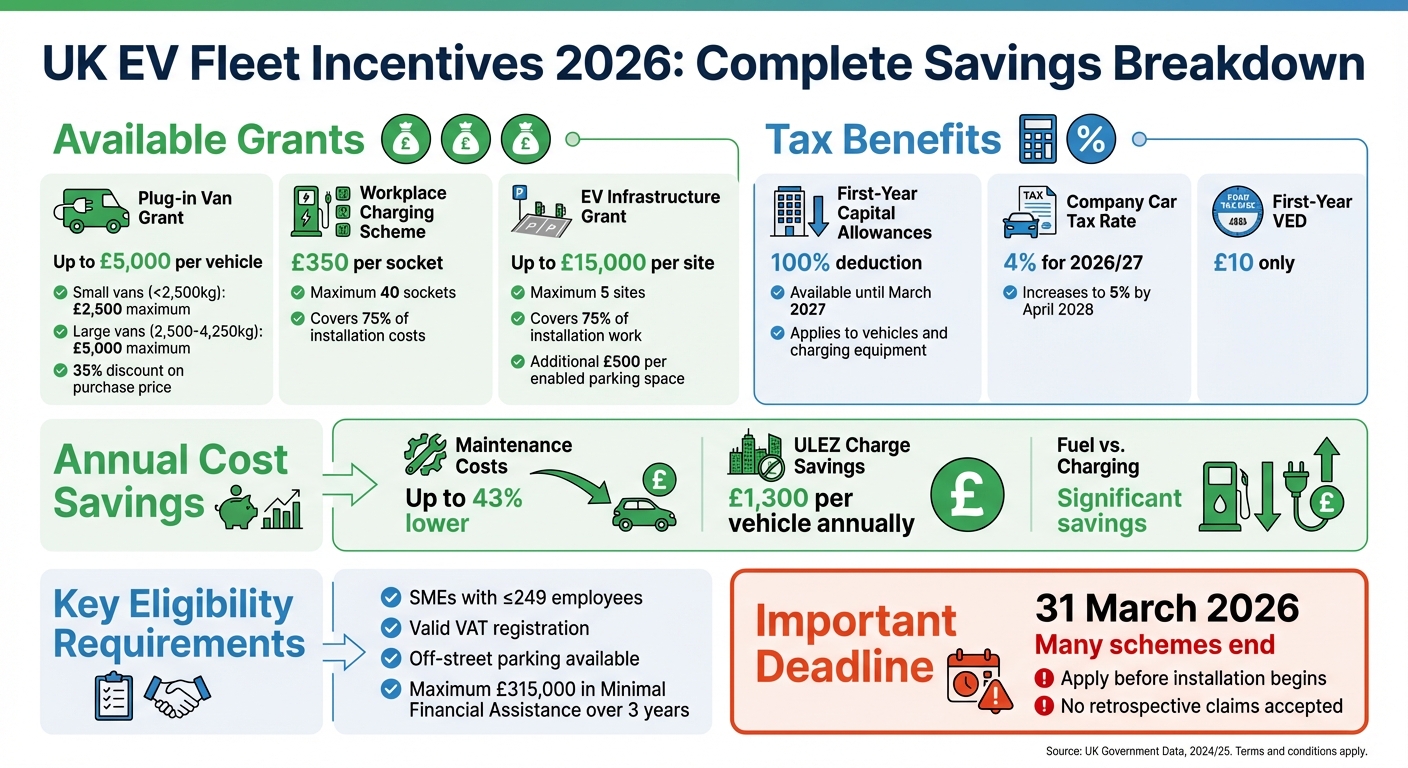
UK EV Fleet Incentives 2026: Grants, Tax Benefits and Cost Savings Overview
Checking Your Eligibility for UK EV Incentives in 2026
Before applying for any electric vehicle (EV) incentives, make sure your business meets the necessary criteria. For example, the EV Infrastructure Grant is specifically aimed at small and medium-sized enterprises (SMEs) with 249 or fewer employees. On the other hand, the Workplace Charging Scheme is open to businesses, charities, and public sector organisations. Both schemes require your business to be registered with Companies House or to hold valid VAT registration with HMRC.
Additionally, your business must not have received more than £315,000 in Minimal Financial Assistance over the current and previous two financial years (public authorities are exempt). Another key requirement is having off-street, dedicated parking for your staff or fleet vehicles.
Available Grant Schemes
Several grant options can help reduce costs when transitioning to EVs:
- Plug-in Van Grant: This grant offers a 35% discount on the purchase price of eligible vehicles. For small vans (under 2,500kg), the maximum discount is £2,500, while large vans (2,500kg to 4,250kg) can receive up to £5,000. To qualify, vehicles must produce 0g/km of CO₂ and have a zero-emission range of at least 60 miles.
- Workplace Charging Scheme: Covers 75% of purchase and installation costs for chargepoints, up to £350 per socket, with a limit of 40 sockets across all sites.
- EV Infrastructure Grant: Provides up to £15,000 per site (for a maximum of five sites), covering 75% of the installation work needed for multiple chargepoints. To qualify, at least five parking spaces must be worked on, and the scheme is available exclusively to SMEs. Both charging schemes are confirmed to run until 31st March 2026.
All installations must meet OZEV-approved standards, and retrospective claims are not allowed. You must secure approval before starting any work. If your business rents its premises, you’ll also need written consent from your landlord before applying.
Assessing Your Current Fleet
To take full advantage of these schemes, you’ll need to carefully evaluate your current fleet. Start by categorising vehicles based on their Gross Vehicle Weight (GVW). Vehicles under 2,500kg are eligible for the small van grant, while those between 2,500kg and 4,250kg qualify for the large van scheme. Replacement vehicles should meet a zero-emission range of at least 60 miles and comply with the speed requirements - 50 mph for most vehicles, or 40 mph for refuse vehicles.
Next, ensure your parking facilities meet the grant conditions. Eligible sites must be located within the UK (excluding the Channel Islands and the Isle of Man). For the EV Infrastructure Grant, you’ll need a minimum of five parking spaces. Keep in mind that installations already required under Part S Building Regulations are not eligible for grant funding.
Lastly, consider battery warranties when evaluating your fleet. Vehicles must come with a warranty guaranteeing at least 80% battery capacity for three years or 60,000 miles. Reviewing the age, mileage, and maintenance costs of your fleet can help you decide which vehicles are most suitable for an upgrade to electric. Implementing van tracking solutions can provide the precise data needed for this evaluation. A thorough assessment now will make the application process smoother and set you up for a successful transition.
Combining Grants and Tax Reliefs to Reduce Costs
You can cut costs significantly by combining grants and tax reliefs, as long as you follow the right sequence and meet the specific criteria for each scheme.
Government Grants for EVs and Charging Infrastructure
When setting up your charging infrastructure, you can use the Workplace Charging Scheme alongside the EV Infrastructure Grant at the same location - just ensure they fund different chargepoints. Start by claiming one working chargepoint through the EV Infrastructure Grant, then apply for additional units via the Workplace Charging Scheme.
Here’s the potential savings breakdown:
- The EV Infrastructure Grant offers up to £15,000, covering 75% of broader building work, plus an extra £500 for each enabled parking space.
- The Workplace Charging Scheme provides £350 per socket for up to 40 sockets.
To qualify, installations must be completed by OZEV-authorised installers, and you’ll need to apply for the necessary vouchers before any work begins - retrospective claims aren’t allowed. With these grants, you can significantly offset the costs of your charging infrastructure.
Tax Benefits for Electric Vehicles
Tax reliefs offer another way to reduce costs. Through the 100% first-year allowance, you can deduct the full cost of new zero-emission vehicles and charging equipment from your profits. This relief is available until 31st March 2027 for Corporation Tax and 5th April 2027 for Income Tax. Additionally, you can claim capital allowances on remaining costs after applying grant funding.
For company cars, the tax rate for EVs is highly competitive - 4% for 2026/27, increasing slightly to 5% by April 2028. Plus, the first-year Vehicle Excise Duty (VED) is just £10. These benefits not only lower the cost of running an electric fleet but also make salary sacrifice schemes more attractive.
How to Apply for EV Incentives
Documents You'll Need
When it comes to most vehicle grants, you won’t need to handle any paperwork yourself - your dealer takes care of submitting everything through the portal before the vehicle is registered with the DVLA.
For charging infrastructure grants, you’ll need to apply through the official OZEV Electric Vehicle Chargepoint Grants portal. To get started, have the following ready:
- Your Companies House or VAT number
- A valid email address and UK mobile number
- Your OZEV-authorised installer’s name and registration number
- The property address where the chargepoints will be installed
- The number of parking spaces being equipped
Additionally, ensure your property’s risk assessment is updated to account for the new chargepoints. You’ll also need to declare any "minimal financial assistance" received in the past three financial years, which must not exceed £315,000.
Once you’ve gathered everything, you can move forward with your application.
Submitting Your Application
For infrastructure grants, it’s important to start your application before the installation begins, as retrospective claims are not accepted. After installation, OZEV will email you. If there are any errors in your claim, you’ll have just one week to correct them before the application is automatically submitted.
Double-check all details carefully. Common errors include swapped VINs, incorrect registration numbers, or mismatched dates. Keep in mind that the government audits 10% of validated orders. If your application is selected, you’ll need to provide the requested documentation within 28 consecutive days to avoid cancellation.
For vehicle grants, make sure your order is submitted on the portal before the vehicle is registered with the DVLA. The vehicle must also be delivered within nine months of the order date.
Using GRS Fleet Telematics with Your EV Fleet
Secure your electric vehicle (EV) incentives and optimise fleet performance with GRS Fleet Telematics. This system provides data-driven insights and advanced security measures, helping you make the most of government incentives by improving efficiency and safeguarding your assets.
Monitoring EV Performance and Efficiency
Managing an EV fleet requires a more tailored approach compared to traditional vehicles. Telematics systems from GRS Fleet track key metrics like energy consumption (measured in kWh), journey distances, and real-time vehicle conditions. This data reveals the true operational costs of your fleet.
Route planning is especially critical for EVs. GRS Fleet Telematics calculates the "true range" by factoring in variables like elevation, traffic, and weather conditions. It also integrates public charging stations into routes and alerts drivers when battery levels are low, helping to minimise delays and reduce range anxiety.
Driver behaviour plays a big role in efficiency. The system supports 'Green Driver Training' by monitoring actions like anticipatory driving and regenerative braking. For example, onboard feedback systems have been shown to reduce idle time by 43%, improve driver safety scores by 66%, and cut CO₂ emissions by two tonnes annually.
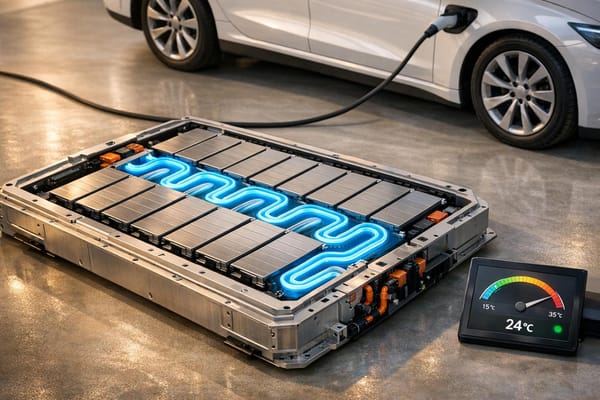
Temperature management is another key area for EVs. Heating the cabin can lower an EV's range by up to 30%, and this impact increases to 41% in temperatures as low as -6°C. GRS Fleet Telematics addresses this with pre-conditioning features, allowing the cabin and battery to be heated while the vehicle is still charging. This ensures the vehicle starts with maximum range.
Protecting Your EV Fleet from Theft
Efficiency is only part of the equation - security is just as important. Given the high capital investment tied to EVs, robust protection measures are essential.
GRS Fleet Telematics uses dual-tracker technology to ensure visibility, even if one tracker is compromised. Remote immobilisation features allow fleet managers to disable a vehicle if needed, preventing unauthorised use.
The system's security measures are highly effective, with a 91% recovery rate for secured assets. Additional features include geofencing alerts, which notify you if a vehicle leaves or enters designated zones, tampering detection, and out-of-hours notifications for suspicious activity.
To meet varying security needs, GRS Fleet Telematics offers three hardware packages:
- Essential (£35): Includes a single wired tracker for real-time monitoring.
- Enhanced (£79): Adds a secondary Bluetooth backup tracker for better theft protection.
- Ultimate (£99): Combines both trackers with immobilisation capabilities for maximum security.
Each package comes with a £7.99 monthly software subscription that covers SIM data, account management, and platform access, ensuring seamless operation and monitoring.
Conclusion
Switching your fleet to electric vehicles doesn’t have to break the bank. By using your fleet telematics data effectively, you can identify the best vehicles to replace and focus on whole life costs instead of just upfront expenses.
Once you've assessed your eligibility and applied for available grants, the financial support on offer - ranging from van grants to infrastructure funding and first-year capital allowances - can make a real difference to your bottom line. But don’t wait too long; many of these schemes are set to close on 31 March 2026. Beyond the grants, you'll see ongoing savings from lower running costs and avoiding ULEZ charges, which add up to significant long-term benefits.
After securing the incentives and upgrading your fleet, keeping track of performance across your industry is essential to maximise savings and improve security. With GRS Fleet Telematics, you can monitor energy use, optimise routes based on accurate range calculations, and benefit from dual-tracker protection with a 91% recovery rate for stolen vehicles. Starting at £35 for hardware and £7.99 per vehicle per month for software, this system helps you protect your investment while ensuring your fleet performs as expected.
FAQs
Can I stack EV grants with tax reliefs without breaking the rules?
Yes, you can usually combine electric vehicle (EV) grants with tax reliefs like the 100% first-year allowances without breaking any regulations. The UK government offers a range of incentives to encourage the use of EVs and support infrastructure improvements. However, it’s essential to ensure that the grants and tax reliefs you’re considering work together and that you meet the eligibility requirements for each programme. For peace of mind and to stay compliant with current guidelines, it’s a good idea to review official documents or consult a qualified advisor.
What’s the fastest way to check if my sites qualify for charging grants?
To determine if your sites qualify for charging grants, use the official government services to check eligibility. Look into the specific criteria for the Workplace Charging Scheme, which is designed for businesses, charities, and public sector organisations. Applications can be made directly through government portals, making it easier to verify whether your organisation meets the requirements for installing EV charging infrastructure.
How do I forecast EV range and charging needs for my daily routes?
To estimate the range and charging requirements for your EV fleet, begin by studying your fleet's operational data. This includes details like trip distances, the weight of loads being carried, and energy consumption. For calculating charging times, use this formula: Charge time (hours) = battery capacity (kWh) / charger power (kW).
Telematics tools can be particularly helpful here, offering detailed insights into mileage and usage patterns. These insights allow you to fine-tune charging schedules and plan your infrastructure effectively. By combining thorough data analysis with telematics, you can ensure precise planning for your daily fleet operations.