Third-Party Logistics API Integration: Benefits
How 3PL API integration automates workflows, improves fleet and inventory visibility, reduces costs and speeds onboarding with real‑time telematics and secure data.

API integration in third-party logistics (3PL) transforms how businesses handle supply chain tasks like transport, warehousing, and inventory management. By connecting systems such as telematics, accounting tools, and job management platforms, APIs simplify data sharing and automate workflows. This reduces inefficiencies, improves decision-making, and saves costs.
Key Benefits:
- Efficiency Gains: Automates data sharing, reducing manual entry and errors.
- Cost Savings: Lowers operational expenses by up to 12% and cuts fuel consumption significantly.
- Improved Visibility: Real-time tracking of shipments, inventory, and fleet performance.
- Faster Processes: Reduces client onboarding time from months to days.
- Enhanced Security: Features like dual-tracker technology and remote immobilisation protect vehicles and shipments.
APIs are no longer optional in logistics. They enable businesses to improve van tracking and fleet control, reduce delays, and deliver a better customer experience - all while supporting growth in a fast-changing market.
Freight API & Logistics Automation | Cut Shipping Costs 30–50%
How API Integration Reduces Inefficiencies
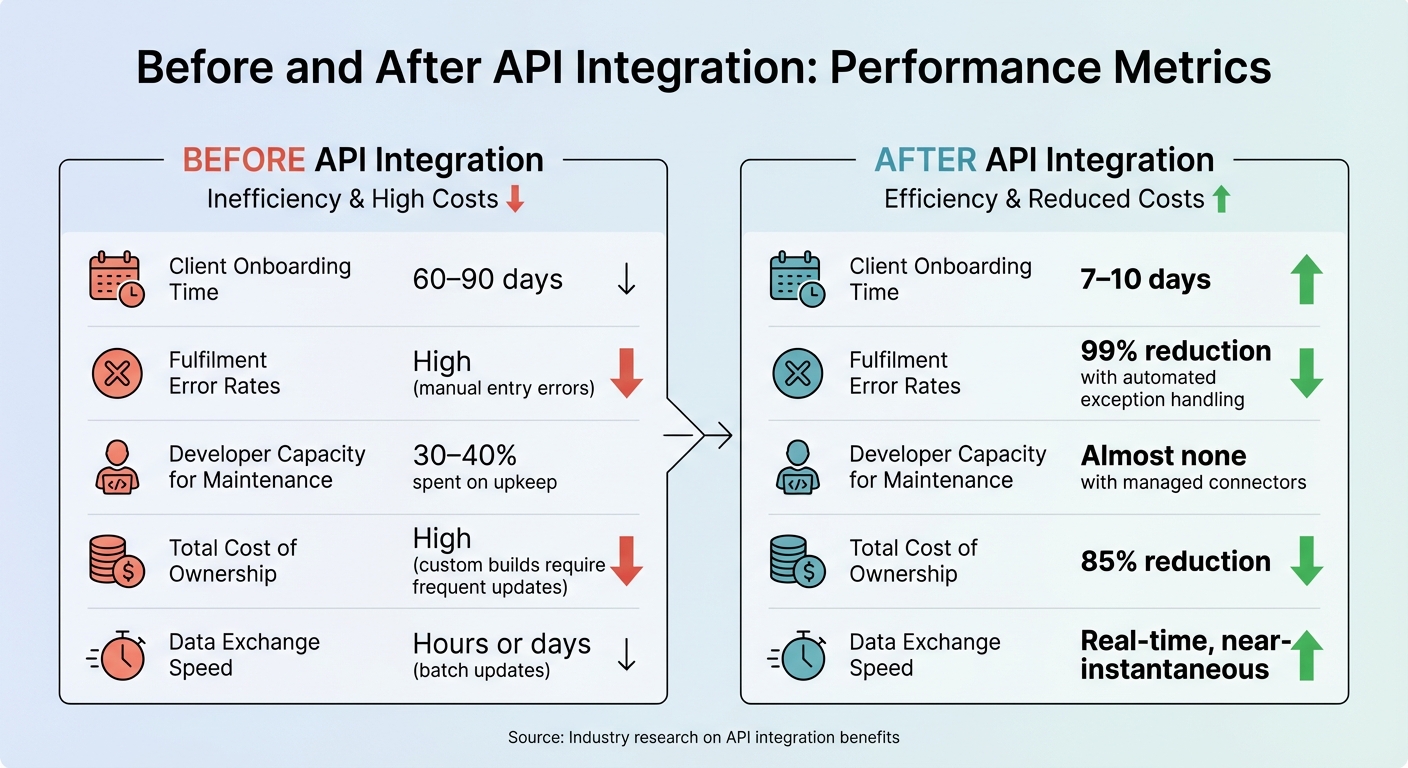
API Integration Performance Metrics: Before vs After Comparison
API integration tackles inefficiencies by automating manual workflows that often consume significant time and effort. By allowing systems to communicate and transfer data automatically, APIs remove the need for manual data entry and reconciliation. This eliminates common issues like missed orders, inventory mismatches, and human errors in data entry - problems that often go unnoticed until it’s too late.
Another advantage is the reduction in developer workload. Businesses relying on custom-built integrations often spend 30–40% of their developer resources maintaining these connections. This is particularly challenging when platforms like Amazon update their APIs over 200 times in just 18 months. Managed API connectors, which update automatically, free up developers to focus on growth-oriented projects instead of constant maintenance. By streamlining these processes, companies not only reduce inefficiencies but also improve fleet management and tracking and optimise costs.
Automating Core Logistics Processes
APIs play a crucial role in automating key logistics workflows, making everyday 3PL operations more efficient. For example, fuel card integration links fuel usage with vehicle location and tank capacity, helping to prevent fraud and better manage costs. Similarly, route optimisation connects GPS routing with job management and proof of delivery systems, enabling more accurate analysis of planned versus actual performance. For accounting teams, APIs automate the validation of business mileage and ignition times, removing the need for manual expense claims and timesheet checks.
Maintenance scheduling also becomes more efficient and proactive. By sharing odometer readings and engine hours from telematics systems to maintenance platforms via API, service reminders can be triggered based on real usage. A great example of this is Beacon Mobility, which in 2023 used advanced APIs to integrate telematics and maintenance data. Over six months, they achieved an 18% reduction in vehicle downtime and improved compliance reporting accuracy by 22%. These automated processes lead to tangible operational improvements, as demonstrated in the metrics below.
Before and After API Integration: Performance Metrics
Switching from manual processes to API-driven automation delivers clear, measurable benefits across critical operational metrics:
| Metric | Before API Integration | After API Integration |
|---|---|---|
| Client Onboarding Time | 60–90 days | 7–10 days |
| Fulfilment Error Rates | High (manual entry errors) | 99% reduction with automated exception handling |
| Developer Capacity for Maintenance | 30–40% spent on upkeep | Almost none with managed connectors |
| Total Cost of Ownership | High (custom builds require frequent updates) | 85% reduction |
| Data Exchange Speed | Hours or days (batch updates) | Real-time, near-instantaneous |
These improvements directly enhance operational capacity. For instance, reducing client onboarding time from three months to just ten days allows 3PL providers to take on more clients without increasing their technical teams. This eliminates the growth bottleneck that custom integrations often create. Such advancements pave the way for better fleet management and real-time operational visibility.
Better Fleet Control and Real-Time Visibility
API integration with telematics systems has reshaped how 3PL providers oversee their operations. Gone are the days of relying on delayed updates or manual checks - businesses now enjoy instant connectivity that tracks every stage of a shipment directly within their software systems. This level of connectivity eliminates common operational blind spots, such as late shipment updates, inaccurate inventory data, and limited insight into carrier performance. With this real-time visibility, logistics teams can make timely, data-driven decisions that enhance efficiency across the board.
For example, 3PL clients using Banyan Technology have reported an average 12% reduction in freight costs thanks to API integration. Real-time tracking also helps prevent overselling by automatically updating stock levels. Research shows this capability can cut picking errors by as much as 40%.
Real-Time Data for Better Decisions
By automating data updates and integrating with tools like Transportation Management Systems (TMS), APIs remove blind spots and enable immediate responses to challenges. API-driven telematics systems provide real-time insights into vehicle locations, shipment statuses, and inventory levels, allowing 3PL providers to make quick, informed decisions on routing, resource allocation, and problem-solving.
These APIs also deliver live updates on key metrics such as order patterns, carrier performance, return rates, and inventory turnover, ensuring smoother coordination across the supply chain. With this enhanced visibility into freight, labour, and costs, 3PLs can compare carrier rates more effectively, choosing the best options to boost profitability.
Specialised tools, like those offered by GRS Fleet Telematics, take these benefits even further by providing advanced solutions for fleet management.
Integration with GRS Fleet Telematics
GRS Fleet Telematics offers cutting-edge van tracking solutions designed specifically for UK businesses. By integrating API data directly into existing TMS or Warehouse Management Systems (WMS), this system ensures seamless fleet visibility. It uses dual-tracker technology, combining a hardwired GPS with a hidden Bluetooth backup, to maintain constant tracking - even if the main device is tampered with. This added layer of security is especially critical for 3PL providers handling high-value shipments.
The system also supports remote vehicle immobilisation and boasts a 91% recovery rate [article context], significantly reducing potential losses that could disrupt operations. Security data streams in real time to management systems, ensuring that businesses can act quickly when needed.
At just £7.99 per month per vehicle - including SIM/data, account management, and platform access - the service offers an affordable way to scale fleet visibility as businesses grow [article context]. Hardware options start at £35, with professional installation often included for free when combined with fleet branding services.
Cost Savings and Resource Management
API integration doesn't just streamline operations - it also cuts costs and helps manage resources more effectively. By linking telematics, GPS, and accounting platforms, APIs eliminate the need for manual data entry, reducing manual handling by up to 70%. This automation not only minimises administrative errors but also frees up staff to focus on more strategic tasks instead of repetitive paperwork.
Real-time route optimisation is another game-changer. Mapping APIs allow drivers to adjust routes dynamically based on traffic and weather conditions, cutting down mileage and fuel use. They also help detect fraud and flag inefficient driving habits like excessive idling. A great example is Actavo Group, which operates a fleet of 2,000 vehicles across 29 airports. By integrating telematics APIs, they managed to reduce fuel consumption by a staggering 60%, slashing operational costs significantly.
Lower Operating Costs
Predictive maintenance is a standout feature for saving money. By integrating engine diagnostics with maintenance platforms, APIs can trigger alerts for servicing before minor issues escalate into costly repairs.
APIs also streamline payroll and expense management. They connect ignition times, mileage, and time-on-site data directly to accounting systems, automating expense claims and validating timesheets. This eliminates errors, speeds up reimbursements, and reduces admin overhead - all without manual intervention.
Better Use of Fleet Assets
Beyond lowering costs, APIs help optimise the use of fleet resources. They provide insights into vehicle usage, identifying underutilised and overworked assets. Armed with this data, 3PL providers can rebalance their fleets, cutting down the number of vehicles needed while maintaining service efficiency. Geofencing features further enhance operational efficiency by automating arrival logs and inventory updates, reducing the need for manual reporting and ensuring accurate asset tracking.
Security is another area where APIs shine. Dual-tracker technology and remote immobilisation features improve vehicle recovery rates, cutting the financial impact of theft and potentially lowering insurance premiums. With hardware starting at just £35, and professional installation often included with fleet branding services, these solutions are an affordable way to protect fleet investments. These resource management improvements lay the groundwork for better customer satisfaction and business growth, as we'll explore in the next section.
Improved Customer Satisfaction and Business Growth
By enhancing fleet visibility, API integration doesn’t just improve operations - it builds stronger customer relationships and supports business expansion. When customers have clear updates on where their delivery is and when it will arrive, their confidence in the service grows. API integration helps make this transparency a standard feature. For instance, automated email and SMS alerts can be triggered the moment an order is shipped, delayed, or delivered. This kind of proactive communication removes uncertainty and reduces the volume of order-tracking queries.
More Accurate Deliveries and Transparency
Electronic Proof of Delivery (ePOD) takes things up a notch by providing instant, detailed delivery confirmations. Digital signatures, photos, and GPS-stamped timestamps are captured in real time. Customers receive digital receipts as soon as the delivery is completed, cutting down on disputes and offering a clear audit trail. Additionally, tools like what3words, integrated via API, allow drivers to pinpoint precise delivery locations - even in complex urban settings. This reduces failed delivery attempts and boosts first-time delivery success rates.
Real-time inventory synchronisation is another game-changer, ensuring stock levels update instantly across platforms. This prevents overselling and enables reliable delivery date commitments, creating a smoother and more dependable customer experience.
These advancements not only enhance delivery precision but also lay the groundwork for scaling operations to meet increasing demand.
Scaling Operations for Growing Demand
APIs streamline processes by eliminating manual handoffs between various systems like TMS, ERP, and CRM platforms. A stateless API architecture plays a key role here, allowing businesses to scale horizontally. By adding more instances, companies can handle sudden demand spikes without performance issues. Since authentication is client-provided, applications can seamlessly connect to any instance, ensuring smooth operations.
This adaptability is essential for managing mixed fleets or expanding service areas. APIs unify data from different vehicle manufacturers into a single, user-friendly dashboard, making it easy to onboard new vehicles and routes. The result? A logistics operation that grows alongside the business, without adding unnecessary complexity.
Conclusion: The Benefits of API Integration in 3PL
API integration takes third-party logistics (3PL) from a manual, reactive process to one that's efficient and proactive. The benefits outlined throughout this article highlight how integration can reshape operations. For example, recent studies show businesses saving up to 12% on freight costs through API integration. These savings are a clear indicator of how such technology can improve operations.
But it's not just about cutting costs. API integration also brings a new level of clarity and control to logistics. Real-time tracking, automated updates, and the seamless syncing of systems like TMS, ERP, and WMS ensure that fleets, inventory, and customer expectations are perfectly aligned. This eliminates inefficiencies and helps businesses adapt to the challenges of labour shortages, the rapid growth of eCommerce, and increasing demands for speed and transparency.
For UK-based 3PL providers, integrating advanced telematics systems like GRS Fleet Telematics can elevate these benefits even further. GRS offers features like dual-tracker technology, a 91% stolen vehicle recovery rate, and real-time van tracking starting at just £7.99 per month. When telematics data integrates seamlessly into your API ecosystem, you gain a complete view of your operations - from vehicle locations and driver behaviour to fuel consumption and maintenance alerts. This level of insight not only improves fleet security but also supports long-term growth.
Adopting API-driven logistics isn't just about keeping up with competitors; it’s about preparing your business for the future. Whether you're managing diverse fleets, expanding into new markets, or meeting the rising expectations of the "Amazon Effect", API integration provides the scalability, efficiency, and transparency that today’s customers demand. Combining robust telematics with APIs ensures you're always ahead of the curve.
In a world where speed, accuracy, and accountability are key to success, API integration is no longer optional - it’s essential. By embracing this technology, you can reduce costs, improve service quality, and build a logistics operation that's ready for whatever the future holds.
FAQs
How do I know if my 3PL is ready for API integration?
To determine if your third-party logistics (3PL) provider is prepared for API integration, take a close look at their systems and technical setup. Check that they can support API connectivity, enable real-time data exchange, and implement strong security protocols such as encryption and OAuth 2.0. Make sure they comply with UK GDPR regulations and have the capacity to scale their systems or manage potential connectivity challenges. Evaluating these aspects will help ensure a smooth and reliable integration process.
What systems should I integrate first for the quickest wins?
To see quick improvements, begin by using GPS tracking systems and fleet management software. These essential tools allow for real-time tracking of vehicles, smarter route planning, and seamless data sharing. The result? Increased efficiency, improved security, and reduced costs. Plus, the setup is typically straightforward, so you can start seeing these advantages almost immediately.
How can I keep API integrations secure across fleet and shipment data?
To protect API integrations for fleet and shipment data, implement robust authentication methods such as OAuth 2.0 and Mutual TLS (mTLS). Use TLS 1.2 or higher to encrypt data during transmission, ensuring it remains secure. Enforce role-based access control (RBAC) to limit access based on user roles and responsibilities, and make it a habit to monitor API activity consistently for any unusual behaviour.
Additionally, to comply with UK GDPR regulations, encrypt all sensitive data and restrict access strictly to authorised personnel. This helps safeguard privacy while maintaining legal compliance.