How Telematics Tracks Theft Patterns
GPS telematics, geofencing and dual-trackers detect and prevent vehicle theft, map high-risk zones and boost recovery for business fleets.
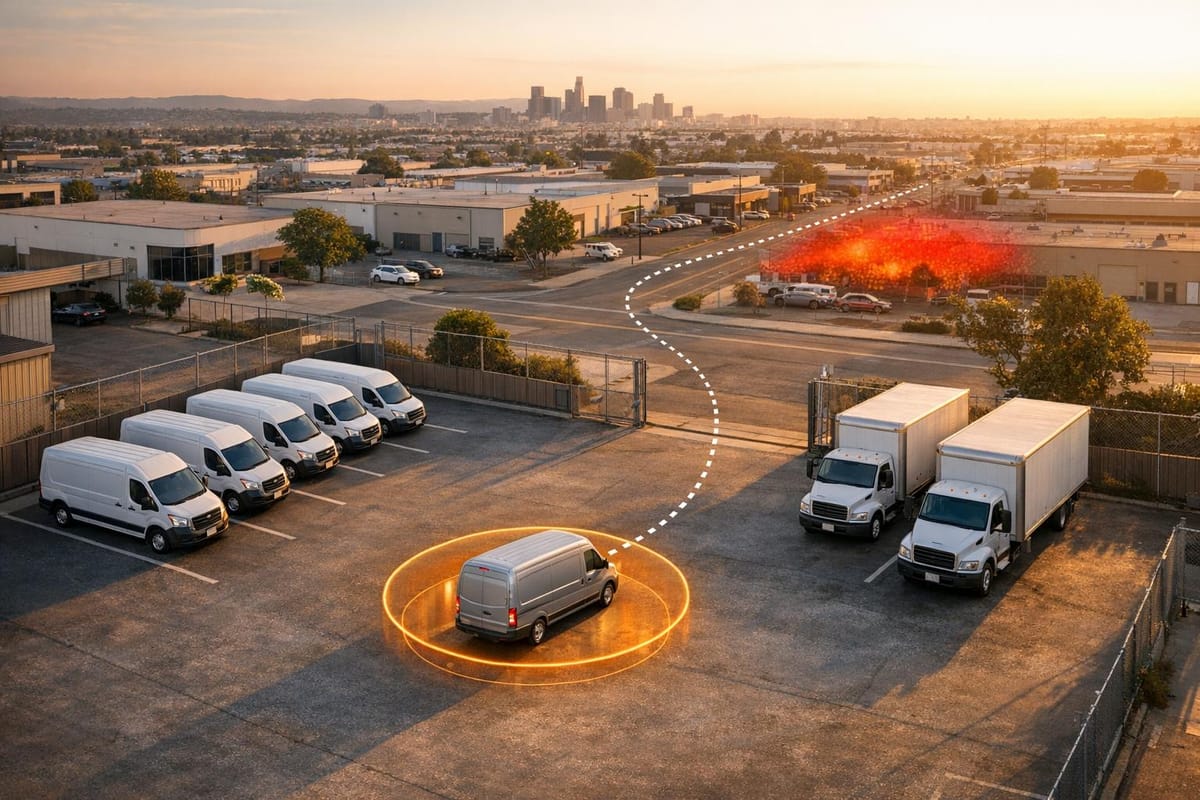
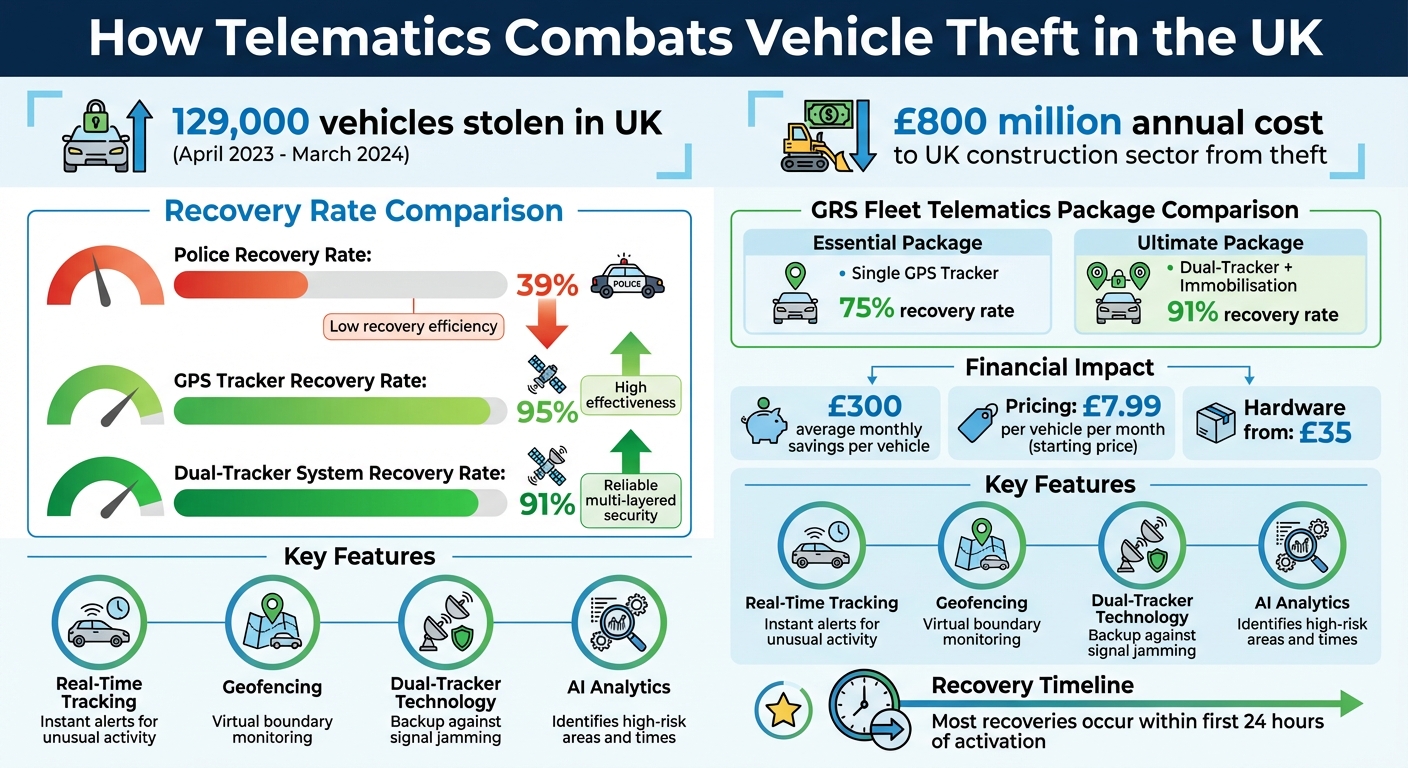
Vehicle theft in the UK is a growing concern, with over 129,000 vehicles stolen between April 2023 and March 2024. Telematics technology offers a smart way to tackle this issue by combining GPS tracking, real-time alerts, and data analysis to monitor fleets and recover stolen vehicles faster. With recovery rates as high as 91% using advanced systems like dual-trackers, telematics is proving to be a reliable tool for businesses.
Key takeaways:
- Real-time tracking: Alerts fleet managers instantly about unusual activity, such as after-hours movement or route deviations.
- Geofencing: Sets virtual boundaries to detect when vehicles leave designated areas.
- Dual-tracker technology: Combats signal jamming with a hidden backup tracker, ensuring uninterrupted monitoring.
- Data insights: Analyses theft trends to identify high-risk areas and times, helping prevent future incidents.
Telematics is not just about recovering stolen vehicles but also about preventing theft and reducing related costs, making it a practical solution for businesses managing fleets.
Telematics Vehicle Recovery Rates and Theft Prevention Statistics UK
Use Case | Anti-theft Solution & Stolen Vehicle Recovery | Teltonika
How Telematics Collects Data to Detect Theft
Telematics systems gather a variety of data to create a detailed picture of vehicle activity. Using GPS satellites, these systems pinpoint a vehicle's exact location, while cellular networks transmit this information in real time to fleet managers. Active tracking devices ensure continuous GPS updates, offering constant visibility.
Beyond just location tracking, telematics monitors ignition events, speed changes, and movement forces through built-in accelerometers. For instance, an engine starting outside approved hours or a vehicle accelerating in an unusual way can trigger alerts for potential theft. Advanced systems take it a step further by using AI to learn a vehicle’s typical routes and operating hours. Any deviation from these patterns sets off alerts. With GPS tracking systems achieving up to 95% accuracy in recovering stolen assets, this data transforms into actionable insights, enabling fleet managers to respond swiftly. Two key methods - real-time tracking and geofencing - form the backbone of theft detection.
Real-Time Tracking and Alerts
Active GPS tracking offers constant oversight, comparing live vehicle coordinates against expected patterns. When something seems off, the system immediately notifies fleet managers. For example, if a van moves at an unusual time, such as 2:00 AM on a Sunday, or suddenly speeds away from its depot, alerts are sent via SMS, email, or mobile app notifications.
This approach has proven effective. In 2022, STL Design and Build successfully recovered a stolen vehicle during the night. The tracking system identified the vehicle’s location within minutes, allowing the company to alert authorities and recover the asset just five minutes after confirmation. Similarly, North Star Mechanical Ltd. used real-time GPS data to help police locate and recover a stolen vehicle within hours, with law enforcement relying on the tracking map for precise information.
"The near real-time alerts delivered from a GPS tracker for equipment allow fleet managers to notify the police of unauthorised use or suspicious movement as soon as possible - speeding up stolen asset recovery."
- Verizon Connect Team
For added security, dual-tracker systems employ a primary GPS unit and a hidden backup device, often using Bluetooth or secondary cellular networks. If the main tracker is disabled by thieves, the backup continues to transmit location data, ensuring uninterrupted monitoring. While real-time alerts handle immediate concerns, geofencing offers an additional layer of security by focusing on spatial boundaries.
Geofencing and Boundary Monitoring
Geofencing creates virtual perimeters around specific areas, such as depots, construction sites, customer locations, or approved parking zones. The system constantly compares live GPS data to these boundaries, triggering alerts whenever a vehicle crosses them. This feature is especially useful for detecting after-hours theft by applying time-based rules to distinguish between authorised daytime activity and suspicious overnight movement.
Precision is key when it comes to geofencing. Instead of relying on simple circular boundaries, advanced systems use polygon geofences that accurately outline entrances and exits. Rishi Mehra, Vice President of Product Vision and Experience at Trimble, explains:
"A simple radius covers the roads leading to a facility, but can't differentiate whether a driver is in a yard or just approaching it. Precise geofences on entrances and exits provide more accurate real-life data."
This level of accuracy reduces false alarms and creates a reliable digital log of all entries and exits, offering clear evidence of when a theft begins.
Analysing Theft Patterns Using Telematics
Telematics data, when studied over time, can reveal theft trends, turning raw information into practical security measures.
Identifying Common Theft Indicators
Telematics systems are designed to detect unusual activity by comparing real-time data against established norms. Using AI, these systems learn a vehicle's usual routes, operating hours, and driving behaviours. For example, if an ignition event occurs at 3:00 AM on a Saturday - well outside typical working hours - or a vehicle veers off its regular Birmingham–Manchester route, the system flags it as suspicious.
Key theft indicators include:
- Ignition monitoring: Tracks engine starts outside authorised hours.
- Speed analysis: Identifies erratic acceleration or sudden route deviations.
Mapping High-Risk Areas
By analysing historical data from theft incidents, telematics platforms can pinpoint locations prone to criminal activity. For instance, if multiple vans are stolen from an industrial estate in East London within six months, that area is flagged as high risk.
Sophisticated systems also consider time-based patterns. A location might be safe during business hours but vulnerable overnight. Armed with this knowledge, fleet managers can make informed decisions - like adjusting parking arrangements, increasing security patrols, or rerouting vehicles to avoid high-risk zones during certain times. This is particularly crucial given that theft in the UK construction sector costs over £800 million annually. Recognising these geographic patterns is a key step in protecting assets and enhancing recovery efforts with dual-tracker technology.
| Common Theft Indicator | Telematics Data Point | Action Triggered |
|---|---|---|
| Unauthorised Movement | Geofence exit alert | Immediate SMS/email notification |
| After-Hours Activity | Ignition event outside working hours | Police notification |
| Route Deviation | Departure from established routes | Real-time tracking escalation |
| Tampering Attempt | Primary tracker signal loss | Backup tracker activation |
| High-Speed Escape | Speed exceeding preset limits | Law enforcement alert |
Improving Vehicle Recovery with Dual-Tracker Technology
How Dual-Tracker Systems Work
Dual-tracker systems are designed to tackle the vulnerabilities of signal jamming, ensuring vehicles remain traceable and boosting recovery rates. Thieves often rely on GPS/GSM jammers to disable tracking devices in mere seconds. To combat this, dual-tracker systems use two independent units: a primary GPS tracker and a secondary, hidden backup tracker.
The primary tracker provides real-time location updates. Meanwhile, the secondary unit, often equipped with Bluetooth, is discreetly installed in an unexpected spot within the vehicle. This setup ensures uninterrupted tracking, particularly during the critical first 24 hours after a theft - when recovery is most likely. Even if the primary tracker is disabled, the backup unit continues transmitting location data. Some advanced systems go a step further, incorporating Very High Frequency (VHF) technology in the secondary tracker. VHF signals can penetrate metal containers and underground car parks, giving law enforcement the ability to locate stolen vehicles, even when hidden in hard-to-reach places. This dual-layered approach ensures consistent monitoring and contributes to outstanding recovery rates.
GRS Fleet Telematics: 91% Recovery Rate
GRS Fleet Telematics has harnessed dual-tracker technology to achieve impressive recovery results. Through its Ultimate package, which combines dual-trackers with remote immobilisation, the company boasts a 91% recovery rate for stolen vehicles. This far surpasses the 39% recovery rate achieved by police efforts alone.
The effectiveness of GRS’s solutions is clear when comparing their packages. The Essential package, which includes a single GPS tracker, achieves a 75% recovery rate. In contrast, the Ultimate package, featuring dual-trackers and immobilisation, pushes that figure to 91%. BuildRight Construction’s Operations Manager, Mark Richards, shared a compelling example: the company successfully recovered two vans targeted by thieves. Thanks to the dual-tracker system, continuous monitoring was maintained even after attempts to disable the primary tracker, resulting in zero losses for the business.
"GRS Fleet Telematics stands out with its unique dual-tracker technology, delivering unmatched reliability and security with a 91% vehicle recovery rate - far above industry averages."
Most recoveries occur within the first 24 hours of activation, significantly reducing business disruption. Beyond the immediate loss of the vehicle, theft often leads to hidden costs - such as lost cargo, insurance investigations, and missed deadlines - which can multiply the vehicle’s initial value by as much as six times.
Visualising Theft Trends with Telematics Analytics
Using Incident Data for Risk Reduction
Telematics platforms turn raw data into clear, actionable insights, helping businesses uncover theft patterns. By analysing historical journey logs, speed variations, and route details, fleet managers can pinpoint when and where vehicles are most at risk. For example, if thefts repeatedly happen at the same spot or during certain hours, intuitive dashboards - available 24/7 on web and mobile apps - bring these trends to light.
Take Premier Vehicle Hire, for instance. Under the guidance of Fleet Operations Manager Sarah Mitchell, they utilised GRS Fleet Telematics tracking to evaluate incident data and identify weak points. The result? An impressive 85% drop in vehicle theft, coupled with better fleet efficiency.
With geofencing alerts in the mix, these analytics tools also flag route deviations and unusual speed changes, offering instant visibility into suspicious activities. This proactive approach has been shown to boost recovery rates by up to 45%. On top of that, the platform supports tailored reporting, ensuring insights are delivered to meet the unique needs of different organisational roles.
Customised Reporting and Insights
GRS Fleet Telematics offers versatile reporting tools, designed to cater to specific stakeholders across your organisation. For instance, finance teams can rely on site-time verification reports for precise billing, while security managers benefit from theft alerts and tamper notifications. This targeted approach ensures that departments receive only the information they need, cutting through unnecessary data.
Automated reports track key metrics like mileage, usage trends, and driver habits, helping identify issues such as territory violations. With advanced AI and machine learning, the platform even provides predictive insights that integrate seamlessly with your existing management systems. And with pricing starting at just £7.99 per vehicle per month, these tools offer professional-grade security monitoring without the hefty price tag.
Conclusion
Telematics is reshaping fleet security by integrating real-time GPS tracking, geofencing alerts, and advanced analytics to prevent theft and improve recovery efforts. While the national police recovery rate lags at just 39%, GPS trackers have been shown to achieve recovery rates as high as 91%.
Dual-tracker technology is a game-changer in vehicle security. By combining a primary hardwired GPS unit with a hidden Bluetooth backup, systems like GRS Fleet Telematics ensure uninterrupted monitoring - even if thieves attempt to tamper with the main device. BuildRight Construction’s experience highlights how this dual-layer approach ensures consistent tracking and effective recovery, even when the primary tracker is disabled.
Telematics doesn’t stop at recovery. It offers predictive insights that help businesses stay one step ahead of potential theft. By analysing historical trends, identifying high-risk areas, and detecting unusual activity, fleet managers can proactively address vulnerabilities. Beyond securing assets, this approach delivers financial benefits too. On average, businesses save £300 per vehicle every month due to reduced theft, lower insurance premiums, and streamlined operations. These predictive insights work hand-in-hand with high recovery rates, providing a comprehensive security solution.
With pricing starting at just £7.99 per vehicle per month and hardware options from £35, telematics has become an affordable solution for businesses of all sizes. Whether managing a handful of vans or a large fleet, telematics offers proven, cost-efficient protection against theft for businesses across the UK.
FAQs
How does telematics help recover stolen vehicles?
Telematics plays a key role in recovering stolen vehicles by leveraging real-time GPS tracking to pinpoint their exact location. With features like geofencing alerts, businesses are immediately notified if a vehicle strays outside a predefined area, providing an added layer of vigilance. For even greater security, dual-tracker systems ensure backup tracking options in case one fails.
Some systems take it a step further with remote immobilisation, enabling users to disable a vehicle from a distance to prevent it from being moved. These technologies have proven highly effective, with recovery rates reaching up to 91%. This not only aids in recovering assets quickly but also helps businesses cut down on costs and minimise resource wastage.
What is dual-tracker technology, and how does it help prevent vehicle theft?
Dual-tracker technology is an advanced security feature in telematics systems designed to safeguard vehicles against theft. It works by employing two separate tracking devices - typically, a primary wired GPS tracker paired with a secondary backup tracker. This dual setup ensures that if one tracker is tampered with or disabled, the other can still transmit location data, maintaining continuous monitoring.
This system adds an extra layer of protection by making it far more challenging for thieves to completely disable tracking. Some setups even send real-time alerts in cases of tampering or unauthorised movement, and certain systems allow for remote immobilisation to halt the vehicle. With recovery rates often surpassing 90%, dual-tracker technology offers businesses a dependable way to secure their fleets, providing both protection and peace of mind.
How does telematics help identify areas at higher risk of theft?
Telematics systems are a game-changer when it comes to identifying areas prone to vehicle theft. By leveraging GPS data, these systems track vehicle locations, monitor movement patterns, and send geofencing alerts. This detailed analysis helps businesses pinpoint high-risk zones where theft is more likely, enabling smarter security planning.
Geofencing, for instance, is a powerful feature that triggers instant alerts whenever a vehicle strays outside a predefined safe zone. This not only highlights unauthorised activity but also helps map out theft hotspots. By studying these patterns over time, businesses can make informed decisions, like adjusting routes to bypass risky areas or increasing security measures in vulnerable locations.
Advanced systems, such as those from GRS Fleet Telematics, provide UK businesses with these vital insights, helping to minimise theft-related losses and enhance fleet protection.