Telematics ROI for EV Charging Management
Telematics cuts EV charging costs up to 45%, improves charger utilisation, unlocks grants and speeds ROI with predictive maintenance for fleets.
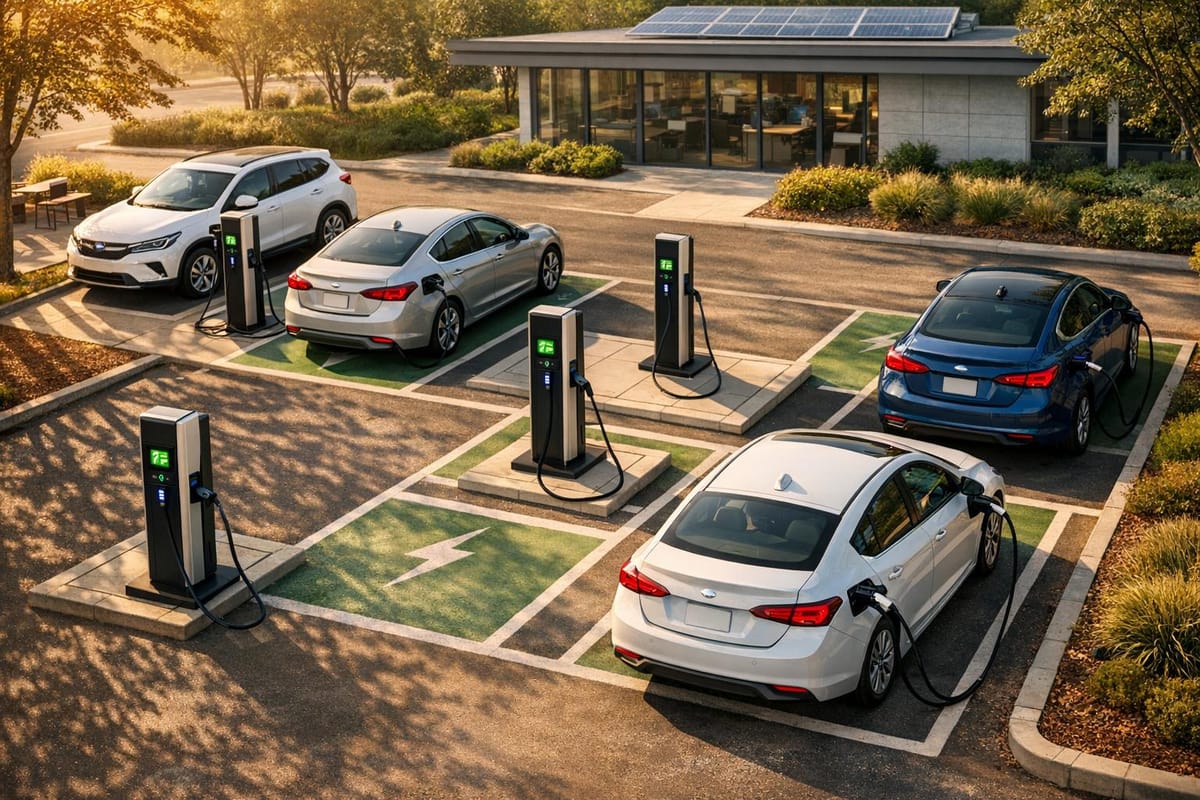
Telematics simplifies the management of EV charging, helping businesses save up to 45% on energy costs by scheduling charging during off-peak hours. It also reduces maintenance expenses by tracking battery health and enabling predictive servicing. For fleets, telematics ensures better utilisation of charging infrastructure, cutting unnecessary costs and improving efficiency.
Key advantages include:
- Cost Savings: Smart load balancing avoids expensive grid upgrades, and grants can cover up to 75% of installation costs.
- Improved Efficiency: Automated systems reduce downtime, monitor battery health, and optimise routes for lower energy use.
- Faster ROI: Managed setups can achieve up to 95% ROI within five years, compared to unmanaged systems taking 3–7 years.
Without telematics, businesses face higher costs, underused infrastructure, and shorter battery life. At just £7.99 per vehicle monthly, telematics offers a clear path to better cost control and fleet performance.
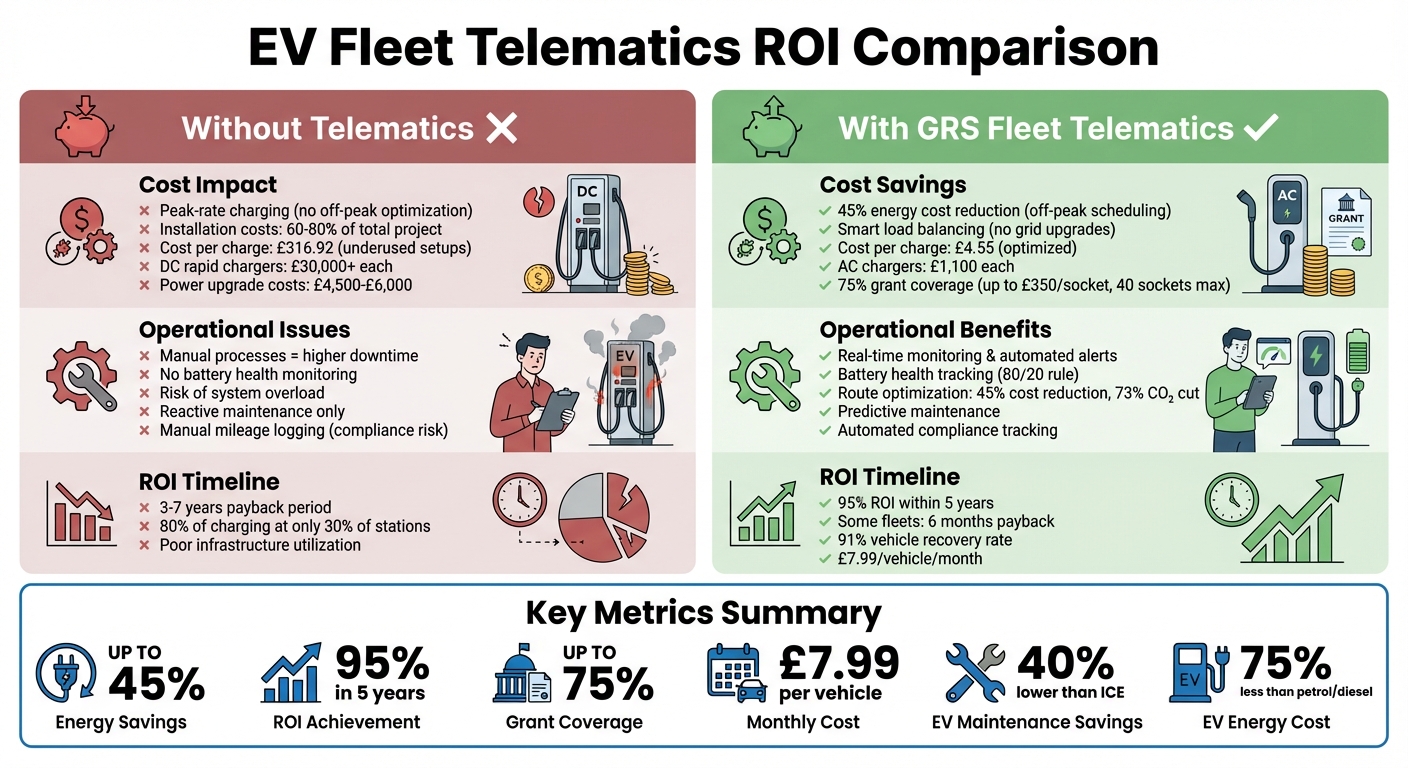
EV Fleet Management: With vs Without Telematics ROI Comparison
1. Without Telematics
Cost Savings
Fleets operating without telematics miss out on cutting energy costs by up to 45%. This happens because charging often takes place during peak-rate windows instead of taking advantage of cheaper off-peak tariffs.
The absence of utilisation data can lead to unnecessary expenses. For example, workplace EV charging installation costs make up 60% to 80% of total project expenses. When these installations are underused, the cost per charge averages £316.92, compared to just £4.55 for optimised, high-use setups. Without proper demand forecasting, businesses may invest in costly DC rapid chargers starting at £30,000 each, rather than more economical AC ports priced at around £1,100. Additional costs arise when upgrading power supplies - for instance, moving from single-phase to three-phase power can cost between £4,500 and £6,000. Without smart load balancing, exceeding the site's electrical capacity could make such upgrades unavoidable.
Emma Smith from Ratio EV notes: "Positioning charge points too far from the electrical supply often incurs unnecessary costs, while poor site planning can lead to ongoing inefficiencies".
These inefficiencies not only increase costs but also affect the overall performance of operations.
Operational Efficiency
Relying on manual processes leads to higher downtime and labour costs. Without automated load balancing, businesses risk overloading their electrical supply, which can result in system failures. Maintenance becomes more time-consuming and expensive as operators need to visit sites physically, rather than using remote diagnostics.
Battery health also suffers without proper monitoring. The "80/20 rule" - maintaining charge levels between 20% and 80% - helps protect lithium batteries from chemical stress.
According to Super B, "The high-voltage charging increases chemical stress inside the battery, which over time reduces its lifetime, so if you don't need the 100% capacity, don't charge it unnecessarily".
Without telematics to monitor the state-of-charge, batteries degrade faster, shortening the lifespan of the vehicle's most expensive component.
Additionally, logging business versus private mileage for Benefit in Kind (BIK) tax purposes becomes prone to errors without automated tracking.
Fleet-Trak warns: "The threat of non-compliance with HMRC can cause stress for management, and sometimes it can even cost the company more money than had the benefits been paid in the form of a higher salary".
Long-Term ROI
The lack of energy savings and operational inefficiencies significantly impacts long-term ROI. Data shows that nearly 80% of charging activity occurs at just 30% of stations, as the remaining 70% often suffer from poor utilisation due to the absence of data-driven forecasting. Without telematics, businesses cannot identify underperforming charge points or adjust their infrastructure to maximise efficiency.
Reactive maintenance adds to costs, as issues are addressed only after they occur.
Mer highlights: "Most of the costs connected to EV chargers are often related to the day-to-day operating expenses, not the capital outlay".
These ongoing expenses, combined with missed opportunities for government grants like the Workplace Charging Scheme, extend payback periods well beyond the typical 3 to 6 years seen in efficiently managed installations.
2. With GRS Fleet Telematics
Cost Savings
GRS Fleet Telematics takes the guesswork out of EV charging by automatically scheduling it during off-peak hours. This approach can cut energy costs by up to 45%. Instead of paying higher rates during peak demand, fleets benefit from lower tariffs - often available overnight when electricity is cheaper.
The system’s smart load management ensures power is distributed evenly across charging points, eliminating the need for expensive electrical upgrades.
Additionally, the Workplace Charging Scheme offers to cover up to 75% of purchase and installation costs, capped at £350 per socket for up to 40 sockets. GRS Fleet Telematics simplifies the process by providing the necessary usage data to support grant applications, ensuring businesses make the most of these incentives.
These cost-saving measures lead to more efficient operations and reduced overheads.
Operational Efficiency
Real-time monitoring is a game-changer for fleet management. Automated alerts ensure that vehicles are charged promptly upon return, minimising downtime caused by uncharged batteries.
Sean L notes: "Managing electrification manually is nearly impossible at scale".
Route optimisation takes it a step further by using live traffic, weather, and battery data to plan energy-efficient journeys. For plug-in hybrid electric vehicles (PHEVs), this approach can reduce running costs by 45% and cut CO₂ emissions by 73%.
These operational improvements not only streamline day-to-day activities but also contribute to long-term sustainability goals.
Long-Term ROI
GRS Fleet Telematics delivers impressive returns, with businesses achieving up to 95% ROI within five years of installing managed workplace charging stations. This is a stark improvement compared to unmanaged setups, where payback periods typically range from 3 to 7 years.
Predictive maintenance further reduces costs by avoiding unexpected repairs, complementing the inherent 40% lower maintenance costs of EVs. Over time, the energy cost of running an EV is 75% less than fuelling a petrol or diesel vehicle. With electricity prices fluctuating - sometimes multiple times a day - real-time energy management has become essential for maintaining cost efficiency.
At just £7.99 per vehicle monthly, GRS Fleet Telematics offers these benefits affordably. The dual-tracker technology, priced between £35 and £99 upfront, also includes theft protection with a 91% recovery rate, ensuring your EVs are safeguarded beyond charging management.
Exploring Telematics - a data driven approach to EV fleets
Advantages and Disadvantages
This section dives into the financial and operational upsides and challenges of using GRS Fleet Telematics, summarising the key points from earlier discussions. In essence, the system replaces guesswork with actionable data. Without telematics, fleet operators often rely on assumptions, making it difficult to measure benefits accurately. This lack of precision leaves businesses vulnerable to peak tariffs and unexpected infrastructure costs.
The financial implications of not using telematics are hard to ignore. Managing loads manually often leads to expensive upgrades and grid reinforcements. For example, switching from single-phase to three-phase power can set businesses back between £4,500 and £6,000. Installation costs alone typically make up 60–80% of a project’s total expenses, with labour costing £400 to £600 per unit. These figures illustrate the significant financial burden of traditional approaches.
On the other hand, GRS Fleet Telematics turns these challenges into opportunities for savings. By using intelligent load management and scheduling during off-peak hours, the system can reduce energy costs by as much as 45%. Some fleets even recover their investment within six months, purely through fuel savings. This is a stark contrast to the typical 3–6 year payback periods seen with unmanaged setups. Plus, the Workplace Charging Scheme can cover up to 75% of installation costs (up to £350 per socket), making the financial case even stronger.
Operationally, the benefits extend well beyond cost savings. The system replaces assumptions with accurate, real-world data, enabling precise total cost of ownership calculations before procurement. Remote diagnostics further cut down on technician callouts. GRS Fleet Telematics offers these features at a competitive price, with annual software fees ranging from £100 to £300 per port.
Here’s a side-by-side comparison of key differences:
| Feature | Without Telematics | With GRS Fleet Telematics |
|---|---|---|
| Decision Making | Based on assumptions | Real-world data-driven |
| Energy Costs | Peak tariff exposure | Up to 45% lower |
| Infrastructure Risk | Grid reinforcement needed | Load balancing avoids it |
| ROI Timeline | 3–6 years | Potentially 6 months |
| Monthly Cost | N/A | £7.99 per vehicle |
This comparison underscores how GRS Fleet Telematics can significantly improve both financial and operational performance while offering a quicker return on investment.
Conclusion
Telematics offers a smart way to cut energy costs - by as much as 45% - while delivering a rapid return on investment, with up to 95% ROI within five years. It also helps you make the most of available grants, covering up to 75% of installation costs. To get started, consider a pilot project to showcase ROI before committing to a full fleet conversion. And don’t forget to apply for grants before the March 2025 deadline. When choosing chargers, focus on those that support ISO 15118 and OCPP 2.0.1 protocols, paving the way for future Vehicle-to-Grid revenue opportunities. At just £7.99 per vehicle monthly, GRS Fleet Telematics offers a low-risk, clear financial path to better operations.
But the benefits don’t stop there. Predictive maintenance, supported by battery health monitoring, can boost asset uptime by 25%. Plus, dual-tracker technology ensures your high-value EVs are protected, with an impressive 91% recovery rate for stolen vehicles.
FAQs
How can telematics help lower the cost of EV charging for businesses?
Telematics plays a crucial role in helping businesses cut down on EV charging expenses by leveraging real-time data to fine-tune charging schedules. By monitoring critical metrics like battery charge levels, vehicle usage patterns, and location, fleet managers can schedule charging during off-peak hours when electricity rates are lower. This smart approach avoids costly peak-time tariffs and ensures energy is used in a cost-effective manner.
Another advantage comes with Vehicle-to-Grid (V2G) technology. Telematics enables vehicles to return stored energy to the grid during periods of high demand, which can either generate extra revenue or offset charging costs. The system also safeguards battery health by carefully managing discharge cycles to stay within safe limits, preserving the battery's lifespan.
By automating charging schedules and improving energy usage, telematics can save businesses hundreds of pounds (£) per vehicle each year, streamlining fleet operations and reducing overall costs.
What are the long-term financial and operational benefits of using telematics to manage EV fleets?
Using telematics for managing EV fleets provides a range of long-term advantages, both in terms of cost savings and operational efficiency. It can help lower energy consumption and charging expenses, enable vehicle-to-grid (V2G) revenue opportunities, and even prolong battery life, reducing the need for frequent replacements.
On top of that, telematics can cut down on maintenance costs, limit idle time, and improve the overall performance of the fleet. These benefits often translate into significant financial savings - potentially thousands of pounds per vehicle each year - while also boosting productivity and supporting environmentally conscious practices for businesses across the UK.
How does telematics help maintain EV battery health?
Telematics offers fleet managers real-time insights into the performance of each EV’s battery by tapping directly into the Battery Management System. It continuously tracks key metrics like temperature, voltage, current, and state-of-health, making it easier to spot irregularities such as overheating or overcharging. By catching these issues early, telematics helps prevent potential damage, ensuring the battery lasts longer and reducing the likelihood of expensive repairs.
On top of that, telematics supports predictive maintenance, which can anticipate when components may start to wear out. This allows for proactive scheduling of repairs, cutting down on downtime, lowering maintenance costs, and extending the battery’s lifespan. For UK businesses, these advantages can mean savings of thousands of pounds per vehicle, as well as more streamlined operations. Telematics even adapts to local needs, using temperatures in °C and costs in £ for tailored alerts and insights. It also helps optimise charging schedules to avoid thermal stress, further protecting battery health and improving efficiency.