Telematics Data for Fuel Budgeting: Best Practices
Monitor fuel use in real time, cut idling and harsh driving, optimise routes and link telematics to finance tools for accurate fuel budgets.
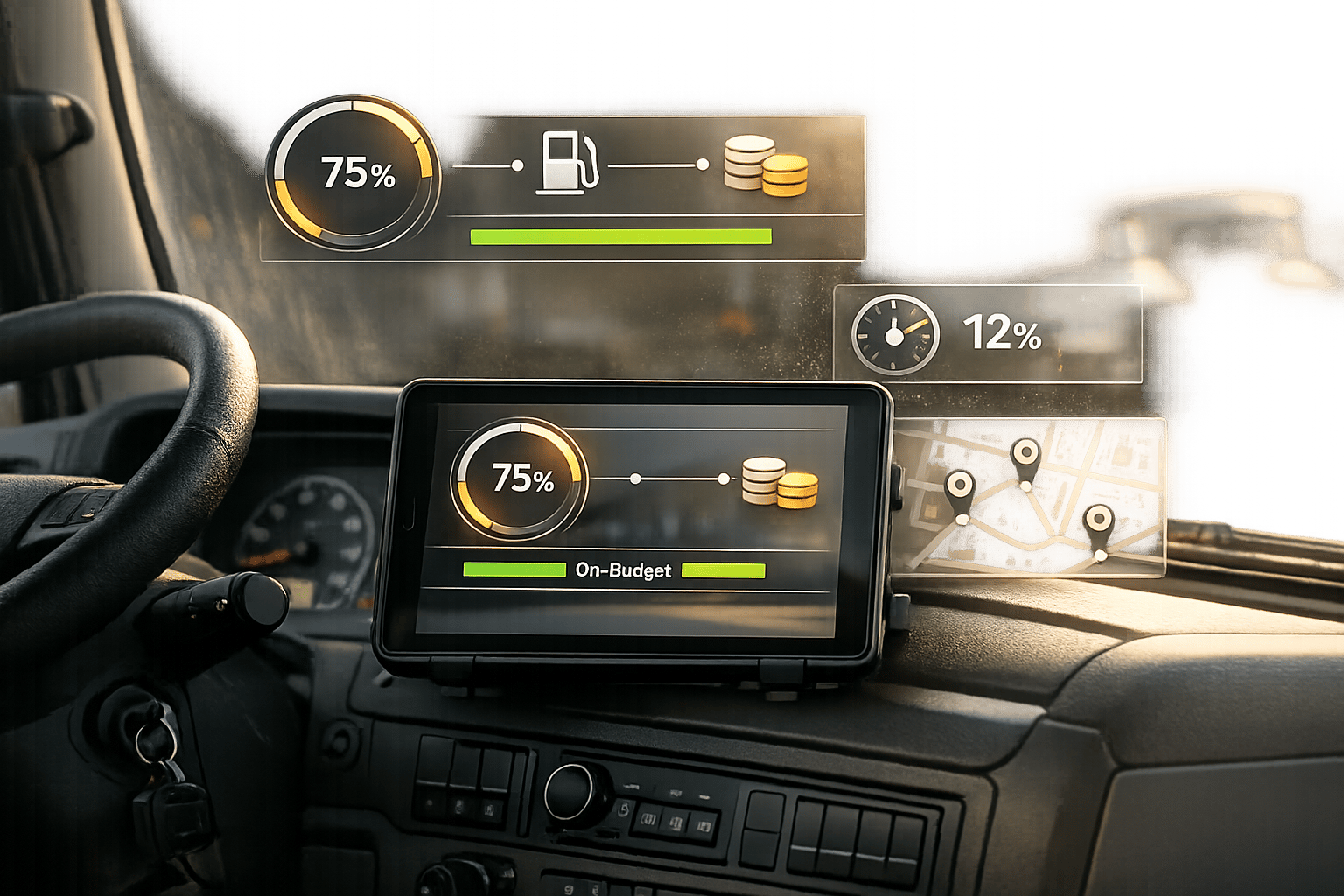
Fuel costs often account for 30–40% of fleet operating expenses. Using telematics, fleet managers can monitor fuel usage in real time, reduce waste, and improve efficiency. Here’s how telematics can help:
- Fuel Tracking: Measure fuel consumption per mile or per 100 km with precise data, eliminating reliance on receipts or manual logs.
- Idling Reduction: Identify and minimise unnecessary idling, which can significantly lower fuel costs.
- Driving Behaviour: Monitor habits like harsh braking or rapid acceleration, which increase fuel use, and coach drivers for improvement.
- Route Optimisation: Use GPS data to avoid congestion and reduce unnecessary mileage.
- Vehicle Health: Get alerts for maintenance needs, ensuring vehicles remain fuel-efficient.
Real-world examples show significant savings:
- Artur Express improved fuel economy by 11.6% over three years, saving £1.6 million in 2022.
- California Freight cut idling costs by 59% in 2025, saving £40,000 annually.
- Metro Logistics reduced fuel costs by £45,000 per year and cut their carbon footprint by 34%.
Key Metrics to Monitor:
- Fuel consumption per 100 km
- Idling time percentage
- Harsh braking events
- Fuel variance
By integrating telematics with financial tools, fleets can automate reporting, forecast costs, and allocate budgets more accurately. For example, Hill Country Construction saved £650,000 annually by implementing telematics across 180 vehicles in 2025.
Telematics offers a clear path to reducing fuel expenses, improving fleet performance, and meeting sustainability goals. Start by setting benchmarks, integrating systems, and monitoring key metrics to achieve measurable results.
Webinar | Telematics For Efficient Fuel Management | Teltonika
Key Telematics Metrics for Fuel Budgeting
Telematics systems gather essential data that impact fuel costs, helping fleet managers pinpoint inefficiencies, address consumption spikes, and make informed decisions. These metrics turn raw telematics data into actionable insights for smarter fuel budgeting.
Tracking Fuel Consumption and Idling Time
Fuel consumption per mile (or per 100 km) is a key starting point for setting a fuel budget. Telematics systems provide precise, electronic readings, bypassing the need for paper receipts. This level of detail makes it easier to spot vehicles or drivers with higher-than-average fuel usage and act quickly to cut costs.
Idling time is another critical factor. Prolonged idling wastes fuel unnecessarily, and telematics systems break this data down by driver, vehicle, and location. Reducing idle time by just 25% can lead to noticeable savings, especially for larger fleets. The data also differentiates between necessary idling (like during loading or unloading) and avoidable habits, such as excessive engine warming.
Next, let’s look at how driving habits and route planning can further refine your fuel-saving strategies.
Analysing Driving Behaviour and Route Efficiency
Driving habits play a big role in fuel consumption. Actions like harsh acceleration, abrupt braking, and speeding can significantly increase fuel usage. Telematics systems track these behaviours, making it easier to identify patterns and provide targeted training to drivers.
Route efficiency is just as crucial. Telematics data can reveal whether drivers are taking the shortest routes or making unnecessary detours. It also highlights congestion hotspots, allowing for better route planning to avoid delays and reduce fuel wastage. Even minor tweaks to routes can add up to substantial savings over time.
While driver habits and routes are important, keeping vehicles in top condition is equally critical.
Vehicle Health and Diagnostics Data
Vehicle diagnostics, such as trouble codes, tyre pressure, and engine temperature, are continuously monitored by telematics systems. These insights help fleet managers stay ahead of potential issues. Automated alerts ensure timely maintenance, keeping vehicles fuel-efficient and preventing small problems from turning into expensive repairs. Advanced tools like GRS Fleet Telematics make it easy to track these metrics and receive alerts to maintain peak performance.
Best Practices for Using Telematics Data in Fuel Budgeting
Telematics KPI Performance Benchmarks for Fleet Fuel Management
Turning telematics data into meaningful savings requires more than just gathering information. It involves a structured plan to transform raw data into actionable insights that can help cut costs.
Setting Baseline Metrics for Fuel Use
Start with a thorough fuel management audit. Since fuel typically accounts for 60% of fleet expenses, establishing an accurate baseline is critical.
Begin by benchmarking internally. Identify the drivers and vehicles in your fleet that achieve the lowest fuel consumption per 100 km. These become your fleet’s performance benchmarks - realistic targets for others to strive towards. For instance, Arte Logistik in Germany leveraged telematics data to set benchmarks, which led to a reduction of 0.69 litres per 100 km. Over nine million kilometres annually, this translated to savings of 64,000 litres of fuel, worth approximately £80,000 (€92,800).
External benchmarking adds another layer of insight. Compare your fleet’s performance to industry averages, taking into account factors such as vehicle type, route conditions (urban versus long-haul), and load weights. These comparisons can be integrated into your financial planning tools to ensure consistent performance monitoring. For example, set thresholds like a 1–2 minute idling limit and use telematics to flag violations. Regular fuel variance analysis is also key - it can help uncover mechanical issues or inefficiencies in routes by comparing actual fuel usage to your baseline.
Finally, bring these findings into your financial planning tools to refine budgeting accuracy.
Connecting Telematics with Financial Planning Tools
By integrating telematics with your fuel management system or ERP, you can shift from reactive to proactive fuel management. Take Hill Country Construction as an example. After integrating telematics across their 180-vehicle fleet, they achieved a 13% drop in fuel consumption, a 10% reduction in mileage through route optimisation, and an 80% decrease in maintenance costs. Altogether, this saved the company £650,000 annually, while also enabling more precise cost allocation for specific projects, improving their bidding process.
This kind of integration also eliminates the need for manual data entry, providing real-time insights into fuel expenses versus budget. With these tools, you can forecast costs more accurately, allocate resources to specific jobs or departments, and detect potential cost overruns before they escalate. Platforms like GRS Fleet Telematics make it easier to link telematics data with financial planning systems, offering real-time oversight of fuel consumption and costs.
Configuring Alerts and Monitoring KPIs
Once benchmarks are set and systems are integrated, real-time alerts can further strengthen your fuel budgeting efforts. Configure notifications for key events such as excessive idling, sudden fuel consumption spikes, harsh driving behaviours, or route deviations. These alerts allow you to act quickly - like contacting a driver about prolonged idling.
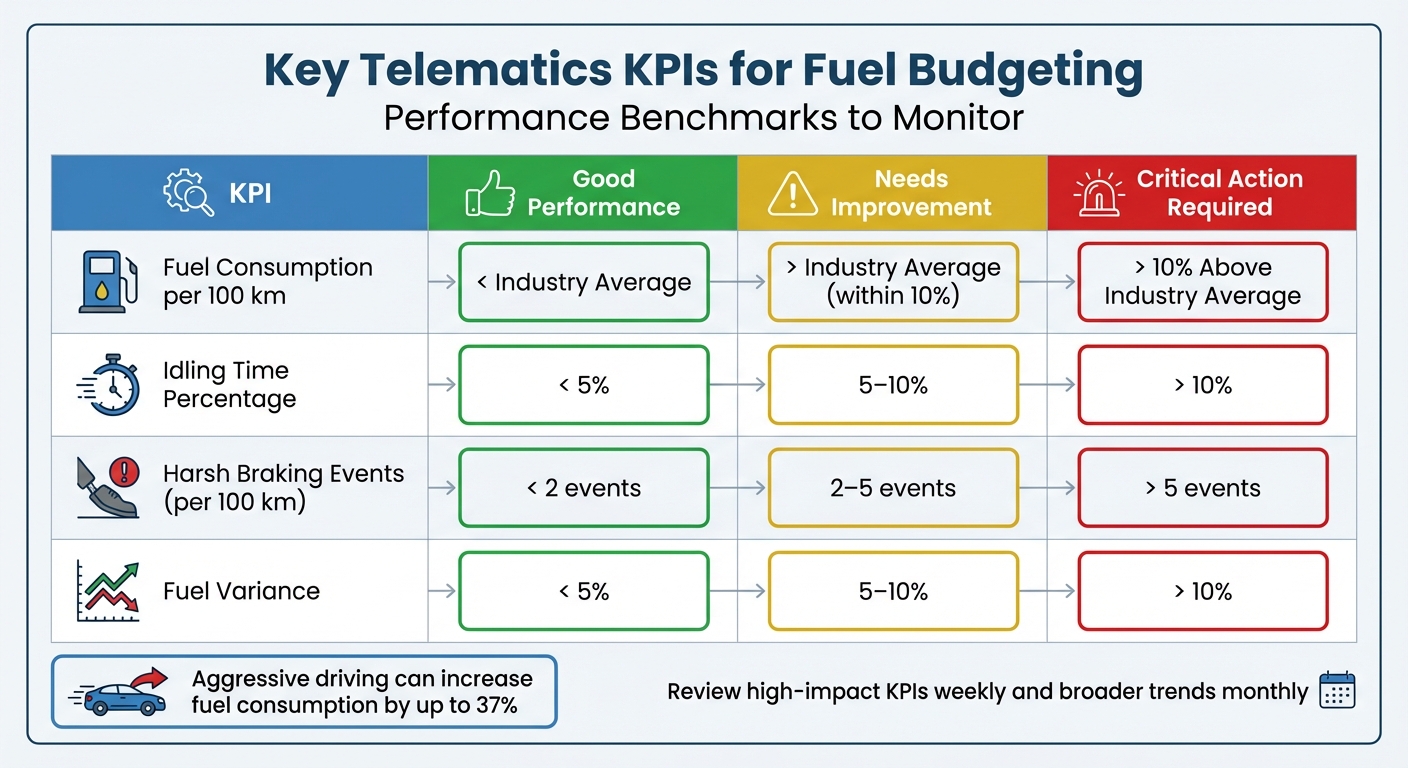
Keep an eye on KPIs that directly influence your budget. Important metrics include fuel consumption per 100 km, idling time percentage, harsh braking events, and fuel variance. Below is a table of benchmarks to guide your monitoring efforts:
| KPI | Good Performance | Needs Improvement | Critical Action Required |
|---|---|---|---|
| Fuel Consumption per 100 km | < Industry Average | > Industry Average (within 10%) | > 10% Above Industry Average |
| Idling Time Percentage | < 5% | 5–10% | > 10% |
| Harsh Braking (per 100 km) | < 2 events | 2–5 events | > 5 events |
| Fuel Variance | < 5% | 5–10% | > 10% |
Prioritise reviewing high-impact KPIs weekly and broader trends monthly. Aggressive driving, for example, can increase fuel consumption by up to 37%, making driver-specific KPIs particularly useful for targeted coaching and improvements.
Reducing Fuel Costs Through Data Analysis
Once you've set up baselines and alerts, the next step is to use telematics data to actively cut down on fuel expenses. This involves spotting wasteful habits, coaching drivers to improve, and streamlining fleet operations.
Identifying Fuel-Wasting Behaviours
Telematics can uncover inefficient driving behaviours like speeding, harsh braking, rapid acceleration, sharp cornering, and excessive idling. For example, you can set alerts to notify managers if a vehicle idles for more than 1–2 minutes. In-cab alerts also prompt drivers to adjust their habits in real time - whether it’s easing off the accelerator or switching off the engine during long stops.
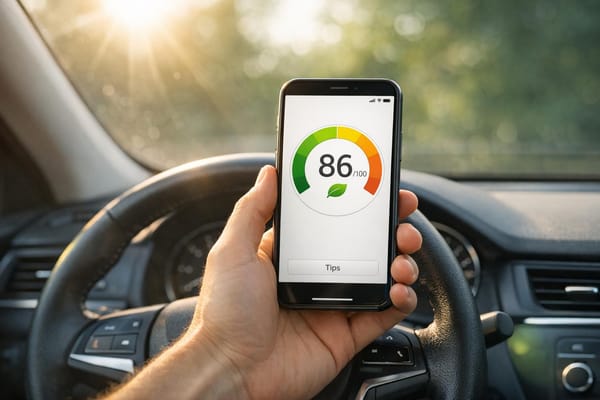
Driver scorecards turn this data into actionable insights, often using a simple "traffic light" system: green for efficient drivers, yellow for those needing attention, and red for high-risk performers. These scorecards help managers focus their coaching efforts. Artur Express has successfully used this system to improve driver performance.
Gamification can also play a role in motivating drivers. Features like league tables and financial rewards for fuel-efficient driving encourage healthy competition. GPS data can highlight problem areas, such as intersections or delivery zones with frequent harsh braking. This allows managers to adjust routes or provide specific coaching for those locations, creating opportunities for targeted training.
Using Data for Driver Training and Coaching
Generic training programmes often miss the mark because they don’t address individual challenges. By using telematics data, coaching can be tailored to each driver’s specific inefficiencies - such as high RPM levels, frequent harsh braking, or prolonged idling. Beverley Wise, regional director for Bridgestone Mobility Solutions, explains:
Performance benchmarks can be set and progress tracked over time - and this approach fosters long-term behavioural change and creates a culture of safety.
Video telematics adds another layer of understanding by providing visual context for risky events. This approach not only improves self-awareness but also helps resolve disputes. For instance, in-cab alerts have been shown to cut average CO₂ emissions by 5%, from 838 g/km to 793 g/km. Con-way Transportation (now XPO Logistics) used telematics-guided training programmes to reduce fuel costs by 12%.
Regularly reviewing scorecard trends ensures training stays relevant. For instance, new routes or seasonal weather changes might require updated coaching to maintain effectiveness. Beyond driver behaviour, optimising routes can further enhance fuel efficiency.
Optimising Routes and Fleet Schedules
Combining behavioural insights with route optimisation tools can significantly cut down on fuel use. These tools rely on GPS and traffic data to minimise unnecessary mileage and avoid congestion. A standout example is UPS, which implemented the ORION system in 2016 across 55,000 routes. By optimising routes in real time, they saved 10 million gallons of fuel annually, reduced driven miles by 100 million, and cut operating costs by £240–320 million each year.
DB Regio Bus, a German operator, used telematics to slash vehicle idling by 40% over two years, cutting CO₂ emissions by 1,400 tonnes annually and saving hundreds of thousands of litres of diesel. Similarly, Healthy Tots, a Scottish food delivery company, adopted fleet visibility tools and achieved a 15–20% reduction in fuel consumption, a 30% boost in vehicle utilisation, and a 25% drop in maintenance costs.
Asset utilisation analysis can also help identify underused vehicles that might be reassigned or retired to lower costs. Sherry Calkins, Senior Vice President at Geotab, highlights:
Excessive driver idle time is often an overlooked cost driver in fleet operations. Reducing idle time is essential not just for cost management but also for promoting environmental responsibility.
Adam Partington from Teletrac Navman UK adds:
Key to reducing carbon emissions is, of course, reducing fuel consumption... it's a matter of driving smarter and maximising efficiency wherever possible.
Measuring ROI and Long-Term Benefits of Telematics
Calculating Fuel Cost Savings with Telematics
To measure the financial impact of telematics, start by establishing baseline fuel usage metrics and tracking improvements over time. On average, fleets using telematics can achieve fuel savings of 10–15% when implemented effectively. Calculating ROI involves comparing the upfront and ongoing costs of telematics systems with the actual fuel savings observed. These costs can vary depending on the complexity of the system.
Take, for example, the case of Be My Bus by Darbier, a coach company based near Orléans, France. By introducing an eco-driving programme supported by telematics and dash cams, their drivers managed to reduce fuel consumption by 2–3 litres per 100 km. This translated into an annual saving of up to 45,000 litres of fuel, as noted by Paulo Da Cunha, their Research & Methods Manager.
Key performance indicators to monitor include:
- Fuel consumption per mile
- Total fuel cost reductions (calculated in GBP)
- Percentage improvements in fuel efficiency across the fleet
- Savings achieved by minimising idling time
Many telematics systems integrate seamlessly with ERP software, providing real-time financial insights from operational data. For most fleets, the cost of standard telematics systems is recovered within 9–18 months.
For UK-based fleets, solutions like GRS Fleet Telematics can simplify the integration of telematics data with financial planning tools, making it easier to manage fuel budgets effectively.
The next step is understanding how these immediate savings contribute to long-term operational efficiency and reduced environmental impact.
Long-Term Efficiency Gains and Reduced Emissions
Telematics isn't just about short-term savings - it also provides ongoing benefits that improve operations over time. With tools like predictive analytics and continuous monitoring, fleets can proactively manage vehicle maintenance and optimise fuel use, extending the lifespan of vehicles and lowering overall costs. Additionally, tracking fleet-wide fuel efficiency helps identify the best times to replace ageing vehicles.
There’s also a clear environmental upside. By reducing fuel consumption, fleets can significantly cut emissions, aligning with corporate sustainability goals. This combination of cost reduction and environmental responsibility offers a win-win scenario. Regular reporting keeps fuel efficiency in focus for the entire team, encouraging a culture of ongoing improvement.
The blend of financial and environmental benefits underscores the strategic importance of telematics in managing fuel costs and achieving broader organisational goals.
Conclusion
Key Benefits of Telematics for Fuel Budgeting
Telematics transforms fuel budgeting from guesswork into precise, data-backed planning. By offering real-time insights into fuel consumption, idling habits, and driver behaviour, fleet managers can quickly identify inefficiencies and address them head-on. For instance, Hill Country Construction implemented telematics across 180 vehicles in 2025. The result? A 13% reduction in fuel use and £650,000 in annual savings across operational costs. In another example, some operators have cut idling by up to 40%, significantly reducing diesel costs and emissions.
This dual advantage - cutting costs while lowering emissions - positions telematics as a valuable tool for optimising fleet performance. Beyond immediate savings, the long-term benefits are just as compelling. Continuous monitoring helps extend vehicle lifespans and ensures fuel efficiency remains a priority. Plus, the environmental gains, like fewer emissions and a reduced carbon footprint, align with broader sustainability goals, making telematics a smart investment for both financial and ecological reasons.
Next Steps for Fleet Managers
With these benefits in mind, fleet managers can now take practical steps to modernise their fuel budgeting strategies. Start by assessing your current fuel consumption to establish baseline metrics. Introducing a telematics system allows you to track performance, pinpoint waste, and measure progress over time. For UK-based fleets, GRS Fleet Telematics provides advanced tracking solutions starting at just £7.99 per month. Select from hardware options tailored to your needs and begin monitoring critical metrics like fuel usage per mile, idling time, and driver habits. Use this data to implement meaningful changes and drive efficiency across your operations.
FAQs
How do I set a fuel-use baseline for my fleet?
To get started with setting a fuel-use baseline, dive into historical fuel consumption data. Tools like GRS Fleet Telematics can be incredibly helpful for this. Focus on key metrics such as litres per 100 km or miles per gallon to understand typical fuel usage during normal operations.
Analyse data over a meaningful timeframe - such as a month or a quarter - to calculate an accurate average. It's important to revisit and update this baseline regularly to account for any shifts in your fleet's operations, ensuring the data stays relevant and precise.
Which telematics KPIs matter most for fuel budgeting?
When it comes to fuel budgeting, some key telematics KPIs to monitor include fuel consumption per mile or 100 km, idling time, and driver behaviour metrics such as speeding and harsh braking. These elements play a major role in determining fuel efficiency and overall expenses, making them crucial for tracking and improvement.
How can I link telematics data to my ERP or finance tools?
To link telematics data with your ERP or finance tools, you’ll need to integrate your telematics system with management software. This can be done using APIs or secure data synchronisation platforms. Such integration allows for real-time data sharing, making cost tracking, maintenance planning, and compliance reporting more precise and efficient.
Key components include fuel sensors, GPS modules, and GDPR-compliant software. These ensure that fuel usage, location, and driver behaviour data are seamlessly aligned with your existing systems.