Cross-Platform Telematics APIs for Fleet Management
Cross-platform telematics APIs unify GPS, diagnostics and driver data to cut downtime, reduce fuel and maintenance costs and ensure secure, GDPR-compliant fleet operations.

Fleet management is evolving, and cross-platform telematics APIs are at the core of this transformation. These APIs unify data from GPS, fuel usage, engine diagnostics, and driver behaviour into a single system, eliminating the inefficiencies caused by disconnected platforms.
Key takeaways:
- The commercial telematics market is projected to exceed $84 billion by 2032, driven by the need for integrated systems.
- Businesses using telematics APIs reduce wasted time (up to 30% of workweeks) and cut costs by optimising routes, automating processes, and scheduling predictive maintenance.
- Real-time data access, secure API frameworks (OAuth 2.0, JWT), and UK GDPR compliance are critical for effective implementation.
- Case studies show benefits like 25% fewer unexpected repairs, 40% faster vehicle recovery, and up to 20% lower fuel costs.
Why it matters: Integrated telematics systems improve efficiency, protect assets, and reduce downtime. Companies like GRS Fleet Telematics offer scalable solutions starting at £7.99 per vehicle per month, with features like dual-trackers, real-time monitoring, and seamless integration with existing tools. The right API partner ensures security, scalability, and long-term savings for fleet operators.
Using telematics insight to improve fleet operations
Core Features of Modern Telematics APIs
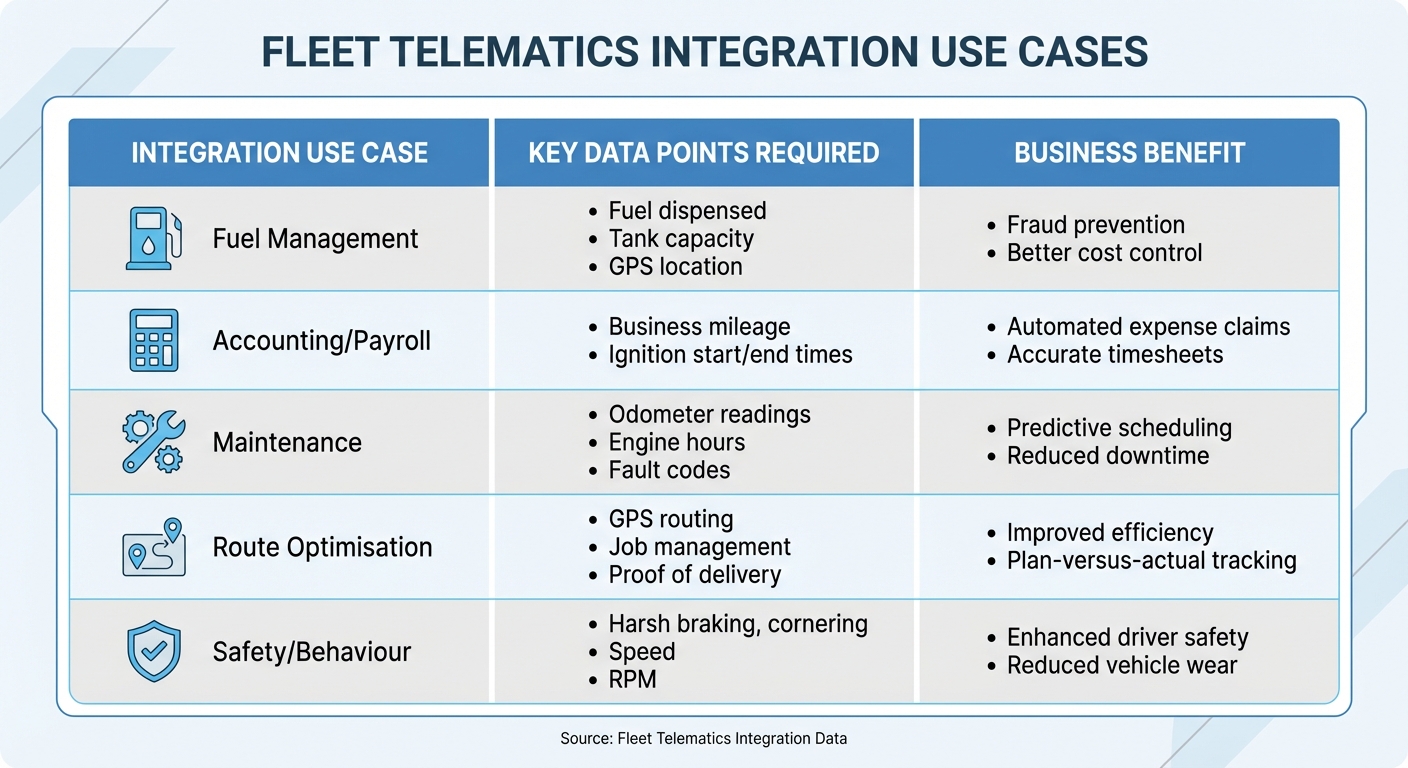
Fleet Telematics Integration Use Cases and Business Benefits Comparison
Modern telematics APIs deliver three key functionalities. First, real-time data synchronisation ensures instant updates through push technologies while buffering data during connectivity interruptions. This guarantees uninterrupted monitoring across operations, even in remote UK regions with unreliable mobile coverage. When connectivity drops, vehicles store data locally and send it once a stable connection is restored.
Second, unified data modelling transforms varied hardware outputs into a consistent format, simplifying multi-brand fleet management. This includes accessing diagnostic data from the ECU, such as engine RPM, oil pressure, coolant temperature, fuel levels, and fault codes (DTCs). By integrating this data into maintenance systems, fleets can reduce unexpected repairs by up to 25%. These features lay the groundwork for robust real-time data access and integration, which we’ll explore further.
Real-Time Data Access and Monitoring
APIs provide multiple data delivery options - snapshots, periodic feeds, and continuous streaming - allowing fleets to balance speed and bandwidth needs. Streaming offers the fastest updates, ideal for high-priority vehicles or urban operations with reliable 4G coverage. Feeds, which update every few minutes, provide a middle ground without overwhelming the network. For UK fleets, streaming is often more efficient than frequent polling, reducing resource strain while maintaining timely updates.
To optimise remote commands, always check device status to avoid 408 timeouts or unnecessary data charges. For HTTP 429 errors, implement exponential backoff to manage retries effectively.
Security and Data Protection Standards
Data security is just as important as access speed. The National Cyber Security Centre (NCSC) recommends avoiding weak methods like basic authentication or API keys, as they can be easily compromised:
"Don't use weak authentication methods such as basic authentication or API keys... Both these methods can be easily compromised, often due to poor secrets management." - National Cyber Security Centre (NCSC)
Modern telematics APIs address this by using OAuth 2.0, OpenID Connect (OIDC), and JSON Web Tokens (JWT) for secure, authorised access. Role-based access control adds another layer of security, limiting data visibility based on user roles. For instance, finance teams might access mileage data for expense claims, while only senior managers can view driver location history or issue immobilisation commands.
UK GDPR regulations also require detailed logging to track when and to whom personal data is shared. The Government Digital Service highlights:
"If your API provides personal or sensitive data, you must log when the data is provided and who you provide it to. This will help you follow UK GDPR." - Government Digital Service
Centralised logging systems can help trace high-risk actions and facilitate Data Protection Impact Assessments (DPIAs). Additionally, a stateless architecture using JWT tokens supports horizontal scaling, ensuring the system can handle sudden surges when multiple vehicles reconnect simultaneously.
Integration with Fleet Management Tools
Modern APIs integrate seamlessly with various platforms - ERP systems, fuel cards, maintenance software, and accounting tools - streamlining fleet operations. These integrations centralise data, improving both cost management and operational clarity. Here’s how specific integrations utilise telematics data:
| Integration Use Case | Key Data Points Required | Business Benefit |
|---|---|---|
| Fuel Management | Fuel dispensed, tank capacity, GPS location | Fraud prevention and better cost control |
| Accounting/Payroll | Business mileage, ignition start/end times | Automated expense claims and accurate timesheets |
| Maintenance | Odometer readings, engine hours, fault codes | Predictive scheduling and reduced downtime |
| Route Optimisation | GPS routing, job management, proof of delivery | Improved efficiency and plan-versus-actual tracking |
| Safety/Behaviour | Harsh braking, cornering, speed, RPM | Enhanced driver safety and reduced vehicle wear |
For UK-specific operations, ensure your API supports GBP (£) transactions, uses ISO 8601 date formats (YYYY-MM-DD), and encodes location data in GeoJSON. Before deploying live, test integrations in a sandbox environment using synthetic data. To improve performance, bundle related data points - like driver and vehicle info - into a single API call using eager loading, reducing HTTP overhead.
How to Implement Cross-Platform Telematics APIs
Steps to Integration
Start by defining your business objectives and identifying the systems that need to connect, such as transport management, HR, accounting, and fuel card platforms. Check whether these systems support built-in integrations or if custom REST/SOAP development will be required.
Once that's clear, obtain API credentials from your provider and review the documentation carefully to pinpoint the endpoints you'll need. Decide whether to proceed with direct API integration for maximum control or use an SDK to simplify development and handle technical complexities. Keep in mind that building a single API integration can take around 150 engineering hours, with an additional 300 hours per year for maintenance.
Before launching, test the integration thoroughly in a sandbox environment using synthetic data. This step is crucial to avoid costly mistakes or disruptions. After successful testing, activate imported vehicles within your management platform to enable routing and operations. A well-executed integration enhances fleet efficiency and boosts responsiveness. Finally, design a scalable and adaptable architecture to accommodate future growth in fleet operations.
Planning for Scalability and Flexibility
Adopt a stateless API design where the client handles authentication. This approach allows horizontal scaling across multiple server instances. The UK Home Office explains:
"A stateless API means that the client is responsible for providing information about authentication etc. In turn, this means an application can then scale easily horizontally, as it doesn't matter which instance a client connects to."
Switch from frequent polling to telemetry streaming or event-driven models. These methods reduce resource consumption as your fleet grows and improve overall efficiency. Implement rate limiting with exponential backoff logic to handle high-demand scenarios, such as when vehicles reconnect after passing through areas with poor signal.
Automate the rotation of credentials to maintain security without manual effort. Use an API gateway to centralise security, rate limiting, and auditing as you scale and integrate additional microservices. With projections showing the global telematics market surpassing US$84 billion by 2032, preparing for growth is essential.
Even with careful planning, challenges are inevitable during implementation.
Common Implementation Challenges and Solutions
One major hurdle is data standardisation. Different APIs may use varying terms (like 'odometer' versus 'mileage') or measurement units. To address this, audit data to remove duplicates and set up automated validation processes to ensure consistency.
Connectivity gaps in remote areas can result in data loss or inaccurate reporting. To mitigate this, design backends with store-and-forward mechanisms that buffer data and verify connectivity before sending commands. This avoids timeouts and prevents unnecessary charges.
| Integration Challenge | Operational Impact | Recommended Solution |
|---|---|---|
| Data Silos | Fragmented insights, 30% time wasted searching for info | Centralise fleet management platforms |
| Connectivity Gaps | Data loss in rural areas, inaccurate reporting | Local buffering & store-and-forward logic |
| Rate Limiting | System 429 errors, failed data sync | Exponential backoff retry logic |
| Unit Mismatches | Errors in fuel/odometer reporting (km vs miles) | Automated data validation & standard naming |
Staff training is another critical factor. Build a strong relationship with your API provider’s support team to stay updated on new features and changes. Regularly query endpoints like /invalidrecords to identify and resolve rejected data quickly - most data expires within 48 hours. Proactively addressing these issues helps prevent minor problems from escalating into major disruptions.
Analytics and AI in Telematics
The integration of advanced analytics and AI is transforming telematics, offering new ways to enhance fleet performance and efficiency.
AI-Driven Insights for Fleet Optimisation
AI takes telematics data and turns it into actionable insights, helping fleets operate more efficiently. By analysing driver behaviour, traffic patterns, and vehicle performance, AI can optimise routes and cut costs. For example, real-time rerouting has been shown to decrease failed deliveries by 40%, increase fleet capacity by 25%, and reduce route planning time by 75%.
In 2024, a major UK city showcased the potential of AI-powered analytics. After introducing AI-driven tools, the city doubled its global safety score from 40.5 to 80.5 in just three months and saw a 65% drop in monthly speeding incidents. As the Enterprise EHS & Workers' Compensation Lead explained:
"When we looked at the inputs for driver safety, we realized that we had a global score of 40.5... In three months, we reached 80.5... We doubled the score essentially in three months."
AI also plays a key role in improving driver habits. Features like in-cab alerts and scorecards provide instant feedback, helping drivers correct risky behaviours. For instance, Team Goliath Inc., which operates 14 Domino’s Pizza outlets, used driver scorecards and video telematics to cut annual insurance costs by over £100,000. To maximise the benefits of AI, fleet operators are advised to run a 4–8 week pilot programme to establish baseline metrics for fuel efficiency, maintenance needs, and delivery success before fully rolling out AI systems.
Beyond optimising routes and behaviours, AI also supports predictive maintenance strategies, reducing risks and costs.
Predictive Maintenance and Risk Mitigation
Predictive analytics rely on real-time data from IoT sensors to monitor critical metrics like engine performance, tyre pressure, and environmental conditions. This approach can reduce unplanned vehicle downtime by up to 30% and lower repair costs by 20%. AI-driven systems also extend the lifespan of vehicle components, cutting maintenance expenses by up to 15% and reducing unexpected breakdowns by over 70%.
Different vehicle components provide specific warning signs before failure. For example:
- Brakes may show abnormal temperature spikes and frequent harsh braking patterns.
- Diesel particulate filters might indicate high exhaust temperatures and repeated regeneration cycles.
- 12v vehicle batteries often signal issues with low voltage and slow cranking.
- EV batteries may exhibit rapid discharge and irregular charging behaviours.
When implemented effectively, predictive systems can achieve a forecast accuracy of up to 98% for asset utilisation.
While predictive maintenance minimises risks, telematics also promotes eco-friendly practices through smarter driver behaviour monitoring.
Sustainability Metrics and Driver Behaviour Analysis
Modern telematics systems encourage sustainable practices by tracking driver behaviour and other key metrics. For instance, integrating video telematics has been linked to a 20% reduction in fatal crashes and a 35% decrease in injury-related incidents. Plastic Express, a logistics company, implemented AI-driven "green-zone" scoring to monitor following distances and driver drowsiness, achieving a 13% drop in severe safety alerts.
Real-time traffic data also contributes to sustainability, saving an average of 12 minutes per delivery and cutting fuel costs by 42p per mile in busy urban areas. Fleet managers can even gamify safety improvements by using AI-generated driver scorecards to create friendly competitions among drivers. The adoption of 5G technology further enhances these capabilities by enabling high-speed data transfer for real-time applications, while edge analytics ensures faster processing directly on the vehicle.
Choosing the Right Telematics API Partner
Picking the right telematics API partner can make or break your fleet management system. The right choice ensures smooth scaling and operational efficiency, while the wrong one could lead to vendor lock-in, integration headaches, and unexpected costs. To avoid these pitfalls, it's essential to evaluate potential partners based on their technical architecture, security measures, and pricing transparency. Here's a framework to help you make an informed decision.
Key Evaluation Criteria
Opt for a stateless API for scalability. A stateless API design ensures that client authentication is handled independently of specific server instances. This makes it easier to scale horizontally, as you can add server capacity without requiring clients to reconnect to particular servers. Look for providers that use event-driven models such as telemetry streams or webhooks, which are far more efficient than traditional polling methods, especially as your fleet expands.
Hardware and connectivity matter. The quality of the physical tracking device is just as important as the software behind it. Assess the manufacturer's quality control processes and how they ensure reliable performance under varying network conditions. For operations in the UK, it's crucial to have store-and-forward mechanisms that buffer data during poor network coverage and de-duplicate it once connectivity is restored.
Avoid vendor lock-in with open platforms. Choose partners offering free, well-documented SDKs and APIs that allow for customisation without locking you into proprietary systems. For UK-specific operations, ensure the API supports GBP (£), ISO 8601 date formats, and GeoJSON encoding for accurate location data.
Prioritise security and compliance. Security should be baked into the system from the start. Look for partners that adhere to high standards like OAuth 2.0 authentication, TLS 1.2 encryption for data in transit, and AES-256 encryption for data at rest. Verify certifications such as ISO 27001 and confirm hardware approvals like Thatcham or TASSA to meet UK insurance requirements. Compliance with UK GDPR is non-negotiable, as fines can reach up to £17.5 million. Ensure your partner conducts Data Protection Impact Assessments and offers features like driver privacy modes for tracking outside working hours.
A partner like GRS Fleet Telematics ticks all these boxes, offering solutions tailored to these challenges.
The Benefits of Partnering with GRS Fleet Telematics
GRS Fleet Telematics stands out as a partner that delivers on scalability, connectivity, and security. Their dual-tracker system combines a hardwired GPS with a hidden Bluetooth backup, achieving an impressive 91% recovery rate for stolen vehicles. Pricing is straightforward, starting at £35 for the Essential wired tracker, £79 for the Enhanced dual-tracker system, and £99 for the Ultimate setup, which includes remote immobilisation. Subscription fees start at £7.99 per vehicle per month, covering SIM/data, account manager access, and full platform functionality - no hidden charges.
White-label options give businesses the flexibility to maintain their branding or resell tracking services under their own name. The platform integrates seamlessly with back-office systems like ERP, CRM, and payroll, consolidating data from GPS, fuel cards, and maintenance logs into one dashboard. This eliminates data silos, which can consume up to 30% of an employee's workweek.
Assessing Long-Term Value and ROI
A robust telematics solution isn't just about technical features; it’s about the financial impact. Fleet downtime can cost around £727 per vehicle daily. GRS Fleet Telematics’ API integration has been shown to save businesses approximately £1,224.52 monthly, translating to annual savings of about £14,694.25. Some companies have reported ROI figures as high as 2,965%, with payback periods as short as 0.3 months.
By integrating with maintenance systems, businesses can cut unplanned repairs by up to 25%. Automated mileage claims and scheduling also reduce manual admin work, while fuel costs can drop by 10–20% within the first year of implementation.
Before signing any contracts, confirm that you retain full ownership of your data and have the freedom to share it with third-party vendors without incurring extra charges. As Jeff Simon from DOT Safety Plus explains:
"The carrier who learns how to best utilize the real time delivery of data produced by ELDs will have a distinct competitive advantage over those who don't".
Finally, look for partners that offer UK-specific support, such as automated compliance with DVSA requirements for driver hours and maintenance records.
Conclusion
Cross-platform telematics APIs are becoming a cornerstone of modern fleet management, with projections suggesting that 70% of UK fleet operators will adopt GPS tracking or telematics by 2025. By transitioning from isolated systems to integrated, cloud-based platforms, businesses can cut down on time and cost inefficiencies. However, as Andrew Till, General Manager of Secure Platform at Trustonic, points out:
"As vehicles become software‐driven, they gain increased cybersecurity risks... complexity of software systems, greater connectivity and cloud integration expand the potential attack surfaces".
This highlights the critical importance of choosing a telematics partner with strong security protocols and GDPR compliance to mitigate these risks. Beyond security, the financial advantages of such systems are undeniable.
Fleet downtime, which can cost around £727 per vehicle per day, is significantly reduced with integrated telematics. These systems also deliver savings through 15% lower fuel consumption and 20% reduced maintenance costs. Real-world examples show how integrated platforms help prevent asset losses, making them a smart investment for any fleet operator.
When selecting a telematics partner, focus on technical and security features. Look for solutions with stateless API architecture for scalability, OAuth 2.0 authentication for secure access, and ISO 27001 certification to ensure data protection. Testing integrations in a sandbox environment is also essential before full deployment. Additionally, ensure the platform supports UK-specific needs such as GBP transactions, ISO 8601 date formats, and compliance with DVSA regulations.
GRS Fleet Telematics stands out as an affordable and transparent solution, offering monthly subscriptions starting at £7.99 per vehicle. This includes SIM/data, account management, and full platform functionality. With a 91% recovery rate for stolen vehicles and white-label capabilities, it provides both security and flexibility for businesses.
FAQs
How can cross-platform telematics APIs help improve fleet management efficiency?
Cross-platform telematics APIs make managing fleets easier by connecting various systems like GPS trackers, vehicle maintenance tools, and driver monitoring platforms. This integration allows real-time data sharing, removing the need for manual data entry. Fleet managers can instantly track vehicle locations, monitor fuel consumption, assess driver behaviour, and stay on top of maintenance requirements.
By automating tasks such as scheduling maintenance, generating compliance reports, and sending incident alerts, these APIs lighten administrative workloads and reduce the risk of errors. They also boost security with features like geofencing, vehicle immobilisation, and automated notifications for unsafe driving behaviours. Thanks to improved data flow and operational insights, fleet operators can fine-tune routes, lower fuel expenses, and speed up delivery times - all while staying compliant with UK regulations and GDPR.
In short, these APIs help businesses save time, cut costs, and enhance fleet performance.
What are the key security practices for integrating telematics APIs?
Ensuring the secure integration of telematics APIs is crucial for protecting sensitive fleet data and maintaining smooth operations. A good starting point is using strong authentication protocols, like OAuth 2.0, to ensure that only authorised users and systems can access the data.
Another key measure is encrypting data both in transit and at rest. This protects critical information, such as vehicle locations and driver details, from being exposed during transmission or while stored.
To strengthen security further, consider implementing role-based access controls to limit access based on user roles. Regular security audits are also critical for identifying vulnerabilities, and compliance with GDPR regulations in the UK ensures that data privacy standards are met. Additionally, manage API keys carefully by avoiding hard-coded credentials and monitor for any unusual activity to detect potential breaches early.
By combining these strategies, businesses can establish a strong defence for secure telematics API integration.
How do AI and analytics improve fleet management with telematics?
AI and analytics are transforming fleet management by leveraging real-time telematics data to streamline operations. These systems analyse key factors like traffic patterns, weather conditions, vehicle performance, and driver behaviour to plan smarter, more efficient routes. The result? Fewer delays, reduced fuel usage, and lower operational costs.
One standout feature is predictive maintenance, where AI identifies potential vehicle issues before they lead to breakdowns, helping to minimise downtime and repair costs. AI also ensures compliance with regulations, such as monitoring driver hours and navigating Low Emission Zones (LEZ) or Ultra Low Emission Zones (ULEZ). By integrating these technologies, businesses can improve safety, cut costs, and boost overall efficiency.