Telematics for Analysing EV Battery Usage
Telematics turns EV batteries into cloud digital twins, providing real‑time SoC and SoH insights to cut costs, extend lifespan and reduce downtime.
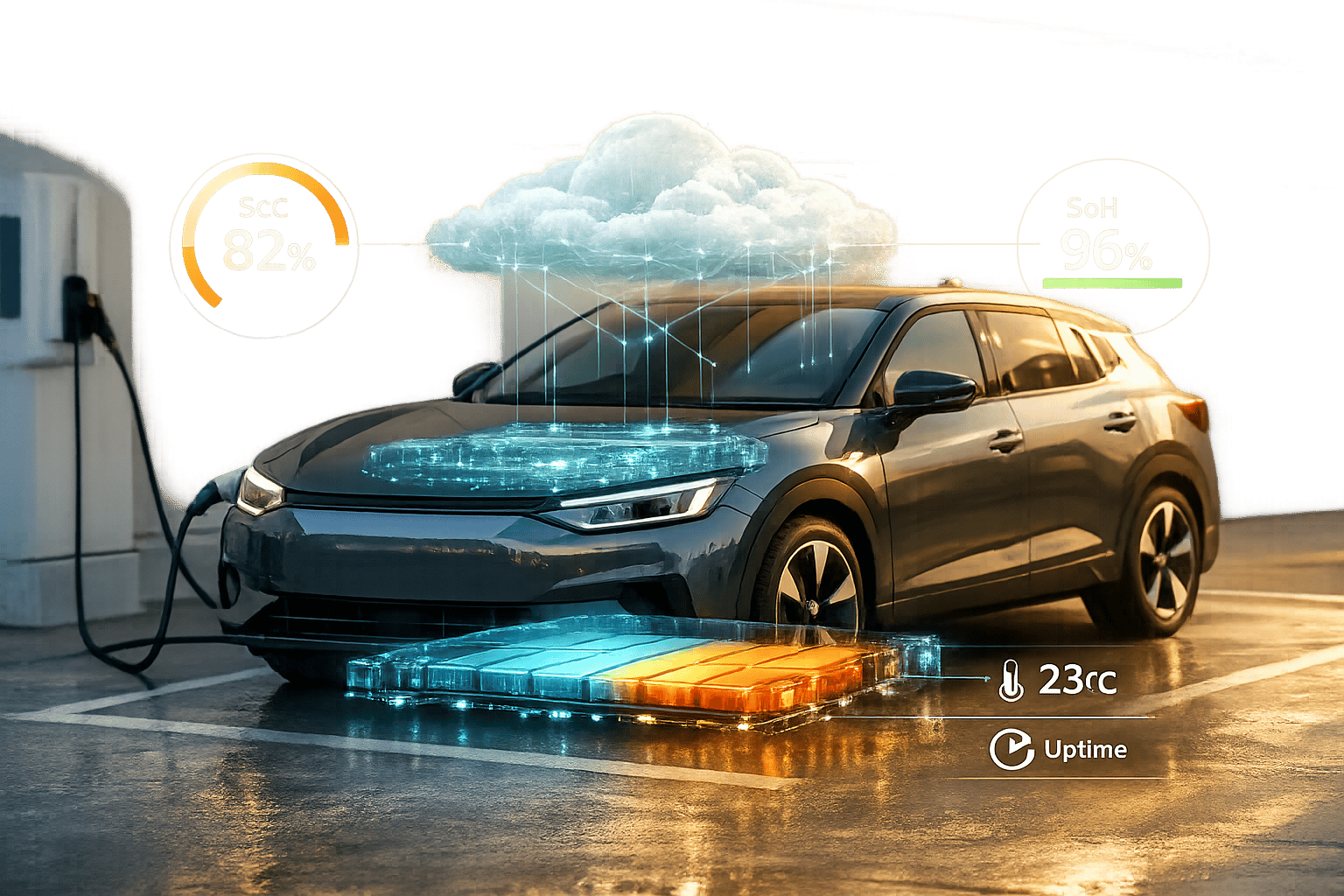
Telematics systems are transforming how electric vehicle (EV) batteries are monitored and managed, offering fleet managers a clearer understanding of battery health, performance, and costs. By creating a "digital twin" of the battery in the cloud, telematics provides real-time data on key metrics like State of Charge (SoC), State of Health (SoH), energy efficiency, and thermal conditions. This helps reduce downtime, extend battery life, and lower operational costs.
Key Takeaways:
- Cost Savings: Smart charging can cut electricity costs by up to 60%, and predictive maintenance reduces unplanned downtime by 30%.
- Battery Health Insights: Metrics like SoC and SoH help track energy levels and battery ageing, ensuring better long-term performance.
- Driving Behaviour: Data on acceleration, braking, and speed identifies habits that impact battery wear.
- Charging Optimisation: Scheduling charges during off-peak hours and avoiding extreme SoC levels improves efficiency and battery lifespan.
- Predictive Maintenance: Early warnings for faults reduce repair costs by 20% and prevent breakdowns.
Telematics bridges the gap between raw data and actionable insights, helping fleets improve efficiency and protect their investment. For UK fleet managers, platforms like GRS Fleet Telematics offer affordable, real-time tracking solutions starting at £7.99 per month, enabling smarter decisions and better battery management.
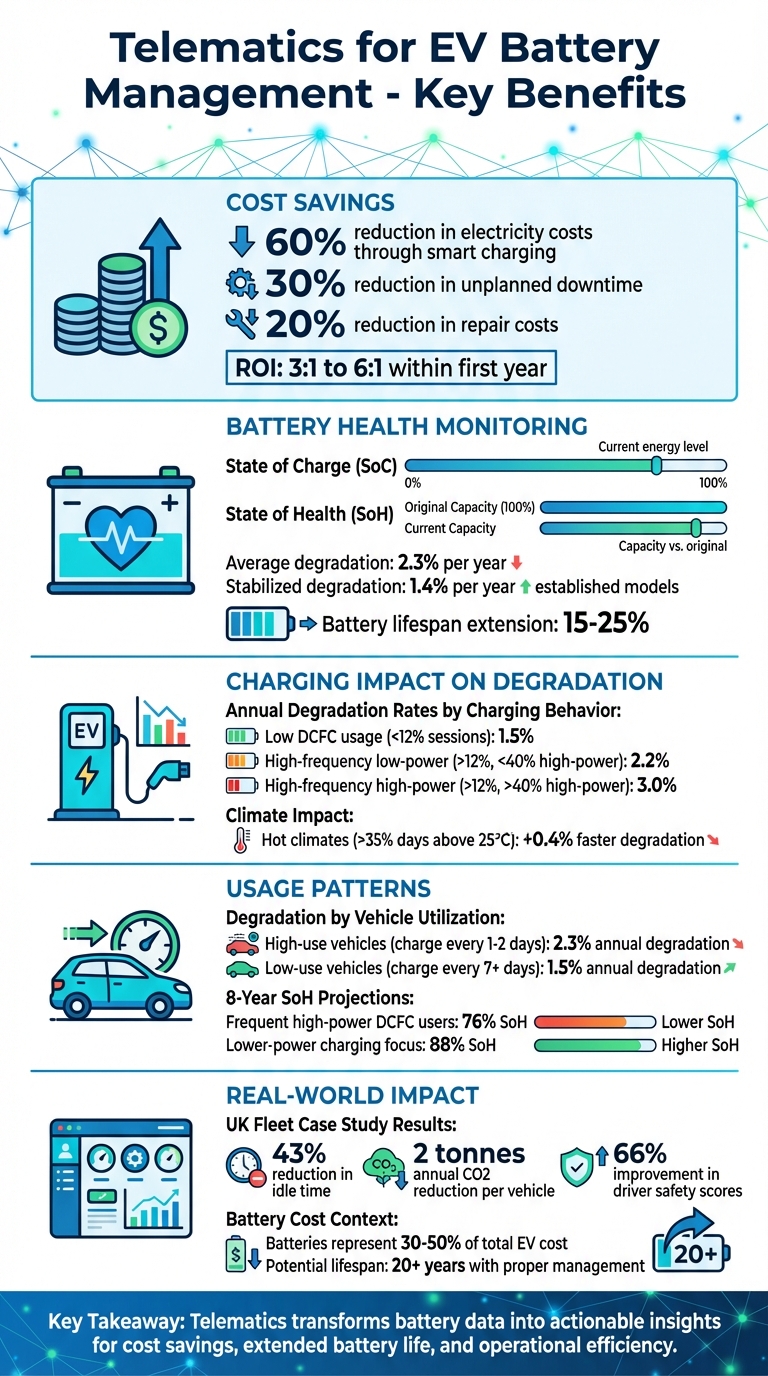
EV Battery Telematics: Key Benefits and Cost Savings for Fleet Management
Exploring Telematics - a data driven approach to EV fleets
How Telematics Systems Track EV Battery Performance
The Battery Management System (BMS) serves as the "brain" of an EV battery, constantly monitoring key factors like voltage, current, and temperature to ensure everything runs smoothly. While the BMS handles the basics, telematics takes it a step further by pulling live data from the CAN bus - a standard communication setup used in automotive electronics and EV batteries - and sending it to the cloud for analysis. This allows telematics systems to not only retrieve standardised data but, in newer vehicles, even request specific details using advanced diagnostic tools.
Once the data is collected, it’s transmitted to cloud servers via WiFi or 4G/LTE networks. Some systems can capture data at lightning-fast intervals, as quick as every millisecond, though most operate closer to every 500 milliseconds. This constant flow of information creates a "digital twin" of the battery, offering a complete historical record for analysis and remote monitoring. The result? Better insights for driving habits and maintenance decisions, especially for managing fleets.
Real-Time Data Collection
Telematics systems are always on the job, collecting crucial metrics like State of Charge (SoC), State of Health (SoH), voltage imbalances, current flow, and temperature changes from various sensors. This allows for early detection of potential issues, reducing downtime. On top of that, the data highlights energy efficiency trends, helping to pinpoint which vehicles - or drivers - are performing at their best. All this real-time information is sent to the cloud for detailed analysis, ensuring no detail is overlooked.
Cloud-Based Monitoring Systems
With real-time data in the cloud, monitoring becomes centralised and far more effective. Fleet managers can view the battery status of every vehicle from a single dashboard, giving them a clear overview without needing to inspect each vehicle individually. This centralisation also enables predictive analytics, as historical data collected over time can reveal patterns of battery wear and help predict when maintenance will be needed.
Some systems are now equipped with AI tools, making it even easier to manage fleets. For instance, managers can ask natural language questions like, "Which vehicles have the lowest State of Health?" and get instant answers. Alerts are also sent when any battery parameter falls out of the safe range, allowing managers to adjust charging schedules or prioritise maintenance remotely. This means they can make informed decisions without being tied to a desk or physically inspecting vehicles.
Key Battery Health Metrics Tracked by Telematics
Telematics data plays a key role in helping fleets make smarter decisions. Two critical metrics stand out: State of Charge (SoC) and State of Health (SoH). Together, they provide a comprehensive view of battery performance. SoC shows the current energy available, while SoH measures the battery's capacity compared to when it was brand new. Beyond these, telematics systems also track charging habits, temperature changes, and energy usage - factors that directly impact battery life and operating costs. These metrics are essential for understanding battery performance over time.
State of Charge (SoC) and State of Health (SoH)
SoC measures a battery's current energy level as a percentage (0–100%). However, a battery showing 100% SoC might not hold the same energy it did when new. This is where State of Health (SoH) becomes vital.
SoH compares the battery's current capacity to its original value. For instance, a 60 kWh battery with 90% SoH effectively functions as a 54 kWh battery. This metric is a primary indicator of battery ageing, with many fleet operators considering a battery's useful life to end when SoH falls to about 70%.
In January 2026, Geotab released a study analysing real-world battery health data from over 22,700 electric vehicles across 21 makes and models. Led by Charlotte Argue, Senior Manager of Sustainable Mobility, the research revealed an average annual degradation rate of 2.3%. Interestingly, eight out of 11 established models stabilised at an average degradation rate of just 1.4% per year.
Understanding the difference between SoC and SoH is crucial for daily operations. SoC helps with tasks like charging schedules and route planning, while SoH determines how far an ageing battery can actually go. Telematics also flags extreme charge levels - vehicles spending over 80% of their time at very high or very low SoC levels degrade faster.
Battery Degradation Tracking
Telematics systems track long-term capacity loss by monitoring energy input during charging and output during driving. This continuous monitoring highlights degradation patterns influenced by battery age and charging habits.
| DCFC Usage Group | Usage Criteria | High Power Sessions (>100 kW) | Avg. Annual Degradation |
|---|---|---|---|
| Low Frequency | <12% of sessions | N/A | 1.5% |
| High-Frequency Low-Power | >12% of sessions | <40% of DCFC sessions | 2.2% |
| High-Frequency High-Power | >12% of sessions | >40% of DCFC sessions | 3.0% |
Source: Geotab 2025/2026 Analysis
The table above illustrates how charging behaviour affects battery life. Vehicles frequently using high-power DC fast charging (DCFC) are projected to have around 76% SoH after eight years. In contrast, those relying more on lower-power charging are expected to retain about 88% SoH.
"Using the lowest charging power that still meets operational needs can make a measurable difference to long-term battery health without limiting vehicle availability."
– Charlotte Argue
Telematics systems also monitor thermal management, as extreme heat accelerates chemical activity and stresses the battery. For example, vehicles operating in hot climates - where over 35% of days exceed 25°C - experience an annual degradation rate roughly 0.4% faster than those in milder conditions. This insight helps fleet managers take preventive measures, like parking vehicles in shaded or indoor spaces during heatwaves, to protect their investment.
With batteries accounting for 30% to 50% of an electric vehicle's total cost, understanding degradation patterns is key to managing resale value and planning replacements. A vehicle with 90% SoH typically commands a far higher resale price than one at 70%. By connecting battery metrics to operational decisions, telematics systems empower fleets to balance performance with cost management. These insights lay the groundwork for optimised maintenance and charging strategies, which are covered in the next sections.
How Driving Behaviour Affects Battery Longevity
Driving habits play a significant role in determining how long a battery lasts, complementing insights into battery degradation. Telematics systems are key here - they track energy throughput, which measures how much energy flows through battery cells during charging cycles. This data helps evaluate how usage patterns impact battery health. For instance, frequent full charge cycles increase energy throughput, which can speed up battery wear. However, the trade-off is often worth it when balanced against the productivity benefits.
Geotab’s 2025/2026 analysis sheds light on this. High-use vehicles, which undergo a full charge cycle every 1–2 days, show an annual degradation rate of 2.3%, compared to 1.5% for low-use vehicles that charge every 7+ days. Charlotte Argue, Senior Manager of Sustainable Mobility at Geotab, comments:
"The acceleration in degradation from high utilisation is a manageable cost (an approximate 0.8% penalty) when weighed against the significant revenue and productivity gains from maximising vehicle deployment".
Analysing Driver Behaviour Patterns
Driving patterns also have a big impact on battery stress, and telematics can monitor these behaviours closely. For example, harsh acceleration - where drivers press the throttle aggressively - puts extra strain on the battery and increases energy usage. In contrast, gentle acceleration reduces chemical stress on the battery cells. Similarly, abrupt braking skips the opportunity for regenerative recovery, while smooth deceleration allows the motor to act as a generator, feeding energy back into the battery.
Speed management is another critical factor. Driving at excessive speeds increases wind resistance and wastes energy, whereas maintaining steady, moderate speeds helps conserve battery health. Telematics systems even track metrics like the "coast fraction", which measures how much speed is lost without using the brake. A study on electric trucks revealed that eco-drivers lost 36% of their speed through coasting, compared to just 9% for aggressive drivers. This anticipatory driving style not only maximises regenerative braking but also limits unnecessary energy use.
These findings highlight the importance of understanding driving habits to improve efficiency and extend battery life.
Driver Feedback and Training
Modern telematics systems go a step further by providing real-time feedback to drivers. In-cab alerts notify drivers of aggressive behaviours, giving them the chance to adjust immediately. Fleet operators can use this data to rank drivers based on safety and efficiency, identifying those who might benefit from additional training. For example, in 2025, a UK fleet operator introduced telematics across its vehicles, equipping them with onboard computers and screens to deliver instant feedback. The results were impressive: idle time dropped by 43%, CO2 emissions fell by two tonnes annually, and driver safety scores improved by 66%.
Training programmes built around telematics data can also be highly effective. By creating "eco-scores" or league tables, operators gamify performance, motivating drivers to adopt sustainable habits. Instead of rewarding speed through "task and finish" incentives, these programmes encourage practices like optimising regenerative braking and anticipating traffic flow. These adjustments not only reduce energy consumption but also minimise battery wear over time.
Charging Optimisation Through Telematics
Telematics systems offer fleet managers the tools to schedule vehicle charging in ways that are both cost-efficient and operationally sound. By monitoring State of Charge (SoC), energy consumption, and vehicle location in real time, managers can plan charging during downtime rather than relying on unplanned top-ups. This ensures vehicles are ready for their next shift without unnecessary energy use or expense. Let’s explore how smart scheduling and dynamic load balancing make this possible.
Smart Charging Schedules
Energy Management Systems (EMS) leverage telematics data to automate charging during low-cost, off-peak electricity windows. In the UK, wholesale electricity prices fluctuate every 30 minutes. By identifying "dwell time" opportunities - like overnight parking or mid-shift breaks - telematics aligns charging needs with these cheaper periods. For vehicles parked for extended periods, such as eight hours or more, Level 2 AC chargers are recommended. These chargers are more affordable to install and less taxing on battery health compared to DC fast chargers, which are better suited for quick charging during shorter stops or en-route.
Dynamic load balancing is another critical tool. It monitors the total power usage at a site and adjusts charging levels to stay within the Maximum Import Capacity (MIC). This prevents grid overload and avoids costly peak demand charges.
"Using the lowest charging power that still meets operational needs can make a measurable difference to long-term battery health without limiting vehicle availability".
– Charlotte Argue, Senior Manager of Sustainable Mobility at Geotab
By using optimised schedules, fleets not only save on energy costs but also extend the lifespan of their batteries.
Reducing Energy Costs
Effective charging strategies can significantly lower overall fleet expenses. For example, public charging stations can cost three times more than charging at home. Fleet managers can cut energy costs by 75% by focusing on depot-based or home charging for drivers. Telematics plays a role here by tracking metrics like kWh per mile, helping to pinpoint expensive routes or driving habits that consume more energy. Additionally, charge-completion alerts can notify staff when a vehicle is fully charged, allowing chargers to be used more efficiently by swapping to the next vehicle.
Maintaining batteries within the optimal SoC range - between 20% and 80% - is another way to minimise costs and extend battery life. Charging beyond this range accelerates battery wear, while staying within it reduces stress on the battery. By automating these limits and scheduling charges during off-peak hours, fleets can lower operational costs while preserving battery health.
Predictive Maintenance and Fault Detection
Predictive maintenance takes real-time monitoring a step further by using collected data to anticipate potential issues before they occur. By tracking key metrics like voltage, current, and temperature at both the pack and cell levels, telematics systems can detect patterns that suggest a fault might be on the horizon. Some advanced platforms even create a digital twin for each battery in the cloud, using historical data to predict battery heat and State of Charge with over 97% accuracy.
This shift from reactive to proactive maintenance is a game-changer. Instead of waiting for a battery to fail, fleet managers receive alerts about degradation trends and anomalies. The system can pinpoint issues down to individual cells, allowing technicians to replace only the faulty components rather than an entire battery pack. This targeted approach significantly reduces maintenance costs.
With these predictive insights, fleet managers gain access to actionable alerts that can prevent small issues from becoming major problems.
Early Warning Alerts
Telematics systems are designed to continuously monitor critical battery parameters and flag anomalies as soon as they arise. Alerts are triggered by events like temperature spikes, voltage imbalances between cells, or sudden drops in usable capacity. For example, monitoring cell voltage instability can help identify wear in older battery packs before it leads to a failure. Fleet managers can also customise alerts for specific scenarios, such as prolonged exposure to extreme charge levels or reduced effectiveness in thermal management systems.
"By implementing predictive maintenance practices and analysing battery performance trends, early warning signs of potential failures can be identified and addressed promptly."
– Team ChargePoint
These alerts aren’t limited to the primary traction battery. They also cover auxiliary systems, such as the 12-volt battery that powers essential functions like lights and infotainment. A failure here can leave a vehicle unable to start, causing unexpected downtime. Telematics systems track this smaller battery alongside the main pack, helping prevent "dead-on-arrival" situations.
By catching these issues early, fleet managers can plan service more effectively and keep vehicles on the road.
Minimising Vehicle Downtime
Predictive maintenance doesn’t just identify problems - it actively reduces downtime by 30% and cuts repair costs by 20%. Instead of relying on fixed maintenance schedules, fleet managers can use real-time data to service vehicles exactly when needed. This precise approach ensures that fleets stay operational and efficient. For instance, by monitoring degradation rates - typically 1.8% per year but potentially as high as 3.0% with frequent high-power DC fast charging - managers can schedule battery replacements at the optimal time.
Additionally, telematics data provides a transparent record stored in the cloud, which can be critical for warranty claims. This documentation helps distinguish between normal wear and misuse, making it easier to determine whether a failure stems from a manufacturing defect or operational stress. For vehicles nearing the end of their first life, this same data can estimate the remaining State of Health, helping evaluate the battery’s potential for second-life applications like energy storage.
Implementing Telematics Across Your Fleet
Rolling out telematics across your fleet involves four key phases: Assessment (2–4 weeks), where you evaluate your fleet and define its needs; Platform Selection (4–6 weeks), focusing on compatibility and analytics features; Deployment (4–8 weeks), which includes installing hardware and integrating data; and Optimisation (ongoing), where you monitor performance indicators and fine-tune processes like charging schedules. This structured approach ensures every vehicle is properly equipped, and data seamlessly integrates into your management systems. These steps align telematics capabilities with earlier fleet management priorities.
Start by establishing baseline metrics, such as energy efficiency, daily range requirements, and initial State of Health (SoH). These benchmarks help measure telematics-driven improvements and provide evidence for the investment. Most fleets can be fully onboarded within about 10 days, with organisations often achieving a return on investment between 3:1 and 6:1 within the first year.
Integration with Existing Fleet Systems
Modern telematics platforms are designed to integrate with your existing systems through APIs, enabling data synchronisation with fleet management tools, CRMs, and automated workflows. Hardware options are flexible, ranging from hard-wired systems to OBD-II port devices or mobile applications. For fleets incorporating electric vehicles, mixed-fleet management platforms let you oversee both internal combustion and electric vehicles from one interface.
When selecting a platform, ensure it supports a broad range of EV models - ideally more than 300 - since EVs often lack a universal data standard. Additionally, look for compatibility with charging infrastructure via Open Charge Point Protocol (OCPP) and direct APIs, which allow you to coordinate vehicle deployment with charging station availability. This level of integration provides detailed battery insights that go beyond what standard Battery Management Systems offer.
Once the system is in place, the aggregated data enables detailed performance reporting, helping to identify areas for operational improvement.
Performance Reporting and Analysis
Telematics systems generate automated reports covering everything from maintenance schedules to operational compliance and energy consumption (tracked in kWh) - data that would otherwise be challenging to collect manually. These reports should focus on key metrics to support decisions related to battery health and operational efficiency.
For deeper insights, raw fleet usage data can be downloaded for customised analysis, aligning with your decarbonisation objectives. Role-based alerts can also be set up for critical issues, such as "Low State of Charge" during shifts or "EV Not Charging" when plugged in. These insights play a direct role in proactive battery maintenance and extending battery life, as previously discussed. For example, in 2023, King County Metro used ChargePoint telematics software to monitor the performance of their electric buses in real-time, tracking efficiency and battery health to scale their eBus operations more effectively.
GRS Fleet Telematics: Advanced Tracking for UK Fleets
GRS Fleet Telematics takes fleet management for electric vehicles to the next level by combining real-time tracking with advanced battery monitoring. For UK fleet managers, this platform offers real-time visibility and battery insights, helping protect valuable assets while improving operational efficiency. Unlike traditional Battery Management Systems that often rely on offline data, GRS Fleet Telematics provides continuous monitoring, helping to safeguard your investment and extend the lifespan of your EV batteries.
The platform employs dual-tracker technology for added reliability. This means even if one tracker fails, data flow remains uninterrupted - contributing to an impressive 91% vehicle recovery rate. And with pricing starting at just £7.99 per month, it offers a cost-effective way to access advanced battery monitoring without the need for a large upfront expense.
By keeping tabs on critical battery metrics like temperature, voltage, and current, fleet managers can identify issues early on. This not only enables proactive, cell-level maintenance but also helps distinguish between regular wear and misuse - valuable information for warranty claims. The result? Reduced resource expenditure and less vehicle downtime.
Comprehensive battery health reports also make it easier to plan for future replacements and manage budgets effectively. For dispatch teams, real-time updates on State of Charge and charging status help minimise unnecessary mileage and improve energy efficiency. These features align perfectly with strategies to optimise charging and enhance driver behaviour, as discussed earlier. GRS Fleet Telematics integrates smoothly with broader telematics systems, ensuring better battery performance and less downtime for your fleet.
Conclusion
Telematics has reshaped EV fleet management, bridging the gap between data and day-to-day decisions. It enables fleet managers to turn real-time battery insights into actionable steps that enhance operations. By tracking metrics like State of Charge, State of Health, and battery temperature, managers can extend battery life by 15–25% and cut unplanned downtime by up to 30%. Considering that batteries account for 30–50% of an EV’s total cost, these insights translate into substantial savings and better asset protection.
The cost savings don’t stop at maintenance. Smart charging strategies can lower electricity expenses by as much as 60%, while predictive maintenance reduces repair costs by 20%. With these benefits, fleet telematics systems typically deliver a return on investment of 3:1 to 6:1 within the first year.
"EV batteries could last 20 years or more if they degrade at an average rate of 1.8% per year. The vast majority of batteries will outlast the usable life of the vehicle." - David Savage, Vice President for the UK and Ireland, Geotab
Telematics also enhances operational readiness. Real-time charging status ensures vehicles are prepared for their routes, while insights into driver behaviour minimise energy use and reduce battery wear. Additionally, cloud-stored battery data supports warranty claims and helps maximise resale value.
For UK fleet managers transitioning to electric vehicles, telematics isn’t just about tracking - it’s the intelligence layer that makes EV adoption practical and profitable. By shifting battery management from reactive to proactive, telematics safeguards investments and boosts efficiency across operations. Discover how GRS Fleet Telematics can revolutionise battery management with cutting-edge, real-time tracking solutions.
FAQs
What data do I need to track EV battery health properly?
To keep tabs on EV battery health, focus on monitoring critical metrics like temperature, voltage, current, and state of charge (SOC). These indicators can reveal potential issues and safety concerns early. Another important measure is the state of health (SOH), which shows how much capacity the battery has left compared to its original state.
Using advanced telematics systems, this data can be analysed in real time, making it possible to predict maintenance needs and prolong the battery's lifespan. Regularly testing the vehicle's range and keeping an eye on charging habits are also effective ways to maintain top-notch performance.
How can telematics reduce EV charging costs in the UK?
Telematics helps lower EV charging costs by fine-tuning charging schedules. For instance, it can prioritise overnight charging when electricity rates are typically cheaper. By monitoring battery levels and usage patterns, fleet managers can plan charging during off-peak hours or even switch to cost-effective home charging options. Plus, telematics offers real-time insights into energy consumption, promoting smarter charging habits and driving savings through better energy management.
Will installing telematics affect my vehicle warranty?
Installing telematics usually won't void your vehicle's warranty, provided it's done correctly by a trusted provider. Manufacturers are obligated to honour warranties unless the telematics device itself is proven to cause a fault. To avoid complications, ensure the installation is carried out properly.