Scaling Drone Training for Large Logistics Fleets
How hybrid classroom and simulation training, combined with telematics, scale drone operator programmes—cutting costs, improving compliance and flight precision.
Drone delivery is transforming logistics, but scaling operations requires better training solutions. With over 1.2 million drone deliveries projected in the U.S. for 2024 - a 340% jump from 2023 - logistics firms face challenges in training operators for complex fleet management and evolving regulations. Traditional classroom methods are reliable for regulatory knowledge but struggle with cost and scalability. Simulation-based training offers flexibility, reduced costs, and precise skill-building, making it ideal for large fleets. Combining both approaches ensures compliance, safety, and efficiency.
Key Points:
- Classroom Training: Effective for regulations and theory but limited by instructor availability, fixed schedules, and high costs (£2,200–£2,600 per person).
- Simulation Training: Scalable, cost-efficient, and allows risk-free practice. Studies show it improves flight precision by 32%.
- Hybrid Model: Classroom sessions for theory, simulators for skill-building, and telematics for performance tracking.
Quick Comparison:
| Metric | Classroom Training | Simulation Training |
|---|---|---|
| Scalability | Limited by venues and instructors | Accessible remotely for many users |
| Cost | Higher (£2,200–£2,600 per person) | Lower; avoids fuel and crash costs |
| Training Time | Fixed schedules, 3–5 days | Flexible, 24/7 access |
| Compliance | Ideal for regulatory exams | Approved for 63% of advanced flight hours |
Using a hybrid model ensures operators are well-prepared for the growing demands of drone logistics.
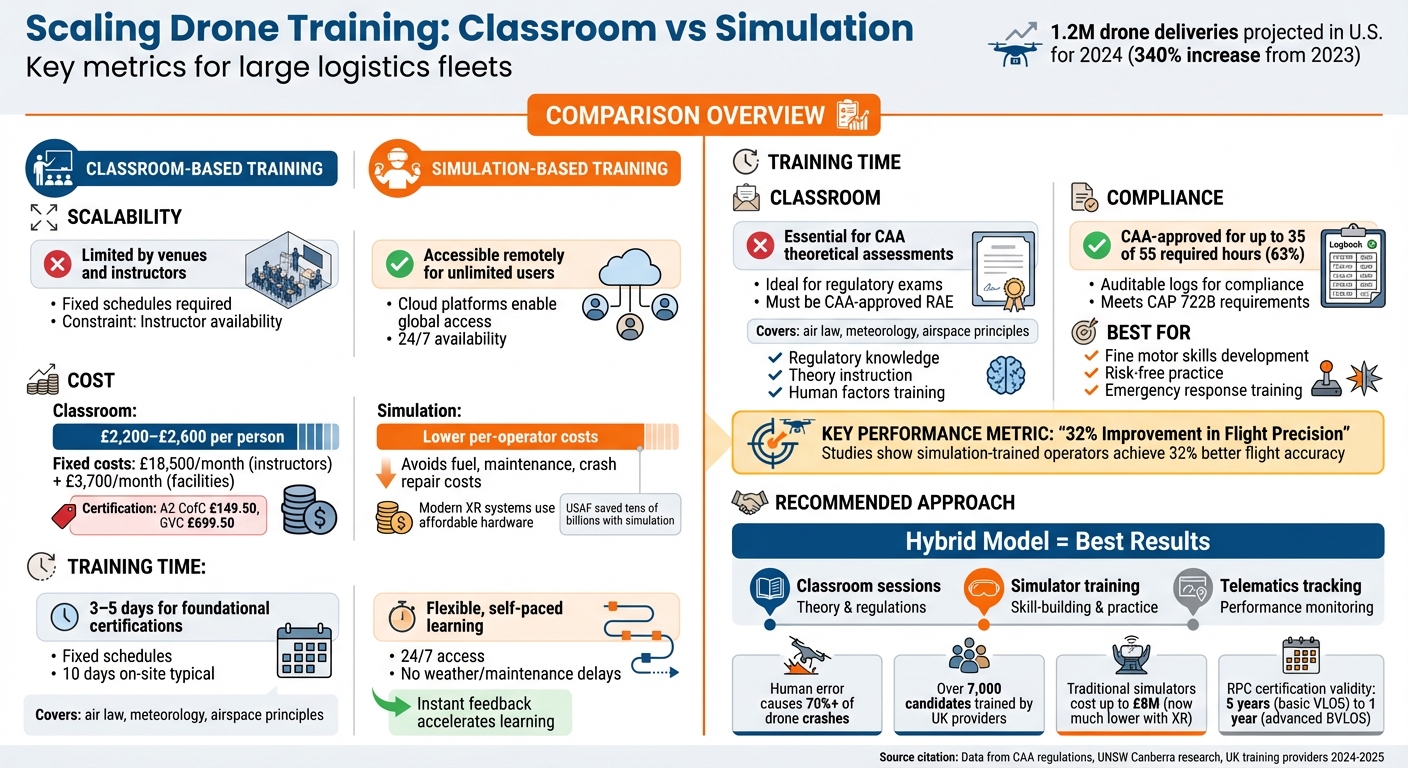
Classroom vs Simulation Drone Training: Cost, Scalability & Compliance Comparison
Ever wondered how drone delivery pilots get trained? 🚁
1. Classroom-Based Training Methods
Classroom-based training has long been the go-to method for equipping drone operators with the regulatory knowledge and flight theory needed before they take to the skies. For logistics companies expanding their drone fleets, this traditional approach provides a standardised framework, ensuring every operator receives consistent instruction. This is especially crucial when managing operations across multiple locations. Take Heliguy, for instance - this UK-based training provider has conducted over 330 closed courses nationwide, training more than 7,000 candidates in person. While this method establishes a solid foundation for practical skills, it does come with limitations that newer approaches aim to address.
One major challenge is scalability. As fleet sizes grow, the logistics of organising in-person training sessions across various sites can become overwhelming. This method demands physical venues, scheduled classes, and dedicated instructors, which all add layers of complexity when trying to train dozens - or even hundreds - of operators simultaneously.
Scalability
Classroom training is highly effective for safety-critical instruction but is constrained by the availability of qualified instructors, which limits its scalability. As the German Aerospace Center points out, "The more formalised a UAV organisation is structured, the more specific a suitable training concept can be elaborated".
To address these challenges, many organisations now adopt hybrid models. These combine online Learning Management Systems (LMS) for 30% to 50% of the theoretical material with in-person sessions focused on practical skills. This approach reduces the need for physical venues and instructor hours while still preserving the benefits of face-to-face learning for complex topics.
Another effective strategy is the "train-the-trainer" model. Here, companies send select personnel to advanced external courses, enabling them to return as in-house instructors. This method supports ongoing training needs more sustainably. According to the National Academies of Sciences, Engineering, and Medicine, "investing in an in-house training programme... can be more cost-effective than relying on paying external trainers each time training is needed".
Cost Efficiency
The cost of classroom training can be a significant factor. Fixed expenses, such as instructor salaries (around £18,500 per month) and facility leases (£3,700 per month), remain constant regardless of the number of operators trained. This means per-operator costs decrease only when classes are filled to capacity.
For UK logistics firms, certification costs vary depending on the level required. For example, an A2 Certificate of Competency costs £149.50, while the more comprehensive General Visual Line of Sight Certificate (GVC) is priced at £699.50. Companies can save by opting for combined courses, such as the A2 CofC & GVC package, which costs £749.50. This bundled option offers better value for organisations training multiple operators.
Training Time
The duration of classroom-based courses also impacts fleet operations. Foundational certifications typically require 3 to 5 days of training. While this concentrated timeframe is ideal for quickly certifying operators, it can disrupt schedules if not carefully managed.
Hybrid models offer greater flexibility. By delivering theoretical content through self-paced online modules, companies can reduce the time operators spend in the classroom. This allows in-person sessions to focus exclusively on practical skills and assessments. Operators can complete the theoretical portion at their convenience, making it easier to fit training around their existing responsibilities.
Compliance Readiness
Classroom training is particularly effective for meeting the structured requirements of UK Civil Aviation Authority (CAA) certification. To be valid, all theoretical instruction must be delivered by a CAA-approved Recognised Assessment Entity (RAE). The curriculum includes essential topics such as air law, airspace operation principles, meteorology, and technical knowledge of unmanned aircraft systems (UAS) - all critical for legal operations in the Specific Category.
For logistics firms planning Beyond Visual Line of Sight (BVLOS) operations, classroom training must align with the UK Specific Operational Risk Assessment (SORA) framework. The CAA's new tiered Remote Pilot Certificate (RPC) system adds another layer of complexity. Certification validity ranges from 5 years for basic Visual Line of Sight (VLOS) operations to just 1 year for the advanced RPC-L4 qualification, which covers BVLOS in any environment.
Additionally, classroom settings are ideal for teaching human factors such as fatigue management, stress response, and situational awareness - skills that are difficult to convey through self-study. These "soft skills" become increasingly important as drone operations expand into densely populated urban areas, where the stakes of human error are much higher. This underscores why classroom-based training remains a critical starting point before exploring alternatives like simulation-based methods.
2. Simulation-Based Training Methods
Simulation-based training provides drone operators with the flexibility to train remotely using cloud platforms and XR headsets, removing the need for physical venues and rigid schedules. Unlike traditional classroom setups, simulation allows for scalable, real-time feedback and risk-free practice. This is especially useful for dispersed fleets across the UK, as it enables simultaneous training without requiring centralised facilities. Once limited by high costs - traditional simulators could reach up to £8 million - modern XR systems now utilise affordable, off-the-shelf hardware to make this technology more accessible. These advancements complement in-person training by addressing challenges like scalability and risk management.
Human error accounts for over 70% of drone crashes, making it essential for operators to develop fine motor skills and master procedural tasks before flying real drones. Alexander Somerville of UNSW Canberra highlights this need:
"The operation of drones/RPAS requires a distinct skill set, where fine motor control plays a significant role in ensuring precise control inputs".
The ability to practise without real-world risks significantly enhances flight accuracy. Studies show that simulator-trained participants achieved a 32% improvement in flight precision, as measured by reduced mean final displacement during actual manoeuvres.
Scalability
AI-powered platforms are transforming the scalability of training programmes. By generating realistic scenarios from incident logs and natural language reports, these systems reduce the time needed to design training exercises and personalise them for individual learners. Tools like "VARPLE" offer immediate feedback - both qualitative and quantitative - minimising the reliance on one-on-one instruction. Advanced simulators also feature Instructor Operator Stations, enabling trainers to remotely monitor metrics like eye-tracking, gaze patterns, and control inputs in real time.
Cost Efficiency
The United States Air Force's 2019 Pilot Training Next initiative illustrates the financial advantages of simulation. A cost–benefit analysis showed that replacing a portion of actual flight hours with XR simulation could save the USAF tens of billions of dollars over a decade. For UK logistics firms, similar savings are achievable. Simulators cut fuel expenses, reduce wear and tear on equipment, and eliminate the risk of costly accidents during training. These economic benefits not only improve operational efficiency but also align seamlessly with traditional classroom methods. The growing adoption of commodity XR headsets and web-based simulators has further reduced the entry cost for large-scale implementation.
Training Time
Simulation addresses common delays in conventional training, such as weather disruptions, aircraft maintenance, and instructor availability. Operators can train repetitively at their own pace, with instant feedback speeding up the learning process. Recognising this potential, the UK Civil Aviation Authority updated CAP 722B in March 2025 to include specific requirements for using Flight Simulator Training Devices (FSTD) in remote pilot training. As the CAA explains:
"This revision has been issued to introduce Entity requirements for applications in relation to the new remote pilot competence scheme... In addition, new requirements, and guidance material regarding the use of Flight Simulator Training Devices (FSTD) has been provided".
Compliance Readiness
Beyond operational benefits, modern simulators ensure regulatory compliance by offering auditable logs and consistent assessment frameworks. For UK organisations, CAP 722B outlines the administrative steps for operating as a Recognised Assessment Entity using simulators. Additionally, CAP 1933 provides guidance on implementing web-based training, distance learning, and Virtual Reality for aviation maintenance and engineering. The focus should be on platforms that prioritise repeatability, measurable results, and integration into real-world workflows, rather than just visual fidelity, as highlighted by the Upscend Team.
Advantages and Disadvantages
When comparing classroom and simulation-based training for drone operations, both methods bring distinct strengths and challenges to the table. Classroom training is particularly effective for delivering theoretical knowledge and ensuring compliance with regulations. This is crucial for passing CAA assessments on topics like air law, meteorology, and airspace principles. However, classroom training comes with limitations, such as fixed schedules and the need for physical attendance at specific venues. These constraints highlight the trade-off between scalability and the delivery of foundational instruction.
Simulation-based training, on the other hand, offers solutions to many of these limitations. It allows for unlimited remote access, avoids weather-related delays, and significantly reduces costs associated with training crashes. Studies have shown that simulation training can lead to a 32% improvement in flight precision. Alexander Somerville, the lead researcher of one such study, explained:
"Simulation-based training for such skills is supported by the cognitive theory of skill acquisition, which hypothesizes that the development of fine motor skills benefits from repetitive practice and immediate feedback".
The UK CAA has recognised the effectiveness of simulation training, now allowing up to 35 of the required 55 hours for RPC-A certification to be completed using approved Flight Simulator Training Devices - covering 63% of the total flight hours. This regulatory update underscores simulation's capability to develop fine motor skills while maintaining compliance. However, classroom training remains essential for building foundational knowledge, suggesting that a hybrid approach offers the best of both worlds.
| Metric | Classroom-Based Training | Simulation-Based Training |
|---|---|---|
| Scalability | Low; constrained by venue size and instructor ratios | High; software accessible globally to unlimited users |
| Cost Efficiency | Lower; high per-student costs (£2,200–£2,600 per person) | Higher; avoids fuel, maintenance, and crash repair costs |
| Training Time | Fixed; typically requires 10 days on-site | Flexible; available 24/7 for faster learning |
| Compliance Readiness | Essential for theoretical CAA assessments | Approved for up to 63% of advanced flight hours |
Using Telematics to Support Training and Fleet Management
Telematics systems bridge the gap between simulation training and real-world operations by providing precise telemetry that replicates actual flight conditions. This realistic approach allows pilots to hone their skills on systems that closely reflect the environments they’ll face during real delivery missions. By combining this telemetry with cloud-based flight log analytics, detailed post-training reviews become possible. These reviews identify specific performance trends, such as difficulties with nose-in orientations, helping to fine-tune training outcomes while integrating seamlessly with fleet management systems.
Mission planning tools like QGroundControl and MissionPlanner are also transforming how operators prepare for missions. These tools allow pilots to plan, test, and refine delivery routes within realistic 3D environments before taking to the field. Validated missions can then be directly uploaded as flight paths from the simulation platform, ensuring efficiency and accuracy.
Geofencing simulations and augmented reality (AR) telematics further expand training possibilities by creating virtual obstacle courses within real-world settings. For instance, in February 2021, António Pereira and his team at the Polytechnic Institute of Leiria developed a Web AR prototype for UAV training. Using a Raspberry Pi 3, a camera, and markers, the system enabled pilots to practise manoeuvres in real environments augmented with virtual obstacles, significantly reducing crash risks. As the research team noted:
"The use of AR per se allows for the creation of different virtual training activities based on real environments and of digital obstacles which make it impossible to crash the UAVs".
Telematics platforms like GRS Fleet Telematics highlight how real-time tracking, route optimisation, and performance analytics can enhance drone operations, just as they do for van fleets. While GRS’s van tracking system offers features like geofencing, speed monitoring, and fuel efficiency tracking from £7.99 per month, the underlying principles - centralised cloud platforms, live data streaming, and automated performance metrics - are equally valuable for scaling drone training programmes. Fleet managers can use these tools to monitor pilot performance, optimise delivery routes, and ensure operational compliance across diverse locations.
Cloud-based platforms play a vital role in managing large-scale operations, much like simulation and classroom training. For example, the Auterion Suite serves as a centralised operational hub, allowing managers to plan, execute, and analyse missions from a single interface. As Auterion explains:
"Simulation enables your operators and pilots to practice more often, and with less set up and risk".
Conclusion
Simulation-based training has proven to be an effective and scalable way to prepare drone operators. It significantly improves flight precision, which is crucial given that human error remains the top cause of drone crashes. The ability to practise emergency responses and complex manoeuvres in a risk-free environment greatly enhances safety.
Unlike real-world training, simulators bypass constraints such as weather conditions, daylight hours, or restricted airspace, allowing for uninterrupted, round-the-clock practice. This flexibility is especially valuable for training large groups of pilots, as theoretical lessons alone cannot develop the fine motor skills and muscle memory needed for safe drone operations. As Alexander Somerville et al. put it:
"Simulation-based training for such skills is supported by the cognitive theory of skill acquisition, which hypothesises that the development of fine motor skills benefits from repetitive practice and immediate feedback".
This adaptability also supports better fleet management when combined with telematics tools.
By integrating simulation with telematics, organisations can monitor performance trends and maintain consistent safety standards. For example, cloud-based flight log analytics allow managers to pinpoint specific skill gaps - such as difficulties with nose-in orientations - and ensure pilots stay proficient across dispersed teams. This approach turns training into an ongoing development process rather than a one-time certification. The benefits of such integration are evident in systems like GRS Fleet Telematics, which optimise fleet operations through centralised data tracking.
To maximise the impact of simulation-based training, adopting a hybrid model is key. This involves classroom instruction for regulatory knowledge, simulator sessions to build baseline proficiency, and telematics-supported real-world practice for final validation. Such a model not only boosts safety but also keeps costs in check. Platforms featuring real-time tracking and performance analytics further enhance this process, mirroring the success seen in fleet management solutions like those used by GRS Fleet Telematics.
As drones become increasingly integral to logistics operations, training methods must evolve to match the pace of fleet expansion. Simulation-based training, reinforced by telematics infrastructure, lays the groundwork for sustainable growth while maintaining the safety standards critical to commercial success.
FAQs
What should a hybrid drone training programme include?
Hybrid drone training programmes need to strike a balance between theory and hands-on experience. On the theoretical side, trainees should gain a solid understanding of hybrid drone design, including how multicopter and fixed-wing systems are integrated, the basics of aerodynamics, and the workings of control systems.
Practical training is equally important. This should focus on mastering flight skills, handling transition modes, and understanding the specific features that set hybrid drones apart. Incorporating simulation-based exercises can enhance this learning by allowing operators to practise in a controlled environment.
Additionally, the programme should include modules on safety protocols, risk management, and maintenance procedures. These elements ensure that operators are not only skilled but also equipped to meet industry standards and handle the demands of hybrid drone operations effectively.
How do you prove simulator hours meet CAA requirements?
To ensure simulator hours meet CAA requirements, it's crucial that the training strictly adheres to the standards set by the CAA. This involves documenting the tasks completed during simulator sessions, backed by detailed training programmes and task analyses. While simulators can serve as a supplement to live flight training, they must meet clearly defined standards to be fully acknowledged. Keeping comprehensive logs of all sessions is essential to show compliance and confirm that the necessary competencies, as outlined in CAA guidelines, have been addressed.
Which telematics metrics best show pilot proficiency?
Telematics data offers a blend of qualitative and quantitative insights that can effectively gauge pilot proficiency. Key metrics include error rates, which highlight mistakes during operations, response times, reflecting how quickly pilots react to scenarios, and decision-making accuracy, which assesses the quality of choices made under pressure. These metrics are typically analysed in realistic operating conditions, providing actionable feedback to fine-tune training programmes and ensure pilots consistently meet required performance standards.