How to Save on Fleet Tracking for Large Businesses
Cut fleet costs 10–40%: choose the right tracking, standardise devices, phase rollouts, optimise subscriptions and trim data use.
Fleet tracking can save businesses money by improving fuel efficiency, reducing theft, and streamlining operations. But costs can quickly rise with hardware, installation, and subscription fees. Here’s how you can cut expenses without sacrificing performance:
- Choose the right system: Match tracking features to your fleet’s needs. Avoid paying for unnecessary extras.
- Standardise hardware: Use the same device model across your fleet to save on installation and bulk costs.
- Roll out in phases: Start with high-risk or high-mileage vehicles to see immediate savings.
- Optimise subscriptions: Tailor plans to each vehicle’s usage and negotiate discounts for larger fleets.
- Reduce data usage: Use event-based reporting and limit high-data features like live video streaming.
These strategies can cut tracking costs by 10%–40%, with savings often covering the system’s cost within months. For example, reducing fuel waste by 8% on a £1 million fuel budget saves £80,000 annually, while theft recovery tools, like dual trackers, can lower insurance premiums and prevent costly losses.
Fleet tracking isn’t just about cutting costs - it’s about making smarter investments. By focusing on the right tools and efficient usage, you’ll see real returns in both savings and improved operations.
5 Ways Smart Field Service Fleets Cut Costs & Improve Job Performance
sbb-itb-499a7f0
Choosing the Right Fleet Tracking Model
Choosing the wrong fleet tracking system can lead to unnecessary expenses. A basic system may leave gaps in visibility and security, while an overly advanced system might include features you’ll never use. Surveys across UK fleets reveal that many operators only use a small portion of the features they pay for. To save costs and maximise efficiency, selecting the right model from the start is crucial.
Matching Tracking Features to Fleet Size and Needs
Start by reviewing your fleet’s specific requirements, including vehicle types, operating hours, geographic coverage, and risk factors. Different vehicles often have different priorities. For instance, high-value vans in urban areas may need robust theft prevention tools more than driver behaviour analytics. On the other hand, long-haul vehicles running fixed routes might benefit most from fuel usage data.
A practical way to manage this is by segmenting your fleet into two or three groups based on risk and usage. For example:
- High-risk vehicles, such as security-critical vans, could be equipped with real-time monitoring and theft recovery systems.
- Lower-risk vehicles, like pool cars or short-range service vehicles, might only require basic location tracking and reporting.
This approach ensures you’re not paying for premium features where they’re unnecessary.
Once you’ve matched features to needs, it’s time to examine the costs of hardware and software.
Breaking Down Hardware and Software Costs
When it comes to hardware, you’ll need to decide between plug-in OBD devices and hardwired units, as well as whether to use single or dual trackers.
- OBD devices: These are cheaper and quicker to install but are more visible and easier to remove, making them less ideal for theft-prone vehicles.
- Hardwired units: While more expensive to install, they’re better concealed and offer greater reliability over time.
For fleets at higher risk of theft, dual-tracker systems provide an extra layer of security. These systems include a secondary device, increasing the likelihood of recovering stolen vehicles. GRS Fleet Telematics offers three hardware tiers to suit different needs:
- Essential: A single wired tracker at £35.
- Enhanced: A dual-tracker option priced at £79.
- Ultimate: Includes immobilisation capability for £119.
Software subscriptions start at £7.99 per vehicle per month, covering SIM and data costs. This makes it easier to calculate the total cost of ownership for fleets of any size.
Calculating Long-Term Return on Investment
To gauge the true value of fleet tracking, you need to consider both upfront costs and long-term savings. While higher-quality hardware may have a steeper initial price, it often pays off quickly through theft prevention and fuel savings.
Take theft recovery as an example. GRS Fleet Telematics reports a 91% recovery rate for stolen vehicles, which can significantly reduce the financial loss of vehicle theft and may even lower insurance premiums over time. Across a large fleet, even a small improvement in recovery rates can translate into substantial savings.
Fuel efficiency is another area where tracking systems shine. Properly managed telematics can reduce fuel consumption by 8–10% through better route planning and improved driver performance. By incorporating these savings into a 3–5-year cost model that includes hardware, installation, and subscriptions, you’ll have a clearer picture of the system’s long-term value.
Cutting Upfront Hardware and Installation Costs
Upfront costs for hardware, professional installation, and vehicle downtime can quickly add up. In the UK, professional hard-wired installation typically costs £50–£150 per vehicle, meaning a fleet of 200 vehicles could rack up £20,000 in labour costs alone. Managing these expenses is essential to keeping your budget in check. Here are some effective strategies to help reduce costs related to hardware, installation, and procurement.
Standardising Device Selection Across the Fleet
One of the easiest ways to lower procurement and installation expenses is to use the same tracker model across as much of the fleet as possible. Standardising devices allows you to take advantage of bulk pricing, simplifies inventory management, and makes installation more efficient. It also eliminates the risk of over-ordering parts or needing custom wiring for individual vehicles.
For large UK fleets with similar vehicles, like vans or company cars, sticking to a single tracker model is practical. If your fleet includes specialist vehicles with unique power or data needs, limiting yourself to two standard models can still deliver most of the cost benefits. The key is to avoid buying more advanced hardware than necessary for vehicles that don’t require it.
Rolling Out Devices in Phases
Phased rollouts can help spread costs over time while allowing you to identify and resolve potential issues before scaling up. Start by deploying devices to a pilot group - around 5–10% of the fleet or one depot. This initial phase helps validate your hardware choice and installation process, uncovering hidden costs like extra wiring or compatibility problems. Fixing these issues on a small scale is far more economical than addressing them across the entire fleet.
After the pilot, focus on equipping your highest-mileage or highest-risk vehicles first. These vehicles deliver quicker returns through fuel savings and theft prevention, helping to offset the costs of the broader rollout.
Utilising Bundled Deals
Bundled packages can significantly reduce upfront costs, but only if the included services meet your actual needs. For example, GRS Fleet Telematics offers free installation when paired with fleet branding services. This is a smart choice for businesses already planning to update their vehicle livery, as it combines both jobs into a single visit, cutting down on labour and vehicle downtime.
Before committing to a bundle, compare the total first-year cost to buying services separately. Be cautious of paying for features or services you won’t use, as this can negate the savings.
Reducing Ongoing Subscription and Data Costs
Once you've tackled upfront costs, it's time to focus on trimming those ongoing subscription and data expenses. While hardware is a one-time purchase, monthly fees for subscriptions and data can quickly add up. As industry experts often point out:
"The cost of the hardware is often a fraction of the total cost of ownership; the ongoing monthly service fees are where most of the spend occurs over time."
Take a fleet of 200 vehicles as an example. Saving just £2–£3 per vehicle per month adds up to an annual saving of £4,800–£7,200. Clearly, fine-tuning your subscription plan can make a big difference over time.
Picking the Right Subscription Plan
One of the easiest ways to cut monthly costs is by aligning subscription plans with the actual needs of each vehicle. For instance, not every vehicle in your fleet requires real-time tracking with updates every 10 seconds. A long-haul lorry on a predictable route may only need basic location updates, while a courier vehicle navigating a busy city centre might benefit from more van tracking solutions. By assigning simpler plans to less critical or low-risk vehicles and reserving premium options for key assets, you can significantly reduce your costs per vehicle.
For larger fleets in the UK, negotiating enterprise pricing can also help. Many providers offer discounts based on fleet size, with lower rates kicking in at thresholds like 100, 250, or 500 vehicles. Additionally, opting for longer contracts - such as 12 to 36 months - can secure better rates, though it’s wise to include a price cap (linked to the Consumer Price Index) to avoid steep increases later. If your fleet experiences seasonal peaks, check if licences can be paused for temporary or hired vehicles, rather than paying for them year-round.
Managing SIM and Data Usage
Beyond subscriptions, managing SIM and data usage is another way to save. Data usage often depends on factors like ping rates, active features, and video streaming. A device sending location updates every 10 seconds over a 10-hour shift will consume far more data than one set to report every 60–120 seconds. For vehicles where real-time updates aren’t essential, switching to event-based reporting - such as sending data only during ignition events or geofence alerts - can reduce data consumption while still providing critical information.
Video telematics is another area to review. High-definition video streaming can use hundreds of megabytes per vehicle daily. Switching to event-triggered, lower-resolution video uploads can cut data usage by 70–90%. Even better, configure uploads to occur over Wi-Fi when vehicles are parked overnight, further lowering SIM-related costs.
Cutting Out Features You Do Not Use
Many fleets end up paying for features they rarely or never use. Advanced driver behaviour scoring, multi-year data retention, complex third-party API integrations, and AI-powered analytics might sound appealing, but they only add value if they’re actively used in daily operations. Conducting an annual review of dashboard, report, and alert usage can help identify underutilised features. By consulting depot managers and transport planners and pulling usage reports, you can remove or downgrade features that don’t deliver measurable benefits. This approach alone could cut 10–20% from your monthly fees without affecting the core functionality of your fleet management system.
Using Tracking Features to Lower Running Costs
Tracking tools don't just help with subscriptions - they can also drive down everyday costs like fuel, maintenance, and even theft-related losses.
Improving Routes and Cutting Fuel Costs
Fuel expenses typically make up 20–30% of total fleet operating costs, making them an obvious target for savings. Route optimisation tools can cut down on miles driven by using real-time data to find the most efficient paths, rather than relying on drivers' instincts. By grouping jobs in the same area, you can avoid unnecessary backtracking and reduce empty runs, both of which inflate fuel costs.
Pairing route planning with eco-driving analytics - which track behaviours like harsh braking, speeding, rapid acceleration, and over-revving - provides managers with actionable data to coach drivers. This approach not only improves driving habits but also sets measurable goals that amplify fuel savings. For example, Geotab reports that telematics solutions like better routing and reduced idling can cut fuel costs by 10–25% for many fleets. Similarly, Samsara customers have reported fuel savings of 8–15% by combining route optimisation, idling reduction, and driver coaching.
Reducing Idle Time and Unauthorised Vehicle Use
Idling may seem minor, but it adds up fast. A diesel engine left running can burn 1–2 litres of fuel per hour, depending on its size. Across a large fleet, this can translate into significant costs. Setting clear policies - such as a three-minute idling limit - and reinforcing them with automated alerts can help managers enforce these rules effectively.
Geofencing addresses another issue: unauthorised vehicle use. By creating virtual boundaries around depots, customer sites, or authorised zones, and setting alerts for out-of-hours movements, fleet managers can quickly spot and handle personal or off-contract vehicle use. This not only saves fuel but also reduces wear and tear on tyres, brakes, and engines. Fleetio highlights that cutting harsh driving and unnecessary mileage can extend the lifespan of tyres and brakes by 20–40%. These measures also lay the groundwork for effective theft prevention, further protecting your fleet's bottom line.
Preventing Theft and Recovering Stolen Vehicles
Vehicle theft can have a domino effect on operating costs. A stolen van means missed jobs, emergency replacements, insurance claims, and potential penalties - all before factoring in the cost of replacing the vehicle itself.
Advanced tracking systems with features like real-time monitoring, tamper alerts, and remote immobilisation can significantly improve recovery rates. For instance, GRS Fleet Telematics offers dual-tracker solutions with a 91% recovery rate for stolen vehicles, starting at just £7.99 per vehicle per month. For high-risk vans or those carrying expensive equipment, this kind of tracking can make a noticeable difference to overall costs. Additionally, documenting your tracking measures with your insurer can lead to savings. Many UK insurers recognise Thatcham-approved trackers and may offer reduced premiums for fleets with strong theft-prevention systems in place.
Planning the Rollout and Upkeep of Fleet Tracking at Scale
Once you've optimised your subscription and upfront costs, the next step is to plan the rollout and upkeep of your fleet tracking system. A well-thought-out approach ensures smoother implementation and long-term savings.
Deploying in Phases to Manage Costs
Rolling out your system in phases can help control expenses and minimise disruptions. Start with a pilot programme that includes a mix of routes, depots, and vehicle types across different industries. This lets you test compatibility and connectivity before committing to a full-scale deployment.
Next, focus on prioritising vehicles that are likely to show early returns. These might include high-mileage vans, vehicles operating in areas with higher theft risks, or those carrying expensive equipment. Savings from reduced fuel costs and lower insurance premiums on these vehicles can help fund the later stages of the rollout.
| Rollout Approach | Upfront Cost | Disruption Risk | Learning Curve |
|---|---|---|---|
| All vehicles at once | High capital outlay | High – issues affect the entire fleet | Staff may struggle with sudden changes |
| Phased by depot or vehicle type | Spread over months | Limited to each phase | Gradual, allowing for smoother training |
To further streamline the process, align device installations with scheduled maintenance or MOT visits. Grouping installations by depot or shift can cut down on engineer travel time and call-out fees.
Once the rollout is underway, the focus shifts to ensuring the system remains reliable over time.
Keeping Devices Maintained and Software Up to Date
Routine maintenance is essential to keep your tracking devices in top condition. During servicing, include checks for power supply, GPS signal strength, and secure mounting. For hard-wired units, inspect cables, fuses, and antenna placement. Regular health checks can reduce replacement call-outs by 25–30%, saving both time and money.
On the software side, most cloud-based telematics platforms update monthly or quarterly, often outside of business hours. Assign a system administrator to review release notes, flag any significant changes, and communicate updates to the team. For major updates, testing new features with a small group of managers before a wider rollout can prevent workflow disruptions.
Training Staff to Get the Most from the System
Proper training is crucial for making the most of your fleet tracking system. Drivers should learn how to use data on location, speed, idling, and harsh braking to improve efficiency. For instance, smoother acceleration and reducing unnecessary idling can save several litres of fuel per 100 km on high-mileage routes. Driver scorecards and coaching sessions can also cut severe speeding incidents by 60–80%, further boosting savings from fuel efficiency and theft prevention.
Fleet managers and back-office staff need role-specific training as well. This might include configuring dashboards, setting up automated reports, managing geofence alerts, and integrating telematics with other tools. Embedding this training into driver induction programmes and holding annual refreshers ensures everyone remains confident and up to date with the system as it evolves.
Key Takeaways for Cost-Effective Fleet Tracking
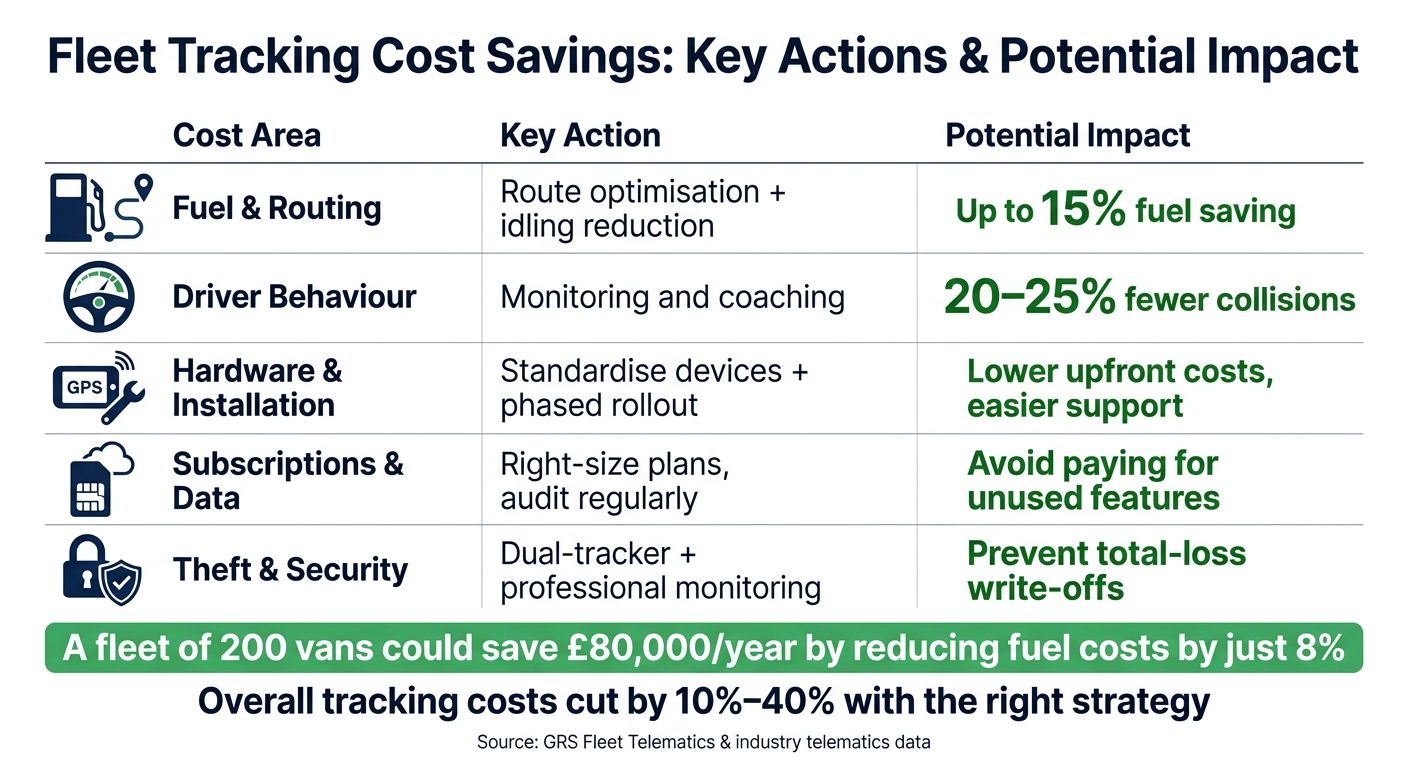
Fleet Tracking Cost Savings: Key Actions & Potential Impact
Achieving cost-effective fleet tracking means selecting systems tailored to your fleet's requirements and ensuring they’re used consistently and effectively.
When evaluating costs, consider hardware, installation, subscription fees, data plans, and training expenses over three to five years. For example, a fleet of 200 vans could save £80,000 annually by reducing fuel costs by 8% on a £1 million fuel budget. This easily offsets typical telematics costs of £40,000–£60,000 per year. The financial case becomes even stronger when the data is actively used to drive improvements.
Security is another critical factor in cost calculations. A stolen van can lead to losses worth tens of thousands of pounds, including vehicle replacement, lost tools or stock, temporary hire cover, and missed jobs. Solutions like GRS Fleet Telematics tackle this issue with dual-tracker technology, boasting a 91% recovery rate for stolen vehicles, at a monthly cost starting at £7.99 per vehicle. This is a fraction of the potential cost of an unrecovered theft.
To break it down further, here’s a table highlighting key cost areas, actions, and their potential savings:
| Cost Area | Key Action | Potential Impact |
|---|---|---|
| Fuel & routing | Route optimisation, idling reduction | Up to 15% fuel saving |
| Driver behaviour | Monitoring and coaching | 20–25% fewer collisions |
| Hardware & installation | Standardise devices, phased rollout | Lower upfront costs, easier support |
| Subscriptions & data | Right-size plans, audit regularly | Avoid paying for unused features |
| Theft & security | Dual-tracker, professional monitoring | Prevent total-loss write-offs |
The key to turning cost control into genuine savings lies in how the system is used. Beyond reducing costs and improving security, consistent operational use is essential. Structured training, clear performance metrics, and integrating telematics data into daily management processes - such as weekly fuel reports or monthly driver scorecards - ensure the system delivers real value. This is how fleet tracking evolves into a powerful cost-saving tool.
FAQs
How do I choose which vehicles need advanced tracking?
To determine which vehicles should have advanced tracking, start by aligning the decision with your business goals and the size of your fleet. Focus on vehicles where theft prevention is a top concern - advanced systems often include features like dual-tracker technology and remote immobilisation for added security. If cutting fuel costs or keeping an eye on driver behaviour is a priority, these systems also provide in-depth analytics to help you achieve those goals. For businesses looking to streamline operations, advanced telematics integrates smoothly with software to automate tasks like maintenance scheduling and reporting.
What’s the quickest way to calculate payback for fleet tracking?
To estimate payback efficiently, monitor essential metrics - such as fuel cost per mile, idling time, and failed delivery rates - over a period of 4–8 weeks before making any changes. Once you have this data, apply the formula: (Net Financial Benefit ÷ Total Investment) × 100%.
Here’s how it works: the Net Financial Benefit is calculated by subtracting ongoing costs from annual savings, while the Total Investment includes all expenses like hardware, software, and setup costs. By comparing this baseline data with results after implementation, you can clearly determine ROI. For UK fleets, payback is typically realised within 2–12 months.
How can we cut data costs without losing key tracking insights?
To keep data costs in check while still gaining the insights you need, concentrate on gathering only the most important metrics and skip collecting data that doesn't add value. By integrating telematics with your current fleet management or ERP systems, you can simplify operations and cut down on inefficiencies. Using automated, cloud-based systems makes it easier to scale without needing expensive hardware upgrades. For predictable costs, flat-rate subscriptions - like those offered by GRS Fleet Telematics at £7.99 per vehicle each month - cover both data usage and platform access, helping you manage expenses effectively.