Renewable Energy Storage for Commercial Fleets
Compare lithium‑ion, flow, pumped hydro and solid‑state storage for UK commercial fleets — costs, efficiency, scalability and lifespan explained.
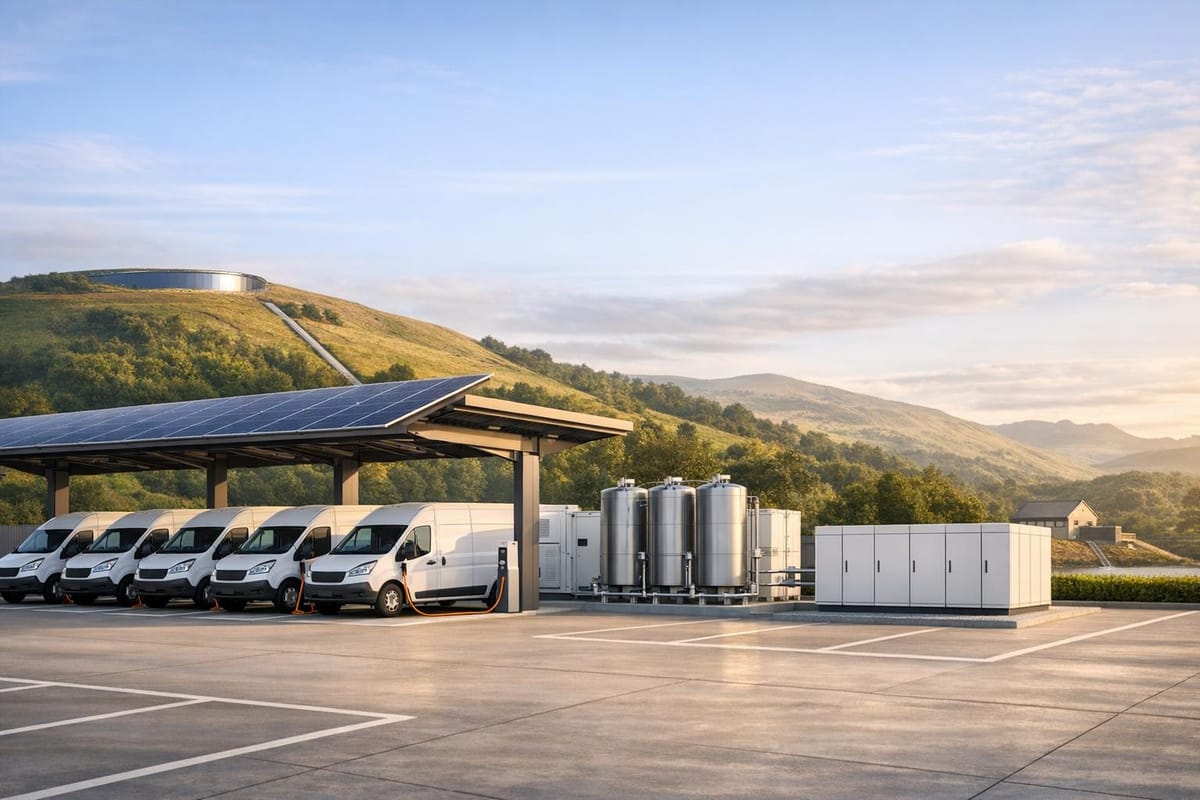
The UK's electricity demand is rising again, driven by the adoption of electric vehicles (EVs) and heat pumps. This shift is a game-changer for commercial fleets, which account for a significant share of transport CO₂ emissions. Battery energy storage systems (BESS) are becoming a key solution, enabling operators to store renewable energy, cut costs, and reduce grid reliance.
Here’s a quick breakdown of the main storage technologies shaping fleet energy management:
- Lithium-Ion Batteries: Affordable, efficient (85%), and scalable, with up to 6,000 charge cycles. Ideal for daily depot use but requires temperature management.
- Flow Batteries: Long-lasting (30 years) and safe, suited for long-duration storage. Higher upfront costs but lower for extended storage needs.
- Pumped Hydro Storage: Reliable and cost-effective for large-scale grid stability, but unsuitable for individual depots due to geographical limitations.
- Solid-State Batteries: High energy density and safety, with 10,000+ cycles. Still expensive and not widely available but promising for future fleets.
Integrating these technologies with fleet tracking solutions can optimise energy use, lower costs, and support the transition to zero-emission transport. Read on for a detailed comparison of costs, efficiency, scalability, and lifespan.
Grid-Scale Energy Storage: 5 Technologies Explained
1. Lithium-Ion Batteries
Lithium-ion batteries lead the way in energy storage for commercial fleets, thanks to their proven dependability and reduced costs. By 2025, battery pack prices had dropped to $108/kWh (£85/kWh), while stationary storage systems reached $70/kWh (£55/kWh) - a 45% decrease from the previous year and an impressive 93% reduction since 2010. These systems are now even more affordable than battery electric vehicle packs, which stand at $99/kWh.
Cost (£/kWh)
The type of battery chemistry you choose can significantly impact costs. Lithium Iron Phosphate (LFP) batteries come in at an average of $81/kWh (around £64/kWh), whereas Nickel Manganese Cobalt (NMC) batteries are pricier at $128/kWh (approximately £101/kWh). For commercial systems with a four-hour duration, costs hover around $199/kWh (roughly £157/kWh), while systems with longer durations of six to eight hours can bring costs down to $164–$174/kWh. Regional differences also play a role - Chinese manufacturers offer the lowest prices at $84/kWh, but North American and European systems are 44% and 56% more expensive, respectively, due to higher production and import costs.
"Record-low battery prices create an opportunity to lower EV costs and accelerate the deployment of grid-scale storage to support renewables integration around the world." – Evelina Stoikou, Head of Battery Technology, BloombergNEF
Efficiency (%)
Lithium-ion systems boast a round-trip efficiency of about 85%, meaning they return 85p of energy for every £1 used to charge them. This efficiency remains steady throughout the discharge cycle, reducing pressure on depot electrical systems. Optimal performance occurs when batteries are kept between 15°C and 30°C, making temperature-controlled depots essential for maximum efficiency. The levelised cost of electricity for a four-hour battery system dropped by 27% in 2025 to $78/MWh (£62/MWh), making it more affordable than new combined cycle gas turbines at $102/MWh. This reliability and cost-effectiveness make lithium-ion batteries an excellent fit for diverse fleet needs across various industries.
Scalability (MW potential)
Lithium-ion systems are highly scalable, ranging from 100 kW to 2,000 kW (0.1–2.0 MW). Their modular designs allow fleet operators to increase capacity as their electric vehicle fleets expand. For utility-scale projects supporting large fleet hubs, installations can reach 60 MW or more. A notable example is Lombard Shipping, which in 2024 installed a 102.4 kWh SolarEdge CSS-OD commercial battery at its Ipswich logistics hub. Paired with 226 solar panels, the system powers new electric HGVs. Managed by the SolarEdge ONE Controller, it enables the company to utilise 83% of its solar energy and is projected to save £1 million over 20 years, with a payback period of just 5.3 years. This scalability, combined with long-term savings, makes these systems a smart choice for fleet operations.
Cycle Life (years)
Lithium-ion batteries typically offer between 1,000 and 3,000 charge cycles, but top-tier LFP models can reach up to 6,000 cycles at 100% Depth of Discharge. Most commercial systems are designed for a 15-year operational lifespan. LFP batteries, in particular, provide better longevity compared to NMC variants (3,000–6,000 cycles versus 1,000–2,500), making them ideal for daily charging at depots. Additionally, lithium-ion batteries outperform lead-acid alternatives, lasting up to 10 years without requiring maintenance and weighing up to 70% less, which improves overall vehicle performance. This durability makes them a benchmark for other energy storage technologies to match.
2. Flow Batteries
Flow batteries present a different approach to energy storage compared to lithium-ion systems by separating power output from energy capacity. In these systems, the electrochemical stack determines the maximum power, while the size of the electrolyte tanks dictates how long energy can be stored. This setup means you can increase storage duration by simply adding more tanks, without needing to expand the electrochemical stacks themselves. Let’s dive into the costs, efficiency, scalability, and lifespan of these systems to understand their potential for commercial fleet use.
Cost (£/kWh)
Currently, vanadium flow battery systems cost between $350/kWh and $400/kWh (approximately £276–£316/kWh), which is higher than lithium-ion alternatives. However, the picture changes for longer discharge durations. While lithium-ion batteries are 15–25% cheaper for four-hour systems, flow batteries become 30–40% less expensive for applications requiring eight to ten hours of storage. By 2027, commercial vanadium systems are expected to drop to $250/kWh (around £197/kWh) for eight-hour durations.
The capital costs for these batteries are divided into three main components:
- Electrochemical stack: 30–40% of the total cost
- Electrolyte solution: 20–35%
- Balance-of-system infrastructure: 30–45%
Maintenance costs add about $5–8/kWh (£4–£6/kWh) over 20 years, and insurance costs are lower - 30–40% less - due to reduced risks of thermal runaway. Additionally, leasing models for the vanadium electrolyte can reduce upfront costs by 20–30%, with annual fees ranging from $2–3/kg (£1.60–£2.40/kg) of vanadium pentoxide instead of requiring operators to purchase it outright.
Efficiency (%)
Flow batteries operate at a 75–85% round-trip efficiency, meaning they return 75–85p for every £1 of energy used to charge them. While this is slightly lower than the 90–95% efficiency of lithium-ion systems, flow batteries maintain consistent performance across a temperature range of 10–40°C. They are particularly suited to slower charging and discharging cycles, making them ideal for depot operations where overnight charging is common.
For longer durations, such as a 12-hour vanadium redox flow system, the levelised cost of storage can drop below $0.12/kWh (approximately £0.09/kWh), compared to £0.11–£0.13/kWh for lithium-ion batteries under similar conditions. This cost stability, even under varied conditions, makes flow batteries a compelling option for high-capacity storage needs.
Scalability (MW potential)
Scalability is another key strength of flow batteries, especially for growing fleet depots. These systems can scale from 2 MW to 100 MW for commercial applications. Their modular design allows operators to increase capacity by adding more electrolyte tanks, making them a flexible choice for expanding operations.
A striking example of their scalability is the 800 MWh vanadium redox flow battery system in Dalian, China, which started operating in 2022. This system uses approximately 3 million litres of electrolyte solution and showcases the feasibility of gigawatt-hour-scale projects for large fleet hubs. These batteries also respond in milliseconds, enabling them to support grid services while simultaneously powering fleet charging needs.
Cycle Life (years)
Flow batteries offer an impressive 10,000 to 13,000 cycles at full depth of discharge, translating to an operational lifespan of around 30 years. This is about double the lifespan of standard lithium-ion systems, which typically last 15 years. Additionally, the vanadium electrolyte doesn’t degrade over time and retains nearly all its value after the battery is decommissioned, thanks to its ability to be recycled indefinitely.
This recyclability provides a financial advantage, as it supports favourable financing terms and reduces long-term costs for fleet operators planning for decades-long infrastructure. These durability and cost benefits position flow batteries as a strong contender for long-haul fleet applications and large-scale energy storage systems.
3. Pumped Hydro Storage
Pumped hydro storage takes a different approach to energy storage by using gravity and water instead of chemicals, making it a practical option for large-scale energy needs. The process is simple: when electricity is plentiful or cheaper, water is pumped to a higher reservoir. Later, when energy demand rises, the water is released through turbines to generate electricity. While this method isn't designed for individual depots, it plays a crucial role in stabilising the UK grid, indirectly supporting commercial fleets by ensuring a more reliable energy supply. This setup also contributes to a cost-effective energy solution, which is explored in the following section.
Cost (£/kWh)
The cost of pumped hydro storage is estimated between 15p/kWh and 18p/kWh. This is about half the cost of lithium-ion batteries for long-duration use, making it one of the most affordable choices for large-scale energy storage. Although these figures primarily reflect utility-scale projects, fleet operators still benefit indirectly. By balancing supply and demand, pumped hydro helps reduce electricity costs during off-peak times.
The economics are fairly straightforward: with a 70% efficiency rate, electricity purchased at 10p/kWh would need to be sold at roughly 14.29p/kWh to break even. Compared to alternatives like green hydrogen, which requires significantly higher sale prices due to lower efficiency, pumped hydro offers a clear advantage.
Efficiency (%)
Pumped hydro systems are highly efficient, with a round-trip efficiency of 70–85%. This means that for every £1 of energy used to pump water uphill, 70–85p is recovered when the water is released. This makes the technology ideal for managing fluctuations in renewable energy generation, enabling intra-day energy shifts and even inter-seasonal storage. The combination of efficiency and scalability makes it a key player in maintaining grid stability.
Scalability (MW potential)
Globally, pumped hydro dominates non-primary energy storage, accounting for 96% of installed capacity. Projects can reach up to 3.2 GWh, such as a recent installation in Tenerife launched in February 2026. In the UK, future renewable energy systems are expected to require between 5 GW and 8 GW of intra-day storage capacity, a demand well within the scope of pumped hydro.
However, scalability in the UK faces challenges. The technology depends on large reservoirs and suitable elevations, and many of the best locations have already been developed. Environmental concerns further restrict new projects, suggesting that the UK may be nearing its limit for pumped hydro installations. For fleet operators, this means relying on existing projects, such as the proposed Coire Glas facility in Scotland, rather than building new on-site systems.
Cycle Life (years)
Pumped hydro is a well-established technology with an impressive lifespan. When properly maintained, these systems can remain operational for over 50 years, far outlasting battery-based alternatives. This durability spreads the initial investment over decades, making pumped hydro a cost-effective solution in the long run.
4. Solid-State Batteries
Solid-state batteries are gaining attention as a promising alternative to traditional storage options, offering higher energy density and improved safety. Unlike conventional batteries that use flammable liquid electrolytes, this technology relies on solid materials like ceramic, glass, or polymer. These materials not only provide better energy storage but also reduce fire risks, making them particularly appealing to commercial fleet operators aiming to maximise vehicle range safely. While still in the early stages of commercialisation, solid-state batteries are moving beyond laboratory research, with broader adoption anticipated by 2030.
Cost (£/kWh)
Currently, solid-state batteries are more expensive to produce than traditional lithium-ion systems due to the complexities of their design and the specialised materials required. For comparison, lithium iron phosphate (LFP) batteries cost about £64/kWh, and nickel manganese cobalt (NMC) batteries cost approximately £101/kWh. Despite the higher costs, solid-state technology holds potential for significant savings - up to £2,500 per vehicle - thanks to reduced weight and simpler thermal management. As production scales up, these costs are expected to drop considerably.
Efficiency (%)
Solid-state batteries are highly efficient, with round-trip efficiency exceeding 90%. This means that over 90p of every £1 spent on charging is retained for use, outperforming the 70–85% efficiency rates of pumped hydro storage. Their superior energy density also allows for longer vehicle ranges. For instance, QuantumScape Corporation demonstrated a prototype in November 2025 that could charge from 10% to 80% in under 15 minutes while maintaining high energy retention. These efficiency gains, combined with faster charging times, position solid-state batteries as a strong contender for commercial fleets, although scaling up production remains a key hurdle.
Scalability
Scaling solid-state battery production is a significant challenge. The technology is still transitioning from small-scale pilot projects to broader commercial manufacturing, with large-scale deployment expected by 2030. Market forecasts highlight the growing interest in this sector: the global solid-state battery market, valued at around £1.28 billion in 2025, is projected to grow to approximately £12.52 billion by 2033, reflecting an annual growth rate of 31.8%. This rapid expansion is expected to meet the increasing energy needs of modern fleets.
Cycle Life (years)
One of the standout features of solid-state batteries is their durability. They can last for 10,000–12,000 cycles under normal conditions, far exceeding the 3,000–5,000 cycles typical of conventional lithium-ion batteries. For commercial fleet operators, this durability means a battery could last the entire lifespan of a vehicle, eliminating the need for costly mid-life replacements. This extended cycle life not only reduces maintenance but also lowers the total cost of ownership over time.
Advantages and Disadvantages
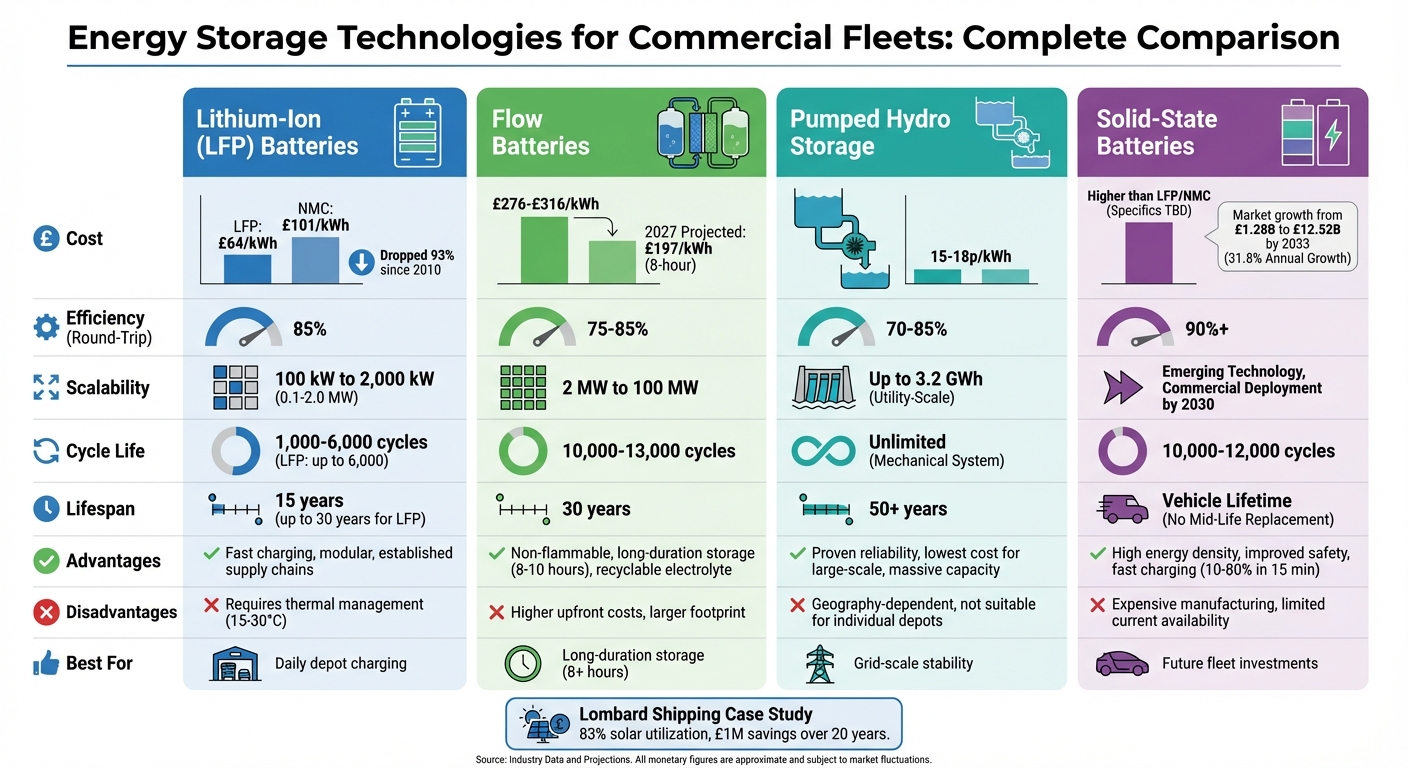
Commercial Fleet Energy Storage Technologies Comparison: Cost, Efficiency, and Lifespan
Here's a breakdown of the key strengths and challenges of each technology, based on the earlier analysis.
Lithium-ion batteries, particularly the Lithium Iron Phosphate (LFP) type, strike a good balance for UK fleet operations. They offer around 85% round-trip efficiency and can last for up to 6,000 cycles at 80% depth of discharge. That’s roughly double the lifespan of conventional Nickel Manganese Cobalt batteries. Their reliability makes them a solid option for depot-based operations, though managing heat effectively is a crucial factor to consider.
Flow batteries stand out for their durability and safety. With a non-flammable design, they eliminate the risk of thermal issues, making them ideal for long-duration storage exceeding four hours. On the downside, they require more physical space and come with higher upfront costs, which can be challenging for urban depots where space is tight.
Pumped hydro storage is the leader in global grid energy storage. Its long lifespan - often exceeding 50 years - and proven dependability make it a fantastic choice for large-scale energy storage. However, its reliance on specific geographical features makes it unsuitable for individual fleet use.
Solid-state batteries offer improvements in energy density and safety by replacing liquid components. This could help reduce vehicle weight and extend driving range. However, their manufacturing process is complex, leading to high costs and limited availability for now.
Below is a table summarising these points for easier comparison:
| Technology | Scalability (Application) | Expected Life | Fleet-Specific Advantages | Fleet-Specific Disadvantages |
|---|---|---|---|---|
| Lithium-Ion (LFP) | High – ideal for depot scaling | Long (up to 30 years) | Fast charging, modular, established supply chains, high cycle life | Requires strict thermal management; resource constraints |
| Flow Batteries | Moderate – larger footprint | Around 30 years | Non-flammable, effective for long-duration storage, reusable electrolyte | High initial costs; space requirements |
| Pumped Hydro | High – geography dependent | Over 50 years | Proven reliability, very large capacity | Limited to certain locations; impractical for fleets |
| Solid-State | Emerging | Uncertain | High energy density, improved safety | Expensive manufacturing; limited availability |
Conclusion
Selecting the right energy storage solution hinges on understanding your fleet's operational demands and the limitations of your site. Different technologies cater to specific needs. For instance, lithium-ion batteries are a practical choice for fleet operators in the UK seeking immediate scalability and dependable daily usage. Their proven reliability and market readiness make them ideal for depot-based charging setups, though ensuring proper thermal management is essential.
For operations requiring longer storage durations - typically exceeding four hours - flow batteries stand out. They offer durability and enhanced safety, especially for sites with sufficient space. Meanwhile, solid-state batteries represent a forward-looking option, promising higher energy density as costs continue to decline, making them a potential investment for future fleet expansions.
The real advantage lies in integrating these storage solutions with telematics systems to optimise energy usage and overall fleet performance. As Peter Fraser, Director at Lombard Shipping, highlighted:
"Rising energy demand across our operations made it essential for us to take a more strategic approach to managing our power use. We needed a solution that could maximise clean energy generation on site and ensure it is used as efficiently as possible."
Case studies have shown that integrated energy management can lead to notable reductions in electricity costs. By pairing storage technologies with telematics platforms like GRS Fleet Telematics (https://grsft.com), fleet operators can monitor energy in real time and optimise charging schedules based on solar forecasts and grid pricing. This approach has been shown to achieve up to 83% on-site solar utilisation, while also providing the insights needed to maximise return on investment.
With battery storage installations on the rise and electricity costs expected to increase, combining the right storage technology with intelligent fleet management is essential. This strategy not only helps control costs but also ensures that fleet operators can effectively utilise renewable energy to meet both current and future operational needs. It reflects the growing emphasis on sustainability within UK fleet operations.
FAQs
How do I choose the right storage duration for my depot?
When deciding on the right storage duration, it all comes down to your energy requirements and how you plan to manage them. Shorter storage durations (1–4 hours) work well for tasks like peak shaving or shifting loads to off-peak times. On the other hand, longer durations (6–8 hours) are better suited for storing renewable energy to cover periods when generation is low.
To make the best choice, think about your energy usage patterns, how much renewable energy fluctuates, and how much operational flexibility you need. While shorter durations tend to cost less, longer durations offer more reliability during extended periods of low energy generation.
What size battery (kW/kWh) do I need for my fleet charging?
The size of the battery needed for fleet charging hinges on your vehicles' energy demands and the time available for charging. For example, smaller vans usually come with batteries ranging from 50 to 100 kWh, which are well-suited for overnight charging using 7 kW or 22 kW chargers.
When deciding on the right battery size, think about factors like your fleet's daily mileage, how much energy the vehicles consume, and the charging infrastructure you have in place. A handy formula to guide your planning is:
Charging time (hours) = Battery capacity (kWh) ÷ Charger power (kW)
This calculation can help ensure your fleet stays powered and ready to go.
How can telematics improve battery charging and solar use?
Telematics offers a smarter way for fleets to manage battery charging and make the most of solar energy. By delivering real-time data and advanced management tools, it allows fleet managers to keep track of battery levels, fine-tune charging schedules, and synchronise energy use with solar generation or cheaper electricity periods.
When paired with vehicle-to-grid (V2G) technology, telematics takes things a step further. Vehicles can send surplus energy back to the grid, boosting efficiency, cutting costs, and helping integrate renewable energy into the system.