
Real-Time Load Monitoring for Construction Fleets
Real-time load monitoring prevents overloads and fines, boosts safety and compliance, cuts fuel and maintenance costs, and links to telematics.

Overloading construction equipment is risky and costly. It leads to accidents, damages machinery, delays projects, and incurs legal penalties. Real-time load monitoring solves this by alerting fleet managers and operators to unsafe load levels instantly.
Here’s why it matters:
- Safety: Prevents rollovers, brake failures, and tyre blowouts caused by overloading.
- Compliance: Avoids fines and legal issues under strict UK load management laws.
- Cost Savings: Reduces fuel waste, maintenance expenses, and downtime.
- Efficiency: Tracks load data to optimise fleet usage and identify recurring issues.
- Technology: Sensors, GPS, and software provide real-time alerts and insights.
With the construction sector rapidly adopting IoT, this technology is becoming essential for safer, smarter, and more cost-effective fleet management.
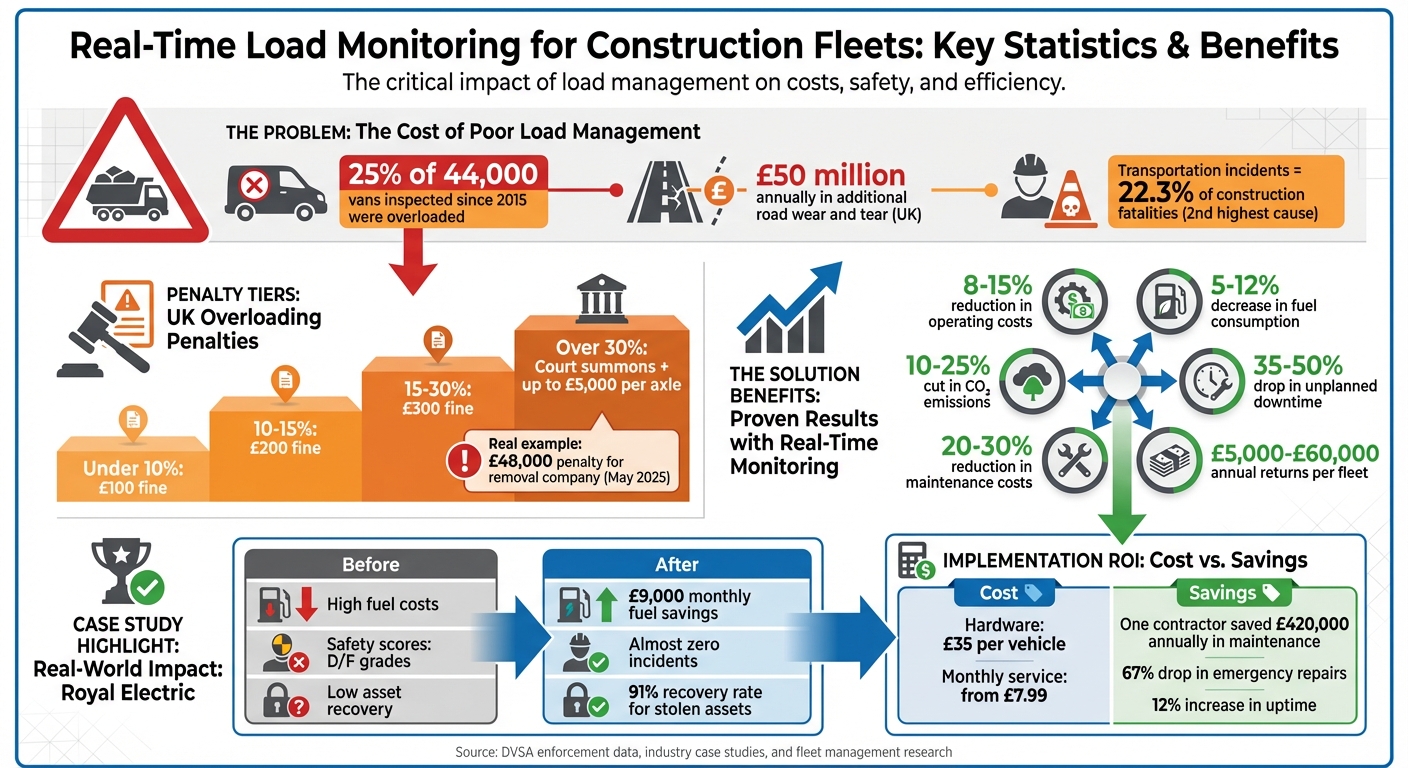
Real-Time Load Monitoring Benefits: Cost Savings and Safety Statistics for Construction Fleets
Load Management Challenges in Construction Fleets
Safety Hazards and Equipment Damage
Improper load management poses serious risks to both drivers and machinery. Overloading raises a vehicle's centre of gravity, making rollovers more likely during sharp turns or sudden manoeuvres. It also compromises steering precision, extends braking distances, and causes tyres to overheat and wear out faster. This can lead to dangerous blowouts, whether on site or on the road.
The strain on equipment is just as concerning. Excessive weight accelerates wear and tear on suspension systems, axles, and chassis components. A stark example occurred in February 2026 when the DVSA stopped a 3,500 kg light goods vehicle that was carrying 5,000 kg - an overload that had already broken its main leaf spring. Derek Hack, Sales Director at Axtec, emphasises:
"The extra weight means it will not be able to stop as quickly in an emergency - as well as its steering and suspension, which means its handling will be impaired."
Another danger comes from improperly secured loads, which can shift during transit. This not only destabilises the vehicle but also risks spilling cargo onto the road, potentially resulting in fatal accidents. These safety concerns are compounded by strict compliance requirements and harsh penalties for violations.
Compliance Requirements and Legal Penalties
UK law holds drivers and fleet operators accountable for proper load management. The DVSA actively enforces these rules with roadside checks and weigh-in-motion sensors that identify violations instantly. Penalties are tiered: £100 for overloads under 10%, £200 for overloads between 10% and 15%, and £300 for those ranging from 15% to 30%. Overloads exceeding 30% lead to court summons and fines of up to £5,000 per axle.
The financial repercussions don’t stop at fines. In May 2025, a removal company faced a £48,000 penalty after two vans were found overloaded by 33% and 46% in the same month. The drivers were fined £1,848 and £2,464 respectively. Beyond the immediate costs, these violations can have lasting effects. Overloading convictions must be reported to the Traffic Commissioner, who has the authority to suspend or revoke an operator’s licence. Additionally, such offences harm a firm's Operator Compliance Risk Score, increasing the likelihood of frequent DVSA inspections and the loss of "Earned Recognition" status.
The consequences can escalate further if an overloaded vehicle is involved in an accident. Insurers may void coverage entirely, leaving the operator to bear all associated costs. Van tracking solutions with real-time load monitoring can significantly reduce these risks, ensuring vehicles remain within legal weight limits.
Fuel Waste and Higher Operating Costs
Excessive weight forces engines to work harder, leading to higher fuel consumption. On the flip side, under-loading may require additional trips, inflating operational costs. Data from the DVSA reveals that nearly 25% of the 44,000 vans inspected roadside since 2015 were overloaded, contributing to over £50 million annually in additional road wear and tear across the UK.
Operational inefficiencies add to the financial strain. If a vehicle is issued a prohibition notice by the DVSA, it cannot move until the excess weight is removed. This can lead to missed deliveries and may even require a backup vehicle to complete the job. As Derek Hack from Axtec points out:
"The fine that is handed out is usually the least of a business's problems. If you were due to deliver some product... and you are found to be overloaded and prohibited from moving... Will that customer use you again?"
How Real-Time Load Monitoring Systems Work
Load Monitoring System Components
Real-time load monitoring systems combine specialised hardware and cloud-based software to keep track of load forces with precision. The hardware includes components like load cells, strain gauges, load links, and load pin shackles, which are strategically placed on key areas such as axles or suspension systems to measure weight directly.
These sensors translate mechanical forces into electrical signals, which are then processed by an onboard computer. This allows drivers to view real-time weight data on in-cab displays or wireless handsets. On the software side, cloud platforms not only store and analyse this data but also use machine learning algorithms to detect patterns and improve load distribution across the fleet. Since the data is transmitted instantly, fleet managers can stay updated on load conditions at all times.
Data Collection and Transmission Process
Once the sensors gather load information, the data is transmitted through 4G or IoT networks to cloud systems, where it becomes actionable. This live feed of weight data allows fleet managers to monitor and address overloading issues remotely, even before a vehicle leaves the depot or job site.
Cloud platforms process the raw sensor data using techniques like constraint layering. This method matches vehicle capacity with factors such as delivery schedules, driver availability, and access limitations, resolving conflicts in real time. Interestingly, 95% of commercial transport companies report that AI has significantly boosted the usefulness of IoT data collected from their devices. Once analysed, this data integrates seamlessly with existing fleet management tools, offering a more comprehensive view of operations.
Integration with Fleet Management Software
Integrating load monitoring systems with fleet management software helps construction fleets tackle safety and compliance challenges more effectively. These systems work alongside GPS tracking, Electronic Logging Devices (ELDs), and maintenance software, providing a unified operational overview. Aftermarket platforms further simplify management by allowing diverse fleets to be monitored through a single dashboard.
Geofencing adds another layer of efficiency by triggering automated updates when vehicles arrive at customer sites. This feature can even initiate searches for return loads, minimising empty miles. Additionally, load data feeds into predictive maintenance software, enabling condition-based servicing. Metrics like engine load and hydraulic pressure help predict maintenance needs, reducing reliance on rigid schedules. Construction companies employing AI-driven predictive maintenance have reported up to 40% cost savings within the first year.
Benefits of Real-Time Load Monitoring
Better Safety and Compliance
Real-time load monitoring is a game-changer for addressing safety risks in construction operations. For construction fleets, it helps reduce dangers linked to uneven loads and heavy machinery. These systems provide instant visual and audible alerts when loads exceed safe limits, allowing for quick adjustments. This is especially important given that transportation-related incidents are responsible for 22.3% of construction fatalities, making them the second-highest cause of death in the industry.
These systems don’t just protect workers - they also help maintain fleet integrity. By preventing stress-related damage to critical components like aerial devices, hydraulic systems, and suspensions, they reduce wear and tear. Wireless notifications keep fleet managers informed of overload events, enabling them to address risky behaviours and provide tailored coaching. For operators in the UK, axle weight monitoring ensures compliance with DVSA regulations while maintaining vehicle stability both on-site and on the road.
Operational Efficiency and Cost Reduction
The benefits go beyond safety - real-time monitoring delivers measurable cost savings. Take Royal Electric as an example: after implementing fleet monitoring, they achieved monthly fuel savings of £9,000, improved safety scores from D/F grades to almost zero incidents, and managed to recover lost assets swiftly.
Switching from scheduled maintenance to condition-based servicing using live data also cuts unnecessary repairs and extends the lifespan of components. These systems monitor engine performance, diagnostics, and operational status in real time, identifying issues like unusual vibrations or reduced fuel efficiency before they lead to costly breakdowns. With GRS Fleet Telematics’ hardware starting at £35 per vehicle and monthly service fees from £7.99, along with a reported 91% recovery rate for stolen assets, the financial benefits are hard to ignore.
Better Decision-Making with Real-Time Data
Real-time data doesn’t just save money - it also improves decision-making. Data collected from sensors and cloud platforms helps distinguish between productive and wasteful journeys, cutting down on inefficiencies that eat into budgets. Automated alerts for critical metrics like engine temperature or diagnostic trouble codes allow for quick intervention before minor problems become major headaches.
When integrated with fleet management software, these systems streamline operations and maximise asset utilisation. Features like advanced geofencing add another layer of safety. This level of real-time visibility gives managers the tools they need to make informed, proactive decisions that keep operations running smoothly.
Implementing Real-Time Load Monitoring in Construction Fleets
Step-by-Step Implementation Process
Start by cataloguing your entire fleet - everything from massive cranes to compact generators. Each piece of equipment needs a unique identifier to streamline tracking and data collection. Next, install the right sensors for each type of machinery. For example, trucks might need axle load sensors, cranes can use load cells, and excavators may require hydraulic transducers. Once installed, ensure every sensor is paired correctly with its respective equipment.
These sensors should then be connected to a telematics gateway or a Centralised Maintenance Management System (CMMS). This integration converts raw sensor data into actionable insights. Calibration is crucial - use certified weights to ensure accuracy and set alert thresholds based on the original equipment manufacturer's (OEM) guidelines. These thresholds should define idle, optimal, and overload conditions. Finally, train your operators and technicians to use mobile inspection tools and interpret real-time data visualisations effectively.
One contractor who integrated telematics with Oxmaint CMMS over an 18-month period saw impressive results: a 67% drop in emergency repairs, a 12% increase in uptime, and annual maintenance savings of £420,000.
Once the system is up and running, it’s essential to adapt it to the specific requirements of your construction equipment.
Adapting Systems for Construction Equipment
With the sensors installed, the next step is to tailor the system to your fleet’s diverse machinery. Modern solutions can handle a wide range of equipment without requiring overly complicated sensor setups. For example, high-precision GNSS data alone can track productivity, bypassing the need for harder-to-calibrate sensors like IMUs or accelerometers.
These systems use motion classification algorithms to adapt to specific machine functions. For instance:
- Excavators monitor digging, loading, rotating, levelling, and movement.
- Dozers differentiate between forward, backward, and stationary states.
- Dump trucks use geofencing to track activity in loading and dumping zones.
If your fleet includes equipment from multiple manufacturers, consider implementing the ISO 15143-3 (AEMP 2.0) telematics standard. This allows you to consolidate data from various brands into a single dashboard. However, only 14% of construction firms currently use this approach. Dr. Kristian Daub, Managing Director of Schwinger Quarry, highlighted the benefits of such a system after adopting VisionLink Productivity in mid-2023:
"In the past, we thought we knew…now we know. We can make decisions based on data instead of gut feeling".
His company reported significant benefits, including reduced fuel consumption and an estimated 150-tonne reduction in CO₂ emissions.
Performance Tracking and System Optimisation
Real-time alerts are just the beginning - ongoing optimisation helps fleets stay safe and compliant. Regularly refining the system is key. Use the data collected to adjust alert thresholds, score operator behaviour, and implement condition-based maintenance strategies. This can lead to a 35–50% drop in unplanned downtime and a 20–30% reduction in maintenance costs. Considering that downtime for heavy equipment can cost around £1,200 per hour, these savings are substantial.
At a minimum, schedule annual system calibrations, and perform additional checks after major repairs or modifications. Monthly data audits are also essential to ensure telematics data aligns with actual equipment performance. Geofencing can add another layer of efficiency, automating logs for arrivals and departures while flagging any unauthorised movements outside working hours.
To maximise impact, start by focusing on the 20% of assets responsible for 80% of downtime costs - often excavators or cranes. Once you’ve proven the system’s value, you can expand its use across the rest of your fleet.
Conclusion
Real-time load monitoring takes fleet management from guesswork to a level of precision driven by data. The results? Tangible improvements in safety, efficiency, and compliance. To put it into perspective, fleets often see operating costs drop by 8–15%, fuel consumption decrease by 5–12%, and CO₂ emissions cut by 10–25% in mixed fleets. These savings can amount to annual returns ranging from £5,000 to £60,000 per fleet.
This technology also tackles major operational headaches. Mark Richards, Operations Manager at BuildRight Construction, shared his experience:
"Tool and van theft was costing us thousands each year. Since installing GRS van trackers, we've had zero thefts and have recovered two attempted van thefts thanks to the dual tracker system."
This example highlights how real-time load monitoring can deliver practical, impactful results.
Beyond theft prevention, this shift from reactive problem-solving to proactive management reaps further rewards. Fleets benefit from fewer surprise repairs, improved vehicle use, and up to a 20–30% boost in dispatcher efficiency with AI-assisted planning. Plus, the detailed operational data helps fleets remain competitive in bidding processes while adhering to DVSA regulations and Low Emission Zone standards.
FAQs
What are the best sensors for different types of construction equipment?
The best sensors for construction equipment are hydraulic degradation sensors, engine performance sensors, structural fatigue sensors, and load weight sensors. These play a crucial role in tackling major failure points while improving maintenance accuracy, boosting safety, and optimising operational performance.
How accurate are real-time load readings, and how often should systems be calibrated?
Real-time load readings achieve a high level of accuracy thanks to advanced sensing technologies. To maintain this precision over time, it's essential to calibrate these systems regularly. Calibration schedules should align with the manufacturer's guidelines or be adjusted according to specific operational requirements.
What does load monitoring integration with telematics and a CMMS enable day to day?
Integrating load monitoring with telematics and a Computerised Maintenance Management System (CMMS) brings a host of practical benefits. By providing real-time data on load weights, distribution, and vehicle status, it helps ensure loads are evenly balanced and avoids the risks of overloading. This not only improves safety but also boosts efficiency through smarter route planning and cutting down on unnecessary empty miles.
On top of that, it aids in proactive maintenance by spotting potential problems early, keeping vehicles in better condition and reducing downtime. With load data, tracking, and maintenance information combined into a single system, fleet management becomes more streamlined and safety compliance is easier to maintain.