Predictive Maintenance: Save on Emergency Repairs
Use real-time telematics and AI to predict vehicle faults, reduce emergency repairs, lower maintenance costs and cut downtime for fleets.

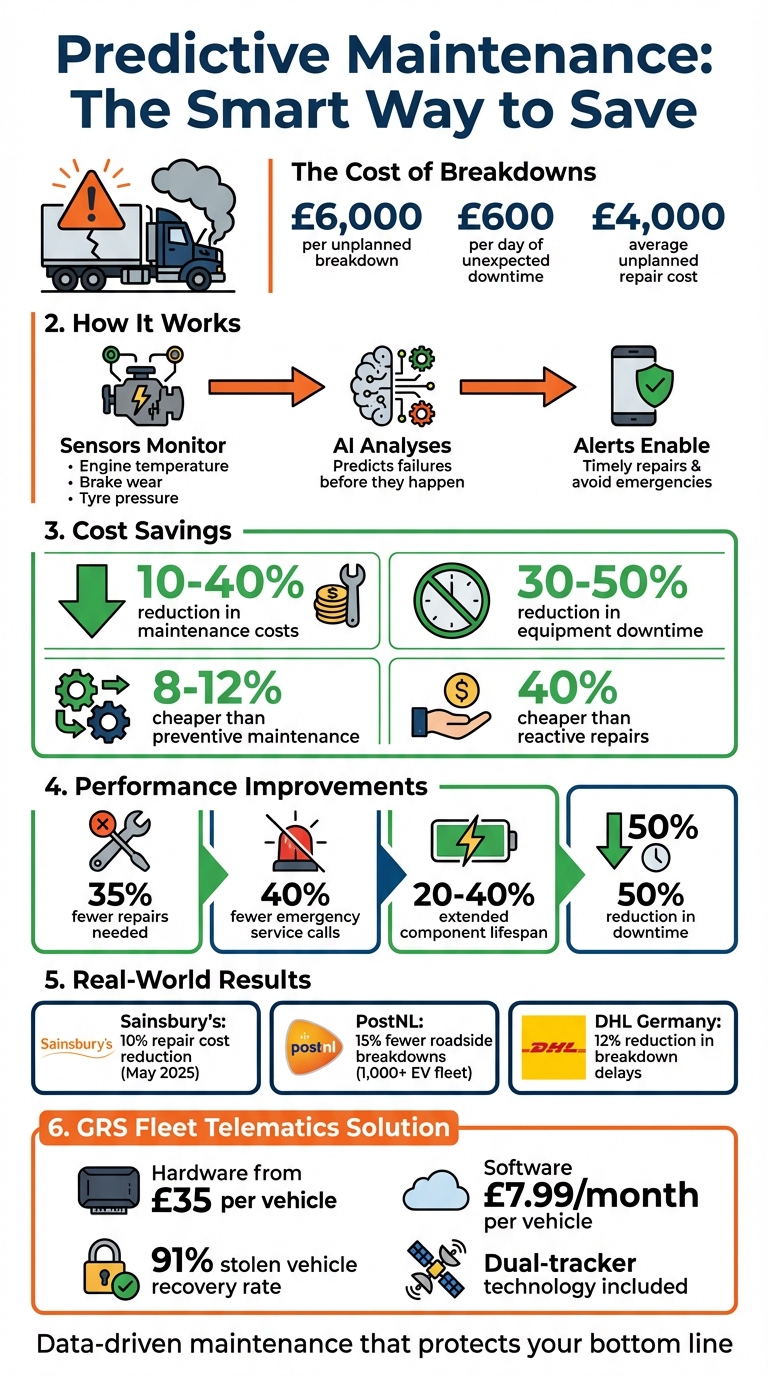
Unplanned vehicle breakdowns are costly - up to £6,000 per incident - and can disrupt operations significantly. Predictive maintenance uses real-time telematics data to spot potential issues early, cutting downtime by up to 50% and reducing maintenance costs by 10–40%. It’s a smarter, data-driven approach that helps fleet operators plan repairs, avoid roadside emergencies, and extend vehicle lifespan.
Here’s how it works:
- Sensors monitor critical metrics like engine temperature, brake wear, and tyre pressure.
- AI analyses patterns to predict failures before they happen.
- Alerts allow timely repairs, avoiding expensive breakdowns and ensuring compliance with safety standards.
For example, in May 2025, Sainsbury's reduced repair costs by 10% using predictive tools for their EV fleet. Similarly, PostNL cut roadside breakdowns by 15%. With systems like GRS Fleet Telematics, fleets can implement predictive maintenance affordably, starting at £35 per vehicle.
Key benefits include:
- Lower emergency repair costs and downtime.
- Longer vehicle lifespan and improved performance.
- Enhanced safety and compliance with DVSA standards.
Predictive maintenance is a cost-effective way to keep fleets running smoothly while protecting your bottom line.
Predictive Maintenance Cost Savings and Benefits for Fleet Operators
Predictive vehicle maintenance.
How Predictive Maintenance Works with Telematics
Predictive maintenance hinges on a steady flow of real-time data from your fleet to a centralised platform. Modern vans are equipped with IoT sensors across critical components like engines, brakes, tyres, and electrical systems. These sensors continuously collect telemetry data, monitoring everything from engine temperature to brake pad wear. Telematics systems serve as the communication hub, transmitting this diagnostic data via 5G or cellular networks to cloud platforms, enabling near-instant alerts based on predictive analysis.
AI-driven analysis identifies patterns, or "failure signatures", within this data. For example, a system might detect rising coolant temperatures paired with specific vibration patterns. While each reading might appear normal on its own, the combination could signal an imminent water pump failure. As CameraMatics succinctly puts it:
Preventative maintenance follows a schedule. Predictive maintenance follows the data.
This approach replaces rigid maintenance schedules with condition-based interventions, allowing for targeted, need-based servicing. Some systems even utilise "digital twins" - virtual replicas of vehicle components that simulate wear in real time, helping optimise maintenance plans. By tracking these critical metrics, predictive maintenance transforms unplanned breakdowns into scheduled, cost-efficient repairs.
Data Points Used in Predictive Maintenance
Telematics systems monitor a wide range of metrics, but certain data points are especially useful for predicting failures. For instance:
- Engine diagnostics: Tracks temperature, oil pressure, coolant levels, and fan activity to identify wear patterns.
- Brake system metrics: Monitors pad thickness, rotor wear, stroke measurements, and ABS events to forecast replacement needs.
- Tyre health: Captures pressure, temperature trends, and tread depth to detect slow leaks or alignment issues before they escalate.
Other critical metrics include electrical system data, which tracks battery voltage, charging cycles, and alternator health to prevent "no-start" incidents. Vibration patterns - such as shifts in frequency or intensity - can reveal issues like bearing wear, misalignment, or loose parts. Even driver behaviour, such as harsh braking or rapid acceleration, contributes to component wear, and telematics systems capture these behaviours alongside mileage and engine hours.
| Data Point | Monitored Metric | Predicted Failure |
|---|---|---|
| Engine Diagnostics | Temperature, oil pressure, fan cycles | Water pump failure, overheating, oil issues |
| Brake Systems | Pad thickness, ABS events, rotor wear | Brake failure, stopping distance problems |
| Tyre Monitoring | Pressure, tread depth, temperature | Blowouts, alignment problems, slow leaks |
| Electrical Systems | Battery voltage, alternator performance | No-start events, alternator failure |
| Vibration Patterns | Frequency and intensity changes | Bearing wear, loose components, misalignment |
AI tools integrate these metrics, analysing patterns to predict failures before they happen.
AI and Analytics in Maintenance Forecasting
The wealth of data collected by telematics systems is only as useful as the insights it generates. AI systems excel at connecting variables that might seem unrelated, providing actionable predictions rather than overwhelming technicians with unnecessary alerts. This eliminates the need for manual checks and repetitive data entry.
Some advanced systems link directly to Transportation Management Systems, automatically rerouting vehicles for maintenance when a failure is predicted. This proactive approach prevents disruptions by addressing issues before they escalate. For example, in May 2025, DHL Germany used telematics and AI to monitor battery strain and motor wear across its fleet of light commercial vehicles. By scheduling repairs during off-peak hours, they reduced breakdown-related delays by 12%.
Sarah Whitman from Debales AI highlights the complexity of this process:
Predictive maintenance is not a single model that 'predicts failure.' In operations, it is a chain: sensing, interpretation, prioritisation, and execution.
The real power lies in refining the system. When technicians confirm whether a predicted issue was accurate during a repair, that feedback trains the AI, improving its accuracy and reducing false alarms. This continuous improvement ensures that predictive maintenance systems remain effective and actionable over time.
Benefits of Predictive Maintenance for Fleet Operators
Lower Emergency Repair Costs and Downtime
Predictive maintenance helps fleet operators catch small issues before they escalate into expensive repairs. For instance, a sensor can detect minor faults in a transmission, preventing a complete failure that could cost around £4,000. These early warnings allow for repairs to be scheduled during quieter periods, avoiding the chaos of sudden roadside breakdowns.
Real-time telematics alerts play a key role here, showing how early intervention can save considerable money. Predictive maintenance can lower overall maintenance expenses by 10–40% compared to reactive methods and reduce equipment downtime by 30–50%. To put it into perspective, a single day of unexpected downtime for a commercial truck can cost around £600. Moving from rigid, time-based servicing to condition-based maintenance avoids unnecessary garage visits and cuts down on costly emergency callouts.
Take PostNL in the Netherlands as an example. In May 2025, they used predictive tools to monitor wear and tear across a fleet of more than 1,000 electric light commercial vehicles. The result? A 15% reduction in roadside breakdowns. These savings also extend the lifespan of vehicles and improve their overall performance.
Longer Vehicle Lifespan and Better Performance
One of the biggest advantages of predictive maintenance is that it prevents one small failure from snowballing into larger problems. For instance, ignoring an overheating engine can lead to extensive damage and costly repairs. By identifying wear and tear early, fleet operators can extend the lifespan of components by 20–40%, delaying the need for expensive new vehicles.
Real-time data also ensures vehicles are running as efficiently as possible. Proper tyre inflation, for example, not only improves fuel efficiency but also prolongs the life of the vehicle. Similarly, well-maintained engines and fuel filters reduce fuel consumption, while poorly maintained vehicles tend to operate inefficiently, driving up costs. Reliable performance doesn’t just save money - it also keeps drivers happier by reducing the frustration of breakdowns and delays. On top of that, better-maintained vehicles naturally lead to safer operations, which ties into the next point.
Better Safety and Compliance
Predictive maintenance systems constantly monitor critical safety components. Sensors can detect problems like sudden tyre pressure drops or unusual vibrations, allowing for immediate action to prevent accidents.
As CameraMatics points out:
A vehicle in top condition is a safer vehicle. Predictive maintenance reduces the risk of accidents caused by mechanical failure, while real-time alerts give drivers and operators visibility of potential hazards before they become critical.
For UK fleet operators, these systems also simplify compliance with MOT, DVSA, and other roadworthiness checks. They automatically log Engine Management Light alerts, defect reports, and completed repairs, creating a digital service history that’s invaluable for audits. The Geotab Team highlights this benefit:
Predictive maintenance helps prevent common CVSA inspection violations such as brake system failures, tyre wear and engine malfunctions.
Additionally, telematics data can identify risky driving behaviours like harsh braking or rapid acceleration. This allows for targeted safety training, protecting both drivers and the public.
How GRS Fleet Telematics Supports Predictive Maintenance
Real-Time Data Tracking and Alerts
GRS Fleet Telematics keeps a close watch on essential vehicle metrics like engine temperature, tyre pressure, brake performance, and vibrations. By identifying early signs of wear, it helps prevent expensive breakdowns. Automated alerts notify fleet managers weeks before potential issues arise, allowing proactive scheduling of repairs during less busy times instead of dealing with emergency roadside fixes. For instance, the system can flag emerging problems with batteries or brakes. Mechanics can even use remote diagnostics to evaluate a vehicle's condition without needing it in the workshop. This constant monitoring is a cornerstone of GRS Fleet Telematics' dual-tracker system.
Dual-Tracker Technology for Security and Reliability
The dual-tracker technology combines a primary tracker with a secondary Bluetooth backup, ensuring uninterrupted data flow and enhanced security. This setup supports a 91% recovery rate for stolen vehicles. If the primary tracker fails, the backup ensures fleet managers still have full visibility into vehicle conditions. This redundancy not only safeguards vehicle data but also enables timely maintenance decisions, which can help cut repair costs and keep vehicles running smoothly.
Affordable and Scalable Solutions
GRS Fleet Telematics pairs its advanced features with pricing designed to suit fleets of all sizes. There are three hardware options available: Essential (£35), Enhanced (£79), and Ultimate (£99). Each comes with a monthly software subscription of £7.99 per vehicle, which includes SIM data, dedicated account management, and full platform access. This pricing structure allows even smaller fleets to implement predictive maintenance without breaking the bank. The scalable system lets businesses start with a few vehicles and expand as needed. Additionally, vehicle health scores help managers prioritise maintenance, whether by pulling unsafe vehicles off the road or selling underperforming ones before they reach the end of their lifecycle.
How to Implement Predictive Maintenance
Step 1: Install Telematics Devices
The first step in predictive maintenance is equipping your fleet with telematics devices. GRS Fleet Telematics offers three options tailored to different needs: the Essential tracker (£35) for basic real-time tracking, the Enhanced system (£79) with dual-tracker backup, and the Ultimate package (£99), which includes immobilisation features. These devices track critical metrics like engine performance, fault codes, battery health, and tyre pressure. Installation is straightforward, and if you pair it with GRS Fleet Graphics for branding, the fitting is free. Once installed, these devices begin collecting data immediately, enabling usage-based maintenance scheduling. The next step is configuring the system to turn this data into meaningful alerts.
Step 2: Configure Data and Alerts
With the telematics devices in place, it’s time to set up the system to monitor key metrics like engine temperature, fault codes, battery status, tyre pressure, and vibrations. The platform compares real-time data to normal operating baselines, flagging potential issues weeks in advance. Automated workflows can be created to generate work orders when thresholds are exceeded, such as irregular vibrations or sudden temperature spikes. Don’t overlook driver behaviour - actions like hard braking, sharp turns, and rapid acceleration can accelerate wear and influence maintenance needs. Alerts should be prioritised by risk level, ensuring critical issues like brake wear are addressed immediately. These alerts feed directly into the dynamic scheduling process described in the next step.
Step 3: Monitor and Adjust Maintenance Schedules
Once alerts are configured, refine your maintenance schedule based on actual usage rather than fixed intervals. For instance, instead of servicing every six months, base schedules on engine hours and mileage. Historical data can help identify vehicles needing more frequent attention and highlight components prone to failure. Vehicle health scores can also pinpoint underperforming assets, helping you decide whether to retire or remarket them before they become a liability. Keep track of completed work orders and assess whether the predictive alerts were accurate or false alarms - this feedback is crucial for fine-tuning thresholds over time. Considering that downtime costs around £600 per day and unplanned repairs average £4,000, a data-driven maintenance schedule not only reduces emergency repairs but also protects your bottom line by keeping vehicles operational.
Conclusion
Key Points to Remember
Predictive maintenance is changing the way fleets are managed by focusing on proactive servicing rather than waiting for issues to arise. With telematics providing real-time vehicle health data, fleet managers can detect potential problems weeks in advance. This approach can save up to £6,000 per breakdown and as much as £30,000 annually for a fleet of 50 vehicles.
By adopting this strategy, fleet operators benefit from fewer repairs, reduced emergency callouts, and longer-lasting vehicle components. Predictive maintenance is also more cost-effective, being 8–12% cheaper than preventive maintenance and up to 40% less expensive than reactive repairs. On average, operators report 35% fewer repairs, 40% fewer emergency service calls, and component lifespans extended by 20–40%. Additionally, vehicles remain prepared for MOT and DVSA inspections, helping operators avoid penalties and out-of-service violations.
These savings highlight the impact of a proactive, data-driven approach to maintenance. GRS Fleet Telematics supports this with hardware starting at £35 and software subscriptions priced at £7.99 per vehicle per month. Their dual-tracker technology offers continuous monitoring with a 91% recovery rate, and free installation with GRS Fleet Graphics branding removes any barriers to getting started.
FAQs
What vehicles can predictive maintenance work on?
Predictive maintenance works well across different vehicle types, including vans, electric vehicles (EVs), and other commercial fleet vehicles. By leveraging telematics, sensors, and AI, it tracks critical metrics such as vehicle health, fault codes, and battery performance. This method is particularly beneficial for fleets in leasing, rental, and mobility services, as it helps cut down on downtime and lowers maintenance costs by enabling proactive repairs and efficient planning.
How accurate are predictive maintenance alerts in real life?
Predictive maintenance alerts are incredibly precise, enabling businesses to slash equipment downtime by an impressive 30–50%. They also help extend the lifespan of components by 20–40% and trim maintenance costs by 10–40%. When you add it all up, these benefits can lead to a 35% cut in repair and emergency call expenses. By leveraging data-driven insights, companies can better plan their maintenance schedules and steer clear of expensive, unexpected breakdowns.
How quickly can I see ROI after installing telematics?
Telematics systems often deliver a return on investment (ROI) within 8 to 12 months. However, in certain scenarios, these systems can cover their costs in as little as 0.3 months, provided they are implemented and utilised efficiently.