Last-Mile Delivery: Drones and AVs in Urban Areas
Drones speed low-weight, low-emission deliveries; autonomous ground vehicles add capacity and quieter urban service — hybrid fleets boost last-mile efficiency.
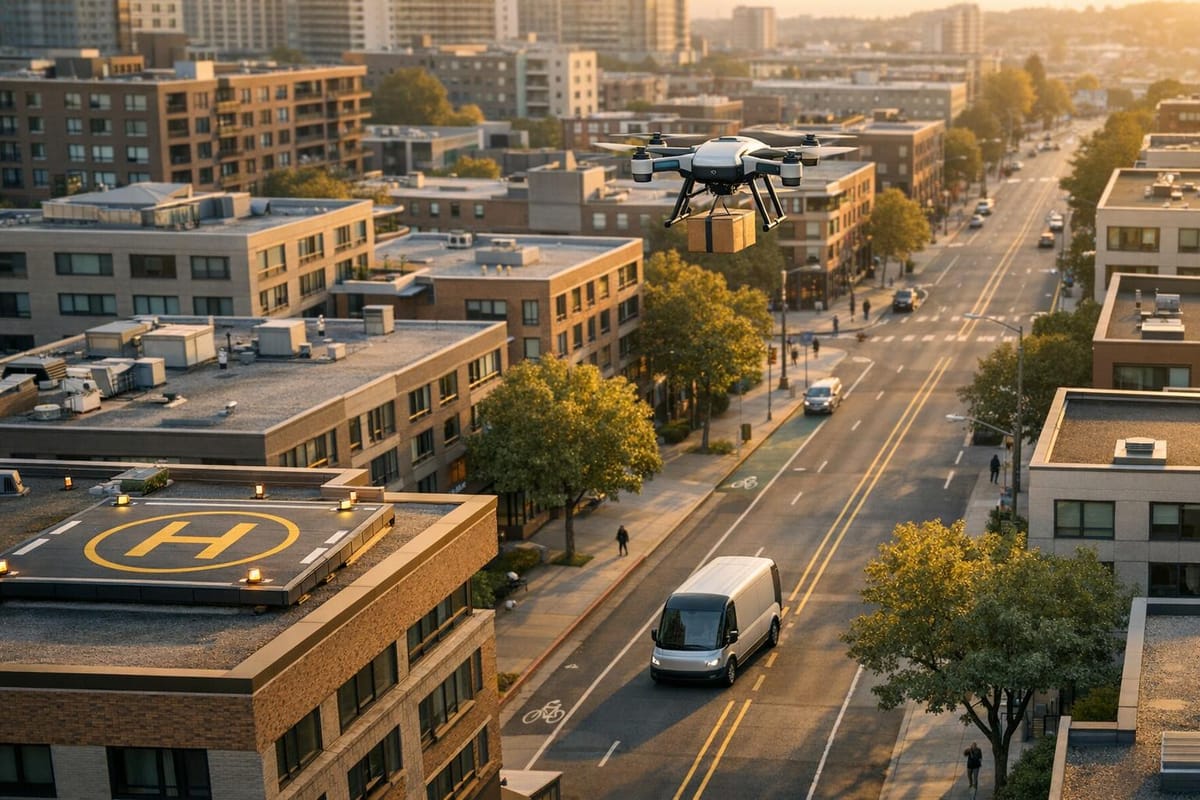
Last-mile delivery is the most expensive and complex part of the supply chain, with rising e-commerce demand straining urban infrastructure. Drones and autonomous vehicles (AVs) are emerging as alternatives to traditional delivery methods, aiming to reduce costs, congestion, and emissions. Here's what you need to know:
- Drones: Offer fast, low-cost delivery for lightweight parcels. They can cut delivery emissions by up to 71% compared to diesel trucks. However, they face challenges like limited payloads, high energy use for take-offs, and public concerns over noise and privacy.
- Autonomous Vehicles (AVs): Ideal for urban areas, carrying heavier loads with quieter operations. They reduce delivery costs by up to 68% and can operate 24/7. But they require significant infrastructure, such as micro-hubs and accessible pavements, and are slower than drones.
Key Takeaway: Drones excel in speed and emissions reduction for small parcels, while AVs are better suited for urban settings with larger loads. Combining both could optimise delivery systems, balancing efficiency and cost.
1. Drones
Infrastructure Requirements
Urban drone deliveries hinge on a blend of physical and digital infrastructure. Cities need to establish vertiports, designated landing zones, and nearby hubs to support drone operations. To address limited ground space, rooftop facilities equipped with automated charging and maintenance systems have been suggested.
Equally important are robust communication networks. For drones to function effectively, real-time tracking, air traffic management, and Beyond Visual Line of Sight (BVLOS) operations must be supported. From 1 January 2026, drones are also required to broadcast their identification and location data using Direct Remote ID systems to ensure safe airspace sharing. Interestingly, delivery vans can double as mobile drone launch platforms, extending the range of operations and enabling multiple deliveries in a single mission.
Charging infrastructure poses another challenge, particularly in urban areas. Strict regulations in cities can demand a 223% increase in charging stations compared to less regulated regions, with these stations accounting for roughly 8% of total delivery costs. Such requirements highlight the complexities of scaling drone operations in densely populated areas.
Scalability
Although drones perform well in rural areas, scaling their use in crowded cities is far more complex. Most drones are designed to carry just one parcel per trip, meaning high-volume operations would require extensive fleets and additional landing infrastructure. Frequent take-offs and landings in urban settings also consume significant amounts of energy, which can make drones less efficient than electric trucks for short inner-city routes.
Currently, only about 7% of EU citizens have access to drone delivery services, but with better infrastructure, this figure could rise to 30%. A noteworthy example is the UK's first BVLOS medical deliveries in 2020, conducted by the startup Skyports. These drones transported PPE between hospitals in Scotland during the COVID-19 pandemic. However, public acceptance remains a hurdle. Only 11% of Americans are comfortable with drones operating near their homes, and a trial in Canberra, Australia, saw Google Wing’s service shut down due to community opposition. These scalability issues directly impact the economic feasibility of drone delivery systems.
Cost Efficiency
Drones offer a significant cost advantage over traditional delivery methods. Delivery costs for drones range from £0.02 to £0.05 per parcel under relaxed regulations, compared to £0.95 to £1.50 for electric or diesel trucks. Labour costs, which make up 44–70% of truck delivery expenses, drop to just 6% for drone-based systems thanks to automation. In 2025, Manna Aero reported profitability over a 3.4 km range, charging customers around £1.75 per trip.
For drones to achieve large-scale profitability, operators need to bring delivery costs below £5 per trip, a significant drop from current averages of £22. Encouragingly, 86% of last-mile deliveries involve parcels weighing less than 2.25 kg, which aligns well with the payload capacities of most drones. These cost dynamics are closely tied to their environmental performance.
Environmental Impact
Drones can reduce last-mile delivery emissions by up to 71% compared to diesel trucks and use as much as 94% less energy per package than traditional vehicles. However, their environmental benefits vary based on location. In urban areas with short delivery distances, electric trucks often outperform drones, emitting 75% to 92% less due to the high energy demands of drone take-offs and landings.
"Large drones have lower emissions than diesel trucks for deliveries in rural areas and... drones don't compete with electric trucks, mainly due to the high energy demand required for take-off and landing for each delivery." – Nature, 2023
The source of electricity also plays a crucial role. For instance, using a European electricity mix can increase drone emissions by up to five times compared to cleaner grids like Sweden’s. A standout example is Zipline, which has flown over 1 million kilometres and completed more than 13,000 deliveries in Rwanda as of 2023. Their operations deliver 35% of the country’s blood samples for transfusion outside the capital, cutting delivery times from a full day to just 30 minutes. Transitioning to renewable energy for drone operations could reduce their emissions by 87.5% to 97.5% during their utilisation phase.
2. Autonomous Vehicles (AVs)
Infrastructure Requirements
For autonomous vehicles (AVs) to thrive, cities need to invest in both physical and digital infrastructure. One key element is the creation of micro-hub networks - local depots designed to dispatch autonomous delivery robots (ADRs). These hubs are especially important in dense urban areas where space is limited.
Another essential component is a widespread automated charging network. Cities must establish numerous recharging stations where AVs can autonomously recharge or swap their batteries. Traditional delivery vans can also act as mobile hubs, extending the delivery network's reach and flexibility.
On the digital side, high-speed 5G and broadband connectivity play a critical role. These technologies enable real-time data sharing, telematics, and seamless coordination between AV fleets and their central management systems. In the UK, advanced telematics is particularly important for smooth operations. Urban infrastructure will also need adjustments - such as redesigned sidewalks - to minimise conflicts between ADRs and pedestrians. Currently, ADRs spend around 30% of their time halted due to pedestrian interference.
This combination of physical and digital upgrades lays the groundwork for efficient and scalable AV operations in urban settings.
Scalability
Scaling AV operations in busy cities depends on several factors, including the width of sidewalks, pedestrian traffic levels, and the strategic placement of micro-hubs. Sidewalk ADRs, which typically travel at 3–6 km/h and carry around 10 kg or a single parcel, are only efficient when deployed in well-coordinated fleets.
Two main models are emerging for ADR deployment:
- Truck-based model: A van acts as a mobile hub, deploying multiple ADRs in a given area.
- Hub-based model: Fixed micro-hubs serve as central points for ADR operations.
For instance, Starship Technologies operates ADR services in cities like London and Washington, DC. Their robots, capable of carrying up to 9 kg, operate within a 6.4 km radius of their hubs. However, since ADRs typically deliver one parcel at a time, they may use more space compared to traditional delivery vans.
Cost Efficiency
One of the biggest advantages of AVs is their potential for cost savings. Systems using truck-based ADRs can cut last-mile delivery costs by up to 68%, primarily by reducing labour costs, which account for 70–76% of traditional delivery expenses. Unlike human drivers, AVs can operate 24/7 without breaks or salaries, further enhancing efficiency.
"The cost of delivering one unit is under £1 per delivery, which is 15 times less expensive than other delivery services used for the same purpose." – Hoffmann and Prause
The upfront cost of ADRs is also manageable. For example, Starship Technologies' units are priced at approximately £4,700 each (converted from $5,500). Additionally, AI-powered route optimisation can increase fleet capacity by 25% and cut planning time by 75%. The upcoming February 2025 introduction of sidewalk delivery robots on Uber Eats in Jersey City highlights the growing commercial appeal of these systems.
Environmental Impact
Autonomous vehicles offer significant environmental benefits by reducing the need for traditional delivery trucks. Studies suggest that AVs can lower local emissions by up to 60%. Pilot programmes using electric autonomous vans have shown a 40% drop in emissions while also cutting long-term operating costs by 25%, thanks to reduced fuel and maintenance expenses.
Integrating ADRs with public transport systems - such as using buses or trams to bring robots closer to delivery zones - can further reduce costs by up to 7.5% and help cut emissions. The launch of Level-4 fully autonomous "robovans" by Cainiao (Alibaba’s courier division) in September 2024 marks a shift towards larger, more capable vehicles that promise improved delivery efficiency on public roads.
Autonomous drone deliveries are taking off
Pros and Cons
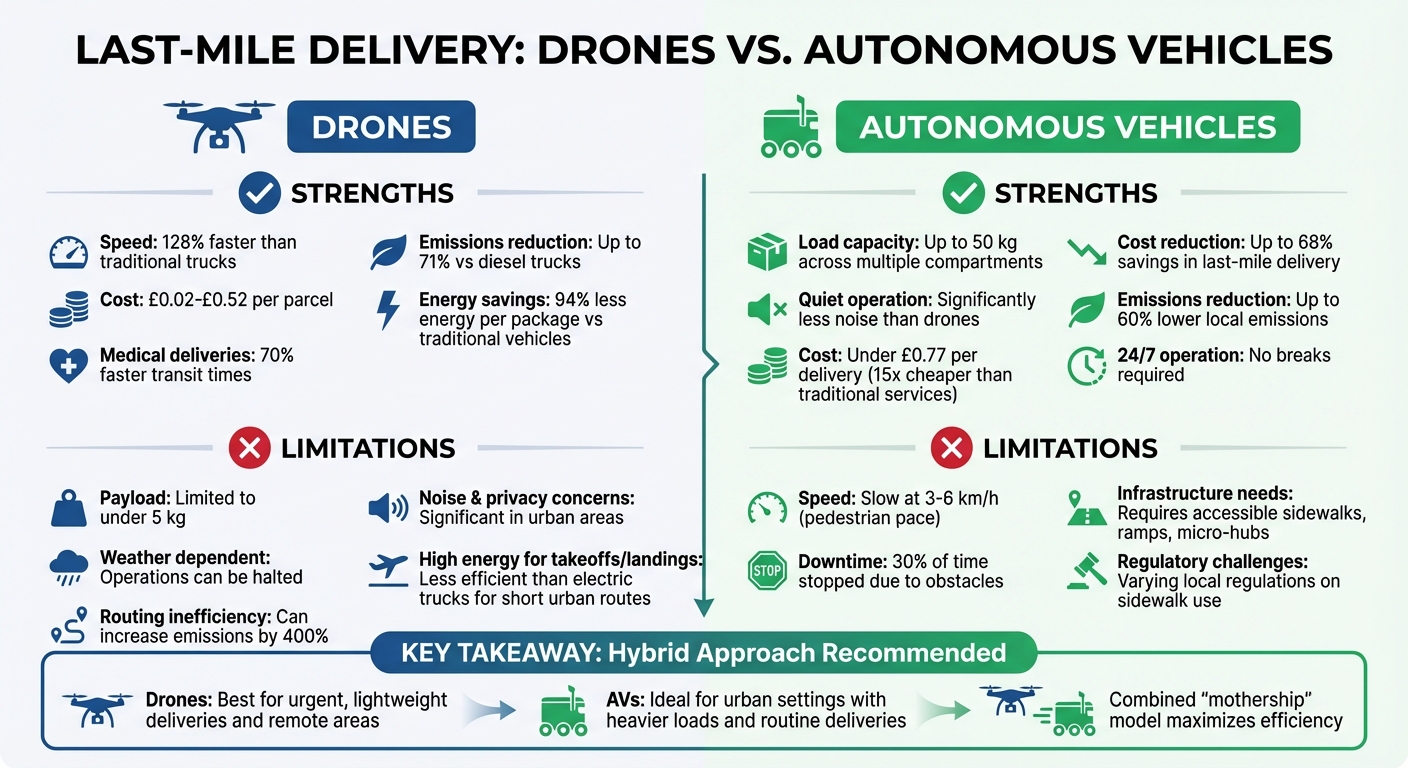
Drones vs Autonomous Vehicles for Last-Mile Delivery: Cost, Speed, and Environmental Impact Comparison
This section breaks down the trade-offs of using drones and autonomous vehicles for urban last-mile delivery, highlighting their respective strengths and limitations.
Drones excel in speed and cost efficiency. By completely avoiding road traffic, drones can deliver parcels 128% faster than traditional trucks. They’re also extremely cost-effective, with delivery costs ranging from £0.02 to £0.52 per parcel, depending on regulations and demand density. In urgent scenarios, such as delivering medical supplies, drones can slash transit times by up to 70%, making them a valuable tool in healthcare logistics. These benefits align with earlier findings on their cost and energy performance.
But drones aren’t without challenges. Their payload capacity is small - typically limited to under 5 kg - making them suitable only for lightweight parcels. Weather conditions and airspace restrictions can halt operations, and inefficient routing under such circumstances can increase emissions by up to 400%. Additionally, noise and privacy concerns remain significant hurdles, particularly in dense urban areas. Frequent take-offs and landings also demand high energy, which can make drones less eco-friendly than electric trucks for short-range deliveries.
While drones are ideal for small, urgent deliveries, autonomous vehicles (AVs) bring different strengths to the table.
Autonomous vehicles prioritise load capacity and quieter operations. These vehicles can carry heavier loads - up to 50 kg across multiple compartments - and operate with minimal noise, causing less disruption to residents.
"As SUGVs emit significantly less noise than UAVs, we assume that SUGVs have an additional advantage for usage in autonomous urban last mile delivery from a resident's perspective".
Their operating costs are also impressively low, at under £0.77 per delivery, making them around 15 times cheaper than traditional human-led delivery services.
However, AVs face their own set of drawbacks. They’re relatively slow, moving at pedestrian speeds of 3–6 km/h, and spend about 30% of their time stopped due to obstacles like pedestrian traffic or crossings. They also require significant infrastructure support, such as accessible sidewalks, ramps, and micro-hubs, and must navigate varying local regulations on sidewalk use and weight limits.
Conclusion
Choosing between drones and autonomous vehicles for deliveries largely depends on the specific requirements of the task. Drones excel in speed, cutting down transit times significantly. Their ability to bypass ground traffic makes them perfect for urgent deliveries, emergency supplies, or accessing remote areas. On the other hand, ground-based autonomous vehicles shine in bustling urban settings.
In cities, autonomous vehicles are often the preferred choice. They are quieter, operate seamlessly in pedestrian-friendly zones, and are ideal for tasks like grocery deliveries, food services, and routine parcels. Additionally, they generally carry larger payloads and offer cost-effective solutions in high-demand areas.
A combined approach could be the key to maximising delivery efficiency. For instance, a hybrid "mothership" model - where delivery vans deploy drones or ground robots - can expand coverage while lowering costs.
When it comes to infrastructure, each technology has unique requirements. Drones need vertical launch pads and charging stations, while autonomous vehicles benefit from accessible pavements and local micro-hubs. Regulatory challenges also play a significant role. Integrated fleet management tools, such as those offered by GRS Fleet Telematics (https://grsft.com), can help streamline operations and unify the strengths of both delivery methods.
FAQs
What challenges do drones face in urban last-mile delivery?
Drones face several hurdles when it comes to urban last-mile delivery. One of the main obstacles is their limited flight range. They need to strike a balance between conserving energy and maintaining delivery efficiency, which can be tricky. On top of that, their payload capacity is generally quite small, making it challenging to carry heavier packages or sensitive goods.
Urban settings bring their own set of complications, too. Issues like airspace management can get particularly tricky, especially with the need to comply with strict regulations, such as Beyond-Visual-Line-of-Sight (BVLOS) rules. These are even tougher to navigate in crowded, densely populated areas. Beyond the technical and regulatory challenges, there’s also the matter of infrastructure gaps, winning over public approval, and ensuring advanced safety measures are in place. Overcoming these barriers is crucial if drones are ever to become a practical and reliable option for urban deliveries.
How do drones and autonomous vehicles compare in terms of environmental impact?
Drones and autonomous vehicles (AVs) each have their own effects on the environment, shaped by how they consume energy and operate. Drones, for instance, tend to generate fewer emissions than diesel delivery vehicles, particularly in rural areas where traditional engines struggle with efficiency. But there’s a catch - drones use a lot of energy during take-off and landing. This can reduce their environmental edge, especially when compared to electric vehicles.
Drones also shine when it comes to speed and cost-effectiveness, especially for deliveries in remote or hard-to-reach places. However, their environmental footprint hinges on factors like the energy source used for charging and the drone's size. On the other hand, AVs - especially electric models - are a better fit for urban deliveries. They offer more scalability and produce fewer emissions over longer distances.
Ultimately, both technologies have their niches. Drones are ideal for specific, often rural scenarios, while AVs provide a greener solution for city logistics.
What infrastructure is needed to enable drones and autonomous vehicles for urban deliveries?
To make drones and autonomous vehicles (AVs) practical for last-mile deliveries in cities, certain infrastructure pieces need to be in place. A key component is automated docking and charging systems for drones. These systems allow drones to operate continuously by enabling quick recharges and fast turnarounds. Plus, they’re designed to handle multiple drones at once, making them essential for scaling up operations.
Another critical piece is air traffic management systems, especially for Beyond Visual Line of Sight (BVLOS) operations in busy urban areas. These systems ensure compliance with regulations and include features like safety protocols, detect-and-avoid technologies, and designated landing zones. Such measures help maintain secure and efficient deliveries from the air.
On the ground, advanced telematics solutions - like GRS Fleet Telematics - play a key role. They enable real-time tracking, improve security, and ensure smooth coordination between AVs and drones. By integrating these technologies into urban logistics, cities can establish a solid foundation for safe and efficient delivery systems.