Lifecycle Management for IoT Fleet Devices
Practical guide to planning, deploying and securing IoT trackers for UK fleets, comparing Essential, Enhanced and Ultimate models, OTA updates and decommissioning.
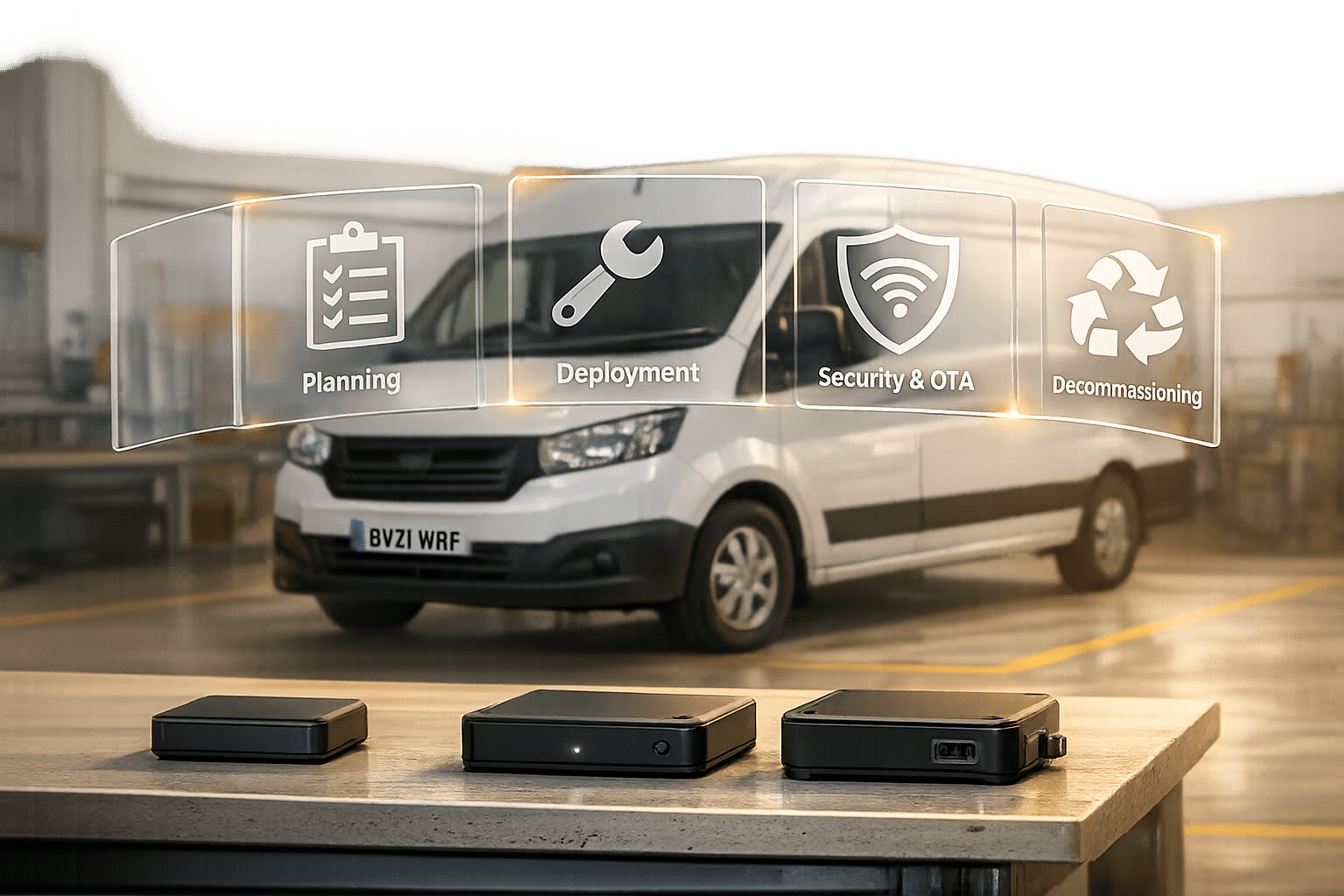
Managing IoT devices across a fleet involves five stages: planning, deployment, operation, optimisation, and decommissioning. Each stage ensures secure handling, compliance with UK regulations, and efficient performance. Here's what you need to know:
- Onboarding: Devices are authenticated with Secure Boot and configured for zero-touch provisioning to reduce errors.
- Operation: Over-the-air (OTA) updates address vulnerabilities, while network segmentation limits risks.
- Maintenance: Automated alerts based on real-time data help reduce unnecessary servicing.
- Decommissioning: Cryptographic methods ensure secure data erasure and certificate revocation.
For UK fleets, GRS offers three tracker models, each tailored to different needs:
- Essential Tracker (£35): Basic tracking and OTA updates. Suitable for small fleets.
- Enhanced Tracker (£79): Dual-tracker system for added security, with a 91% recovery rate.
- Ultimate Tracker (£99): Includes remote immobilisation and advanced data security features.
Key takeaway: Choosing the right tracker depends on your fleet size, budget, and security priorities. Larger fleets benefit from advanced features, while smaller fleets can opt for cost-effective solutions.
1. GRS Essential Tracker
Deployment Cost
The GRS Essential Tracker is priced at £35 for the hardware, with a monthly fee of £7.99 per vehicle (excluding VAT). Installation costs range from £40 to £100, but fleets using branding services can benefit from free installation, bringing the initial cost down to just £35. For UK fleet operators working within tight budgets, this entry-level tracker offers real-time tracking without the advanced features of higher-tier models. A great example of its impact comes from WGM Engineering Group, which achieved a 22% reduction in fuel costs through route optimisation and driver behaviour monitoring.
Update Mechanisms
Firmware updates are handled remotely via built-in cellular modules, with hourly synchronisation managed by the Intune Management Extension. The system automatically retries any failed updates, ensuring devices stay up-to-date without requiring physical access. This streamlined process not only keeps the system secure but also reduces the need for manual intervention, making maintenance more efficient.
Maintenance Automation
The Essential Tracker takes a proactive approach to maintenance by adapting schedules based on actual usage. Maintenance alerts are triggered by real-time engine hours and mileage data, ensuring that servicing aligns with the vehicle's actual wear and tear. This approach helps avoid unnecessary visits to the workshop while addressing potential issues before they become major problems.
Jo McGarvie, Plant Manager at JMC Construction, shared: "Since having the trackers on our vehicles and plant, productivity has increased during the day".
Redundancy Features
Unlike the Enhanced (£79) and Ultimate (£99) models, the Essential Tracker does not include dual-tracker technology with GPS and Bluetooth backups. While this makes it less suited for safeguarding high-value assets against theft or GPS jamming, it keeps costs low for operators prioritising basic tracking needs. This design reflects a focus on balancing affordability with essential functionality, making it a practical choice for fleets aiming to optimise their operational investments.
Managing a connected AWS IoT device fleet | Amazon Web Services
2. GRS Enhanced Tracker
The Enhanced Tracker builds on the Essential Tracker's foundation, offering additional security features, improved redundancy, and extended data retention. It's designed for fleets that prioritise both safety and operational reliability.
Deployment Cost
The GRS Enhanced Tracker is available for £79 (hardware cost), with a monthly subscription of £7.99 per vehicle (excluding VAT). Installation typically starts at £145, but this fee can be waived if you combine the tracker purchase with GRS Fleet Branding services. On average, users of GRS tracking solutions report annual savings of £14,694.25 per fleet, making this model a practical choice for businesses looking to enhance security while controlling operational costs.
Redundancy Features
This tracker incorporates a dual-layer system: a primary hardwired GPS unit and a secondary hidden Bluetooth device. If the main GPS tracker is tampered with or disabled, the Bluetooth backup continues transmitting location data. This dual setup has increased vehicle recovery rates to 91%.
The Enhanced Tracker also combats signal jamming by using both cellular and satellite networks, ensuring location accuracy within 1.8 metres. It delivers real-time updates every 60 seconds and holds Thatcham S5/S7 certification, which can help reduce insurance premiums by 5% to 20%. Additionally, it stores up to 365 days of journey history, significantly more than the 100 days offered by the Essential Tracker.
"What sets this dual-tracker system apart is its pairing of a primary wired unit with a Bluetooth backup. This ensures vehicles remain traceable, even in cases of tampering." - GRS Fleet Telematics
A UK-based delivery company experienced a 30% drop in unauthorised vehicle use after adopting the GRS Enhanced Package in 2025. The dual-tracker technology also enabled the recovery of a stolen van within 24 hours of a theft alert.
Update Mechanisms
The Enhanced Tracker takes a step forward in reliability with its advanced update system. Firmware updates are delivered securely over-the-air (OTA) via cellular networks (GSM/GPRS), using fail-safe protocols to verify packages before installation. By employing incremental updates, it only downloads and installs the modified portions of code, reducing downtime and minimising bandwidth usage.
The system's dual-partition architecture ensures seamless updates. New firmware is installed on an inactive partition, allowing an immediate switchover once the update is verified. To avoid disruptions, updates can be scheduled during low-usage periods.
Maintenance Automation
This model integrates with the vehicle's ECM (Engine Control Module), automatically tracking daily mileage and engine hours. This ensures maintenance schedules align with actual usage rather than relying on manual logs. Real-time diagnostic monitoring sends alerts for diagnostic trouble codes (DTCs), enabling managers to address issues promptly and avoid costly breakdowns.
Automated service reminders - delivered via email, web dashboards, and mobile notifications - help fleet operators stay on top of maintenance tasks, including MOT deadlines. One business in Medway saved £2,000 annually on repair costs by using these features to identify and resolve vehicle health issues before they escalated.
3. GRS Ultimate Tracker
The Ultimate Tracker from GRS Fleet Telematics is their most advanced solution, designed for businesses that demand high performance, security, and compliance. It's built to handle the challenges of long-term fleet operations, offering enterprise-level reliability and secure protocols for the entire lifecycle of the device.
Deployment Cost
The Ultimate Tracker hardware is priced at £99, with a monthly subscription of £7.99 per vehicle (excluding VAT). Installation typically costs £145, but this fee is waived if you opt for GRS Fleet Branding services. On average, businesses using the Ultimate Tracker save £14,700 per vehicle annually, thanks to AI-driven route optimisation that can cut fuel expenses by 10–20% within the first year.
Redundancy Features
In addition to the dual-tracker setup found in the Enhanced model, the Ultimate Tracker includes remote immobilisation, allowing fleet managers to disable a vehicle's engine remotely if unauthorised use is detected.
The system's data storage is powered by geo-redundant storage (GRS), which synchronously replicates data in a primary location and asynchronously backs it up to a secondary site hundreds of miles away. This setup ensures an impressive data durability rate of 16 nines (99.99999999999999%) over a year. Even in the event of a regional outage or natural disaster, the system automatically switches to a secondary read-only endpoint, keeping critical data accessible.
"Geo-Redundant Storage is built to keep your data available - even when the unexpected happens. It's not just redundancy. It's resilience by design." - Delinea Glossary
This robust infrastructure also supports advanced update capabilities.
Update Mechanisms
The Ultimate Tracker comes with a lifetime flat-rate Firmware Over-the-Air (FOTA) licensing model, which eliminates unpredictable recurring cloud costs by consolidating them into a one-time fee per device. This approach complies with the EU Cyber Resilience Act, ensuring secure and traceable firmware updates throughout the device's lifecycle. Updates are deployed in staged rollouts with built-in analytics, so fleet managers can evaluate performance before applying updates across the entire fleet. If any issues arise, the system can automatically revert to a previous firmware version.
"Preparing for compliance with the EU Cyber Resilience Act is going to add significant operational overhead and project complexity for device manufacturers." - François Baldassari, VP Software Services, Nordic Semiconductor
The Ultimate Tracker also supports proactive maintenance, offering real-time alerts and monitoring to help reduce maintenance costs by up to 20%.
Decommissioning Security
When the device reaches the end of its lifecycle, the Ultimate Tracker ensures data security through cryptographic erasure, which destroys encryption keys and renders stored data unreadable. Firmware is fully removed to prevent unauthorised reuse, and storage media can be physically destroyed if needed. Automated deletion schedules align with data minimisation principles, while all data is safeguarded with AES-256 encryption at rest and TLS 1.3 during transit. Additional protection is provided by Trusted Platform Modules (TPMs) and Hardware Security Modules (HSMs), which store encryption keys in tamper-proof environments.
"When done effectively, encryption renders data unreadable to anyone without authorised access... protecting your data with some form of encryption is necessary to mitigate risks." - David Grady, Chief Cybersecurity Evangelist, Verizon Business Group
Advantages and Disadvantages
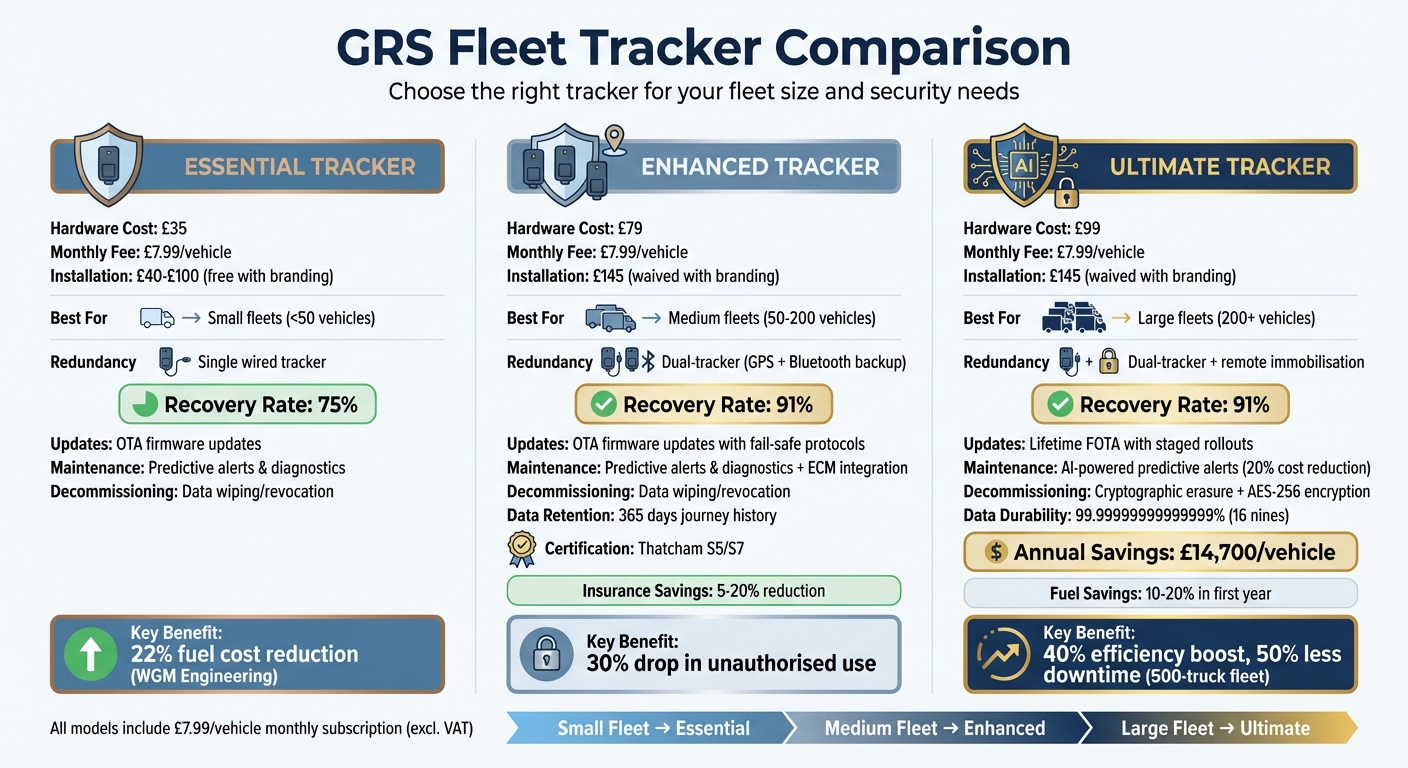
GRS IoT Fleet Tracker Comparison: Essential vs Enhanced vs Ultimate Models
When it comes to lifecycle management, choosing the right GRS tracker model boils down to weighing upfront costs against long-term benefits like security and operational efficiency. Here's a closer look at the pros and cons of each model.
The Essential Tracker is priced at £35 and provides basic real-time tracking along with predictive diagnostics. It achieves a 75% recovery rate but lacks the dual-tracker redundancy that higher-tier options offer.
Stepping up, the Enhanced Tracker (£79) combines a hardwired GPS unit with a hidden Bluetooth backup. This dual-tracker setup significantly improves the recovery rate to 91%, ensuring traceability even if the main tracker is compromised. It also includes OTA (over-the-air) updates and predictive maintenance alerts. However, it doesn't feature remote immobilisation.
At the top of the range, the Ultimate Tracker (£99) offers the most comprehensive solution. It includes remote engine immobilisation and uses cryptographic erasure for secure decommissioning. This feature ensures that encryption keys are destroyed, reducing the risk of retired devices becoming cybersecurity threats.
| Feature | Essential | Enhanced | Ultimate |
|---|---|---|---|
| Deployment Cost (£) | £35 | £79 | £99 |
| Redundancy Features | Single wired tracker | Dual-tracker (GPS + Bluetooth) | Dual-tracker with remote immobilisation |
| Update Mechanisms | OTA firmware updates | OTA firmware updates | OTA firmware updates |
| Maintenance Automation | Predictive alerts & diagnostics | Predictive alerts & diagnostics | AI-powered predictive alerts (up to 20% cost reduction) |
| Decommissioning Security | Data wiping/revocation | Data wiping/revocation | Cryptographic erasure |
| Recovery Rate | 75% | 91% | 91% |
Though the Ultimate Tracker comes with a higher price tag, its AI-powered route optimisation can lead to fuel savings of 10–20% in the first year. Additionally, businesses can sidestep the £145 installation fee per vehicle by bundling the tracker with GRS fleet branding services. This makes the Enhanced and Ultimate models attractive options for companies prioritising long-term security and regulatory compliance.
This comparison underscores how each tracker strikes a balance between cost and advanced features to support efficient IoT lifecycle management.
Conclusion
Managing the lifecycle of IoT devices in fleet operations relies heavily on aligning the tracker’s features with the specific needs of the fleet. All GRS tracker models come with a monthly subscription fee of £7.99 per vehicle (excluding VAT), with differences primarily in hardware costs and functionality.
For fleets with fewer than 50 vehicles, the Essential Tracker priced at £35 is a budget-friendly option. It provides real-time tracking and basic lifecycle management via OTA updates, making it a solid choice for startups focusing on affordability. For instance, a UK logistics company managing 30 vans reported a 15% reduction in costs after adopting the Essential Tracker.
Medium-sized fleets, ranging from 50 to 200 vehicles, can benefit from the Enhanced Tracker, which costs £79. Featuring dual-tracker technology, it boasts a 91% recovery rate and centralised management for firmware updates. One fleet of 100 vehicles achieved 25% less downtime and maintained the 91% recovery rate, showcasing how efficient maintenance can directly reduce costs.
Larger fleets with over 200 vehicles may find the Ultimate Tracker, at £99, particularly advantageous. It leverages AI-driven predictive maintenance and automated workflows to prevent failures before they lead to breakdowns. A 500-truck operator reported a 40% boost in efficiency, cutting unplanned downtime in half while maintaining the same 91% recovery rate. Additional features like remote immobilisation and cryptographic erasure enhance security during decommissioning.
Both the Enhanced and Ultimate models uphold the 91% recovery standard, with the Ultimate Tracker offering advanced tools for secure and efficient fleet management. By simplifying provisioning, updates, and decommissioning, these trackers ensure compliance with UK regulations while supporting robust IoT lifecycle management.
Ultimately, effective IoT lifecycle management revolves around balancing security, scalability, and cost-efficiency. Choosing the right tracker ensures your fleet operates smoothly, whether it’s scaling for growth or securely retiring outdated devices. Matching your tracker to your fleet size and future needs is key to achieving operational efficiency and long-term success.
FAQs
Which tracker is best for my fleet size?
The right tracker for your fleet comes down to your security priorities and budget. For smaller fleets, the Essential Package (£35) provides basic tracking with a 75% recovery rate - a solid choice for straightforward needs. If you're looking for more advanced protection, the Enhanced (£79) or Ultimate (£99) Packages step things up with features like Bluetooth backup or remote immobilisation, both offering a 91% recovery rate. Pricing for all packages starts at £7.99 per vehicle per month.
How do OTA updates avoid disrupting vehicles?
Over-the-air (OTA) updates help reduce vehicle downtime by combining automated alerts, real-time health monitoring, and scheduled updates or maintenance based on diagnostic insights. This forward-thinking system helps avoid sudden breakdowns and keeps vehicles running smoothly.
What happens to data when a tracker is decommissioned?
When a tracker is taken out of service, its data is securely erased to protect it from unauthorised access. This process ensures sensitive information is disposed of safely and aligns with data protection standards, maintaining security throughout the device's entire lifecycle.