How to Integrate Voice Biometrics in Fleets
Integrate voice biometrics into fleets: hardware, software, GDPR compliance, enrolment, and telematics integration.
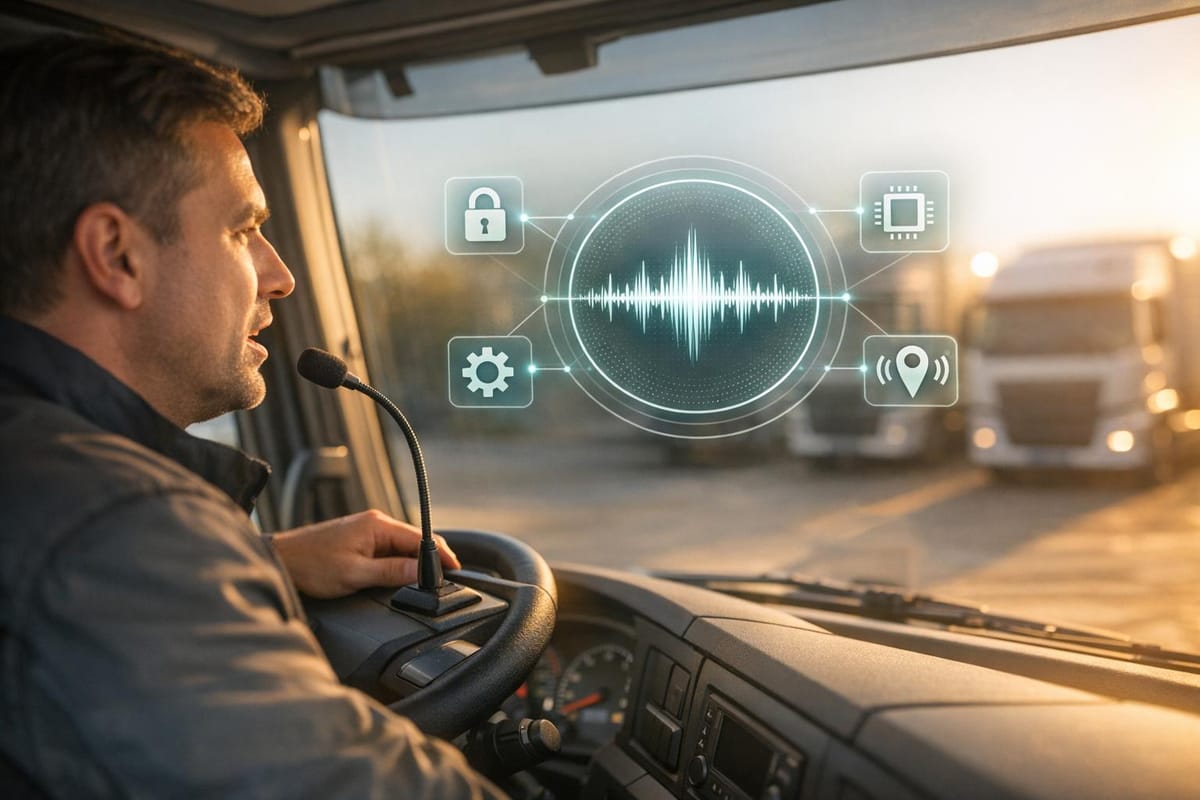
Voice biometrics is transforming fleet security by verifying drivers' identities through their unique vocal traits. Unlike PINs or RFID cards, which can be shared, this technology ensures only authorised drivers can access vehicles. Here's how it works:
- Driver Verification: Uses encrypted voiceprints compared to real-time voice samples.
- Fast Authentication: Takes less than 2 seconds, ensuring smooth operations.
- Data Security: Processes voice data locally, with encrypted templates protecting privacy.
- Fleet Integration: Links verified drivers to GPS, trip data, and safety events for accountability.
To implement, you'll need in-cab microphones, edge processing units, and GDPR-compliant systems. Drivers enrol by recording natural speech, creating voice profiles linked to telematics platforms. The result? Improved security, accurate driver tracking, and reduced risks. Whether you're managing a small or large fleet, voice biometrics can streamline access control while safeguarding data.
Voice Biometric solution by Accura Scan

Preparing Your Fleet for Voice Biometrics Integration
Before implementing voice biometrics in your fleet, ensure your infrastructure meets both technical and legal requirements. This preparation is key to ensuring the system operates reliably, even in areas with patchy connectivity, and that driver data is handled in line with UK regulations. Below, we cover the essential hardware, software, and legal steps needed for a smooth rollout.
Required Hardware and Equipment
Start by installing in-cab microphones that connect to van tracking solutions via a telematics gateway. These microphones capture driver voice samples, while the gateway combines verification results with operational data, creating a comprehensive audit trail for each journey.
Edge processing units are a must for maintaining continuous driver verification in areas with poor connectivity. These on-device processors convert raw voice data into encrypted templates locally, allowing authentication to proceed even when offline. Without this, drivers in remote areas could face delays in verification.
Your server-side hardware also needs to meet specific standards. A high-speed CPU of at least 3 GHz is required, with an 8-core processor recommended for fleets with 50–100 concurrent users [[3]](https://help.ivanti.com/ht/help/en_US/Voice/2022.3/User-Help/Voice-OLH/Installation and Deployment/03b_Hardware_and_Network_Requirements.htm). At least 2 GB of RAM is necessary, but larger fleets should allocate more memory for call recording and RAID storage. If integrating with existing communication systems, ensure all gateways and IP phones comply with RFC-3261 SIP/2.0 UDP standards to handle voice signals effectively.
| Component | Minimum Requirement | Scalability Recommendation |
|---|---|---|
| Server CPU | 3 GHz (2-core) | 8-core (for 50–100 concurrent users) |
| Server RAM | 2 GB | Higher for call recording/RAID storage |
| Network | 100-Mbit LAN | 1 Gbps connection for SQL backends |
| Storage | 2 GB HDD | Separate RAID server for recording logs |
Software and Platform Requirements
Once hardware is ready, your software must securely manage and process the data. A key feature to look for is passive verification, which allows drivers to authenticate naturally during conversations without needing to memorise specific phrases. This simplifies the process and speeds up identity checks - modern systems can verify identities in as little as three seconds.
Anti-spoofing measures are also critical. The software should be capable of distinguishing a live human voice from pre-recorded audio or deepfake attempts. This ensures both security and compliance with data protection laws.
Seamless integration with your telematics platform is another essential. The software should automatically timestamp authentication events and log GPS coordinates, creating a verified identity trail for every trip. For payroll and compliance purposes, choose platforms with features like exception handling and audit trails. These help supervisors manage missed punches, approve manual overrides, and maintain tamper-proof logs of all access attempts.
"Voice biometrics reduces customer verification time by more than 95%. The average busy IVR time is 90 seconds with traditional methods, while it becomes 5 seconds with this solution." - Héctor Estella, VoIP Manager, Mutua Madrileña
GDPR and Data Protection Compliance
Under Article 4 of the UK GDPR, voice patterns are classified as biometric data when processed using technical methods to identify physical or behavioural traits. When used to verify a driver’s identity - such as unlocking a vehicle - this data is further classified as special category data under Article 9, which comes with stricter legal requirements.
To comply, you must establish both a lawful basis under Article 6 (such as legitimate interests or consent) and a specific condition under Article 9 (typically explicit consent). Consent must be clear and freely given. Offer drivers a non-biometric alternative, like a PIN or key, to ensure they are not forced to use biometrics.
Before deploying the system, conduct a Data Protection Impact Assessment (DPIA). This evaluates risks to drivers’ rights and freedoms and ensures the system is necessary and proportionate. Update your privacy notices to explain the purpose of voice data collection, how long it will be retained, and the driver’s right to withdraw consent at any time. Protect stored voice templates with AES-256 encryption and secure data in transit with TLS encryption. These measures not only safeguard driver data but also build the trust needed for secure operations.
How to Implement Voice Biometrics: Step-by-Step
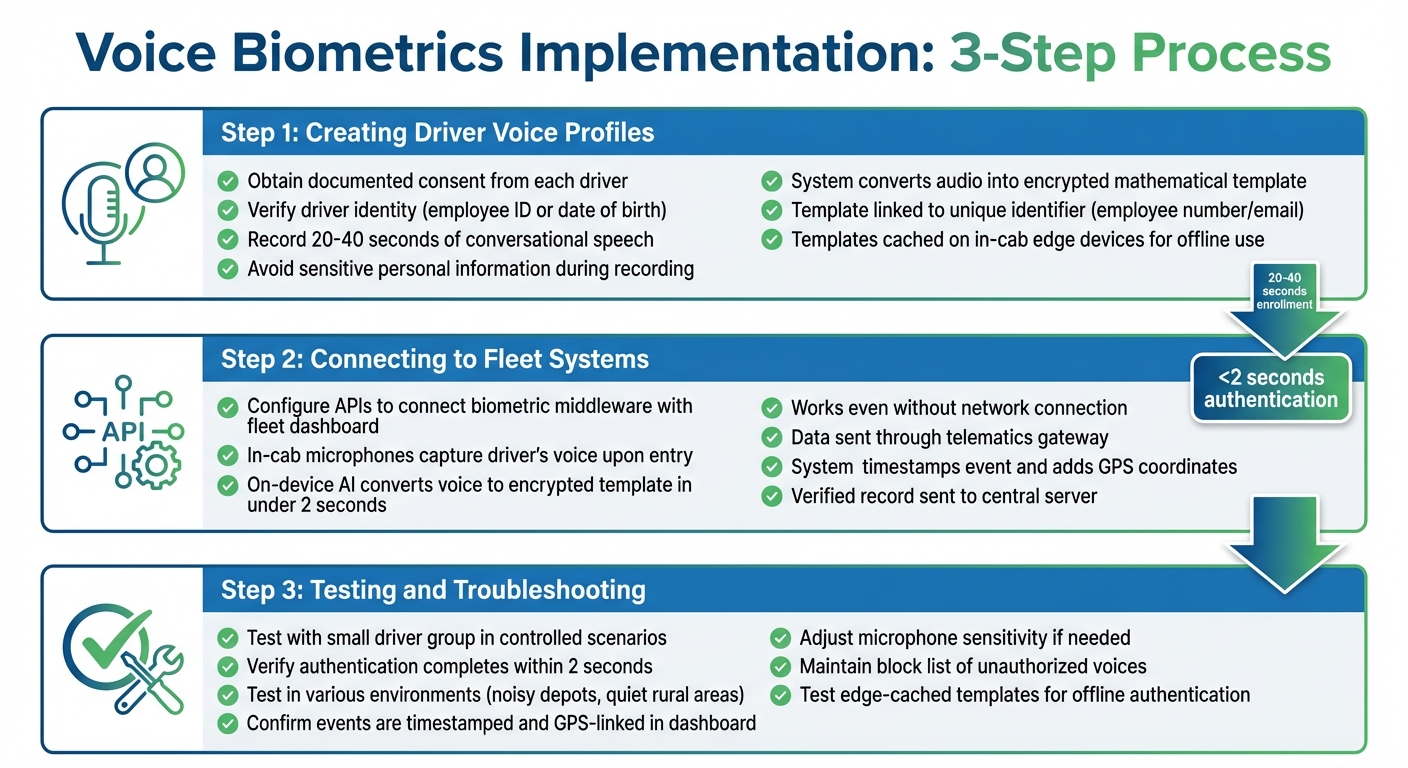
Voice Biometrics Implementation Process for Fleet Management
Once you’ve handled installation and ensured compliance, it’s time to roll out voice biometrics across your fleet. The process involves enrolling drivers, integrating the authentication system with your telematics platform, and ensuring the system operates smoothly in real-world conditions.
Creating Driver Voice Profiles
Before creating a biometric profile, you must obtain clear, documented consent from each driver. Once consent is secured, confirm the driver’s identity using manual authentication methods, like asking for their employee ID or date of birth. This step ensures the voiceprint is tied to the correct individual.
To enrol, drivers need to provide 20 to 40 seconds of conversational speech. There’s no need for them to memorise specific phrases - the system simply records natural dialogue to capture the required audio. During this process, drivers should avoid saying sensitive personal information to prevent it from being included in the baseline recording.
The recorded audio is then converted into a mathematical template - a compact, encrypted representation that cannot be reverse-engineered. This template is securely stored and linked to a unique identifier, such as an employee number or email address. For uninterrupted functionality in remote areas, these encrypted templates can also be cached on in-cab edge devices.
Once driver profiles are set up, the next step is connecting these credentials to your fleet’s telematics platform.
Connecting Voice Authentication to Fleet Systems
To integrate voice authentication with your telematics system, you’ll need to configure APIs that connect the biometric middleware with your fleet dashboard. This setup ensures that key data - such as organisation IDs, driver IDs, and authentication tokens - is logged and attributed to the correct events.
Here’s how the authentication works: microphones installed in the vehicle cab capture the driver’s voice upon entry. In under two seconds, on-device AI converts this into an encrypted template, even when there’s no network connection. The result is sent through the vehicle’s telematics gateway, which timestamps the event and adds GPS coordinates before forwarding it to your central server. This creates a verified record of who is operating the vehicle at any given time.
"Every vehicle start, every trip segment, and every safety event gets linked to a verified human identity. That's not just a security upgrade. It's a complete transformation of how fleets manage accountability and risk." - Etransolutions
This secure data flow forms the foundation for rigorous testing in real-world conditions.
Testing and Troubleshooting
Start by testing the system with a small group of drivers in controlled scenarios. Ensure the authentication process is completed within two seconds, as delays may lead to drivers attempting to bypass the system. Test the system in various settings, from noisy depots to quiet rural areas, to confirm that microphones and edge processors handle different acoustic environments effectively.
Check that each authentication event is correctly timestamped and tied to GPS coordinates in your telematics dashboard. This reinforces the link between driver verification and fleet accountability. If drivers experience authentication failures, investigate whether background noise is interfering with voice capture. If so, adjust the microphone sensitivity as needed.
Additionally, maintain and regularly update a block list of unauthorised or fraudulent voices to prevent spoofing attempts. For fleets operating in areas with poor connectivity, test edge-cached templates to ensure offline authentication remains seamless and without delay.
Improving Fleet Security with Voice Biometrics
Voice biometrics adds an extra layer of protection to your fleet's existing security measures. By incorporating biometric authentication, you create multiple barriers that make it harder for intruders to gain access. This is particularly important in the UK, where statistics show that a van is stolen every 8.5 minutes.
This technology works best when paired with tracking and immobilisation systems. Since voice authentication is tied directly to the individual driver, combining it with real-time monitoring and GPS tracking offers full visibility into who is operating each vehicle and when. Together, these tools create a stronger security framework, making it easier to integrate with advanced tracking systems.
Integration with GRS Fleet Telematics
GRS Fleet Telematics takes this a step further by integrating voice biometrics with its tracking solutions, creating a robust security system. The setup requires voice verification before disarming the tracker and starting the vehicle. If the voice doesn't match an authorised driver, the vehicle remains locked.
The GRS Ultimate package, priced at £99 for hardware, includes remote immobilisation and dual-tracker technology. Voice authentication can trigger immobilisation by cutting power to the starter motor or fuel pump until the driver is verified. This dual-layer defence ensures that even if a thief gains physical access to the vehicle, they cannot operate it without passing the voice check. Impressively, this system has contributed to GRS Fleet Telematics achieving a 91% recovery rate for stolen vehicles.
For fleets spread across different locations, voice biometrics also creates an audit trail linking each vehicle start to a verified driver. If an unauthorised voice is detected, the system can send immediate alerts to fleet managers while keeping the vehicle immobilised. These features not only secure the vehicle but also allow real-time monitoring of access, giving fleet managers greater control.
Restricting Vehicle Access to Authorised Drivers
By building on driver profile data, the system enforces role-based access. It cross-references each driver's voice with an authorised list, logs every access attempt with GPS data, and enables scheduled immobilisation during non-operational hours or when vehicles leave designated zones.
Unlike traditional keys or PINs, which can be shared or stolen, voice authentication is highly secure and difficult to replicate. Every interaction is logged in detail, giving fleet managers a complete record of vehicle usage and ensuring accountability across the board.
Conclusion
Voice biometrics offer a security solution that goes beyond traditional methods like PINs or RFID cards by linking vehicle access to a driver's unique voice. This approach effectively blocks proxy driving and unauthorised use, ensuring only verified drivers can operate the vehicle.
The implementation process is simple: choose the right hardware, enrol drivers by creating voice profiles, integrate the system with your telematics platform, and set up geofencing within a 50–100-metre range. To ensure proper functionality and compliance with standards, professional installation of vehicle electronics is recommended.
In addition to enhancing security, voice biometrics improve operational efficiency by associating every telematics event with a verified driver. This allows for accurate performance tracking and tailored training programmes. Many mid-size fleets report seeing returns on investment within 12–18 months.
These systems are also designed with GDPR in mind, using encrypted templates instead of raw voice recordings to maintain privacy. Regular maintenance and edge processing on the device ensure that authentication is completed in under two seconds.
"The identity of every driver, on every vehicle, on every trip matters. Biometric solutions make that identity verifiable, tamper-resistant, and operationally actionable" - Etranssolutions
For UK fleet industries, adopting voice biometrics is more than an upgrade - it's a critical step towards strengthening both security and operational efficiency.
FAQs
Will voice biometrics work when the vehicle is offline?
Yes, voice biometrics can work offline when paired with local processing capabilities. Offline systems, like those found in voice control technologies, enable biometric verification to function without needing an internet connection. Recent advancements in offline voice recognition ensure consistent performance, even when there’s no connectivity.
How do you stop replay attacks or deepfake voices?
Voice biometrics systems rely on voice liveness detection to guard against replay attacks and deepfake voice threats. This involves using anti-spoofing methods that examine specific audio features to tell the difference between genuine, live speech and recordings.
Studies emphasise the need for end-to-end detection systems that operate independently of wearables. These systems strengthen defences against impersonation attempts, offering a higher level of security for voice authentication technologies.
What’s the quickest way to roll this out across a mixed fleet?
The quickest way to roll out voice biometrics across a mixed fleet is by using a phased strategy. Begin by choosing hardware that allows for easy and fast installation, like plug-and-play devices. Set up the software to work seamlessly with your fleet management system, ensuring it meets UK regulations. Start with a small pilot programme to identify and fix any problems, then scale up gradually. Along the way, offer thorough driver training and maintain clear communication to make the transition as smooth as possible.