How Battery Storage Improves Fleet Energy Management
Battery storage helps fleets cut energy costs, shave peak demand, integrate onsite renewables, avoid grid upgrades and optimise charging with telematics.
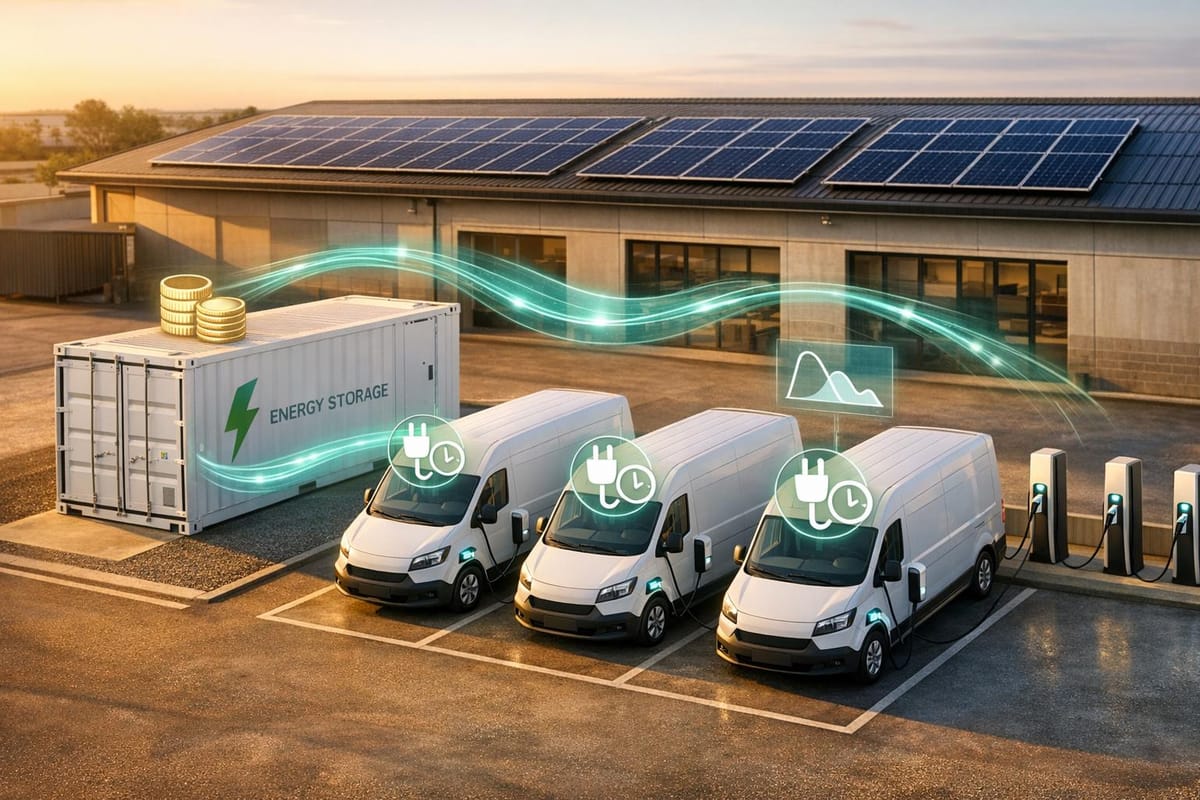
Battery Energy Storage Systems (BESS) are helping fleets save money and manage energy more efficiently. By storing electricity during off-peak hours and using it during peak demand, BESS can lower energy costs by up to 65% and reduce peak power demand by 67%. They also help fleets avoid expensive grid upgrades, support renewable energy use, and provide backup power.
Key Benefits:
- Cost Savings: Smart charging and peak shaving reduce electricity costs.
- Grid Upgrade Avoidance: Up to 40% of grid investment costs can be delayed or avoided.
- Renewable Energy Integration: Use solar or other renewables to power fleets.
- Backup Power: Keep operations running during outages.
- Revenue Opportunities: Sell surplus energy back to the grid.
Practical Steps:
- Assess Energy Needs: Analyse fleet energy consumption, peak demand, and dwell times.
- Choose the Right BESS: Match system capacity to fleet requirements; consider second-life batteries for cost efficiency.
- Integrate with Telematics: Use real-time data from van tracking solutions to optimise charging schedules and monitor energy use.
- Install and Test: Ensure the system handles peak demand and aligns with operational needs.
Fleets using BESS have reported significant savings and improved energy management, making it a practical solution for transitioning to electric vehicles while keeping costs under control.
Overview of Battery Energy Storage Systems
Assessing Your Fleet's Energy Requirements
Understanding how your fleet uses energy is a crucial step before diving into battery storage solutions. Starting with a clear picture of your fleet’s energy consumption and timing ensures you don’t end up with a system that’s either too large or insufficient for your needs. This baseline is the foundation for optimising battery storage and cutting operational costs.
To get this right, gather journey-level data, such as energy consumption in kilowatt-hours (kWh) per trip, journey lengths, and route details. Don’t forget to account for factors like elevation changes, traffic conditions, weather, and payload, as these all affect energy intensity (measured in kWh per mile or kilometre). For instance, when Nottinghamshire Waste Management Depot analysed their 19 diesel refuse collection vehicles over a year, they calculated that switching to electric vehicles would increase their annual energy demand from 234 MWh to 914 MWh, with peak demand reaching 102 kWh.
Another key metric is dwell time, which refers to periods when vehicles are stationary. These moments are ideal for charging without disrupting operations. G4S Security, for example, used on-board computers and real-time feedback across their fleet to reduce idle time by 43%, cutting two tonnes of CO2 emissions annually.
Once you’ve collected this data, you’ll have the foundation needed to dive deeper into your fleet’s energy usage trends.
Identifying Energy Consumption Trends
To gain meaningful insights, go beyond telematics portals and analyse raw fleet data. Focus on two critical metrics: site-level energy demand (your total daily kWh consumption) and peak power demand (the highest power drawn from the grid at any one time). For example, if 20 vans are charging simultaneously on 7 kW chargers, your peak demand would be 140 kW.
It’s also vital to check your site’s Maximum Import Capacity (MIC) with your local Distribution Network Operator (DNO) early in the planning process. This capacity determines if your grid connection can handle the increased load or if you’ll need costly upgrades, which can take over a year and cost hundreds of thousands of pounds.
Determining Peak Demand and Cost Drivers
Understanding your load patterns can reveal "hidden peaks" caused by overlapping energy demands - like HVAC systems, manufacturing equipment, and EV charging all pulling power at the same time. Analysing a year’s worth of hourly consumption data can uncover seasonal trends, with demand often spiking during the winter months (December to March).
Energy Management Systems (EMS) software can help here by monitoring and predicting load spikes. These systems allow battery storage to discharge when needed, keeping your demand below costly thresholds. This is particularly important because utilities charge demand fees based on the highest power drawn during a billing period, and excess capacity charges when you exceed your agreed grid connection limit. By using battery storage for peak shaving, some UK fleet operators have already reduced energy costs by as much as 30%.
Choosing the Right Battery Energy Storage System (BESS)
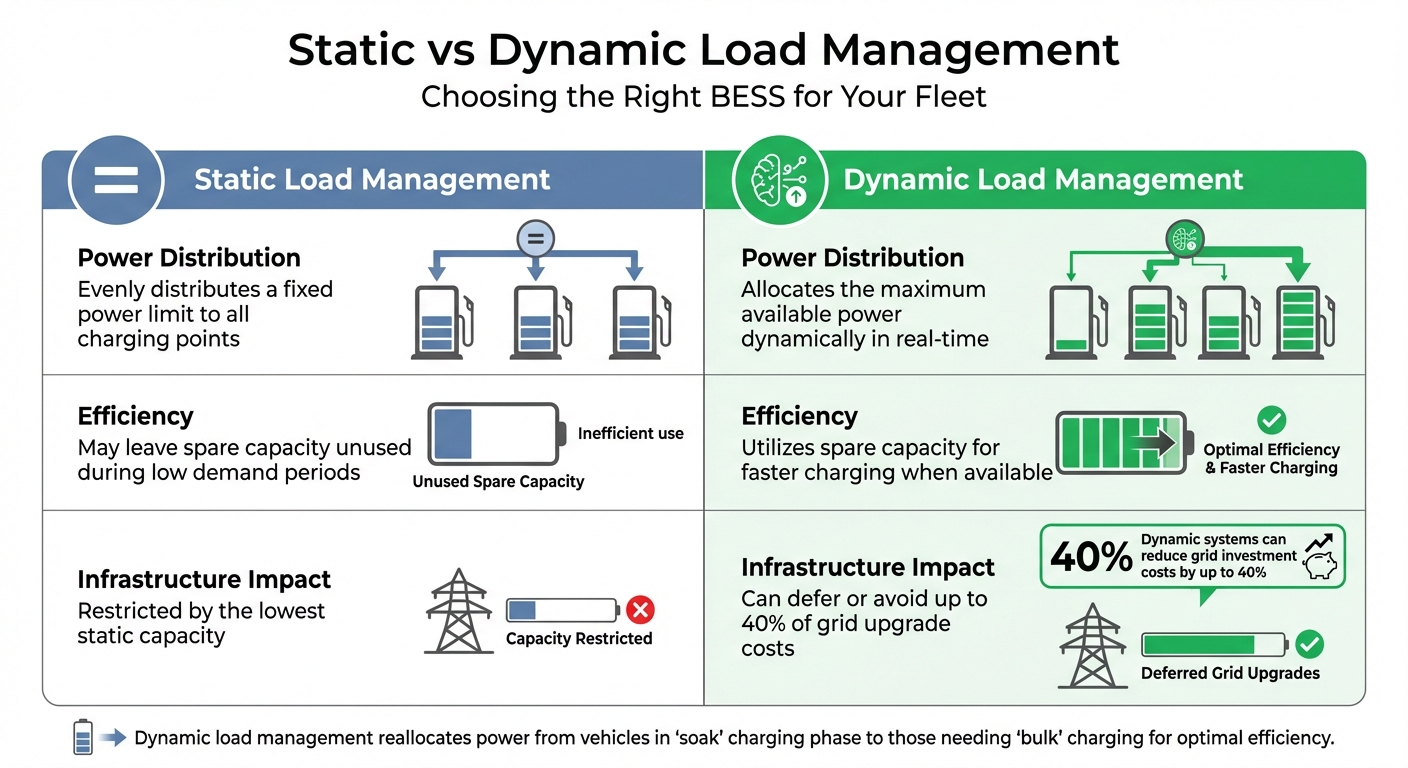
Static vs Dynamic Load Management for Fleet Battery Storage Systems
Picking the right battery storage system is all about aligning it with your fleet's energy needs and the constraints of your grid connection. Your decision will hinge on factors like your site's grid capacity, charging habits, and whether you prefer new or second-life batteries.
Evaluating BESS Features and Capacities
To ensure your BESS meets your requirements, its capacity should match your fleet's daily energy consumption and peak power demands. For instance, if a 20-van fleet consumes 480 kWh daily and hits a peak demand of 140 kW when all vehicles charge at once, you'll need a system capable of bridging this gap within your site's Maximum Import Capacity.
Second-life BESS units, which repurpose batteries from retired EVs, are a smart option. These batteries often retain up to 80% of their original capacity, offering a cost-effective and resource-efficient alternative. A practical example comes from North Tyneside Council, which installed a BESS at their Killingworth Site depot in February 2023. Using second-life batteries from decommissioned electric vans, the system stores surplus solar energy to charge their fleet overnight. Ian Lillie, Strategic Facilities Manager at the council, highlighted the appeal of this approach:
The ability to power the vans of the future using batteries from the vans of the past was a compelling argument for us.
When comparing systems, modular designs are a wise choice, as they allow for future expansion. Additionally, prioritise a BESS with dynamic load management capabilities over static systems. Dynamic systems adjust power distribution in real time, reallocating energy from vehicles in slower "soak" charging phases to those needing rapid "bulk" charging. This approach can reduce grid investment costs by up to 40%.
Here’s a quick comparison of static and dynamic load management:
| Feature | Static Load Management | Dynamic Load Management |
|---|---|---|
| Power Distribution | Evenly distributes a fixed power limit to all points | Allocates the maximum available power dynamically |
| Efficiency | May leave spare capacity unused during low demand | Utilises spare capacity for faster charging |
| Infrastructure Impact | Restricted by the lowest static capacity | Can defer or avoid up to 40% of grid upgrade costs |
Once you’ve determined the right specifications for your BESS, the next step is integrating it with your telematics system to streamline energy and charging management.
Integrating with Telematics Solutions
For optimal efficiency, integrate your BESS with a telematics platform. Using energy data, systems like GRS Fleet Telematics enable you to monitor energy usage per vehicle, track real-time state of charge (SOC), and optimise routes based on battery levels. These systems also allow your Energy Management System (EMS) to schedule charging during off-peak times and predict when vehicles will return to the depot.
Take Dundee City Council's Princes Street hub as an example. They use Connected Energy's E-STOR system, built with second-life batteries, to handle high charging demand without exceeding their grid connection limits. This setup supports six 50 kW and three 22 kW double-outlet chargers, allowing 18 EVs to charge at once while prioritising solar power over grid electricity. By combining a BESS with intelligent charging management, they’ve improved energy efficiency while avoiding costly grid upgrades.
When choosing a BESS, ensure it supports the Open Charge Point Protocol (OCPP). This compatibility ensures seamless communication between your charging hardware and telematics platform. It also allows your system to automatically adjust charging schedules based on factors like electricity prices, battery levels, and upcoming journey demands.
Improving Energy Usage with Battery Storage
Once your Battery Energy Storage System (BESS) is up and running alongside telematics, the next step is maximising its potential. By leveraging stored energy wisely, you can lower costs, improve efficiency, and support cleaner fleet operations. This builds on the telematics integration we discussed earlier, ensuring your fleet operates at its best.
Peak Demand Reduction and Load Shifting
Battery storage acts as a middleman between your fleet and the grid. It charges during off-peak hours - when electricity is cheaper - and discharges during peak times to power your chargers. This strategy, known as load shifting, helps avoid expensive peak tariffs while ensuring your vehicles are always ready for action.
But cost savings are just the beginning. If your depot's Maximum Import Capacity can't keep up with your growing EV fleet, battery storage can step in. It provides extra power during high-demand periods, meaning you can avoid costly grid upgrades. This not only eases grid strain but can also lead to long-term financial benefits.
There’s even potential to generate revenue. By participating in demand response programmes, fleet operators can reduce grid usage during peak times and sell any surplus energy.
Once peak demand is under control, the next priority is refining charging practices with smart scheduling.
Smart Charging Schedules
Smart charging systems, paired with battery storage, take energy efficiency to the next level. An Energy Management System (EMS) automates charging schedules based on factors like real-time electricity prices, vehicle departure times, and battery needs.
Dynamic load management plays a key role here. Unlike static systems that distribute power evenly, dynamic systems adjust in real time. For example, if your depot's background power use (like lighting or HVAC) drops, the system reallocates that spare capacity to EV chargers. This ensures maximum efficiency without overloading circuits.
Another approach is load following. As some vehicles near full charge and their charging rate slows ("soak" phase), power is redirected to vehicles still in the "bulk" phase, which can charge faster. This method improves overnight charging and ensures all vehicles are ready for their routes.
The combination of smart charging and BESS offers major benefits. You’ll rely less on expensive peak-time grid power and more on off-peak electricity or renewable energy. Costs become more predictable, and your dependency on the grid decreases.
Integrating a telematics platform like GRS Fleet Telematics enhances this further, allowing real-time monitoring of energy use per vehicle and aligning charging schedules with operational data.
Incorporating Renewable Energy Sources
To make your energy usage even more efficient, adding renewable energy sources is a smart move. Pairing battery storage with onsite renewables, like solar panels, creates a self-sustaining microgrid. During the day, solar panels generate electricity, and any excess is stored in the BESS rather than being sold back to the grid for minimal returns. This stored energy can then charge your fleet with clean, low-cost power.
DC-coupled systems work particularly well here, enabling you to generate enough renewable energy to meet net zero goals while avoiding export limits. This is especially useful for depots with limited grid connections or ambitious sustainability targets.
As the Energy Saving Trust puts it:
"Energy storage, such as batteries, allows you to store electricity when it is greener and cheaper."
Real-world examples highlight the benefits. Exeter City Council, for instance, uses a Wattstor BESS with the "Podium" EMS to manage energy demand and cut fleet emissions, helping them move closer to carbon neutrality.
Before diving into solar and storage solutions, it’s essential to conduct a thorough site audit. Analyse vehicle mileage, route patterns, and dwell times to ensure your system aligns with your fleet's needs. Also, engaging early with your local Distribution Network Operator (DNO) will confirm your site's Maximum Import Capacity, ensuring a smooth installation process.
Steps to Deploy BESS in Fleet Operations
Conducting a Site Audit
Start by evaluating your depot's electrical infrastructure. Determine the capacity of all power supplies (measured in kVA or MVA) and confirm your Maximum Import Capacity (MIC) - the maximum power your site can draw from the grid. As ZPN Admin from ZPN Energy explains:
The local electricity grid connection is the biggest bottleneck most fleet depots face.
Next, review a year's worth of half-hourly metering data to understand your site's energy usage. Identify whether your supply is single- or three-phase and note your peak demand figures. For instance, if you plan to charge 20 vans, each travelling 60 miles daily at 2.5 miles per kWh, your daily energy requirement will be 480 kWh. However, it's the peak demand - not the average - that determines whether your existing grid connection is sufficient.
Engage your Distribution Network Operator (DNO) early to evaluate grid feasibility and submit necessary connection approvals like G98 or G99. This is critical, as grid upgrades can cost hundreds of thousands of pounds and take over a year to complete. Additionally, use telematics data to map vehicle mileage, routes, and dwell times (when vehicles are stationary and available for charging). This data helps size your Battery Energy Storage System (BESS) correctly and position it near the power source, cutting down installation costs.
Once you've completed a thorough site audit, you're ready to move forward with installing and configuring the system.
Installing and Configuring BESS
Set up your BESS to charge during off-peak hours and discharge during high-tariff periods to reduce costs and stay within your MIC, avoiding expensive grid upgrades.
If you're incorporating renewable energy, consider pairing the BESS with on-site solar panels to create a microgrid. A great example is Dundee's Princes Street charging hub, which opened in 2018. This site uses a 90 kWh battery to store up to 36 kW of solar energy, prioritising renewable power for 18 EV charging outlets before sending any surplus back to the grid.
Implement dynamic load management to make real-time adjustments. Additionally, integrate an Energy Management System (EMS) to automate charging schedules based on half-hourly wholesale electricity prices, ensuring efficient energy use.
Linking to Telematics Platforms
Connecting your BESS to a telematics platform like GRS Fleet Telematics takes energy management to the next level. This integration uses fleet usage data, allowing you to monitor energy consumption per vehicle in real time and align charging schedules with operational needs like dwell times and route patterns.
Your EMS can synchronise data between the BESS and telematics, automating charging based on real-time rates and demand. For example, if a vehicle is parked for eight hours, the system can schedule slow AC charging. On the other hand, if a quick turnaround is needed, the BESS can prioritise rapid DC charging during a short break.
This integration also enables predictive maintenance. Modern BESS setups use AI to monitor component wear, alerting technicians before issues arise and ensuring uninterrupted fleet operation. With GRS Fleet Telematics, you gain a comprehensive view of both vehicle performance and energy usage, streamlining your fleet's overall efficiency.
Testing and Monitoring Performance
After installation and telematics integration, thoroughly test the system. Simulate peak load scenarios to ensure the BESS performs as expected. Monitor how the system handles multiple vehicles charging simultaneously and check that peak shaving is effective without compromising vehicle readiness. Use telematics data to spot any irregularities, such as vehicles consuming more energy than planned or charging sessions that don't match departure schedules.
Fine-tune your EMS settings based on actual performance. For instance, if certain vehicles consistently require more energy than anticipated, adjust your energy allocation. Remote State of Health (SOH) monitoring via telematics can optimise charging cycles and extend the system's lifespan. Regular reviews of performance will help your system adapt to seasonal changes in demand, such as increased mileage during busy periods, keeping your fleet running smoothly throughout the year.
Conclusion
Battery Energy Storage Systems (BESS) transform fleet energy management by cutting costs, boosting efficiency, and lowering emissions. When combined with smart charging strategies, BESS helps fleet operators save money and delay expensive grid upgrades.
Beyond the financial advantages, BESS enables fleets to incorporate renewable energy sources, such as solar panels, making it easier to rely on clean energy and reduce carbon footprints. Backup power ensures that critical fleet operations stay on track during grid outages, while load shifting allows fleets to use cheaper, off-peak energy when rates are higher.
By integrating GRS Fleet Telematics, monitoring and charging can be automated using real-time data, with solutions starting from just £7.99 per vehicle per month. This connection between energy management and live fleet data drives operational efficiency. Research highlights that 79% of businesses experience a positive return on investment within the first year of adopting real-time GPS tracking, with average savings of £660 per vehicle annually.
Together, BESS and telematics provide clear insights into vehicle performance and energy consumption, simplifying operations and cutting costs. This guide has explored how to assess, choose, and implement BESS, alongside telematics, to achieve these results. Whether managing a small delivery fleet or a large commercial operation, combining BESS with GRS Fleet Telematics empowers you to optimise energy use in today's electrified transport world.
FAQs
How big should a BESS be for my depot?
The right size for a Battery Energy Storage System (BESS) at your depot hinges on a few key factors: your energy consumption, the number of vehicles in your fleet, and the capacity of your grid connection. A well-sized BESS should handle your charging demands, minimise dependency on the grid, and enable cost-saving load shifting during off-peak hours. Carefully evaluate your operational needs to find the best fit for your setup.
Will a BESS help me avoid a grid upgrade?
Yes, a Battery Energy Storage System (BESS) can help sidestep the need for a grid upgrade. By lowering peak energy demand, enabling charging during off-peak hours, and alleviating pressure on grid capacity, it supports faster fleet electrification without requiring expensive infrastructure changes.
What data do I need to integrate BESS with GRS Fleet Telematics?
To successfully integrate Battery Energy Storage Systems (BESS) with GRS Fleet Telematics, you'll need several key pieces of data. This includes the state of charge (SoC) of your EV batteries, metrics on battery health, and performance data. Beyond that, understanding grid conditions, energy demand patterns, and details about site-specific infrastructure - like bi-directional chargers - is crucial. These elements help ensure efficient energy flow management and allow for optimised charging schedules tailored to your fleet's operations.