HOS Regulations: What Fleet Managers Need to Know
Practical UK HOS guidance for fleet managers: driving limits, WTD rules, tachograph duties and fixes to prevent costly breaches.
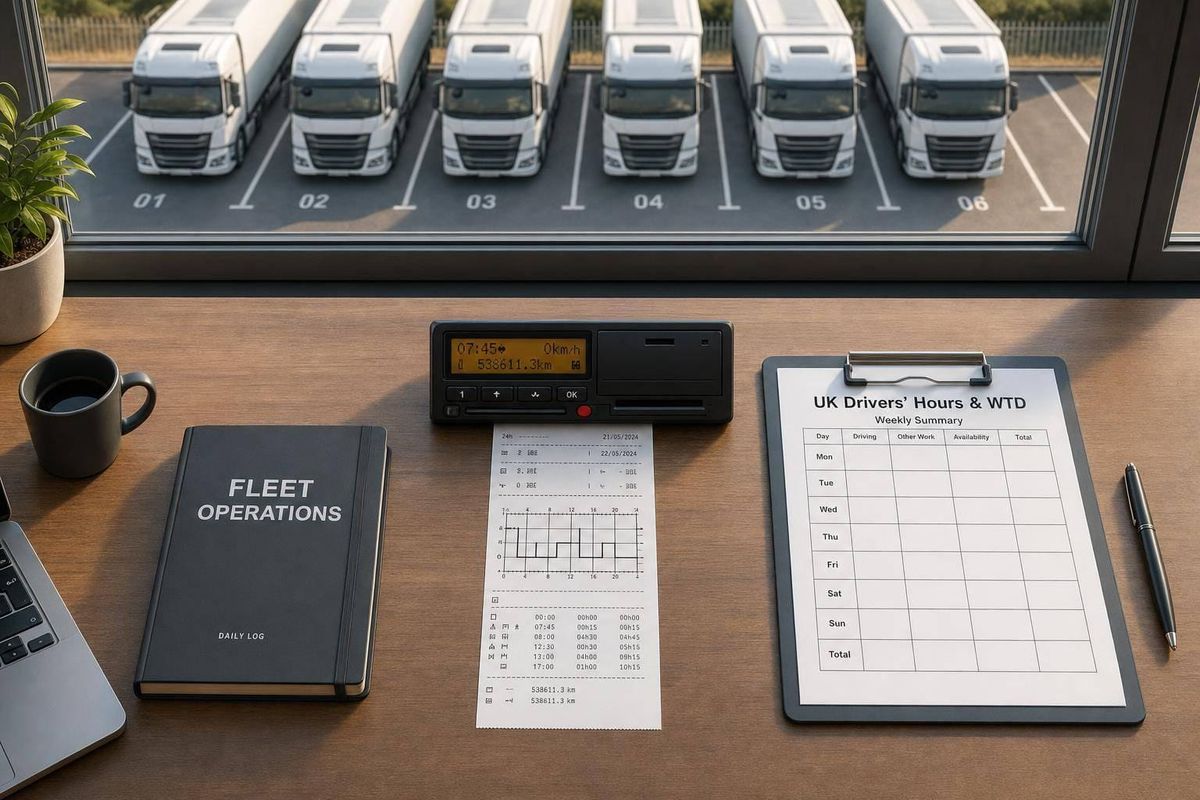
If I had to sum this up in one line: HOS compliance starts with the rota, not the roadside check.
If you run a UK fleet, I’d keep my eye on four things first: driving limits, rest and break timing, WTD working-time caps, and tachograph records. Get those wrong, and one stop can lead to fines of up to £1,500 for one driver, while old issues from the last 28 days can still count.
Here’s the plain-English version:
- Drivers’ Hours and WTD are not the same thing
- A legal route on paper can still fail if loading, traffic, or delays eat into break time
- Split breaks must be 15 minutes, then 30 minutes
- Driver cards and vehicle data have download deadlines
- Yard moves, manual entries, and tachograph faults need clear records
- Some exemptions exist, but they are narrow and easy to misread
- Poor handovers between planning, drivers, and compliance staff often sit behind repeat breaches
I’d also treat these numbers as the ones that shape day-to-day planning:
- 9 hours daily driving, with 10 hours allowed twice a week
- 56 hours weekly driving
- 90 hours across any 2 consecutive weeks
- 45 minutes break after 4.5 hours driving
- 48-hour average working week under WTD
- 60-hour single-week WTD cap
- 10-hour daily working-time cap if any work falls between 00:00 and 04:00
What this means in practice is simple: if the job only works when a driver skips a break, runs over time, or fixes records later, the plan was wrong from the start.
So in this piece, I’d focus on the parts that matter most: the rules that affect route plans, the mistakes fleets make most often, and the checks that help stop small delays turning into infringements.
The HOS rules fleet managers need to track
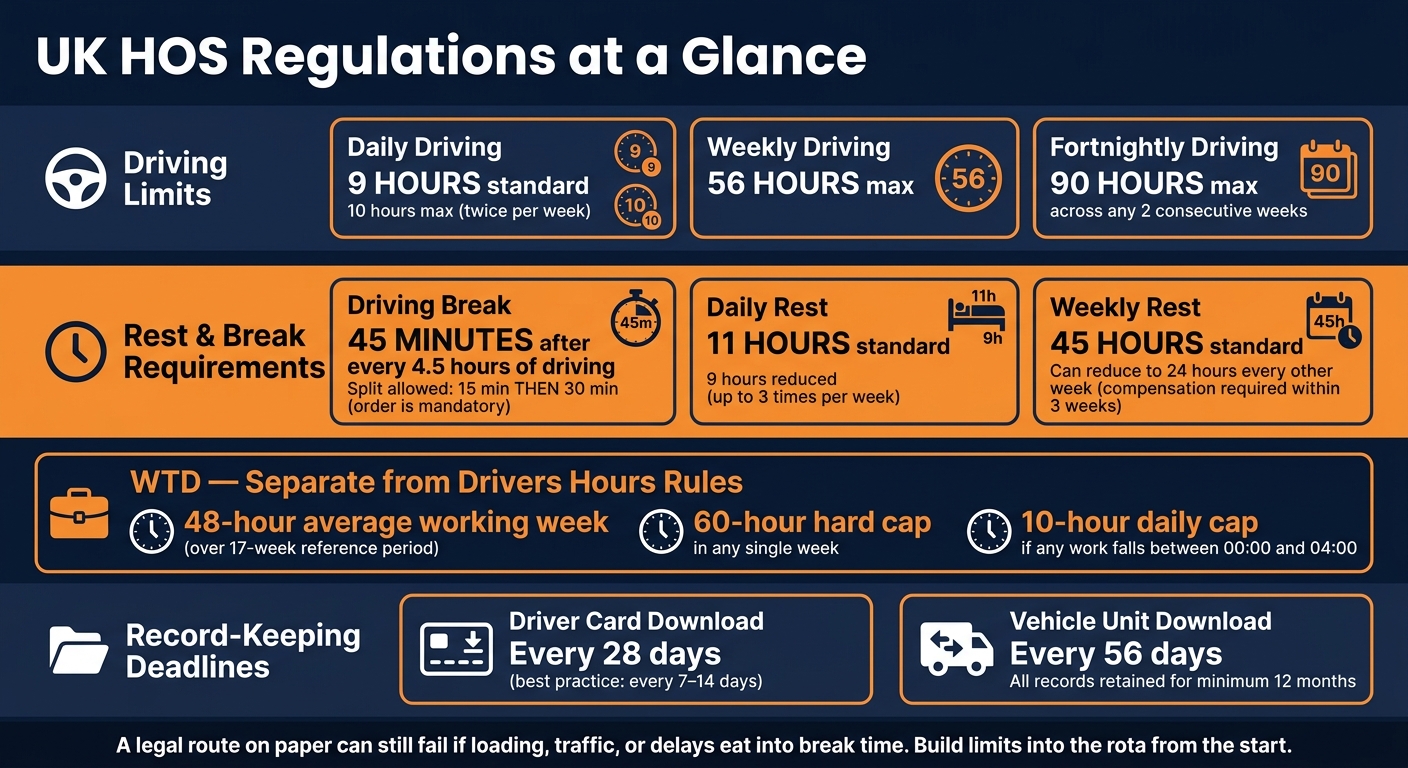
UK HOS Regulations: Key Limits Fleet Managers Must Know
UK commercial fleets usually have to follow two separate rule sets: the assimilated Drivers' Hours rules and the Working Time Directive (WTD). As TransportGuard notes, "It's a classic mistake to think that if you're on top of drivers' hours, you've automatically got the Working Time Directive covered."
These are the limits that shape day-to-day planning, dispatch and delivery timing:
| Rule | Standard Limit | Flexibility |
|---|---|---|
| Daily driving | 9 hours | 10 hours, twice per week |
| Weekly driving | 56 hours | Max 90 hours over any two consecutive weeks |
| Daily rest | 11 hours | 9 hours, up to three times per week |
| Weekly rest | 45 hours | Can reduce to 24 hours every other week, provided the difference is compensated by the end of the third following week |
| Driving break | 45 mins after 4.5 hours | Split as 15 mins then 30 mins - in that order |
The WTD adds a second layer that planners can't ignore. Total working time must average no more than 48 hours per week over a 17-week period, and there is a hard cap of 60 hours in any single week. If any work takes place between midnight and 4 am, total working time for that day is capped at 10 hours.
How each rule affects route planning day to day
In day-to-day use, these limits start affecting a shift long before the vehicle leaves the yard.
Vehicle checks, loading and paperwork all count as working time. So if a driver spends part of the morning on pre-departure jobs, their available driving time is already shrinking. Add traffic or a slow-loading bay, and that pressure builds fast.
The break rule catches out a lot of fleets. After 4.5 hours of driving, the 45-minute break can be split, but only as 15 minutes first and then 30 minutes. Reverse that order and it becomes a penalised infringement. Time spent waiting during a planned delay, such as a ferry crossing or a delivery bay slot, may count as Period of Availability (POA). That is not rest, and it still counts towards working time.
This is where tight schedules start to crack. If there is no spare room in the plan, even a small delay can throw off loading windows, drop order, break timing and return times. The rules need to be built into the route from the start, not patched in halfway through the day.
Some fleets may fall under narrower exemptions, but those cases are limited and closely defined.
Exceptions that may apply to some fleets
Some exemptions are much tighter than they first appear. Certain short-haul derogations apply only within 100 km of the operating base. These can include agricultural or forestry work, breakdown vehicles, and specialist craft-goods transport. Vehicles with a maximum speed of no more than 40 km/h, specialist medical units, and historic vehicles more than 25 years old may also be exempt.
Emergency exemptions do exist, but they are for serious cases only. That includes an immediate risk to the life or health of people or animals, serious interruption of key public services, or major damage to property. If an emergency exemption is used, it must be logged manually on the tachograph with a clear reason recorded.
It's worth being careful here. An assumed exemption can wreck a route plan if it turns out not to apply. Check the current rules before building a job around one.
The next challenge is not the rules themselves, but the failures that most often break them.
sbb-itb-499a7f0
The most common HOS compliance problems in fleet operations
Most HOS breaches begin long before a roadside check. In many fleets, the problem starts in planning, dispatch or record-keeping. The weak spots usually show up before the vehicle even moves: in scheduling, logging and handovers.
Missed breaks, overlong shifts and poor route timing
The most common trigger for a violation is a schedule with no breathing room. If delivery windows are tight and there's no time built in for a slow loading bay or a jammed motorway, drivers get boxed in. Taking a break can mean missing a drop. That's when limits start to creep.
Split-break mistakes are still a common reason for infringements.
| Common cause of breach | How it creates a violation | Preventive scheduling action |
|---|---|---|
| Unrealistic delivery windows | Driver runs past 4.5-hour limit to reach destination | Add fixed buffer time to every route plan |
| Loading delays | Consumes time and reduces available driving window | Use live monitoring to adjust subsequent stops when delays occur |
| Split-break errors | Driver takes incorrect break split instead of required 15+30 min | Use driver briefings and automated tachograph alerts |
| Consecutive long-haul jobs | Compounds fatigue and risks weekly or fortnightly limit breaches | Rotate routes and monitor 90-hour fortnightly totals in real time |
Log errors, incomplete records and unassigned driving time
Record-keeping problems remain a steady audit risk, and many are avoidable. One of the most common is a driver leaving the tachograph set to rest while loading or unloading. The vehicle unit still records movement when no card is inserted, so any gap between what the card shows and what the unit recorded will be flagged.
Unassigned driving time often happens when vehicles are moved around a yard or depot without a card in. That time has to be matched with a manual entry or a workshop record. If it isn't, it appears as unmatched mileage during a download review. Driver card data must be downloaded at least every 28 days, and vehicle unit data every 56 days. Miss those deadlines and the data can be overwritten in full.
| Manual logging risk | Tachograph control point | Manager review check |
|---|---|---|
| Driver forgets to record "other work" during loading | Mode switch (crossed hammers) must be manually selected | Cross-reference tachograph "rest" periods with depot gate logs |
| Unassigned driving time in yard | Vehicle unit records all movement regardless of card insertion | Reconcile unmatched mileage reports against shunter schedules |
| Gaps during annual leave or sickness | Manual entry prompt on card re-insertion after absence | Verify all missing days are covered by a valid manual entry or leave record |
| Missing records for ferry or train travel | "Ferry/Train" mode selection in tachograph menu | Check for Period of Availability or rest recorded during known sea or rail legs |
Poor coordination between drivers, dispatchers and compliance staff
Recurring breaches often mean dispatch, drivers and compliance are not working from the same set of facts. Dispatch builds the load, the driver follows the plan, and compliance checks the record later. If those handovers are weak, the same issues keep coming back.
"An alarming number of operators do not look at the data their tachographs are recording. If the data is there, the expectation is clear: use it." - Traffic Commissioners for Great Britain
Each unresolved infringement also affects the Operator Compliance Risk Score (OCRS). A weaker score makes targeted roadside checks more likely. That’s why handovers matter so much. If one team misses something, the next team inherits the problem.
These failures point to three controls: better scheduling, live monitoring and tighter record review.
Practical fixes fleet managers can put in place
The way to deal with these issues is simple in principle: turn policy into day-to-day planning, live action, and proper review. Each fix below tackles one of the weak spots where things tend to go wrong.
Build schedules around available duty hours and break points
Build the schedule first, then assign the driver. Start with the hours left under Drivers' Hours and WTD, then work backwards from there.
Add fixed buffer time to every route so a slow loading bay or a blocked junction doesn't push a driver into missing a break. Rotate routes and avoid stacking long-haul runs back to back, so drivers have enough recovery time.
"If a driver can only complete the expected run by breaching the limits, that is at least partly an operator problem."
Treat the 00:00–04:00 working-time cap as a hard planning limit.
Good planning removes a lot of the risk. But some delays will still happen, which is why live monitoring matters.
Use live monitoring to catch problems before they become violations
Real-time visibility gives managers a chance to step in before a breach happens. Instead of spotting an infringement after the event, they can see when a driver is getting close to the 4.5-hour driving limit and act while there is still time. That might mean reallocating a stop, moving the next delivery window, or calling the driver before the issue turns into a violation.
Set alerts 15–30 minutes before a limit so dispatch has time to respond. Weekly tachograph audits can also show patterns, such as repeated late breaks on one route, that point to a planning issue rather than a driver issue.
GRS Fleet Telematics' live van tracking gives managers real-time location and journey-time visibility, which helps them spot HOS risks earlier.
When timings slip or a device stops working, record-keeping becomes the control that stops a delay turning into a violation.
Set up a clear process for tachograph malfunctions, exceptions and record reviews
A tachograph fault does not remove the legal duty to keep records. Keep spare printout paper or charts in the cab so drivers can switch to manual recording straight away. If a card is lost or stolen, the driver must report it to the DVLA within seven calendar days. They can keep driving for up to 15 calendar days using daily manual printouts, signed and filled in with all work and rest periods.
All tachograph records - digital files, printouts, and manual entries - must be kept for at least 12 months. The table below shows the normal workflow, what changes when something goes wrong, and what the manager needs to do.
| Normal Tachograph Workflow | Malfunction/Exception Response Step | Manager Action Required |
|---|---|---|
| Digital recording of all activities via driver card and vehicle unit. | Driver reverts to manual entries on printout paper or spare charts. | Provide manual record templates; verify entries against planned schedules. |
| Report card loss to DVLA within 7 days; book hardware repair immediately. | Driver notifies manager immediately if a breach becomes unavoidable. | Ensure vehicle is booked into an approved tachograph centre as soon as possible. |
| Real-time limit alerts and automated notifications. | Driver notifies manager immediately if a breach becomes unavoidable. | Conduct a formal debrief, document the reason, and retain records for 12 months. |
Manual records and debriefs fill the gap between what happened on the road and what ends up in the file. Log every exception and infringement. Record whether the schedule was workable, and keep the debrief ready for audit review.
Conclusion: Building a repeatable HOS control process
HOS compliance depends on process, not good intentions. These controls only work when they become part of the day-to-day routine. That means having written rules for break planning, manual records, tachograph use, and data downloads. And because many breaches begin during scheduling and handover, the control process needs to start there.
Downloading data is only the first step. Best practice is to pull driver card and vehicle unit data every 7–14 days, instead of waiting for the legal deadlines. That gives managers a chance to spot problems much earlier.
Then use that data properly. Look for patterns, find the cause, and deal with it. Each infringement should be recorded in a written log, including:
- the rule that was broken
- the circumstances
- the corrective action taken
That log shows both what went wrong and what changed after the fact. Track each infringement, and track the fix as well.
If your operation has not had a drivers' hours and tachograph audit in the past 12 months, schedule one now. Then use what you find to update training and day-to-day operations. Train schedulers as well as drivers, because many breaches are built into the rota before the vehicle even leaves.
Most breaches start in the rota, so the fix has to start there too. The aim is not a perfect paper trail. It is a system that catches problems early, corrects them fast, and gets better over time.
FAQs
Which rules apply to my fleet?
The rules mainly depend on your vehicle type, its weight, and the kind of work you do.
In the UK, most commercial goods vehicles over 3.5 tonnes must follow retained EU rules. That includes using a tachograph to record driving time, breaks, and rest periods.
GB domestic rules tend to apply to a smaller set of cases, such as certain non-commercial transport, emergency services, or smaller vehicles that are exempt from EU rules.
If you're not sure which set of rules applies, it can be safer to default to the EU framework to avoid misclassification.
What counts as working time under WTD?
Under the Road Transport (Working Time) Regulations 2005, working time means any period when a mobile worker is at their workstation, at the employer’s disposal, and doing their job.
That covers tasks such as:
- driving
- loading or unloading
- daily walkaround checks
- vehicle cleaning
- routine maintenance
- paperwork
- waiting time, if the length of that wait is not known in advance
By contrast, breaks and periods of availability do not count as working time.
What should I do after a tachograph fault?
After a tachograph fault or breakdown, get the unit fixed as soon as you can. If the vehicle can’t get back to base within a week, it must be repaired on the road instead. Until that happens, the driver needs to keep manual records of their activities.
For digital or smart tachographs, ask the repair centre to download any stored data. If that isn’t possible, get a certificate of undownloadability and keep it for at least 12 months.