Future of Drone Charging Networks
Wireless charging, AI scheduling and modular stations enable continuous drone operations while tackling interoperability, regulation and scaling challenges.
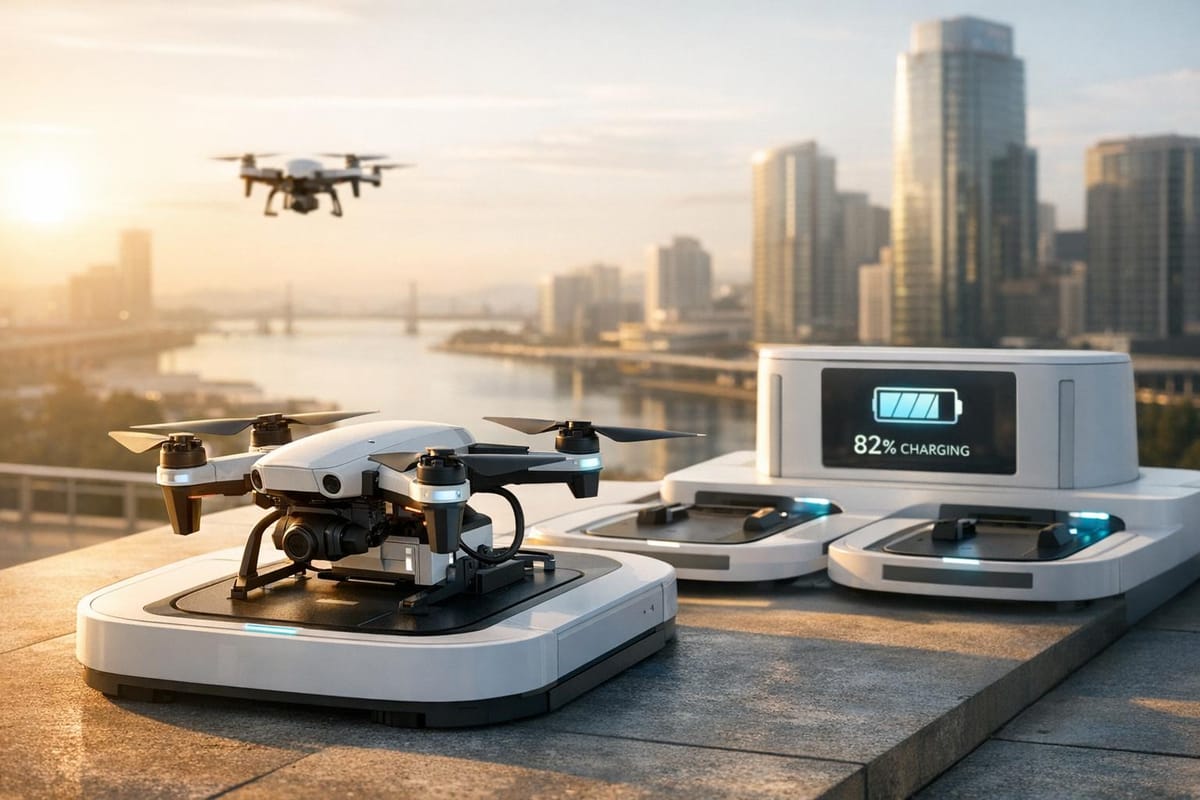
Drone charging networks are transforming how drones operate, eliminating human intervention for recharging. With current drone flight times limited to 20–40 minutes, these networks solve delays by directing drones to automated stations, managing schedules, and prioritising urgent tasks. The UK aims to integrate drones into its economy by 2030, potentially adding £45 billion, supported by regulatory shifts like BVLOS operations by 2027.
Key advancements include:
- Wireless Charging: Technologies like laser power beaming (long-distance charging), resonant inductive coupling (short-range, 90% efficiency), and surface charging pads (flexible designs for urban/rural use).
- AI Integration: AI predicts battery needs, schedules charging, and ensures priority for critical missions. Smart Battery Management Systems extend battery life, while distributed frameworks optimise fleet operations.
- Infrastructure Expansion: Automated battery swapping hubs, solar-powered stations, and modular designs support scalability and reduce downtime.
Challenges remain in standardising charging systems, regulatory compliance, and scaling infrastructure. Emerging technologies like hydrogen fuel cells and drone-to-drone charging could extend flight durations significantly. The UK Government's investments in aviation technology and regulatory frameworks aim to establish a robust ecosystem for autonomous drone operations.
A2Z: Delivery Drones that Live on Top of Light Poles and Road Signs
Wireless Charging Technology Developments
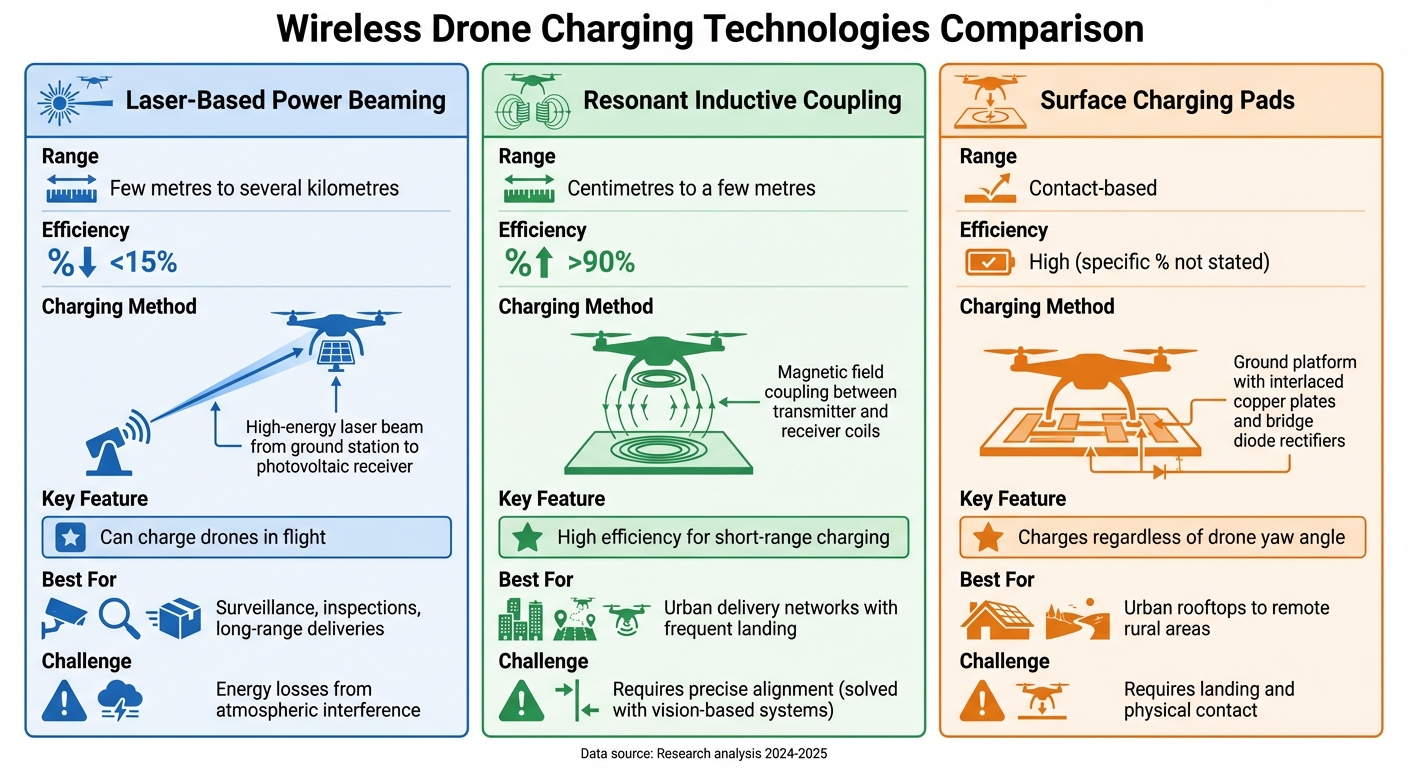
Comparison of Three Wireless Drone Charging Technologies
Wireless charging is reshaping how drones operate, eliminating the need for physical connectors and manual interventions. Three standout technologies - laser-based power beaming, resonant inductive coupling, and surface charging pads - are making strides in this field. Let’s break down how each works and the hurdles they face.
Laser-Based Power Beaming
Laser Power Transfer (LPT) uses a high-energy laser beam directed from a ground station to a photovoltaic receiver on the drone. This enables charging over long distances - ranging from a few metres to several kilometres - even while the drone is in flight. It’s particularly useful for applications like surveillance, inspections, and long-range deliveries, where extended uptime is critical. However, the technology struggles with efficiency, operating at less than 15% due to energy losses caused by atmospheric interference and the conversion process. Additionally, strict beam-steering protocols are essential to ensure safety during operation.
Resonant Inductive Coupling
Also referred to as Inductive Power Transfer (IPT), this method relies on magnetic field coupling between a transmitter coil on the ground and a receiver coil on the drone. It works over short distances, from centimetres to a few metres, and boasts efficiency levels above 90%. This makes it ideal for urban delivery networks, where drones frequently land at designated charging stations. However, the system’s effectiveness depends heavily on precise alignment, a challenge researchers are tackling with vision-based systems that employ tools like ArUco markers and infrared beacons.
Surface Charging Pads
Surface charging pads offer a flexible and scalable solution for drone recharging. One innovative design by Al-Obaidi et al. features a ground platform with interlaced copper plates and six onboard bridge diode rectifiers, allowing drones to charge regardless of their yaw angle. Another approach, developed by Nieuwoudt et al., includes an automated docking station with a weather-protected sliding roof and a 4-axis mechanical centring system. This setup uses actuators to reposition the drone after landing, ensuring reliable contact with the charging strips. These designs are versatile enough to be deployed in locations ranging from urban rooftops to remote rural areas.
These emerging technologies are paving the way for the integration of AI, which promises to take autonomous drone operations to the next level.
AI Integration in Drone Charging Networks
With advancements in wireless charging, artificial intelligence is now a game-changer in streamlining drone charging networks.
AI transforms these networks into smart systems that predict needs and avoid congestion. By analysing real-time fleet data, AI-driven platforms direct drones to the nearest available station and schedule charging sessions efficiently. This system-wide coordination treats the fleet and its charging infrastructure as a unified network rather than disconnected elements.
Deep Reinforcement Learning (DRL) is a standout in energy management. DRL algorithms forecast battery requirements and traffic patterns, enabling drones to proactively select charging stations. Multi-agent DRL systems take this a step further, allowing drones to make independent choices about navigation and sensing. This reduces the reliance on central controllers and supports scalability for larger fleets.
Machine learning also powers Smart Battery Management Systems (BMS). These systems predict the State of Health (SOH) and Remaining Useful Life (RUL) of batteries, fine-tuning charging cycles to maximise efficiency. As noted by researchers:
A smart BMS is central to maximising battery performance as well as the overall safety of the UAV.
– Shiqin Jiao et al.
This predictive approach not only extends battery life but also prevents unexpected failures during critical operations. Alongside these innovations, priority handling is another vital AI application.
Priority handling ensures that drones on urgent missions - like delivering medical supplies - are given immediate access to charging stations during busy periods. Researchers highlight its importance:
This network-oriented strategy is necessary to prevent congestion at charging stations and to make sure that mission-critical UAVs (for example, ones transporting medical supplies) are given priority.
– Maria Camelia Danciu et al.
Distributed optimisation frameworks, such as Economic Planning and Optimised Selections (EPOS), enable drones to plan navigation within battery limits while maintaining system resilience and avoiding single points of failure. Tools like SIGI integrate AI with computer vision to process live data from charging stations, improving resource allocation and situational awareness across urban environments. By blending short-term adaptability with long-term strategic planning, this infrastructure supports large-scale autonomous operations seamlessly.
Infrastructure Requirements for Network Expansion
As AI-driven scheduling and battery optimisation continue to evolve, the backbone of network expansion relies heavily on robust infrastructure.
Scaling drone charging networks demands infrastructure that reduces downtime and supports growing fleets. This involves strategic site selection and flexible, future-ready technology.
Automated Battery Swapping Systems
Automated battery swapping hubs are pivotal in reducing downtime by enabling rapid battery exchanges. Placing these hubs near fulfilment and logistics centres ensures drones can complete multiple delivery runs without unnecessary detours. Collaborating with local councils to utilise public assets and open spaces for these systems further streamlines operations.
A notable example is Amazon Prime Air, which launched operations in January 2026 at its Darlington fulfilment centre. Using the MK30 drone, it delivers packages weighing up to 2.3 kg in under two hours. The MK30, approved by the Civil Aviation Authority for autonomous operations, features advanced detect-and-avoid technology for safe navigation and delivery. Sophie O'Sullivan, Director of Future Safety & Innovation at the UK Civil Aviation Authority, highlighted the potential of drones:
Drones have huge potential to make our infrastructure stronger, safer and cheaper to maintain.
Beyond visual line of sight (BVLOS) capabilities are essential for remote monitoring and control, while lightweight designs demand careful hardware optimisation. Additionally, rapid connections to the electricity grid are crucial. Colm Ring, Business Manager at EasyGo, stressed:
The process needs to be quick and simple along with quicker electricity grid connections in order to keep up with the growing number of EVs on the road which will increase demand.
In tandem with battery swapping, renewable-powered and modular charging solutions provide further scalability for drone networks.
Solar-Powered and Modular Charging Stations
Solar-powered charging stations play a key role in reducing the carbon footprint of drone operations, aligning with net-zero targets. Modular designs allow for gradual expansion, accommodating different drone models without requiring large upfront investments.
The UK government has allocated £40 million to develop 'on-street and wireless' charging solutions. For drones, MHz-frequency wireless charging improves alignment tolerance during landings, enabling lighter coil designs without sacrificing performance. National Grid’s autonomous drone inspection programme showcases how renewable infrastructure can cut reliance on helicopters and ground vehicles, delivering significant environmental benefits.
Challenges and Future Developments
As charging networks grow with advancements in AI and wireless technologies, tackling interoperability and regulatory challenges remains a pressing concern.
One of the biggest obstacles is standardising drone charging technologies. Manufacturers currently use a variety of charging systems, which means stations need to support multiple drone platforms. For example, in 2024–2025, Galvion addressed this issue by creating a universal adapter for its Nerv Centr® MAX-8 Mission Adaptive Charging Station. This innovation allowed the station to seamlessly connect with AeroVironment's fleet of small uncrewed aircraft systems without requiring manual adjustments. While such progress is promising, achieving widespread compatibility - similar to the standardisation seen in the electric vehicle industry - remains a challenge. The lack of uniformity across manufacturers complicates efforts to scale drone charging networks effectively.
On top of technical issues, regulatory compliance adds another layer of complexity, especially in urban areas. From 1st January 2026, all drones in the UK must adhere to a class-marking system (UK0 to UK6), with operating privileges like separation distances tied to these classifications. Drones in categories UK1, UK2, UK3, UK5, and UK6 are also required to broadcast digital IDs and flight data. This means charging stations must integrate systems capable of monitoring network traffic and ensuring only authorised drones access their infrastructure. Failure to comply with these regulations can lead to hefty penalties - under the UK's public charging rules, fines can reach up to £10,000 per charge point.
Meanwhile, emerging battery technologies are expanding the possibilities for drone operations. Hydrogen fuel cells, for instance, offer up to 150 times the energy density of Lithium-Polymer batteries, potentially extending flight durations from minutes to hours. Harsh Abhinandan, Aditya Dhanraj, Aryan Katoch, and R. Raja Singh have highlighted the potential of these advancements:
The vision is to develop a single, intelligent ecosystem where charging is an active and strategic part of the mission, enabling longer autonomous flight.
AI is also playing a transformative role, enabling drones to process data in real time, adjust flight paths, detect obstacles, and optimise charging schedules - all without human input. In one example, a Tokyo-based logistics company increased its daily deliveries by 30% after implementing autonomous drone charging stations, showcasing the practical benefits of these developments.
Looking ahead, new trends like drone-to-drone charging and solar-powered systems are shaping the future of charging networks. Wireless power transfer technologies, such as Inductive Power Transfer (IPT) and Capacitive Power Transfer (CPT), are being refined to eliminate the need for physical connectors, though they still face challenges like sensitivity to misalignment. Companies like Skycharge are working towards "future-proof" infrastructure that can support a variety of drone brands and battery types. As these technologies advance, attention will turn to managing peak-hour traffic at charging stations and ensuring networks can keep pace with the rapid growth of drone fleets.
Conclusion
The future of drone charging networks is being propelled by wireless charging technologies, AI-driven automation, and scalable infrastructure designed to support operations in both urban and rural settings. Technologies like laser-based power beaming and resonant inductive coupling now allow drones to operate continuously without the need for human intervention. The adoption of MHz-frequency charging systems is especially noteworthy, as their lighter coil designs help preserve payload capacity - a critical factor in logistics and last-mile delivery. These advancements pave the way for sophisticated AI-powered management systems.
AI has become the backbone of modern charging networks, enabling predictive maintenance and intelligent Battery Management Systems that not only extend battery life but also minimise operational downtime. Projections suggest that AI in drone technology will grow from £9.8 billion in 2023 to an impressive £162.3 billion by 2033. Similarly, the drone battery and charger market is expected to expand from £940 million in 2024 to £2.7 billion by 2033, with an annual growth rate of 12.5%.
The UK Government is actively supporting this sector, committing over £20 million in April 2025 to accelerate advancements in aviation technology. As Aviation Minister Mike Kane stated:
I want the UK to have the most advanced aviation technology ecosystem in the world. That means creating a nimble regulatory environment and a culture of innovation.
Additionally, the Civil Aviation Authority has been allocated £16.5 million for 2025–2026 to develop regulatory frameworks for Beyond Visual Line of Sight (BVLOS) operations. These investments highlight the strategic importance of building a robust foundation for widespread drone operations.
As wireless charging and AI optimisation continue to evolve, the focus will shift towards interoperability, regulatory compliance, and green energy solutions, such as solar-powered charging stations. Expanding networks will need to support applications ranging from autonomous inspections to round-the-clock logistics. The ability to manage entire fleets as a unified, intelligent ecosystem will be a key factor for organisations looking to scale successfully. While the technology is already here, the real challenge lies in creating infrastructure that can meet growing demand and adhere to the stringent regulatory standards set to take effect from 1 January 2026.
FAQs
How does wireless charging enhance drone performance and efficiency?
Wireless charging is a game-changer for drones, offering a contactless way to recharge and cutting down on the delays caused by manual battery changes or plug-in charging. This means drones can stay active for longer stretches, taking on extended tasks without constant stops.
When wireless charging is built into drone systems, it allows for automatic recharging at specific stations, giving organisations more freedom and the ability to scale up their operations. This is especially useful in sectors like logistics, surveillance, and agriculture, where uninterrupted drone activity is essential.
How does AI improve the management of drone charging networks?
AI plays a key role in improving how drone charging networks are managed, offering intelligent coordination and optimised scheduling. By ensuring drones are charged at the right time and in the right place, it helps prevent overcrowding at charging stations and boosts the overall efficiency of the network.
On top of that, AI enables predictive maintenance by analysing data to spot potential problems before they escalate. This proactive approach not only reduces downtime but also helps extend the lifespan of charging equipment. As drone technology continues to advance, AI's role in expanding and adapting these networks to meet growing demands will only become more critical.
What are the biggest challenges in expanding drone charging networks?
Expanding drone charging networks isn’t without its hurdles. One of the biggest challenges is creating automated and efficient charging solutions that eliminate the need for manual battery swaps. Relying on manual processes can quickly become expensive, slow, and unworkable - particularly for industries like logistics or infrastructure inspections, where operations often involve large fleets. To make charging seamless, especially in remote or complex settings, careful planning and creative deployment strategies are a must.
There’s also the issue of technological limitations. For example, wireless power transfer - while promising - comes with its own set of challenges. These include dealing with interference, designing lightweight receivers that don’t weigh drones down, and ensuring charging is fast enough to minimise downtime. On top of that, charging networks need to meet regulatory standards and fit into existing airspace management systems. These layers of complexity make scaling up a daunting task. Tackling these obstacles is essential for unlocking the full potential of drone operations on a larger scale.