Future of Drone-AV Safety in Fleet Management
UK fleet managers' guide to safe drone and autonomous vehicle integration—BVLOS, UTM, telematics, SORA, layered cybersecurity and real-time tracking.
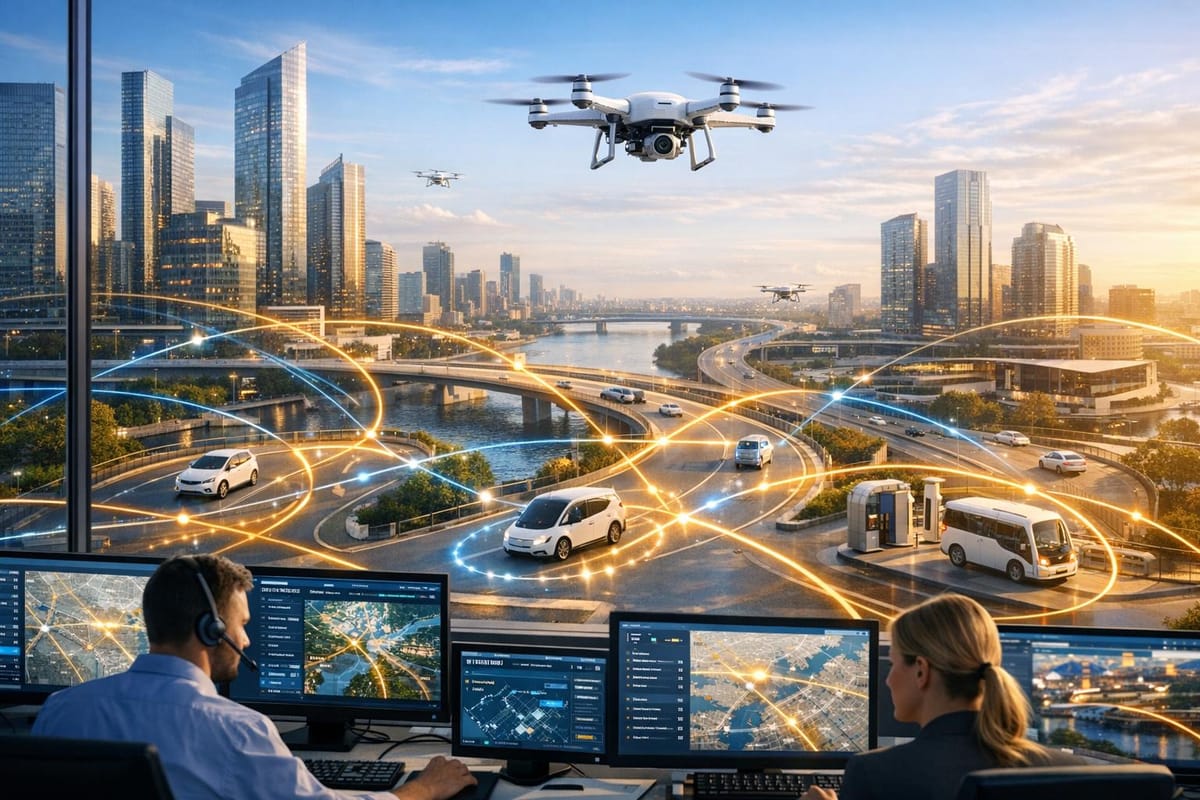
By 2035, the UK's connected and automated vehicle market is expected to reach £41.7 billion, with the commercial drone sector adding £45 billion by 2030. These technologies are already being used in logistics, medical deliveries, and infrastructure inspections. However, safety remains a critical challenge as drones and AVs integrate into daily operations.
Key Takeaways:
- Safety Risks: Mid-air collisions, technical failures, cybersecurity threats, and unclear liability frameworks are major concerns.
- Technologies: Beyond Visual Line of Sight (BVLOS), Uncrewed Traffic Management (UTM), telematics, and AI-powered hazard detection are crucial for safe operations.
- Regulations: The Automated Vehicles Act (2024) and new Civil Aviation Authority (CAA) guidelines aim to enable routine BVLOS operations by 2027.
- Solutions: Real-time tracking, layered cybersecurity, and Specific Operations Risk Assessments (SORA) are essential tools for fleet managers.
This article explores how UK fleet operators can address these challenges, implement safety measures, and prepare for the future of autonomous fleets.
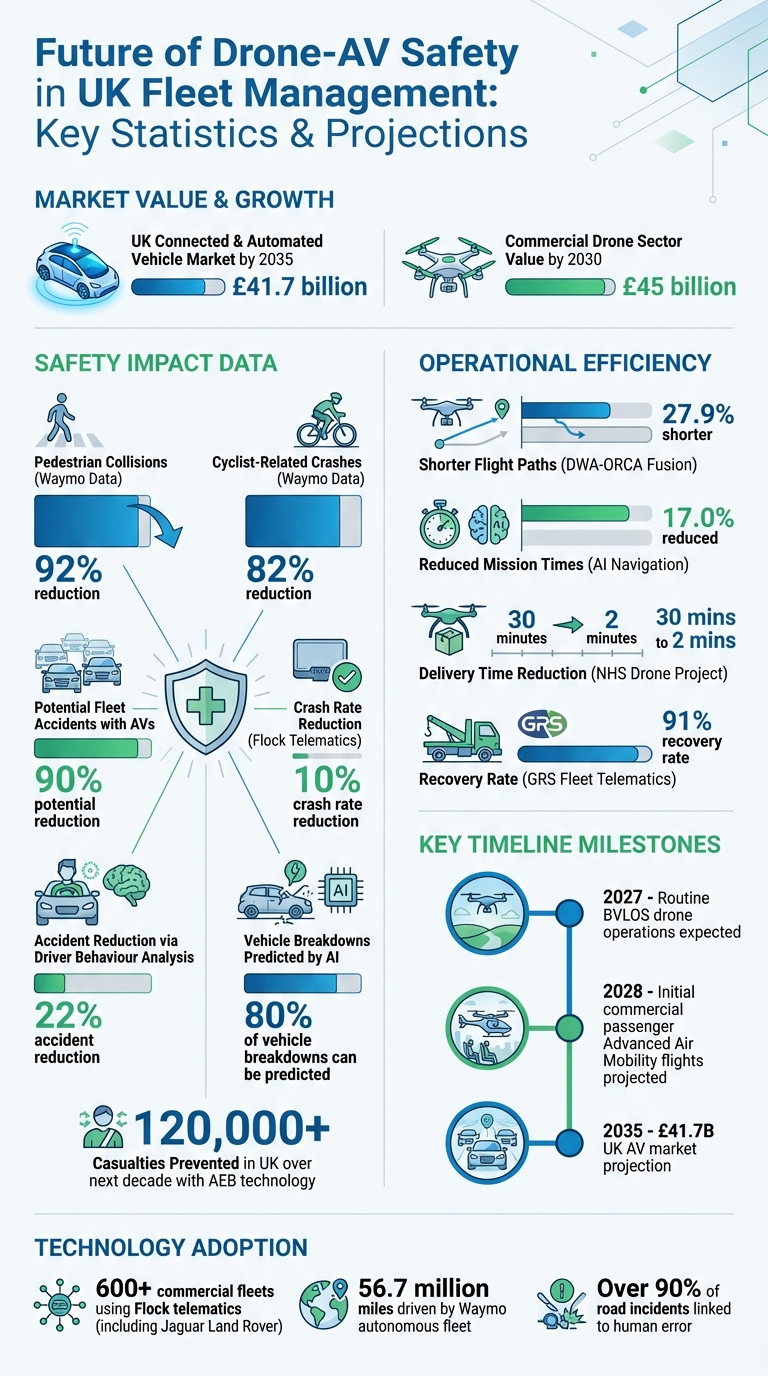
UK Drone and Autonomous Vehicle Fleet Safety: Key Statistics and Market Projections 2024-2035
Current State of Drone and AV Use in UK Fleets
How Drones and AVs Are Being Used Today
In the UK, drones and autonomous vehicles (AVs) are finding their place in a range of industries. Drones are being used to inspect infrastructure like railways, power lines, and pipelines. They’re also taking on roles such as security monitoring and crop spraying, often operating in controlled and segregated airspace to ensure safety and efficiency.
On the roads, Automated Lane Keeping Systems (ALKS) stand out as the first commercially available automated technology in UK fleets. This system allows drivers to temporarily hand over control to the vehicle, paving the way for broader adoption of autonomous technology. While ALKS reduces human error, it still requires drivers to step in during critical moments.
The shift from trials to real-world operations is picking up speed. The UK is moving towards integrated airspace, where drones and crewed aircraft share the same skies, rather than operating separately in segregated airspace. This change is crucial for scaling up applications like last-mile deliveries and warehouse distribution, which often require flights over populated areas. These advancements are setting the stage for the technologies that ensure drones and AVs can operate safely and efficiently.
Technologies Enabling Drone and AV Operations
Several key technologies are driving the safe integration of drones and AVs into UK fleets. One of the most important is Beyond Visual Line of Sight (BVLOS), which allows drones to fly beyond the operator’s direct view - a necessity for scaling commercial operations. To support this, the UK Civil Aviation Authority has introduced Uncrewed Traffic Management (UTM) systems. These systems help manage airspace by coordinating multiple drone operators, ensuring they can share the skies without conflict.
On the ground, telematics platforms are transforming fleet management. These systems collect real-time data, identifying risky routes and behaviours. For example, UK insuretech company Flock uses telematics to provide data-driven insurance for over 600 commercial fleets, including Jaguar Land Rover and a significant portion of independent Amazon fleets in the UK. By analysing driver behaviour, Flock has helped its customers reduce crash rates by up to 10%. This approach not only improves safety but also ties performance directly to insurance costs, offering financial rewards for safer operations.
When combined with technologies like LiDAR, radar, and GNSS, telematics platforms provide continuous monitoring and obstacle detection. Companies like GRS Fleet Telematics offer real-time tracking and 24/7 support, giving fleet managers the tools to oversee both traditional and autonomous assets. This infrastructure is critical for maintaining safety and quickly responding to incidents.
These technological advances have also driven changes in regulations, shaping the way the industry operates.
New Developments Shaping the Industry
As technology evolves, regulatory frameworks are catching up to enable broader use of drones and AVs. The UK Civil Aviation Authority has laid out a roadmap aiming for routine BVLOS drone operations by 2027. Sophie O'Sullivan, Director of Future, Safety & Innovation at the CAA, highlights the importance of this shift:
"To unlock the full economic and societal potential of airborne drones... it is essential to enable operations beyond the pilot's direct line of sight, known as Beyond Visual Line of Sight (BVLOS)".
A key policy update came in 2025 with the CAA’s Atypical Air Environment (AAE) guidelines. This policy allows drones to operate near ground infrastructure - within 50 feet of buildings - where encounters with manned aircraft are unlikely. By reducing the need for segregated airspace, this change is enabling more urban drone operations. Additionally, Temporary Reserved Areas (TRAs) and Transponder Mandatory Zones (TMZ) provide controlled environments for testing new technologies before they’re fully integrated into open airspace.
Connectivity improvements and the development of Level 4 autonomy - where vehicles can operate independently under specific conditions - are setting new standards for safety and efficiency in fleet operations. These advancements are not just reshaping how fleets operate but are also redefining what’s possible in the logistics and transportation industries.
What is Drone Fleet Management?
Safety Risks in Fleets Using Drones and AVs
As drones and autonomous vehicles (AVs) transition from experimental trials to everyday use, fleet managers face three primary challenges: operational risks that could lead to physical damage, cybersecurity vulnerabilities that exploit digital weaknesses, and regulatory hurdles with legal and financial implications.
Operational Hazards
One of the most pressing concerns is mid-air collisions, especially as the UK shifts from segregated airspace to integrated operations where drones and piloted aircraft share the skies. Additionally, technical failures - such as mid-air system malfunctions, loss of control links, or power and propulsion issues - can occur without warning. The Standardised European Rules of the Air (SERA.3205) explicitly state that aircraft must not operate in close proximity to others in a way that creates a collision hazard.
Another risk is Controlled Flight into Terrain (CFIT), where drones crash into buildings, power lines, or the ground. These incidents often result from technical errors or pilot mistakes. The UK's Atypical Air Environment (AAE) policy allows drones to operate within 50 feet of buildings, reducing interactions with manned aircraft but introducing new risks near ground infrastructure.
A real-world example of these challenges arose during the 2024 London Health Bridge project. This initiative involved partially integrated drone operations between two London hospitals. To minimise mid-air collision risks, Temporary Reserved Areas and custom operating procedures were developed by the Air Navigation Service Provider. The project highlighted the complexities of urban drone operations and the need for advanced technological solutions.
To tackle these risks, fleet operators can adopt the Specific Operation Risk Assessment (SORA) methodology, which systematically identifies and addresses both ground and air hazards. Deploying Detect and Avoid (DAA) systems - whether ground-based or airborne - replicates the "see and avoid" capabilities of human pilots for Beyond Visual Line of Sight (BVLOS) operations. Additionally, Electronic Conspicuity devices, such as Mode S transponders, help ensure drones remain visible to other airspace users and Air Traffic Control. Beyond these physical risks, digital threats further complicate fleet safety.
Cybersecurity Threats
After addressing physical hazards, fleet managers must focus on digital vulnerabilities, as these can have serious physical consequences. For example, remote hijacking enables attackers to take control of vehicles, manipulating steering, acceleration, or braking systems. In 2015, researchers Charlie Miller and Chris Valasek demonstrated this by remotely hacking a Jeep Cherokee through its cellular connection, ultimately disabling the engine and brakes while the car was on a motorway. This led Fiat Chrysler to recall 1.4 million vehicles to fix the software vulnerability.
Sensor manipulation is another concern. In 2018, McAfee researchers tricked a Tesla Model S into misreading a speed limit sign by altering it with black tape. The car’s camera system interpreted the sign as 85 mph instead of 35 mph, causing it to accelerate dangerously.
Denial of Service (DoS) attacks can overwhelm vehicle networks, slowing or disabling critical systems and preventing the processing of safety data. Unencrypted communication between drones and controllers also poses a risk, as attackers could intercept sensitive fleet or passenger information. With AVs relying on millions of lines of code, even small bugs can be exploited for cyberattacks.
To counter these threats, fleet managers should implement layered cybersecurity measures. These include AES/RSA encryption, firewalls, and Intrusion Detection Systems to monitor for unusual network activity. Secure Firmware Over-the-Air (FOTA) updates allow remote patching of vulnerabilities, while Hardware Security Modules (HSM) safeguard vehicle data and cryptographic functions. The UK Civil Aviation Authority’s CAP 3098 offers specific guidance on cyber safety for certain operations.
Regulatory Compliance and Liability
Beyond technical solutions, regulatory compliance is essential for managing risks effectively. Current Uncrewed Aircraft Systems (UAS) face challenges in meeting "Rules of the Air" requirements, particularly the mandate for pilots to "see and avoid" other aircraft.
The integration of drones into airspace is progressing through three stages: Segregation (using Temporary Danger Areas), Accommodation (using Temporary Reserved Areas), and eventual Integration into shared airspace. The Civil Aviation Authority (CAA) has acknowledged that continued segregation is not sustainable and that unlocking the potential of BVLOS operations is necessary.
Operators must navigate the "Specific" or "Certified" categories of operation, which require detailed Operating Safety Cases (CAP 722A) and comprehensive risk assessments. Liability often rests on the pilot-in-command, who must ensure that the aircraft avoids collisions and does not pose hazards to others (SERA.3201 and SERA.3205).
| Operational Pathway | Description | Key Use Cases |
|---|---|---|
| Atypical Air Environment (AAE) | BVLOS near ground infrastructure | Inspections of rail, power lines; security; agriculture |
| Integrated Low Level | BVLOS in low-level airspace (<500 ft AGL) over urban areas | Last-mile delivery (medical supplies, consumer goods); urban inspections |
| Fully Integrated BVLOS | BVLOS integrated with all airspace users | Emergency air services; offshore inspections; middle-mile delivery |
Fleet operators should rely on the CAA’s Acceptable Means of Compliance (AMC) and Guidance Material (GM) for practical interpretations of regulations. The CAP 722 series, particularly 722A for safety cases and 722H for pre-defined risk assessments, is regularly updated to reflect advancements in technology. With routine BVLOS operations expected by 2027 and initial commercial passenger Advanced Air Mobility flights projected for 2028, staying informed about regulatory updates is crucial. These compliance measures lay the groundwork for developing effective risk mitigation strategies, which will be explored in the next sections.
Designing Safe Systems for Drone and AV Integration
Ensuring the safety of drone and autonomous vehicle (AV) fleets requires a comprehensive approach. This involves everything from reliable sensors and secure communication systems to robust power sources and human oversight. At the heart of these systems are rapid backup measures designed to respond immediately when things go wrong. Together, these strategies enable effective real-time monitoring and pave the way for advanced AI-driven hazard management in the future.
Backup Systems and Emergency Protocols
Redundancy in sensors is a cornerstone of safety. Using multiple types of sensors - like LiDAR, radar, infrared, and visual systems - ensures drones and AVs maintain situational awareness, even in the unpredictable weather conditions often seen in the UK. A great example of this is "Strider", a prototype robot developed in 2024 by Oxford Dynamics for the UK Ministry of Defence under a £1 million contract. Strider combines infrared, radar, and LiDAR technologies to safely retrieve hazardous materials from areas beyond the operator's line of sight. Its performance is enhanced by "AVIS", a specialised AI software designed for high-risk recovery operations.
Human oversight remains a critical component. In 2024, Guy's and St Thomas' NHS Foundation Trust collaborated with Apian and Wing to transport blood samples using automated drones. These 5 kg foam drones follow pre-set routes at an altitude of 70 metres, cutting delivery times from 30 minutes by van to just two minutes. Certified pilots oversee the operation to ensure safety. Sgt Darren Mundey, Drone Unit Lead at Cheshire Constabulary, highlighted the importance of these systems:
"Having drone capability makes a huge difference in the way we protect vulnerable people and gather critical evidence at scenes".
Fail-safe measures, such as lightweight foam materials and geo-fenced routes, are designed to reduce risks during emergencies. On the cybersecurity front, encryption and hardware security modules shield systems from GPS spoofing and hacking attempts. Additionally, IoT sensors and AI-powered diagnostics allow fleet managers to predict and address potential hardware failures before they escalate.
Real-Time Tracking and Incident Response
Real-time tracking is essential for fully autonomous operations. Operators must continuously monitor vehicle performance and step in when necessary. Since 2022, Waymo has been running a fleet of autonomous Jaguar I-PACE taxis in partnership with Avis Budget Group. Over 56.7 million miles, their tracking systems and sensors have achieved a 92% reduction in pedestrian collisions and an 82% drop in cyclist-related crashes compared to human-driven vehicles. This demonstrates how continuous monitoring significantly enhances safety.
GRS Fleet Telematics offers a unified platform for tracking both traditional and autonomous vehicles. With features like geo-fencing and dual-tracker technology, the system ensures vehicles stay within designated safety zones and enables immediate response during incidents. Starting at just £7.99 per vehicle per month, it provides 24/7 recovery support and boasts a 91% recovery rate.
In October 2025, DoorDash introduced "Dot", a delivery robot capable of reaching speeds of 20 mph. This rollout included an Autonomous Delivery Platform that integrates human couriers, drones, and robots, creating a seamless delivery network. Tom Leggett, Vehicle Technology Manager at Thatcham Research, stressed the importance of transparency in AV deployment:
"In order for AVs to gain acceptance, transparency must be at the heart of deployment. That means making data, functionality, and operational design domain principles clearer to the public and insurers".
AI-Powered Hazard Detection
AI is playing a pivotal role in hazard detection and avoidance. Systems like the DWA-ORCA fusion algorithm combine the Dynamic Window Approach with Optimal Reciprocal Collision Avoidance, cutting flight path lengths by 27.9% and reducing mission times by 17.0%. For obstacle detection, tools like NanoDet deliver high-speed visual recognition, while Kalman Filtering predicts the movement of dynamic obstacles, such as pedestrians or vehicles, with precision.
In October 2024, UK-based Wayve showcased an AI-first autonomous vehicle in London, navigating 45 minutes of complex urban traffic. Unlike traditional systems that rely on pre-mapped routes, Wayve’s approach uses real-time data to handle the challenges of urban environments and adverse weather conditions. The company plans to roll out these vehicles commercially with Uber, pending regulatory approval.
Large Language Models (LLMs) are now assisting unmanned aerial vehicles (UAVs) by interpreting commands and analysing telemetry to predict potential failures. For instance, autonomous emergency braking (AEB) could prevent more than 120,000 casualties in the UK over the next decade. By integrating AI capabilities with real-time telematics, fleet operators can significantly improve safety across their entire operations.
Managing Risks in Drone and AV Fleet Operations
Bringing drones and autonomous vehicles (AVs) into fleet operations demands a structured approach to risk management. Fleet managers must carefully evaluate potential risks, establish clear protocols, and ensure staff are prepared for both routine tasks and unexpected scenarios. Let’s explore how risk assessment, standard procedures, and staff training play a crucial role in maintaining fleet safety.
Risk Assessment and Mitigation
The Specific Operations Risk Assessment (SORA) framework from the Civil Aviation Authority (CAA) is a key tool for assessing risks in drone and AV operations. Fleet managers must evaluate both air and ground risks, including the critical 2-3 second delay needed for a human driver to regain control of an AV during a handover.
Every risk assessment should consider technical and environmental hazards. Potential failure points like command link loss, battery issues, and GPS errors need to be addressed, along with external factors such as bad weather or complex urban environments. Cybersecurity is also a pressing concern, requiring Cyber Safety Objectives to prevent unauthorised access to systems. As Sophie O'Sullivan from the UK Civil Aviation Authority emphasises:
"We need to be assured that BVLOS operations can be safely integrated into the UK's airspace. This requires us to be satisfied that the operation itself is safe, that the technology has the appropriate safety features, pilots are appropriately trained, and real-world operations are enabled".
Fleet managers must also determine the Airspace Integration Level suitable for their operations. Options include Atypical Air Environments (AAE), Integrated Low Level, or Fully Integrated Beyond Visual Line of Sight (BVLOS), each with its own safety and regulatory requirements. Built-in safety features like geo-fencing and "return-to-home" protocols can further reduce risks, preventing drones from entering restricted airspace or losing power mid-flight.
Standard Operating Procedures
Once risks are identified, the next step is creating tailored Standard Operating Procedures (SOPs). These procedures must align with the specific environment and risk profile of each operation. The UK’s regulatory framework categorises operations into Operational Pathways, such as Atypical Air Environments (AAE) for areas near infrastructure, Integrated Low Level BVLOS for urban settings, and Fully Integrated BVLOS. Each pathway demands customised procedures for managing Mid-Air Collision (MAC) risks, particularly in shared airspace.
A practical example of this is the 2024 London Health Bridge project, which involved low-level drone operations between two hospitals. Using Temporary Reserved Areas (TRA) and tailored procedures for MAC mitigation, this initiative showcased how SOPs can adapt to specific operational needs. Fleet managers can adopt a similar Concept of Operations (ConOps) approach, allowing procedures to evolve as technology and regulations advance.
Key elements of drone SOPs include deconfliction checks and strategic tools like Uncrewed Traffic Management (UTM) systems to prevent conflicts with other operators. Controlled environments such as TRA or TMZ are often used during early deployments. Additionally, site-specific risk assessments are critical; for instance, a survey near a building requires different controls than one conducted over open water.
Incident reporting procedures are another essential component. Fleet managers should use the CAA’s RPAS Safety Reporting frameworks (CAP 2356/2357) to document incidents and improve safety across the fleet. As Sophie O'Sullivan noted, enabling routine BVLOS operations for NHS and emergency services remains a key goal for 2027.
Staff Training and Preparation
Even with advanced technology and well-defined procedures, the success of risk management ultimately depends on properly trained staff. In the UK, drone operators must hold a CAA certificate and display their registration number. Training requirements vary with operational complexity - basic tasks might only need online courses, while high-risk operations like BVLOS demand in-person training and exams.
For AV fleets, training must address the challenges of handover management. With over 90% of road incidents linked to human error, the transition from automated to manual control is particularly risky. Lisa Dorn, Associate Professor of Driver Behaviour at Cranfield University, highlights this issue:
"Vehicles (driven autonomously) take drivers out of the loop and we know it can take some time before they are re-engaged".
To mitigate these risks, some manufacturers are bypassing Level 3 autonomy, moving directly from Level 2 (driver assistance) to Level 4 (high automation) to avoid the dangers of handover phases. Fleet managers should implement practical handover drills to ensure drivers can safely transition between automated and manual control.
Telematics-based coaching provides a data-driven way to enhance training. For instance, in February 2023, UK-based startup Flock reported that its telematics insurance platform helped over 600 commercial fleets, including Jaguar Land Rover and Amazon partners, cut crash rates by up to 10%. Similarly, GRS Fleet Telematics offers tools like real-time speed monitoring and eco-driving analytics for £7.99 per vehicle per month, helping managers identify and correct risky behaviours before they result in incidents.
Given the rapid pace of technological and regulatory changes, training must be an ongoing process, not a one-time event. Employers should maintain detailed records of certifications, competency checks, and regular updates for each staff member. Christoph Lauterwasser, Managing Director at Allianz Centre for Technology, underscores the importance of learning from early challenges:
"Especially in the beginning when we will have mixed traffic we will see accidents and it is very important we learn from those accidents".
Conclusion: What's Next for Drone and AV Safety in Fleet Management
The integration of drones and autonomous vehicles (AVs) into UK fleets is no longer a distant concept. The Civil Aviation Authority (CAA) is aiming for routine Beyond Visual Line of Sight (BVLOS) drone operations by 2027, with a regulatory framework for commercial passenger Advanced Air Mobility flights expected by the end of 2028. Achieving these milestones depends on three key elements: thorough risk assessment frameworks, clear regulatory guidelines, and advanced telematics systems that provide the real-time insights needed to manage both present operations and future challenges.
For fleet managers, the transition to automated systems offers a mix of opportunities and challenges. While autonomous vehicles could potentially reduce fleet accidents by up to 90%, the interim period - when human-driven and autonomous vehicles share the roads - poses unique safety risks. This mixed-traffic phase highlights the importance of predictive analytics and real-time monitoring of vehicle behaviour. Modern telematics systems have become essential tools in addressing these risks.
Telematics technology has evolved from basic tracking to becoming a proactive safety partner. AI-powered systems can now predict up to 80% of potential vehicle breakdowns and reduce accident rates by as much as 22% through driver behaviour analysis. For fleets managing the complexities of drone and AV integration, platforms like GRS Fleet Telematics offer practical solutions such as real-time speed monitoring, geofencing, and eco-driving analytics - all starting from £7.99 per vehicle per month. These tools not only help fleets stay compliant with regulations but also assist with liability management and ongoing safety improvements.
The industry is also shifting from traditional insurance models to collaborative risk management. As David Gerrish, Head of UK Motor at AXA XL, and Dougie Barnett, Director of Customer Risk Management at AXA Insurance, explain:
"The development of technology means that risk management and transfer is changing. Conversations are now less about price and more about partnership and service".
Fleet managers who prioritise predictive maintenance, continuous driver training, and robust data security will be better positioned to navigate upcoming regulatory changes and enhance safety measures.
The future of fleet management lies in creating systems that continuously improve. With the right combination of tools, training, and alignment with regulations, UK fleets can lead the way in safely and efficiently integrating drones and AVs. Innovations in risk assessment and telematics will remain central to ensuring the successful adoption of these emerging technologies.
FAQs
What are the key safety concerns when integrating drones and autonomous vehicles into UK fleets?
Integrating drones and autonomous vehicles (AVs) into UK fleets comes with its own set of safety challenges. For drones, operating beyond visual line of sight (BVLOS) remains a major obstacle. This requires advanced detect-and-avoid systems and effective airspace management to reduce risks to people, property, and other airspace users. On the ground, stakeholders must navigate regulatory compliance while ensuring drones fit seamlessly into current aviation systems.
When it comes to road-based AVs, the focus shifts to reliable sensor technology, robust cybersecurity for vehicle communications, and dependable emergency safety systems. The UK’s evolving legal landscape, including the Automated Vehicles (AV) Act 2024, places accountability on manufacturers, operators, and insurers to manage collision risks and ensure systems remain reliable. Comprehensive testing in diverse, real-world conditions is essential to confirm these technologies are safe and effective.
A cohesive safety strategy is key, combining tools like real-time telematics, data analytics, and continuous monitoring. Solutions such as GRS Fleet Telematics’ advanced tracking devices offer fleet managers precise location tracking, geofencing alerts, and detailed incident reporting. These tools play a crucial role in meeting UK safety standards for drones and AVs while enhancing overall fleet safety.
How do BVLOS and UTM technologies improve the safety of drones in fleet operations?
Beyond Visual Line of Sight (BVLOS) technology allows drones to operate outside the pilot's direct view, expanding their operational range while maintaining safety. In the UK, regulations set by the Civil Aviation Authority (CAA) require strict measures like designated airspace corridors, comprehensive risk assessments, and mandatory detect-and-avoid (DAA) systems to ensure the safety of airspace users and people on the ground. Real-time telemetry and dependable command-and-control links enable operators to maintain control, reducing the likelihood of collisions or unauthorised incidents.
Unmanned Traffic Management (UTM) serves as a digital air traffic control system for low-altitude drone operations. It facilitates the sharing of flight plans, broadcasts real-time positions, and resolves conflicts between drones and other aircraft. When paired with BVLOS, UTM creates a well-coordinated, safe environment, allowing fleet managers to oversee compliance and performance while minimising risks.
For businesses already leveraging advanced tracking tools like those offered by GRS Fleet Telematics, integrating BVLOS-enabled drones with UTM connectivity provides the same high standard of oversight and security for aerial operations. With plans starting at just £7.99 per month, this integration helps protect both ground and air assets effectively.
What regulatory changes will make drones and autonomous vehicles safer to use by 2027?
By 2027, the UK is preparing to roll out important regulatory updates to encourage the safer and more regular use of drones and autonomous vehicles. The Future of Flight action plan and the Civil Aviation Authority’s BVLOS roadmap will introduce steps to support beyond-visual-line-of-sight (BVLOS) drone operations. Additionally, these updates will outline guidelines for the early adoption of autonomous electric vertical take-off and landing (eVTOL) vehicles, targeted for 2028.
These initiatives are designed to improve safety standards, simplify risk management processes, and make it easier to integrate drones and autonomous vehicles into fleet management systems throughout the UK.