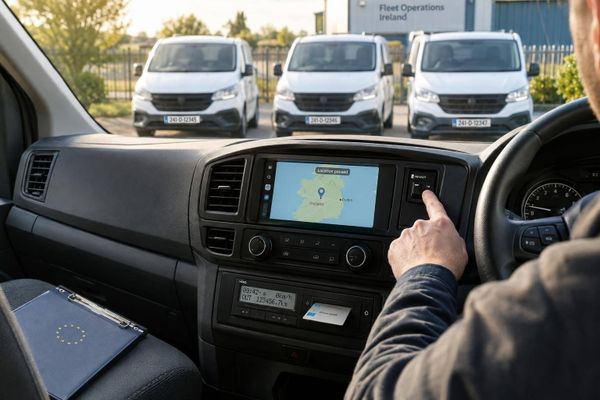
Fleet Tracking Regulations Explained: A Guide for Vehicle Leasing Companies in Northern Ireland
Clear compliance guide for NI vehicle leasing firms on GPS/telematics, UK GDPR duties, tachographs and retention.

Jurisdiction Scope
Northern Ireland; UK data-protection law and Northern Ireland transport and operator-licensing rules
sbb-itb-499a7f0
Overview of Fleet Tracking Laws
Applicable Business Type
Vehicle leasing companies and fleet operators in Northern Ireland
Country or Region
United Kingdom — Northern Ireland
A practical compliance guide for vehicle leasing companies in Northern Ireland using GPS or telematics to protect and manage leased vehicles. It explains the UK GDPR and Data Protection Act 2018 implications of vehicle-location monitoring, including lawful basis, transparency to lessees and drivers, proportionality, security, retention, data sharing, individual rights and controls for private or out-of-hours use. It also distinguishes ordinary leasing activity from separate tachograph, drivers-hours and operator-licensing obligations that may apply when vehicles are used for regulated goods or passenger transport.
Legal Requirements Summary
Northern Ireland vehicle leasing companies may use telematics for legitimate security, theft-prevention, insurance, contract and fleet-management purposes, but must comply with UK GDPR and the Data Protection Act 2018. They should establish and document a lawful basis, give transparent advance notice, minimise and secure location data, control access and sharing, honour data-subject rights, and delete data when no longer necessary. There is no general requirement to install trackers in every leased vehicle and no general fixed retention period for ordinary GPS data. Separate tachograph and operator-licensing rules apply where the fleet or its use falls within regulated transport operations.
Main Regulatory Topics
- Data Privacy and UK GDPR
- Lawful Basis and Transparency
- Driver and Lessee Notice
- Driver Consent
- Data Minimisation and Proportionality
- DPIA and Surveillance Governance
- Data Security and Access Control
- Data Sharing
- Record-Keeping and Data Retention
- Tachograph and Drivers-Hours Compliance
- Operator Licensing
- Enforcement and Practical Implementation
Key Compliance Obligations
- Document a lawful basis and specific purposes for GPS or telematics processing.
- Give lessees, drivers and relevant passengers/staff clear privacy information before tracking, including the controller, data collected, purposes, recipients and retention period.
- Limit collection and use to necessary and proportionate purposes such as security, theft recovery, insurance, contract administration and fleet operations.
- Complete a DPIA where the monitoring is likely to create a high risk, particularly for driver or passenger surveillance.
- Secure tracking data, restrict access, manage service providers contractually and maintain suitable technical and organisational safeguards.
- Respect data-subject rights and maintain privacy notices, processing records and procedures for access and other rights requests.
- Avoid or limit monitoring during authorised private or out-of-hours use unless clearly justified; consider a way to suspend or restrict monitoring where appropriate.
- Share tracking or customer data with law enforcement only on a lawful, documented basis.
- Set and periodically review a retention schedule and delete or anonymise data when it is no longer necessary.
- Where applicable, comply separately with tachograph downloading, drivers-hours recordkeeping and Northern Ireland operator-licensing requirements; ordinary vehicle leasing does not itself create a general GPS-installation mandate.
Driver Consent Requirement
Consent Rule: Prior driver consent is not generally required where the company has another valid UK GDPR lawful basis, such as legitimate interests, contract or legal obligation. The company must inform drivers and lessees clearly before monitoring, explain the purposes and scope, and ensure the processing is necessary and proportionate. Employee consent is generally unsuitable where there is an employment power imbalance; consent, if used, must be freely given and revocable without detriment.
Data Retention Period
Minimum Retention: No fixed statutory minimum for ordinary GPS/telematics tracking data; retain only as long as necessary under a documented, reviewed schedule. A separate 12-month rule applies to specified drivers-hours records, not automatically to ordinary tracking data.
Enforcement Authorities
- Information Commissioner’s Office (ICO) for UK data-protection compliance
- Department for Infrastructure (DfI), Northern Ireland, for goods-vehicle operator licensing and enforcement
- Relevant courts and tribunals for appeals and enforcement proceedings
Penalties for Non-Compliance
Data-protection breaches can lead to ICO enforcement notices, orders to stop or change processing, and monetary penalties of up to £8.7 million or 2% of worldwide annual turnover for the standard maximum, or £17.5 million or 4% of worldwide annual turnover for the higher maximum, whichever is higher. Non-compliance with Northern Ireland goods-vehicle licensing requirements can result in graduated fixed penalties, vehicle detention or impounding, and suspension, curtailment or revocation of an operator’s licence. The exact outcome depends on the breach, seriousness, history and applicable regime.
Implementation Best Practices
Treat location, telematics, driver and customer-linked data as personal-data processing whenever individuals can be identified. Maintain a tracking policy, data map, lawful-basis and proportionality assessment, DPIA where appropriate, privacy notices, retention schedule, processor agreements and incident-response procedure. Put concise notices in vehicles and leasing documentation, separate security/recovery tracking from employee-performance monitoring, and provide a practical private-use or off-duty limitation where relevant. Default audio recording to off; activate it only for an exceptional, documented justification. Review device settings, suppliers, access permissions and deletion logs periodically. Keep driver-hours and tachograph records separately from ordinary GPS data because the legal requirements and retention purposes differ.
Compliance Checklist
- Identify and document the lawful basis, purposes and proportionality of GPS/telematics processing.
- Give vehicle users, employees, contractors and relevant customers clear privacy information before tracking begins, including controller identity, data collected, purposes, recipients, retention and individual rights.
- Use visible in-vehicle notices where surveillance or recording occurs; explain when monitoring is active.
- Limit tracking to necessary purposes such as asset security, theft recovery, contract administration, safety or fleet management; avoid unjustified private-use or out-of-hours monitoring.
- Complete and document a DPIA where monitoring is high risk, particularly for behavioural analytics, profiling, cameras or audio.
- Configure access controls, authentication, encryption, processor contracts and audit logs; restrict data access to authorised personnel.
- Set a documented, purpose-based retention schedule, review it regularly and securely delete data when no longer necessary.
- Provide appropriate mechanisms for access, objection and other UK GDPR rights, and document disclosures to law enforcement or insurers.
- If operating goods vehicles within operator-licensing and drivers-hours rules, ensure vehicles are properly authorised and retain required tachograph/manual records.
- Update tachograph and compliance processes for the 21 April 2025 rule change extending certain records carried by drivers from 28 to 56 days where applicable.
Industry-Specific Guidance
A Northern Ireland vehicle leasing company may track leased vehicles for legitimate security, theft recovery, insurance, maintenance, contract administration and customer-support purposes, but the lessor and lessee must clearly determine their respective controller/processor roles. Notices should reach the leasing customer, any authorised drivers and employees who can be monitored; contractual consent alone is not automatically required or sufficient where tracking is necessary for another lawful purpose. Tracking should be proportionate and should not become covert driver surveillance. A leasing company that merely owns or leases vehicles is not automatically subject to every goods-vehicle operator rule; those rules apply where the business operates qualifying goods vehicles or otherwise falls within the relevant licensing and drivers-hours regime. For vehicles used under an operator’s licence, ensure authorisation and vehicle records are current. Where vehicles are used for goods transport, integrate telematics with, but do not replace, tachograph and manual records.
Recent Legal Updates
The Drivers’ Hours and Tachographs (Amendment and Modification) Regulations 2025 came into force on 21 April 2025 and extend to Northern Ireland. For vehicles and journeys within their scope, certain records that drivers must carry changed from the current day and previous 28 days to the current day and previous 56 days. Northern Ireland Department for Infrastructure guidance also confirms that drivers must record driving, other work, availability, breaks, rest, annual leave and sick leave as required. There is no general UK GDPR fixed retention period for ordinary GPS tracking data: retention must be justified by purpose and business/legal need. As at 7 October 2026, companies should verify whether later amendments or sector-specific rules apply to their fleet.
Authoritative Resources
- Information Commissioner’s Office (ICO): Surveillance in vehicles
- ICO: Data protection and monitoring workers
- UK GDPR and Data Protection Act 2018
- legislation.gov.uk: Goods Vehicles (Licensing of Operators) Act (Northern Ireland) 2010
- Department for Infrastructure (Northern Ireland): Guidance – Recording of other work
- legislation.gov.uk: Drivers’ Hours and Tachographs (Amendment and Modification) Regulations 2025
Related Blog Posts
- Fleet Tracking Regulations Explained: A Guide for Delivery Firms in Northern Ireland
- Fleet Tracking Regulations Explained: A Guide for Van Rental Companies in Northern Ireland
- Fleet Tracking Regulations Explained: A Guide for Vehicle Leasing Companies in the UK
- Fleet Tracking Regulations Explained: A Guide for Vehicle Leasing Companies in England