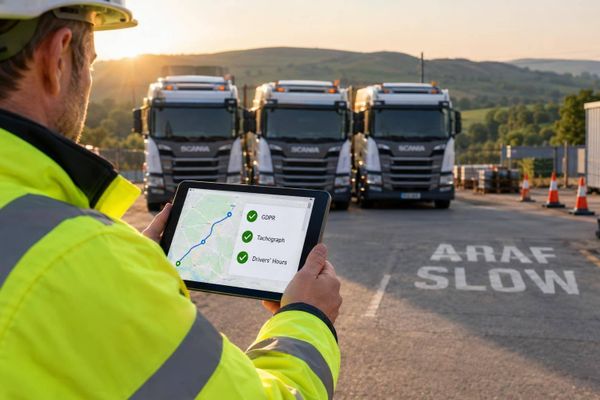
Fleet Tracking Regulations Explained: A Guide for Construction Contractors in England
Construction fleets must balance GPS telematics with UK GDPR and tachograph duties to avoid fines and enforcement.
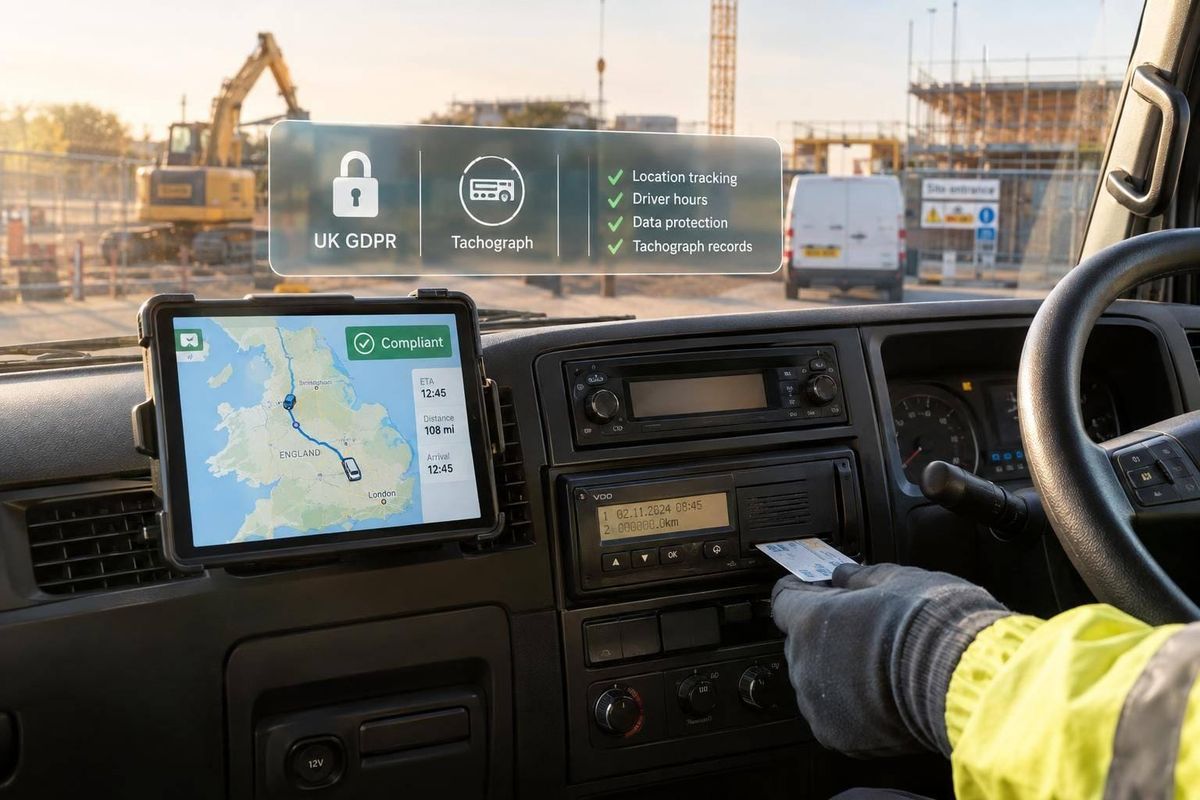
Jurisdiction Scope
England; UK GDPR and Great Britain drivers’ hours/tachograph enforcement framework
sbb-itb-499a7f0
Overview of Fleet Tracking Laws
Applicable Business Type
Construction contractors and businesses operating work vehicles in England
Country or Region
UK — England
A practical compliance guide for English construction contractors using GPS tracking, vehicle telematics, tachographs or in-vehicle surveillance. It explains UK GDPR requirements for monitoring workers and vehicles, privacy safeguards for personal use and passengers, DPIA considerations for intrusive monitoring, and tachograph download and record-production duties where drivers’ hours rules apply.
Legal Requirements Summary
English construction contractors may use fleet tracking, but worker and vehicle telematics data is personal data when it relates to identifiable drivers. The contractor should use a documented lawful basis, provide transparent notices to workers and passengers, limit monitoring to necessary business purposes, and avoid or disable tracking during authorised private use. A DPIA is expected for high-risk or intrusive monitoring such as driver-behaviour analytics, cameras or audio. The UK GDPR does not prescribe a universal retention period: retention must be necessary, justified, reviewed and governed by a schedule. For vehicles subject to tachograph rules, operators must download vehicle data at least every 90 days and driver-card data at least every 28 days, regularly check compliance, and be able to produce records for 12 months.
Main Regulatory Topics
- UK GDPR and data privacy
- Worker and passenger transparency
- Lawful basis and driver consent
- Private-use restrictions
- Data minimisation and retention
- DPIAs and intrusive monitoring
- Tachograph installation and operation
- Tachograph downloads and record-keeping
- Drivers’ hours compliance
- Enforcement records
Key Compliance Obligations
- Identify and document a lawful basis, purpose and necessity for tracking; do not rely on employee consent routinely.
- Tell workers and passengers that monitoring is taking place, what data is collected, why it is collected, and who controls it.
- Do not monitor private use routinely; provide a disablement or privacy mode where appropriate.
- Carry out and document a DPIA for high-risk monitoring, including driver-behaviour analytics, cameras, audio or other intrusive systems.
- Apply data minimisation, security and access controls, and maintain a retention schedule; delete monitoring data when no longer necessary.
- Where tachographs apply, download vehicle-unit data at least every 90 days and driver-card data at least every 28 days.
- Regularly check tachograph records and produce charts, manual records and digital data to enforcement officers for 12 months.
- Provide drivers with copies of relevant charts, manual records or digital data when requested.
Driver Consent Requirement
Consent Rule: Obtain and document a lawful basis and give workers clear privacy information; separate driver consent is not normally required or appropriate in employment because of the power imbalance. Consent is suitable only where workers have a genuine choice and control. Workers and passengers must be informed about vehicle monitoring, and private-use tracking should generally be disabled or avoided unless justified.
Data Retention Period
Minimum Retention: 12 months for tachograph records that operators must be able to produce to enforcement officers; ordinary vehicle-monitoring data has no fixed UK GDPR period and must be retained only as long as necessary for the documented purpose.
Enforcement Authorities
- Information Commissioner’s Office (ICO), for UK data-protection compliance and monitoring practices.
- Driver and Vehicle Standards Agency (DVSA), for commercial-vehicle enforcement and operator maintenance investigations in England.
- Traffic Commissioners for Great Britain, for goods-vehicle operator licensing and regulatory action against operators and drivers.
- Police, which may conduct commercial-vehicle spot checks jointly or separately from DVSA.
Penalties for Non-Compliance
Data-protection non-compliance can lead to ICO regulatory action, including enforcement and potential UK GDPR/DPA 2018 sanctions; the applicable consequence depends on the breach and circumstances. For vehicle and operator non-compliance, DVSA or police may stop vehicles, identify defects and impose prohibitions preventing use until problems are fixed. Operator-maintenance investigations can be reported to the Traffic Commissioners, with further regulatory action possible. Published DVSA enforcement bands range from a verbal warning and fixed penalties of £50, £100, £200 or £300 to court prosecution. Roadworthiness failures can also result in fines or prosecution, vehicle prohibitions and serious safety consequences. The cited sources do not establish a specific construction-sector fine for failure to install GPS tracking.
Implementation Best Practices
Create a written telematics policy and DPIA covering purpose, lawful basis, proportionality, private use, worker/passenger notice, retention, access controls, supplier processing and incident handling. Configure work-only tracking where practicable, turn off audio by default, use signage and a privacy notice, and limit driver-behaviour alerts to safety or operational purposes that have been explained in advance. Integrate telematics with—not instead of—daily defect reporting, planned inspections, maintenance records and tachograph controls. Have a manager review anomalies and give the driver an opportunity to explain before taking employment action; periodically audit permissions, exports, retention and device health.
Compliance Checklist
- Determine whether each vehicle requires a goods vehicle operator’s licence: generally over 3,500 kg gross plated weight, or over 1,525 kg unladen where no plated weight, when used for business goods transport.
- Select the appropriate operator-licence type. A restricted licence generally covers the contractor’s own goods; standard licences can cover hire-or-reward work and require appropriate professional competence/transport-management arrangements.
- Do not assume that GPS tracking itself is legally mandatory. Map the system’s actual purposes—location, mileage, driver behaviour, tachograph or safety evidence—and document the lawful basis for each processing purpose.
- Give drivers and passengers clear, accessible privacy information explaining what is collected, why, when tracking operates, who controls the data, retention, sharing and individual rights.
- If vehicles can be used privately, disable tracking outside work or provide an equivalent privacy control unless monitoring private use can be justified.
- Complete and document a DPIA before high-risk monitoring, particularly driver-behaviour analytics, cameras, audio, or systems making inferences or decisions about workers.
- Use proportionate settings: collect only necessary location and event data, restrict access, secure the telematics account/API, set a documented retention period and securely delete data when no longer needed.
- Provide in-vehicle signage where surveillance or recording occurs. Keep audio disabled by default unless exceptional, documented justification exists.
- Maintain vehicle inspection and repair records for at least 15 months and ensure electronic records are complete and available; tracking data does not replace roadworthiness records.
- Where applicable, download digital tachograph vehicle data at least every 90 days and driver-card data at least every 28 days; retain drivers’ hours records for at least 12 months and working-time records for at least 24 months.
- Use telematics alerts as part of a documented maintenance, defect-reporting and driver-management process, with human review before disciplinary decisions based on automated information.
- Review compliance after changes to vehicles, tracking purposes, software suppliers, private-use arrangements or employment policies, and prepare for DVSA/Traffic Commissioner inspections.
Industry-Specific Guidance
Construction contractors commonly use vans, pickups, plant and goods vehicles across changing sites, so tracking can support site arrival, asset recovery, utilisation, mileage, maintenance and incident investigations. There is no general UK rule identified in the cited official guidance requiring every construction contractor to install GPS tracking or to provide real-time tracking to customers. The principal legal issues are instead vehicle/operator compliance and data protection. A contractor carrying its own tools, materials or equipment may need an operator’s licence when weight thresholds are met; carrying goods for customers or others can change the licence category. Telematics can help evidence journeys and maintenance management, but it cannot substitute for legally required inspection, repair, tachograph, driver-hours or defect records. Construction fleets should also address mixed use, subcontractors, agency drivers, hired vehicles and plant: each affected driver must receive appropriate privacy information, and the contractor remains responsible for roadworthiness of vehicles it hires, leases or borrows while in its possession.
Recent Legal Updates
The current official material reviewed does not show a new England construction-specific mandate for GPS or real-time fleet tracking. Relevant recent material includes DVSA’s updated Guide to maintaining roadworthiness, published 5 November 2024, which confirms electronic safety records must be complete and available and that inspection/repair records must generally be kept for at least 15 months; updated vehicle-operator-licence application guidance was published 16 April 2025. The ICO also published updated small-business dashcam guidance on 7 September 2026. Before publication or implementation, check the ICO, GOV.UK, DVSA and Traffic Commissioners for later changes, especially where tracking includes cameras, audio, automated driver analytics or cross-border operations.
Authoritative Resources
- Information Commissioner’s Office (ICO): Data protection and monitoring workers
- ICO: Surveillance in vehicles
- GOV.UK: Goods vehicle operator licensing guide
- GOV.UK/DVSA: Vehicle operator maintenance investigations
- GOV.UK: Guide to maintaining roadworthiness
- GOV.UK: Vehicle enforcement data for Great Britain