Fleet Telematics for Collision Analysis
How UK fleets use GPS, accelerometers and AI dashcams to detect collisions, speed up claims, cut insurance costs and improve driver safety.
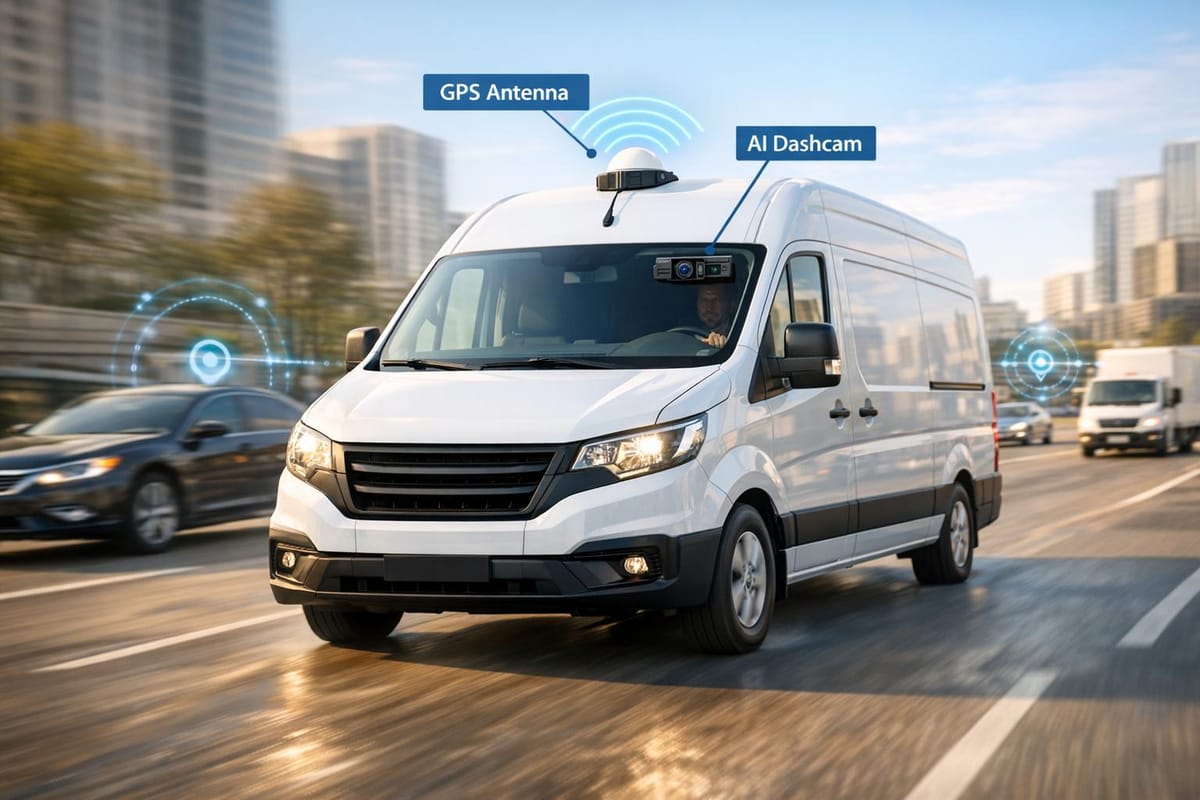
Fleet telematics systems are transforming how UK businesses manage vehicle collisions. By integrating GPS, sensors, and dashcams, these systems provide precise data on speed, braking, G-force impacts, and more during accidents. This technology helps identify fault, reduce collision rates, and lower insurance costs. Key benefits include:
- Accurate Collision Analysis: Advanced sensors and AI-powered dashcams differentiate real collisions from false alarms with up to 92% accuracy.
- Driver Behaviour Monitoring: Tracks speeding, harsh braking, and distractions, enabling targeted coaching to improve safety.
- Cost Savings: Faster claims resolution and reduced fraud lower insurance expenses by up to 50%.
- Operational Efficiency: Real-time alerts and route optimisation cut fuel and maintenance costs by 15–20%.
Telematics is reshaping road safety by offering actionable insights, reducing accidents by up to 40%, and improving fleet management. However, challenges like data privacy and system integration remain. With proper use, telematics can significantly enhance safety and efficiency for UK fleets.
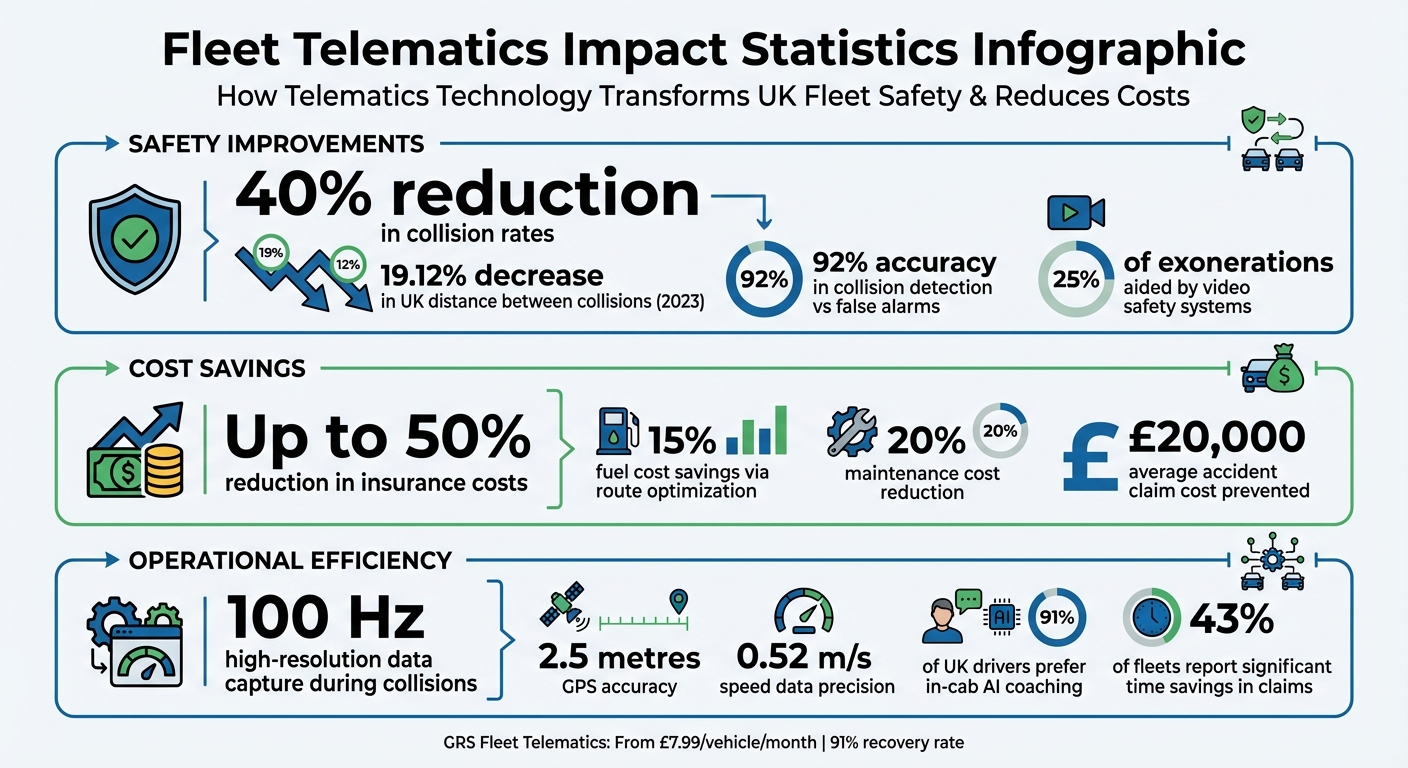
Fleet Telematics Impact: Collision Reduction and Cost Savings Statistics
How Telematics Improves Collision Detection and Reconstruction
Types of Telematics Data Used in Collision Analysis
Telematics systems gather a variety of data streams to piece together the events surrounding a collision. These include GPS coordinates (accurate to within 2.5 metres), speed data (precise to 0.52 metres per second), and three-axis accelerometer readings that measure forces along longitudinal, lateral, and vertical axes. When acceleration hits or exceeds 2.5 G - equivalent to about 24.5 metres per second squared - devices initiate high-resolution recording at 100 Hz, capturing data 100 times per second in what’s referred to as a "Collision Level Event". Other recorded data includes engine RPM, brake application, throttle percentage, and seatbelt usage, with some advanced systems even noting Bluetooth connections, door openings, and safety system activity like ABS or Traction Control.
"Collision reconstruction with telematics is the process of using fleet tracking technology and software to understand the events that occurred before, during and after a collision." – Geotab
To avoid false alarms triggered by potholes or speed bumps, advanced algorithms filter out irrelevant data. For low-speed impacts that don’t meet the 2.5 G threshold, fleet managers can customise "Minor Collision" rules, setting thresholds between 1 G and 2.5 G to ensure smaller incidents are still logged.
Faster and More Accurate Incident Detection
Telematics eliminates the delays associated with manual driver reporting. When a collision occurs, these systems send instant alerts to fleet managers, complete with an exact timestamp, location, and speed profile. This immediate notification replaces the uncertainty of waiting for drivers to report incidents, especially in situations where they may be injured or unable to communicate.
Beyond detection, telematics also speeds up incident handling. For example, FM Conway deployed AI telematics systems across its 1,000-vehicle fleet, integrating in-cab AI cameras to spot dangerous behaviours and notify managers in real time. AI-driven filters drastically cut review times - one fleet of 1,100 vehicles reduced its video review time from over eight hours per week to just minutes per day. Studies show that 43% of fleets using video telematics report significant time savings during claims processes, and combining telematics with 3G vehicle cameras can cut claims costs by as much as 50%.
"Faster claims handling and liability resolution can increase brand protection and minimise unnecessary costs, while making it easier to detect and manage opportunistic and organised fraud." – Jamie Sopp, Managing Director, Sopp+Sopp
Pairing these rapid detection capabilities with video footage adds another layer of clarity to incident analysis.
Video Telematics Combined with Data
While accelerometer and GPS data provide the technical details of a collision, video footage delivers essential context - such as the behaviour of other road users, road conditions, or weather - that helps explain why an incident occurred. When a collision-level event is detected, the system automatically flags video clips from before, during, and after the incident for immediate review. For instance, Ringway Jacobs equipped 163 vans and specialist vehicles with dual-facing dashcams integrated into the Peoplesafe Pro system. This setup allows alarm controllers to access audio and video instantly in the event of a collision or injury.
Research shows that video safety systems have played a key role in at least 25% of exonerations for one in three fleets surveyed. Angie Leathers, Litigation Coordinator at Averitt Express, highlights the importance of this evidence:
"Most of us agree that video is one of the most reliable resources for establishing liability... it often directs the path of the investigation"
| Data Stream | Role in Collision Analysis | Benefit of Adding Video |
|---|---|---|
| GPS & Speed | Tracks location, direction, and velocity at the moment of impact | Offers visual confirmation of road signs, signals, and weather |
| Accelerometer (G-Force) | Measures impact severity and direction (X, Y, Z axes) | Distinguishes between collision-related and non-crash events (e.g., potholes) |
| Engine Data (RPM/Braking) | Captures driver inputs, such as braking before impact | Explains driver reactions (e.g., avoiding a pedestrian) |
| Drowsiness Systems | Monitors driver fatigue and distraction levels | Links physical driver state to telematics exceptions |
Reducing Collision Frequency and Severity with Telematics
Driver Behaviour Monitoring and Coaching
Telematics systems are game-changers when it comes to monitoring driver behaviour. They track actions like speeding, harsh braking, and aggressive cornering, compiling this data into driver scorecards that categorise risk levels as low, mild, medium, or high. This classification allows fleet managers to focus their coaching efforts on those drivers who pose the greatest risk. By integrating telematics insights into daily operations, managers can take proactive steps to reduce collisions.
One standout feature is real-time, in-cab AI coaching. Instead of waiting for retrospective reviews, drivers receive immediate audio alerts, a system preferred by 91% of UK drivers. These instant verbal prompts enable drivers to correct their habits on the spot, fostering safer driving behaviours in real time.
Impact on Collision Rates and Near Misses
Better driving habits lead to fewer collisions and near misses - it's as simple as that. Some fleets have reported collision reductions of up to 40%. In the UK, the average distance between collisions improved significantly, shrinking from 920,000 to 740,000 miles in 2023 - a 19.12% decrease. Germany saw an even more impressive 27.3% reduction over the same period. Interestingly, Spain and Italy reported increases in collision-free distances, with improvements of 5.66% and 5.25%, respectively.
One UK fleet experienced a 30% drop in road incidents within just six months of adopting telematics. Given that work-related collisions make up a large portion of accidents - and that distracted driving is responsible for about 80% of these incidents - it's clear that telematics plays a crucial role. Combining video telematics with data recording has also proven effective in curbing risky behaviours over time. These safety advancements not only save lives but also bring substantial financial and operational benefits.
Financial and Operational Benefits
The ripple effects of reduced collisions extend far beyond safety. For starters, behaviour monitoring and route optimisation cut fuel costs by around 15%. Meanwhile, real-time diagnostic data helps schedule maintenance more efficiently, slashing costs by about 20%. Without video safety measures, insurance claims can soar by as much as 50%, highlighting the importance of telematics in streamlining claims processes and combating fraudulent "crash-for-cash" schemes. Faster First Notification of Loss (FNOL) to insurers also minimises vehicle downtime and repair delays.
Here’s a breakdown of the key benefits:
| Benefit Category | Specific Financial/Operational Gain |
|---|---|
| Insurance | Lower premiums, faster claims resolution, fraud prevention |
| Fuel | Up to 15% savings via route optimisation and behaviour monitoring |
| Maintenance | 20% cost reduction through proactive scheduling |
| Safety | 30–40% fewer collisions |
| Compliance | Automated logging for DVSA, HOS, and GDPR |
| Productivity | Less vehicle downtime and better delivery ETAs |
Poor driving habits impact 84% of businesses negatively, and inattention contributes to nearly 38% of collisions in the UK. By tackling these issues with targeted coaching and real-time alerts, telematics systems safeguard both drivers and the financial health of companies.
Limitations and Challenges in Collision Analysis Research
Study Methods and Potential Biases
Research into telematics and fleet safety comes with its own set of challenges. Most studies on telematics safety focus on organisations that have already embraced these technologies, often because they prioritise safety as part of their culture. This creates a selection bias - fleets that adopt telematics tend to have a strong safety focus to begin with. As a result, it’s hard to pinpoint whether the observed safety improvements are due to telematics itself or the organisation’s pre-existing safety measures.
Another issue lies in the reliability of initial collision reports, which often depend on the judgement of officers at the scene. For instance, data from STATS19 police reports may not always tell the full story. A deeper investigation into fatal collisions revealed that speed-related factors were involved in 35% of cases, compared to only 26% reported initially. Similarly, drug impairment was recorded in 10.1% of fatal collisions after further analysis, nearly double the 5.8% noted in initial reports. Interestingly, in 36% of fatal collision cases, the contributory factors identified at the scene were later revised or removed after more detailed investigations. The Department for Transport acknowledges this discrepancy:
"STATS19 data potentially understates the impact of [speed and impairment] factors... which may not become apparent until test results are known"
The table below highlights how initial reports often differ from post-investigation findings:
| Contributory Factor | Initial Report (STATS19) % | Post-Investigation % |
|---|---|---|
| Exceeding speed limit | 18.7% | 24.4% |
| Driver impaired by drugs | 5.8% | 10.1% |
| Travelling too fast for conditions | 9.8% | 14.1% |
| Driver failed to look properly | 26.6% | 21.7% |
| Driver impaired by alcohol | 11.2% | 14.0% |
(Source: Department for Transport analysis of 2021 fatal collisions)
These gaps in initial data highlight the need for improved methods and a stronger focus on privacy and consent in data collection.
Data Privacy and Consent Issues
Data privacy is a key concern in collision analysis, especially under UK data protection laws like GDPR. For road safety research, the lawful basis for processing personal data typically falls under Article 6(e) ("public interest") and Article 9(j) for sensitive data like health information. Collision data often includes sensitive details such as precise location (e.g., geo-coordinates accurate to within a metre), demographic information (like age and gender), and identifiers such as Vehicle Registration Marks (VRM).
Organisations involved in this research must clearly differentiate between data controllers and processors. Regulations are strict: data must only be used for statistical or research purposes and not to target or harm individuals. Programmes like RAIDS address privacy concerns by avoiding the storage of personal identifiers, instead using random reference numbers to anonymise data. For fleet managers, best practices include early pseudonymisation of data, securing agreements with third parties on data use, and employing encrypted transfer protocols.
Understanding Multiple Factors in Safety Outcomes
Improving safety outcomes is rarely as simple as implementing telematics. It requires a broader understanding of the many factors that influence collision rates. Isolating telematics as the sole reason for safety improvements is challenging. As researchers at TRL point out:
"Successful implementation relies on procuring systems that match needs, managing the potential for data to overwhelm and embedding monitoring and driver feedback within good management systems and strong safety leadership"
Telematics systems, while valuable, cannot account for external factors like poor road conditions, blind spots, or severe weather, all of which play a role in collision outcomes. Additionally, the sheer volume of data generated by telematics can overwhelm fleet managers, making it harder to identify actionable insights. When insurance data is used as the primary source, it often fails to consider all contributing variables, further complicating efforts to establish a direct link between telematics and reduced collision rates.
Christine Beaton, a Content Manager at Geotab, highlights the importance of context in interpreting telematics data:
"Context... provides the necessary background, circumstances and conditions that help us interpret, understand and effectively respond to information. It can add layers of meaning, interpretation, insight and behavioural understanding to important actions or events"
To navigate these complexities, successful fleets combine telematics with tools like video intelligence and driver coaching. Addressing these challenges is essential for improving collision analysis and advancing road safety.
Practical Applications and Future Directions
Practical Strategies for Fleet Safety
Fleet operators can use telematics research to shift from reacting after incidents to actively intervening when risky behaviours - like speeding, harsh braking, or tailgating - are detected in real time. By focusing on high-risk drivers, they can implement tailored training programmes, supported by telematics data, to address and correct unsafe habits immediately.
A great example of this is Brandon Hire Station, which introduced Lytx video telematics across its fleet in January 2020 under the guidance of Fleet Manager Stuart Conway. The system uses 12-second, event-focused video clips to pinpoint risky behaviours. Conway explained:
"One major factor in our decision was that Lytx reviews the 12-second clips captured and uploaded by the cameras, and only sends us what we need to see".
GRS Fleet Telematics complements these strategies with advanced van tracking devices that offer real-time monitoring and alerts. GPS data helps optimise routes, keeping vehicles on safer paths and reducing exposure to high-risk areas. In-cab notifications allow drivers to adjust their behaviour immediately, while managers maintain a detailed record of interventions - evidence increasingly required by insurers to secure better terms. Regular toolbox talks and strong safety leadership help integrate telematics into a culture of continuous improvement, where data is used constructively rather than punitively. These measures not only improve safety but also facilitate collaboration with insurers and authorities.
Working with Insurers and Authorities
Telematics data plays a critical role in working with insurers, legal teams, and emergency services. Accurate timestamps and GPS coordinates allow police records to be linked with Fire and Rescue Service data. For example, fatal collisions have a 41% matching rate compared to just 6% for minor collisions when such data is available. Additionally, 71% of fire service incidents involving the "extrication of person(s)" can be successfully matched to corresponding police records.
For insurers, reporting a First Notification of Loss (FNOL) within 24 hours significantly boosts third-party capture rates and lowers overall claims costs. Stewart Osmond, Haulage & Logistics Sales Leader at WTW, highlighted:
"A proactive, data-led approach to fleet risk management is key to unlocking insurer capacity".
UK insurers are increasingly requiring well-managed, data-driven fleet risk management strategies to offer competitive premiums.
Telematics also supports Road Accident In-Depth Studies (RAIDS), providing investigators with objective data on vehicle speed, environmental conditions, and crash scenarios. This information helps uncover factors that go beyond simple fault attribution. Fleet operators can contribute anonymised data - stripping out registration marks and personal details to comply with privacy standards - while still aiding valuable research. Such collaborations not only improve road safety policies but also influence safer vehicle designs, shaping the future of fleet safety alongside insurer partnerships.
Emerging Trends and Research Gaps
Telematics is evolving rapidly, offering new tools for collision prevention and deeper research insights. AI-powered video analytics now achieve over 95% accuracy in identifying more than 60 specific risky driving behaviours. Advanced Driver Assistance Systems (ADAS), such as Intelligent Speed Assist, drowsiness detection, and collision warnings, are being integrated into telematics platforms to help prevent accidents in real time. Connected Vehicle (CV) data is enabling "Talking Traffic" technology, where vehicles and road authorities share anonymous data digitally.
However, there are still gaps in research. For instance, there is limited published analysis specifically examining the safety impacts of telematics in fleet operations. More studies are needed to explore how telematics-based insurance affects collision rates, especially for young or novice drivers. Additionally, small-fleet studies in urban settings remain underrepresented, as most research focuses on larger organisations with established safety priorities.
Fleet operators should adopt telematics systems tailored to their unique risks. Participating in connected vehicle data initiatives allows fleets to contribute to broader road safety efforts while benefiting from shared infrastructure insights. A key focus should be on identifying "near misses", such as unsafe following distances, before they escalate into actual collisions. These advancements highlight how telematics and emerging technologies are reshaping collision analysis and prevention, empowering fleets to make data-driven safety decisions.
2025 Best AI Dash Cam for Improving Driver Safety | GO Focus Plus
Conclusion
Telematics is reshaping how collisions are analysed, shifting the focus from investigating incidents after they happen to preventing them altogether. By delivering clear, data-driven insights, telematics helps identify collision causes and flags risky behaviours - like harsh braking - before accidents occur. In the UK, fleets leveraging advanced safety tools and predictive analytics have seen a 40% drop in collision rates. Additionally, the total distance driven per collision for truck, van, and taxi operators decreased by 19.12% in 2023.
This technology not only reduces the frequency of collisions but also speeds up the claims process, cutting driver liability and lowering the average accident claim cost, which stands at approximately £20,000. David Savage, Vice President for the UK and Ireland at Geotab, highlighted the importance of these advancements:
"Just over 20% of all road casualties occur in driving-for-work collisions. As an industry, we have a duty to reduce these numbers – which we can with better safety measures".
GRS Fleet Telematics offers cost-effective solutions, with software subscriptions starting at £7.99 per vehicle monthly and hardware priced between £35 and £99. These systems combine dual-tracker technology with a 91% recovery rate, enabling real-time collision prevention and precise post-incident analysis.
However, achieving long-term safety improvements requires more than just installing the technology. Fleet operators need to integrate telematics into well-structured management systems and foster a culture of strong safety leadership. With AI now filtering false positives - reducing review times from hours to minutes - and 91% of UK professional drivers embracing in-cab AI coaching, the move towards predictive analytics, V2X communication, and over-the-air updates continues to enhance road safety. This is especially critical given that work-related driving accounts for one-third of fatal UK crashes.
FAQs
How does telematics identify real collisions and avoid false alarms?
Telematics systems can pinpoint actual collisions by analysing vehicle motion data in real time. Using advanced sensors, they monitor acceleration across multiple axes and only trigger alerts when the force crosses a set threshold - like 2.5 g. This ensures minor bumps or standard driving manoeuvres don’t set off unnecessary alarms.
To make detection even more precise, AI-powered algorithms step in. By comparing vibration patterns and event durations, these algorithms - trained on extensive real-world data - can tell the difference between a serious collision and less severe incidents, such as hitting a kerb or driving over a pothole. Thanks to this technology, GRS Fleet Telematics provides dependable collision detection, minimising false alarms and helping UK businesses safeguard drivers while simplifying claims processes.
What privacy concerns come with using telematics data in the UK?
Telematics systems in the UK gather detailed information about driver behaviour and vehicle locations. Since this is classified as personal data under UK GDPR, it naturally raises questions about how this data is handled - whether it’s being used, stored, or shared with parties like employers, insurers, or law enforcement. It’s crucial that drivers are fully informed about why their data is being collected and are given the choice to consent or withdraw that consent at any time.
Some of the biggest concerns revolve around data security to prevent breaches, keeping data retention periods reasonable to avoid indefinite storage, and strictly managing third-party access to sensitive information. Clear and transparent privacy policies, alongside full compliance with UK GDPR, are vital to ensure that while the safety benefits of telematics are realised, drivers’ rights remain protected.
How can fleet operators integrate telematics to improve safety and reduce collisions?
To bring telematics into a safety management system effectively, fleet operators should begin by choosing a dependable platform capable of collecting detailed vehicle data. This includes information like speed, GPS location, and crash-impact forces. Such data can be used to establish tailored safety measures, such as speed limits or harsh-braking alerts, and to create detailed incident reports. These reports, in turn, can play a vital role in driver training and duty-of-care efforts, helping to reduce risks and enhance overall safety.
The next step is to integrate telematics data into existing safety processes, such as risk assessments and vehicle maintenance logs. By analysing patterns - like the mileage covered before accidents or recurring unsafe driving habits - managers can identify priorities for action and provide real-time coaching to drivers. For businesses in the UK, platforms like GRS Fleet Telematics offer cost-effective tracking solutions at £7.99 per month. With features like dual-tracker technology and a 91% vehicle recovery rate, these systems make it simpler to incorporate telematics into safety initiatives without unnecessary complications.
By leveraging telematics to track driver behaviour, gain actionable insights, and align with safety performance goals, fleet operators can build a culture of proactive safety. This approach not only reduces accidents but also safeguards drivers and helps cut down on costs.