Fleet Sustainability Metrics Explained
Measure and reduce fleet CO₂ with fuel, idling and EV energy metrics, telematics insights and UK compliance guidance (SECR, UK SRS).
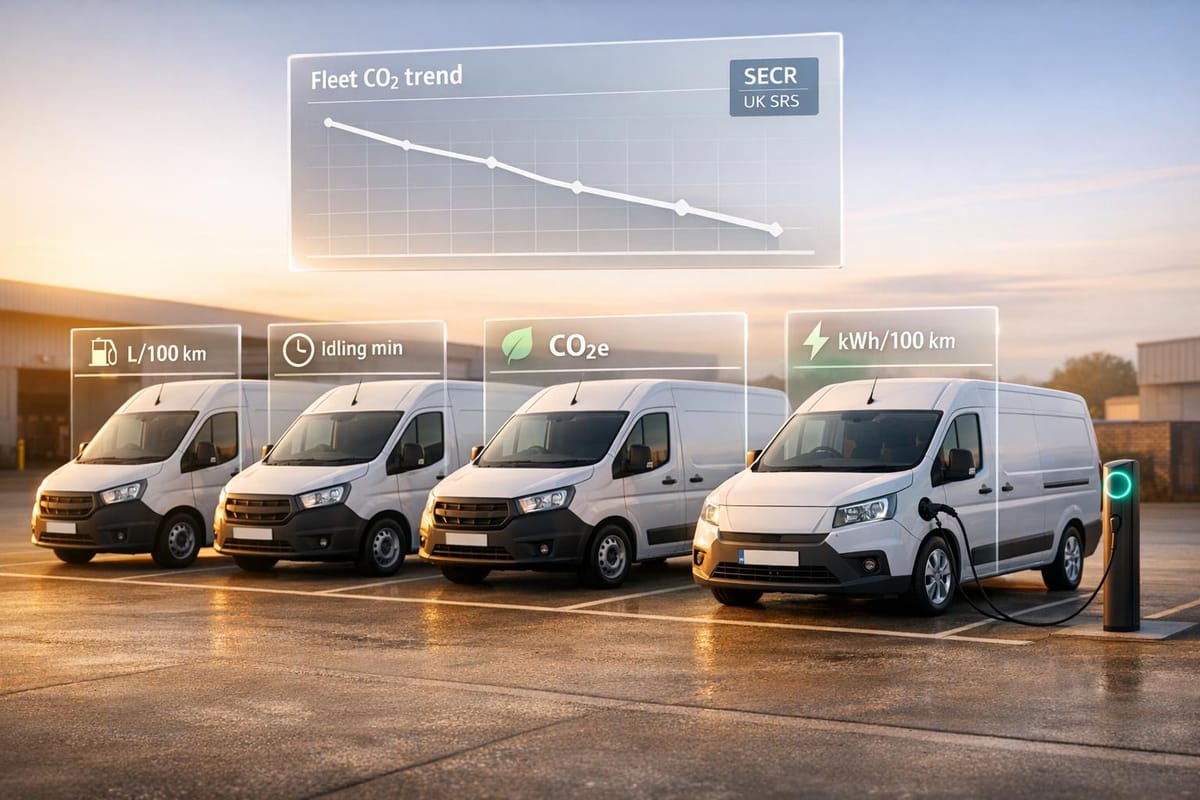
Fleet sustainability metrics help you measure and manage your fleet's environmental impact. These metrics focus on carbon emissions, fuel economy, and energy efficiency, offering insights into areas like vehicle emissions, idling, and driver behaviour. By tracking these, businesses can reduce costs, meet UK regulations like SECR, and improve fleet performance.
Key points include:
- Carbon Emissions: Measured in gCO₂e per kilometre. Use fuel or distance-based methods for calculations.
- Fuel Economy: Monitor fuel consumption and idling to cut costs and emissions.
- Energy Efficiency: For electric vehicles, track kWh per 100 km and charging patterns.
- Telematics Systems: Automate data collection, track inefficiencies, and support compliance efforts.
- Compliance: Large UK companies must report Scope 1 and Scope 2 emissions under SECR and upcoming UK SRS rules.
For example, using telematics, G4S reduced idle time by 43%, cutting CO₂ emissions by two tonnes annually. These metrics are essential for meeting Net Zero targets and avoiding penalties like ULEZ charges.
Carbon Emissions Metrics
CO₂ Emissions per Vehicle and per Kilometre
To calculate your fleet's carbon footprint, you can use one of two methods. The fuel-based method involves multiplying the total litres of fuel consumed by government conversion factors (e.g., diesel: 2.68 kg CO₂/litre, petrol: 2.31 kg CO₂/litre for 2025). If fuel data isn't available, the distance-based method uses average emission factors - simply multiply total mileage by these factors. However, this approach is less precise as it doesn't account for variables like payload, traffic conditions, or driving style.
For ESG reporting, emissions should be categorised into three scopes:
- Scope 1: Direct emissions from vehicles you own or lease.
- Scope 2: Indirect emissions from electricity used to charge electric vehicles.
- Scope 3: Emissions from your supply chain and vehicles funded through operating leases.
Under SECR regulations, large UK companies are required to report Scope 1 and certain Scope 3 emissions.
Real-world conditions such as idling, air conditioning, and aggressive driving can inflate emissions by about 31.5% compared to manufacturer estimates. To adjust for these factors, use uplift percentages. Telematics systems, like those offered by GRS Fleet Telematics, simplify this process by retrieving real-time fuel consumption data directly from vehicles. These systems automate reports for audits and tenders, while also identifying inefficient vehicles or routes. To ensure accuracy, always use the latest Department for Energy Security and Net Zero (DESNZ) conversion factors, which align with UK reporting standards. Accurate calculations are essential for meeting ESG and SECR compliance requirements.
Monitoring NOx and Particulate Matter
While CO₂ is a primary focus, fleets also need to monitor pollutants like nitrogen oxides (NOx) and particulate matter (PM10 and PM2.5), which significantly affect urban air quality. This is particularly critical for fleets operating in Clean Air Zones or London's ULEZ. The Department for Environment, Food & Rural Affairs (Defra) provides an Emissions Factors Toolkit (v13.1, as of March 2025) that uses the COPERT v5.8 methodology to calculate emission rates based on vehicle type, speed, and road class. These calculations include both hot exhaust emissions (after the engine warms up) and cold start emissions (which release higher pollutants at journey start).
Non-exhaust sources, such as tyre wear, brake wear, and road abrasion, also contribute to PM10 and PM2.5 emissions. These are not accounted for in tailpipe measurements but remain key contributors to pollution. Telematics systems can track factors like idling, engine performance, and non-tailpipe emissions, issuing alerts when thresholds are exceeded. For example, Nottingham City Council implemented telematics across its fleet to monitor data from three depots. This provided drivers with real-time feedback, improving efficiency and simplifying sustainability reporting. Reducing idle time not only cuts CO₂ emissions but also lowers NOx levels, improving air quality in urban areas.
Fuel Usage and Energy Efficiency Metrics
Tracking fuel usage and energy efficiency provides essential insights for cutting operational costs and reducing environmental impact, complementing carbon emissions measurements.
Fuel Consumption and Idling Metrics
Fuel accounts for a hefty 60% of fleet operating costs, making it crucial to monitor consumption closely. Telematics systems simplify this by pulling fuel usage data directly from the vehicle's Engine Control Module (ECM) and fuel cards, offering accuracy that manual logs often lack. Despite these advancements, 38% of UK fleet managers still rely on paper logs, which complicate compliance efforts.
Idling time is another key area to scrutinise. Just 15 minutes of idling produces the same CO₂ emissions as driving two miles. By tracking the percentage of time vehicles spend idling, fleet managers can pinpoint inefficiencies that might otherwise go unnoticed. A straightforward "switch off" policy after 30 seconds of idling can immediately cut fuel costs and emissions.
For diesel fleets, monitoring AdBlue levels is essential to ensure Euro 6 compliance and avoid downtime. Integrating fuel card data with telematics adds another layer of oversight, helping to verify transactions and flag irregularities. Automated maintenance alerts, triggered by odometer readings, also play a role in sustaining optimal fuel efficiency.
Detailed fuel and idling data are the foundation for effective eco-driving programmes, which can further improve fleet performance.
Eco-Driving Scores
Driver behaviour has a significant impact on fuel usage. Aggressive habits - like rapid acceleration, hard braking, and excessive speeding - can push fuel consumption up by as much as 20%. Telematics tools monitor these behaviours and generate eco-driving scores, helping fleet managers identify drivers who might benefit from training. Addressing these behaviours can not only cut fuel consumption but also reduce the fleet's carbon footprint. Reports and behaviour monitoring tied to eco-driving initiatives have been shown to deliver a 10% reduction in fleet fuel costs. Many telematics systems also provide real-time feedback, offering tips on maintaining steady speeds and using gears efficiently to maximise fuel economy.
Energy Metrics for EVs and Hybrids
For fleets using electric and hybrid vehicles, traditional fuel metrics are replaced by energy efficiency data. Metrics such as kilowatt-hours (kWh) per 100 km measure energy intensity but are challenging to track manually. Telematics systems, however, can capture precise kWh usage, enabling detailed sustainability assessments. Managers can also monitor charging patterns and cycles to optimise infrastructure and align charging schedules with working hours.
Additionally, "true range" calculations, which factor in conditions like traffic, elevation, and weather, provide a more reliable estimate of battery life than the manufacturer's figures. For compliance, electric fleets must track Scope 2 emissions - those linked to the electricity used for charging.
Robert Jenkins, Fleet Manager at Metro Logistics, shared how implementing a GRS Fleet Telematics system uncovered that 28% of the company's fuel was wasted due to inefficient driving and idling. By launching an eco-driving programme, the company slashed its carbon footprint by 34% and saved over £45,000 annually on fuel costs. Jenkins noted:
"GRS Fleet Telematics has transformed our sustainability efforts. Their tracking system identified that 28% of our fuel was being wasted through inefficient driving and excessive idling."
How Telematics Improves Fleet Sustainability
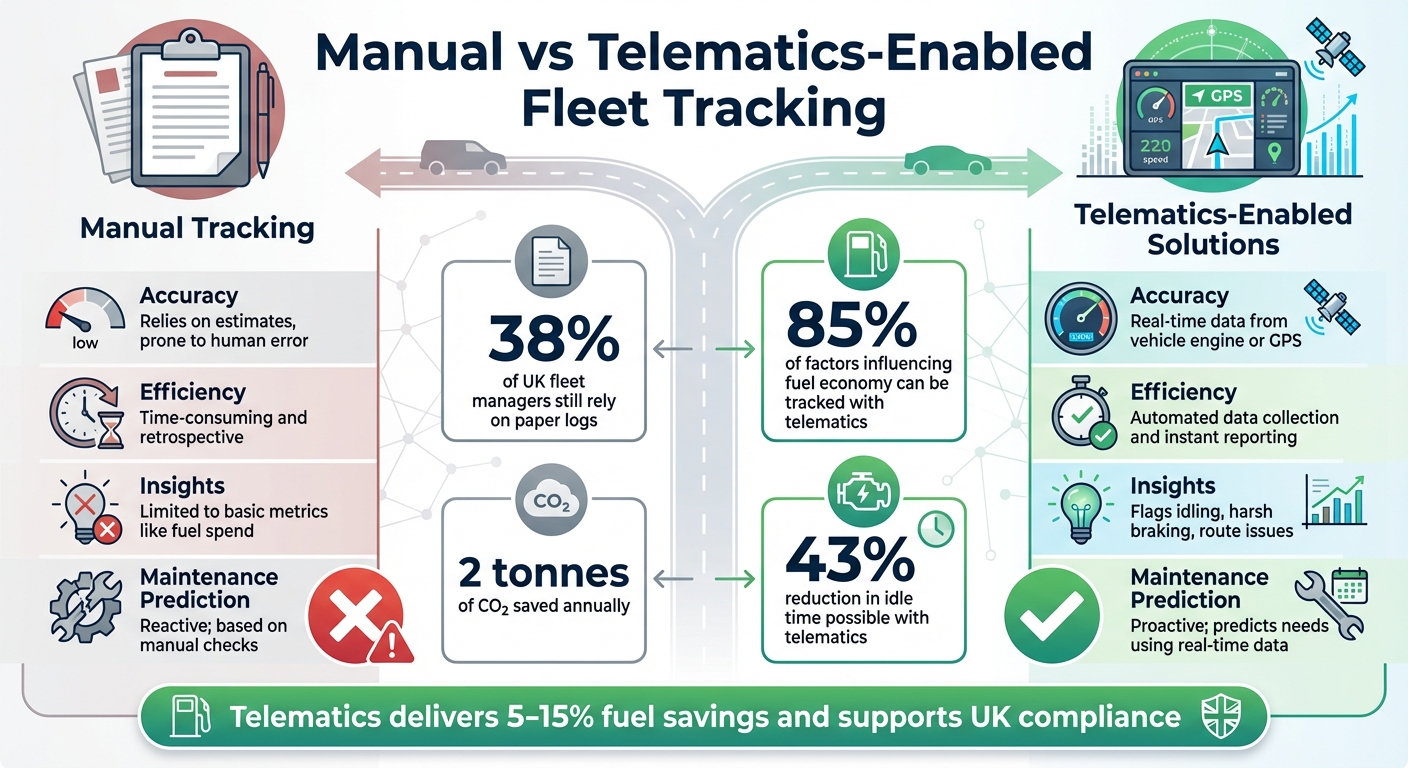
Manual vs Telematics Fleet Tracking Comparison
Telematics takes the guesswork out of sustainability, turning it into actionable, measurable steps. By connecting to a vehicle's OBD-II or CAN-BUS port, telematics devices gather real-time data on GPS location, fuel use, idling, engine issues, and driver habits. This constant flow of information helps calculate Scope 1 emissions – direct emissions from company-owned vehicles – and pinpoints inefficiencies with precision.
Data Collection and Analysis
Modern telematics systems are designed to collect detailed, real-time data, making it possible to accurately calculate a fleet's carbon footprint. In fact, 85% of the factors influencing fuel economy can be tracked and managed using telematics software. These systems monitor fuel consumption, distance covered, and fuel properties, converting this data into precise CO₂e figures using official UK conversion factors.
Telematics doesn't just measure emissions – it uncovers the causes. Real-time diagnostics highlight mechanical problems like faulty oxygen sensors or underinflated tyres, both of which can hurt fuel efficiency. Operational issues, such as excessive idling, inefficient routes, or aggressive driving, are also flagged, allowing fleet managers to act quickly instead of waiting for manual reports to reveal inefficiencies.
Take GRS Fleet Telematics, for example. Their platform combines location tracking with fuel efficiency monitoring and eco-driving analytics. This allows managers to spot wasted fuel and address problems immediately. By offering such precise metrics, telematics lays the groundwork for benchmarking fleet performance.
Benchmarking and Target Setting
Once reliable data is collected, fleet managers can establish clear performance benchmarks. Telematics helps calculate a fleet's current carbon footprint, providing a baseline to measure the effectiveness of decarbonisation efforts. Unlike generic manufacturer data, which often masks inefficiencies, telematics provides insights into actual fuel use and the routes taken.
With this baseline, managers can set specific targets. The data aids compliance with Streamlined Energy and Carbon Reporting (SECR) rules for large companies and supports legally binding goals under the UK's Climate Change Act 2008. For example, between 2023 and 2025, DB Regio Bus in Germany installed telematics in 5,000 buses. By improving driving behaviour and reducing idling, they cut idling times by 40% in just one year, saving 1,400 tonnes of CO₂ annually. Their ultimate goal is to reduce emissions by 15,000 tonnes per year.
Telematics also assists with the shift to electric vehicles through Electric Vehicle Suitability Assessments (EVSA). By analysing data like maximum daily mileage and energy use, these assessments determine which vehicles can be replaced with zero-emission alternatives. This transition can save 4 tonnes of CO₂ per vehicle each year. As Aaron Jarvis, Associate Vice President at Geotab, explains:
"Scope 1 emissions are those that organisations have the greatest control over, and therefore they are where many businesses look to start their decarbonisation journey."
Manual vs Telematics-Tracked Metrics
The difference between manual tracking and telematics is striking. Manual methods rely on estimates, fuel receipts, and averages, all of which are prone to human error. Data entry takes time, and reports are retrospective, delaying corrective action. These methods offer limited insights, often just highlighting total fuel spend and mileage, without providing context on driver behaviour or operational inefficiencies.
Telematics, on the other hand, delivers real-time data directly from the vehicle's engine or GPS. It automates data collection and enables instant reporting for audits and tenders. The system identifies inefficiencies like excessive idling, harsh braking, and route deviations, and uses real-time engine health data to predict maintenance needs, preventing efficiency losses.
| Feature | Manual Tracking | Telematics-Enabled Solutions |
|---|---|---|
| Accuracy | Relies on estimates, prone to human error | Real-time data from vehicle engine or GPS |
| Efficiency | Time-consuming and retrospective | Automated data collection and instant reporting |
| Insights | Limited to basic metrics like fuel spend | Flags idling, harsh braking, route issues |
| Maintenance Prediction | Reactive; based on manual checks | Proactive; predicts needs using real-time data |
For example, Nottingham City Council implemented telematics across vehicles at three depots, enabling faster data collection and providing drivers with tailored feedback on efficiency. This approach not only improved fleet performance but also supported their transition to zero-emission vehicles. Their experience shows how telematics can turn sustainability into a genuine operational advantage.
Implementing Sustainability Metrics for UK Compliance
Shifting from data collection to meeting regulatory requirements calls for a clear and organised approach. Building on the advantages of real-time data, this section explains how fleet operators can use these insights to ensure compliance with UK regulations. Establishing baselines, leveraging predictive tools, and maintaining robust reporting systems aligned with UK standards are key steps. As sustainability moves from voluntary initiatives to mandatory reporting, implementing these measures becomes critical - not just for legal adherence, but also for staying competitive. Below, we explore how audits can transform telematics data into actionable sustainability baselines.
Conducting Baseline Audits
The starting point in this process is calculating your fleet's emissions to create a baseline and pinpoint areas for carbon reduction. Emissions are categorised into three types:
- Scope 1: Direct emissions from fuel burned in company-owned vehicles.
- Scope 2: Emissions from electricity used to charge electric vehicles (EVs).
- Scope 3: Indirect emissions, such as those from grey fleets or salary sacrifice vehicles.
UK regulations require large organisations to report Scope 1 and Scope 2 emissions, as well as specific Scope 3 emissions under their control.
Telematics systems are invaluable here, offering precise data on energy consumption (measured in kWh), journey distances, and vehicle conditions. This allows fleet managers to move beyond generic manufacturer estimates.
When conducting audits, emissions should be reported as CO₂e (carbon dioxide equivalent), which accounts for gases like methane (CH₄) and nitrous oxide (N₂O), in line with greenhouse gas reporting standards. Use tank-to-wheel emission factors for standard reporting, and source upstream, well-to-tank data from fuel suppliers. Beyond telematics portals, downloading raw fleet usage data can provide deeper insights for decarbonisation goals.
Using Predictive Analytics
Once a baseline is established, predictive analytics can drive forward-thinking strategies. For instance, analysing daily mileage against battery range helps determine the feasibility of switching to EVs and identifies where charging stations are most needed. Advanced tools even calculate an EV battery's "true range", factoring in variables like elevation, traffic, and weather.
Route optimisation software is another powerful tool. It maps out efficient routes to maximise fuel efficiency and reduce "empty running" - trips made without cargo. In the UK, 30% of HGVs currently travel empty, presenting a major opportunity for reducing carbon emissions. Maintenance scheduling, supported by service history and MOT logs, ensures vehicles operate at peak efficiency, which is crucial for meeting emission targets.
Predictive models also estimate cost and carbon savings, which can help justify investments in zero-emission vehicles. With the UK aiming for Net Zero by 2050 and projections suggesting that by 2030 80% of new cars and 70% of new vans sold in Great Britain will be zero-emission, these analytics are essential for planning the transition.
Reporting and Compliance with UK Standards
From 2026, the UK Sustainability Reporting Standards (UK SRS) will replace the Streamlined Energy and Carbon Reporting framework, modernising corporate disclosures. Under the new Sustainability Disclosure Requirements (SDR) and TCFD-aligned frameworks, organisations must track:
- Scope 1: Direct emissions from fleet vehicles.
- Scope 2: Electricity used for EV charging.
- Scope 3: Additional business-related emissions.
Telematics dashboards simplify this process by automating data collection on energy use, journey lengths, CO₂ emissions, and idling metrics. Reporting on EV charging emissions now requires factoring in grid carbon intensity at the time of charging to meet SDR standards. Mike Potter, CEO of CrowdCharge, explains:
"Electric vehicles can help individuals, businesses, and the UK as a whole to achieve significantly lower carbon emissions, but only if the EVs are charged with low‐carbon electricity. The challenge is that most organisations don't know what the carbon emissions are each time an EV is charged."
Mandatory reporting applies to central government bodies with over 500 employees or £500 million in operating income, as well as large companies meeting SECR or UK SRS criteria. From 19 January 2026, companies significantly affected by climate-related risks will also need mandatory transition plans under the UK Prospectus Rules. The Digital Markets, Competition and Consumers Act 2024 empowers the CMA to impose fines of up to 10% of global turnover for greenwashing or misleading environmental claims.
GRS Fleet Telematics supports compliance by automating data collection for fuel efficiency monitoring, eco-driving analytics, and real-time tracking. These tools enable fleet managers to develop "assurance-ready" methodologies, preparing for audits by the upcoming Audit, Reporting and Governance Authority. This ensures not only compliance but also improved operational efficiency.
Conclusion
Tracking and implementing fleet sustainability metrics has become a key priority for modern UK fleets aiming to meet Net Zero goals, adhere to UK regulations, and boost operational efficiency. In 2023, domestic transport was responsible for 29% of the UK’s total greenhouse gas emissions, with nearly 89% of these emissions coming from road vehicles. This places fleet operators in a unique position to make a real difference.
Telematics plays a crucial role by offering actionable data insights that simplify sustainability initiatives. For instance, studies reveal that telematics can reduce idle time by 43% and cut CO₂ emissions by two tonnes annually.
GRS Fleet Telematics demonstrates how these solutions work in practice. Their cost-effective, automated tools not only support compliance with regulations but also deliver fuel savings of 5–15%. Additionally, they enhance maintenance scheduling and provide data to guide the shift towards electric vehicles.
As Patricia Espinosa, Executive Secretary of the UNFCCC, aptly said:
"Solutions to climate change don't come from governments alone. They also come from businesses, investors, community organisations, private citizens and more".
With the right metrics and technologies in place, fleet operators can lower emissions, reduce expenses, and strengthen their operations for the future.
FAQs
How can telematics systems help reduce carbon emissions in fleet operations?
Telematics systems are a game-changer for cutting carbon emissions, offering real-time insights into driving habits, vehicle performance, and route efficiency. With this data, fleet managers can encourage eco-conscious driving behaviours. Simple changes like reducing idling, avoiding harsh braking, and easing up on rapid acceleration can significantly lower fuel consumption and CO₂ emissions.
Another key advantage is route optimisation. Using live GPS data, telematics can identify the most efficient routes, helping to eliminate unnecessary mileage. This can lead to fuel savings and emission reductions of up to 20%. On top of that, tracking fuel usage and vehicle performance allows managers to spot inefficiencies and take action to further reduce emissions. These efforts align with sustainability objectives and play a part in advancing the UK's decarbonisation initiatives.
What is the difference between Scope 1, Scope 2, and Scope 3 emissions?
Scope 1 emissions are the direct greenhouse gas emissions that come from sources owned or controlled by your organisation. For example, this includes the fuel burned in company vehicles or machinery.
Scope 2 emissions, on the other hand, are indirect emissions tied to the energy your organisation purchases, such as electricity, steam, or heating.
Scope 3 emissions are broader, covering all other indirect emissions across your value chain. This includes emissions from suppliers, business travel, and the full lifecycle of your products.
Breaking down emissions into these categories allows businesses to better measure and manage their environmental impact. Combining this understanding with tools like advanced fleet tracking systems can make it easier to monitor fuel use and improve energy efficiency.
Why is it important for fleets to monitor NOx and particulate matter emissions?
Monitoring NOx (nitrogen oxides) and particulate matter emissions is essential for fleet operators because these pollutants play a major role in deteriorating air quality, especially in densely populated urban areas where traffic is heavy. High levels of these emissions not only pose risks to public health and the environment but can also lead to stricter regulations and fines for companies that fail to comply.
Keeping an eye on these emissions helps fleets pinpoint ways to lower their environmental impact, boost vehicle efficiency, and work towards sustainability objectives. On top of that, adopting cleaner practices can improve a company's public image and meet the increasing demand for businesses to act responsibly towards the environment.