Fleet Depreciation Metrics: How to Measure and Improve
Key fleet depreciation metrics — straight-line, per-mile and market retention — plus how telematics, predictive maintenance and smart vehicle choice cut costs.
Fleet depreciation is one of the most important costs for UK transport and logistics businesses. Vehicles lose value over time due to usage, wear, and market trends. Managing this effectively can save money and improve financial planning. Here’s a quick summary:
- Why it matters: Depreciation impacts cash flow, profitability, and when to replace vehicles.
- Key metrics:
- Straight-Line Depreciation Rate: Spreads the cost evenly over a vehicle’s lifespan.
- Depreciation per Mile: Links cost to vehicle usage.
- Market Value Retention Percentage: Tracks how well a vehicle keeps its value.
- Best practices:
- Track full acquisition costs, including fees and taxes.
- Use telematics for precise usage and maintenance data.
- Balance vehicle usage to avoid overuse.
- Opt for reliable, high-demand models to retain value.
- Telematics benefits: Automates tracking, improves maintenance, reduces wear, and enhances security.
Learn to Calculate Total Cost of Ownership for Your Fleet | Fleet Management Tips
Key Fleet Depreciation Metrics
Understanding fleet depreciation is one thing, but effectively managing it requires digging into specific metrics. UK fleet operators often rely on three key metrics to get a clearer picture of how a vehicle’s value declines over time. Each offers a unique perspective, helping with financial planning and operational decisions.
Straight-Line Depreciation Rate
The straight-line method is the go-to accounting approach in the UK, offering a simple way to spread a vehicle's cost evenly across its expected lifespan. The formula is straightforward:
(Initial Cost – Salvage Value) ÷ Expected Lifespan.
Let’s break it down with an example: imagine a van bought for £30,000 with a projected salvage value of £6,000 and a lifespan of five years. Using this method, the annual depreciation would be £4,800. This consistency makes it a favourite for budgeting and Profit & Loss statements. However, it doesn’t account for the steeper value drops that typically happen in the early years of ownership.
Another angle to consider is how depreciation aligns with actual vehicle usage, which brings us to depreciation per mile.
Depreciation per Mile
Depreciation per mile links the cost of depreciation to how much the vehicle is actually driven. The formula is:
Annual Depreciation ÷ Total Miles Driven.
For example, if a van depreciates by £4,800 annually and covers 25,000 miles in that year, the cost works out to 19.2 pence per mile. This metric is especially useful for pinpointing the "sweet spot" for replacing vehicles - when the savings from lower depreciation costs are overtaken by the rising expense of maintenance. It’s also a handy tool for comparing models, helping fleet managers identify which vehicles deliver better value in high-mileage scenarios.
Market Value Retention Percentage
This metric focuses on how well a vehicle holds onto its original value over time. It’s calculated using:
(Current Market Value ÷ Original Cost) × 100.
For instance, if a van originally priced at £30,000 is now worth £18,000, its retention rate is 60%. Tools like CAP HPI are often used by UK fleet managers to forecast residual values with accuracy. Considering that vans can lose 30%-40% of their value within the first three years, and fleets typically replace vehicles after about 3.9 years, tracking this percentage is crucial. It helps managers decide when to sell before values drop too sharply. Plus, it’s a valuable metric for comparing different makes and models to see which ones hold their value better in the UK market.
Together, these metrics form the backbone of effective depreciation management, offering fleet operators the insights they need to make smarter decisions.
How to Measure Depreciation Accurately
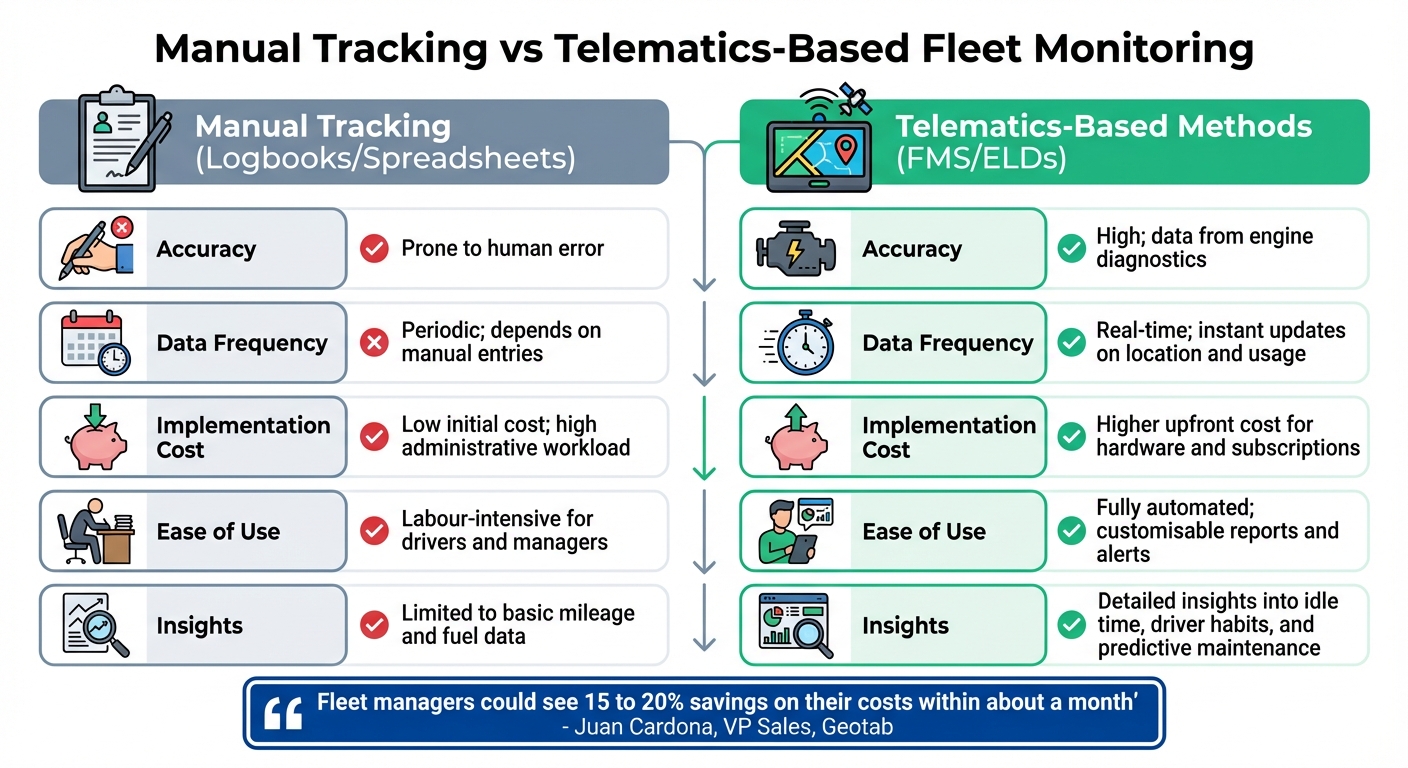
Manual vs Telematics Fleet Tracking Comparison
Measuring depreciation accurately starts with capturing every detail of acquisition costs and keeping a close watch on vehicle usage throughout its lifespan. These precise measurements are essential for making smart decisions about fleet replacements and cutting down on operational expenses. Fleet managers who rely on incomplete or outdated data risk underestimating costs and missing the best times to replace vehicles.
Tracking Acquisition Costs and Usage
Getting depreciation right begins with recording the entire acquisition cost - not just the sticker price. This includes everything: the dealer’s selling price, upfitting expenses for storage or custom configurations, licensing fees, local taxes, environmental taxes, and any non-reclaimable VAT. These "soft" costs are often overlooked, but they can significantly impact the overall value.
Once you've nailed down the full acquisition cost, the next step is to monitor usage. This means keeping track of odometer readings, engine hours, and idle time without any gaps. Relying on manual logbooks can lead to errors or missing data. Automating this process using telematics ensures more reliable and precise tracking.
Using Telematics for Precision
Telematics takes tracking to the next level by automating data collection and eliminating guesswork. These systems pull real-time data directly from a vehicle’s onboard diagnostics, providing a clear picture of how each vehicle is being used. For instance, GRS Fleet Telematics automatically records odometer readings, engine hours, and ignition data - no driver input required.
This automation not only reduces manual errors but also offers instant insights into vehicle activity. Telematics can differentiate between "true idle" and "operational idle", track harsh braking or sudden acceleration, and even flag engine diagnostics to predict maintenance needs. Juan Cardona, VP Sales for Latin America at Geotab, highlights the benefits:
"The return on telematics is quite immediate, maybe about a month. Fleet managers could see 15 to 20% savings on their costs".
With such detailed data, fleet managers can calculate accurate pence-per-mile costs and make well-informed decisions about when to replace vehicles.
Comparing Measurement Methods
The advantages of telematics over manual tracking become clear when you compare their features:
| Feature | Manual Tracking (Logbooks/Spreadsheets) | Telematics-Based Methods (FMS/ELDs) |
|---|---|---|
| Accuracy | Prone to human error | High; data comes straight from engine diagnostics |
| Data Frequency | Periodic; depends on manual entries | Real-time; instant updates on location and usage |
| Implementation Cost | Low initial cost; but high administrative workload | Higher upfront cost for hardware and subscriptions |
| Ease of Use | Labour-intensive for drivers and managers | Fully automated; offers customisable reports and alerts |
| Insights | Limited to basic mileage and fuel data | Detailed insights into idle time, driver habits, and predictive maintenance |
While manual methods may seem cheaper at first, the hidden costs of administrative work and inaccurate data often outweigh the savings. For larger fleets, telematics quickly proves to be the more cost-effective solution.
Strategies to Reduce Fleet Depreciation
To keep fleet depreciation in check and protect vehicle values, it's essential to adopt targeted strategies. On average, British fleets replace vehicles after just 3.9 years, compared to 5.7 years across other European countries. These approaches directly influence key metrics like depreciation per mile and market value retention.
Improving Vehicle Utilisation
Balancing vehicle usage across your fleet can go a long way in reducing wear and tear. Overused vehicles tend to depreciate faster, as excessive mileage and wear lower their resale value. A practical solution is vehicle rotation. Using telematics data, fleet managers can rotate vehicles to ensure even usage across the board.
Optimising routes is another key tactic. By consolidating journeys and planning efficient routes, you can reduce unnecessary mileage and minimise idle engine hours, both of which help slow depreciation.
For fleets with underutilised vehicles, consider a pool fleet solution. This approach offers mobility at a lower cost compared to short-term hires and avoids the financial burden of idle assets.
Advanced telematics tools, like those provided by GRS Fleet Telematics, can help UK fleet managers monitor usage patterns and implement these strategies with precision. Once utilisation is optimised, the next step is focusing on maintenance.
Implementing Predictive Maintenance
Keeping vehicles in top condition is vital for preserving their value. Moving from traditional calendar-based servicing to condition-based monitoring ensures vehicles receive maintenance only when needed. Predictive maintenance uses IoT sensors and data analytics to monitor real-time factors like engine temperature, battery health, vibration levels, and brake performance. This approach forecasts potential issues based on actual conditions rather than fixed intervals.
Proactively addressing maintenance needs prevents "cascading" damage - where one failing component triggers additional problems. Telematics systems can simplify this process by sending instant alerts for upcoming or overdue maintenance based on odometer readings and engine run times. By maintaining vehicles in peak condition, you can secure better resale values when it's time to replace them.
Selecting Low-Depreciation Vehicles
The type of vehicles you choose for your fleet has a lasting impact on depreciation. Opt for models that are in high demand on the secondary market, as this helps maintain their resale value. Vehicles with a reputation for fuel efficiency and reliability are particularly appealing to future buyers.
When selecting specifications, focus on practicality. Prioritise vehicles with ample cargo space and essential features over luxury add-ons that don't contribute to resale value. It's also worth considering factors like the availability of spare parts and the vehicle's performance in UK-specific conditions.
Timing your purchases strategically can also make a difference. Buying vehicles early in the model year can enhance their perceived value, while avoiding sales during slower winter months helps minimise value drops. Additionally, since trucks typically lose about 20% of their value in the first year, purchasing slightly used vehicles can allow the initial owner to absorb the steepest depreciation.
Using Telematics to Reduce Depreciation
Telematics doesn’t just help measure depreciation accurately; it also provides practical ways to minimise the wear and tear that leads to asset value loss.
By offering precise, real-time data, telematics helps extend the lifespan of fleet vehicles and reduces premature wear, ultimately protecting their overall value.
Real-Time Data for Smarter Decisions
One of the standout features of telematics is its ability to monitor driving behaviours in real time. Actions like harsh braking, rapid acceleration, and speeding can cause unnecessary stress on a vehicle’s critical components. By tracking these behaviours, telematics helps fleets address them head-on. For instance, fleets using advanced telematics systems saw a 37% reduction in harsh braking and a 42% drop in speeding incidents over a year.
In-cab coaching takes it a step further by alerting drivers to behaviours like speeding or excessive idling, encouraging eco-friendly driving habits. This not only reduces wear and tear but also improves fuel efficiency. Speaking of fuel, did you know that driving just 5 mph over 50 mph can decrease fuel economy by 7% to 14%? Telematics also tracks engine idling, helping to cut down on unnecessary engine hours, which further preserves vehicle value.
Beyond operational efficiency, these insights also enhance vehicle security, adding another layer of value protection.
Advanced Security to Prevent Theft
Theft is a quick way to lose an asset’s residual value, making robust security measures a must for fleet operators. GRS Fleet Telematics tackles this issue with dual-tracker technology - a combination of a wired tracker and a Bluetooth backup. This setup has achieved an impressive 91% recovery rate. Features like geofencing send alerts if a vehicle leaves its designated area, while the immobilisation feature in the GRS Fleet Telematics Ultimate package (£99 hardware, £7.99 monthly) allows remote engine shutdown, stopping thieves in their tracks.
The Financial Edge of Telematics
Telematics isn’t just about security or operational improvements; it delivers tangible financial benefits too. By shifting from calendar-based servicing to condition-based servicing, fleets can reduce maintenance costs by up to 14%. On top of that, fuel expenses can drop by up to 14%, insurance savings range from 5% to 25%, and optimised routing can increase productivity by as much as 12%.
Unscheduled maintenance, which can cost as much as £510 per day, becomes less of a concern with condition-based monitoring. This approach not only protects fleet values but also helps improve overall depreciation outcomes, making telematics an essential tool for any fleet operator.
Conclusion
Depreciation is often the largest hidden expense in a vehicle's lifecycle, making it a key factor in the total cost of ownership. Despite this, many fleet managers still rely on arbitrary replacement schedules rather than using data to guide their decisions. By focusing on metrics like straight-line depreciation rate, depreciation per mile, and market value retention percentage, it's possible to pinpoint the exact moment when holding costs outweigh an asset's remaining value.
The difference between effective and poor depreciation management can be striking. For example, British fleets typically replace vehicles after just 3.9 years on average, compared to 5.7 years across 12 other European countries. This suggests that many UK businesses may be retiring vehicles too early, missing opportunities to extend their useful life with better monitoring and maintenance strategies.
"Performance-based replacement cycles... help ensure fleets are getting the best bang for their buck - whether through safely extending an asset's useful life or making the decision to retire it." - Rachael Plant, Senior Fleet Content Specialist, Fleetio
Telematics systems take depreciation management a step further by offering tools to monitor driver behaviour, automate maintenance schedules, and provide real-time insights into total cost of ownership. For instance, GRS Fleet Telematics helps extend vehicle lifespan and cut unscheduled downtime, directly improving depreciation metrics. Features like dual-tracker technology and immobilisation (available in the Ultimate package for £99 hardware and £7.99 monthly) also guard against theft - one of the quickest ways to lose an asset's residual value - helping to maintain market value retention.
At its core, managing fleet depreciation is about more than just numbers. It's about making smart, informed decisions that balance operational needs with long-term cost control. Whether you're calculating cost per mile or tracking repair frequency, the ultimate goal is clear: get the most out of every asset before rising maintenance costs signal it's time for a change.
FAQs
Which depreciation metric should I use for my fleet?
The asset depreciation rate measures how fast vehicles lose their value over time, usually expressed as a percentage per year or per mile/kilometre. Keeping track of this rate is crucial for planning when to replace vehicles and estimating their resale value.
By monitoring the total cost of ownership (TCO) - which includes depreciation, maintenance, and fuel expenses - you get a clear view of the financial impact of your fleet. Tools like GRS Fleet Telematics can provide real-time data to help fine-tune these metrics and keep costs under control.
How do I set the best vehicle replacement point?
To figure out the ideal time to replace a vehicle, keep an eye on critical factors such as maintenance costs, vehicle age, downtime, and the total cost of ownership (TCO). Telematics can be a game-changer here, offering real-time data on metrics like mileage, repair expenses, and safety patterns. Many fleets find that replacing vehicles proactively - typically within 5 to 7 years - prevents spiralling costs from breakdowns and inefficiencies. By conducting regular reviews, you can ensure replacements are both cost-efficient and help maintain safety standards.
What telematics data improves depreciation accuracy most?
Telematics data plays a key role in refining depreciation estimates by incorporating real-time vehicle health monitoring, engine diagnostics, and predictive maintenance insights. These metrics allow for accurate tracking of a vehicle's condition and usage patterns, making it easier to estimate depreciation rates more precisely while also helping to maintain the asset's value over time.