Interoperability in EV Telematics: Why It Matters
Why ISO 15118, OCPP and unified protocols matter for fleet charging—improving reliability, cutting integration costs and boosting security.
Interoperability in EV telematics ensures that electric vehicles, chargers, and backend systems can communicate and share data without issues, regardless of the manufacturer or protocol. This is crucial for fleet managers relying on smooth data flow to avoid delays, incomplete reports, and costly errors.
Here’s why it’s essential:
- Data Compatibility: Vehicles, chargers, and systems must "speak the same language" across technical, semantic, and organisational layers.
- Operational Efficiency: Without interoperability, 14–23% of public charging sessions in England failed in early 2026 due to mismatched protocols.
- Future-Proof Standards: The UK and EU are enforcing regulations like ISO 15118-20 and OCPP 2.0.1 to improve compatibility across systems.
- Cost Control: Integration costs can drop by 30–50% when using unified protocols, while fleets can optimise charging during cheaper energy periods.
- Cybersecurity: New standards like TLS 1.3 and certificate-based authentication protect against data breaches and outages.
This article explores how interoperability can simplify fleet operations, ensure compliance with upcoming regulations, and improve data reliability for better decision-making.
Technical Foundations and Standards for EV Data Interoperability
Key Communication Protocols and Standards
The reliability of EV telematics depends on a well-structured chain of communication protocols. These protocols ensure seamless signal transmission from grid operators to vehicles via management systems. Beyond standardising communication, they also play a key role in improving charging efficiency and energy management for fleets.
At the vehicle-to-charger level, ISO 15118 is the backbone for Plug & Charge, smart charging, and bidirectional power transfer. This standard enables automatic authentication over the charging cable. As AMPECO puts it:
"ISO 15118 is the international standard that defines how electric vehicles and charging stations communicate digitally over the charging cable. It's the technical foundation for... Plug & Charge, smart charging, and bidirectional power transfer."
Moving up the chain, OCPP (Open Charge Point Protocol) facilitates communication between chargers and backend systems. The widely adopted version 2.0.1 ensures compliance with regulations, while version 2.1 introduces support for V2G (Vehicle-to-Grid) and grid parameters. For network roaming, OCPI (Open Charge Point Interface) handles interoperability between different charging networks. At the grid level, protocols like IEEE 2030.5 and OpenADR manage demand response and interactions between utilities and charging station systems.
Marc Mültin highlights the role of these standards:
"Grid codes define what a V2G unit must do. OCPP 2.1 and ISO 15118-20 are how those rules actually travel, from a grid operator's control room to the inverter inside your car."
Upcoming regulations in the UK and EU are reshaping these standards. From 8 January 2026, the EU's Alternative Fuels Infrastructure Regulation (AFIR) mandates ISO 15118-2 compliance for all new public AC chargers. By 1 January 2027, this requirement extends to ISO 15118-20, which includes mandatory TLS 1.3 encryption, mutual authentication, and V2G support for both public and private chargers. However, ISO 15118-20 is not backwards compatible with version -2, making current infrastructure decisions crucial for long-term alignment.
These evolving standards underscore the need for fleets to manage integration challenges effectively with fleet telematics.
Data Integration Challenges in Multi-Brand Fleets
Managing a mixed fleet - combining vehicles from different manufacturers and using various charging networks - creates what’s called the "N×M problem". Every new vehicle or charger adds another integration point, leading to rising complexity and costs, often referred to as "integration debt".
The solution lies in adopting a unified protocol architecture. This approach uses a common abstraction layer to translate messages from diverse protocols like OCPP, OpenADR, and IEEE 2030.5 into a single internal data model. Instead of direct connections between systems, an event-driven model allows components to publish and subscribe to shared events, such as GridAuthorizationGranted. This structure enhances the system's adaptability to changes.
Understanding the difference between data sources is also critical. Charger (EVSE) data offers the metered accuracy needed for billing and compliance, whereas vehicle telematics provide real-time insights like State of Charge, temperature, and driver schedules. Researcher Steve Letendre, PhD, explains:
"The charger records what happened; the vehicle reveals what's possible next."
Both data types are essential for effective fleet management, but neither can stand alone.
As integration becomes more complex, ensuring robust security measures is equally important.
Security and Privacy in EV Telematics
Security in EV telematics goes beyond protecting data in transit. It’s about establishing trust between hardware devices that have never interacted before. ISO 15118-20 addresses this with TLS 1.3 encryption (mandatory in this version) and mutual authentication, where the vehicle and charger verify each other’s digital certificates before exchanging data.
To secure sensitive fleet data, a Public Key Infrastructure (PKI) underpins this trust system. Implementing robust van tracking solutions can further enhance this security layer by providing real-time oversight. PKI relies on a hierarchy of digital certificates issued by V2G Root Certificate Authorities. Hubject, for instance, has operated the world’s first productive V2G Root CA since 2018. Automating certificate management through a Charging Station Management System (CSMS) is essential for reducing risk and administrative workload. A managed PKI service handles tasks like certificate renewal, revocation, and replacement.
Hardware also plays a role in security. Chargers require a Hardware Security Module (HSM) - a physical chip that stores certificates and performs cryptographic operations. This hardware cannot be added via software updates. Fleet managers should verify that their chargers are equipped with both PLC (Power Line Communication) capability and HSM hardware. Chargers relying on older PWM signalling will need to be physically replaced to meet the 2026–2027 standards.
From a data privacy perspective, ISO 15118 separates technical identity from personal identity. The EVCCID identifies the hardware, while the eMAID manages user authorisation and billing. This separation aligns with GDPR principles, ensuring minimal exposure of personal data during charging transactions.
sbb-itb-499a7f0
How EVgo Tests Interoperability and Troubleshoots Hardware! | Episode 208
How Interoperable EV Telematics Improves Fleet Operations
With established technical standards, fleet operations are now benefiting from smarter charging, improved efficiency, and reduced administrative headaches.
Charging and Energy Management
Interoperability takes the guesswork out of charging and replaces it with precision. By connecting three critical systems - site energy management systems (EMS), fleet or transport management systems (FMS/TMS), and charge point management systems (CPMS) - fleet managers gain access to seamless data sharing. This integration allows charging decisions to be proactive rather than reactive.
Consider the challenge: high-powered 400 kW DC chargers provide only 6.67 to 16.67 km of range per minute, while diesel dispensers deliver up to 220–300 km per minute. This slower charging speed makes precise scheduling a necessity. Interoperable telematics bridges the gap by delivering real-time insights, such as State of Charge, battery health, and trip requirements - information that hardware alone cannot provide.
"In this model, EVSE remains the primary tool for measuring energy flows, while telematics becomes the coordination and decision layer that enables real-time, fleet-wide dispatch." - Steve Letendre, PhD, V2G Insights
Cost control also becomes more manageable. In regions with high renewable energy usage, electricity prices can vary dramatically - ranging from ±10 to ±120 euros per MWh within a single day. Interoperable systems enable fleets to automatically shift charging to the most cost-effective periods.
Fleet Efficiency and CO₂ Reporting
As the UK approaches the 2035 ban on petrol and diesel vehicles, accurate carbon reporting is becoming essential. Interoperable standards allow fleets to combine vehicle mobility data with energy grid data, creating detailed reports that neither source could deliver independently.
By standardising communication, integration costs can drop by 30–50%, freeing up resources for advanced environmental, social, and governance (ESG) analytics. Telematics also provides insights into driver behaviour, route efficiency, and battery health - key factors in meeting sustainability goals.
"Telematics is uniquely well-suited to capture the mobility context - where the vehicle is, when it's plugged in, what the driver's plans are - which determines when export is truly available." - Steve Letendre, PhD, V2G News
Cutting Administrative Overhead
Interoperability doesn’t just enhance operational performance; it simplifies back-office processes. Mixed fleets often require multiple integrations, which can be time-consuming and costly. Interoperable systems solve this by standardising data points - like connector types and session statuses - into a consistent format that accounting and compliance tools can process directly.
For fleets operating across borders, the EU’s Alternative Fuels Infrastructure Regulation (AFIR) Article 20 mandates that Charge Point Operators publish both static and dynamic data - such as pricing and availability - in a machine-readable format, free of charge. This means a single API call can now retrieve charging data across different countries, eliminating the need for separate national logins. However, challenges remain with ad-hoc pricing, as operators use varying methods (e.g., per kWh, per minute, or time-of-use tiers). Fleet managers still need robust software to reconcile these costs accurately for accounting purposes.
Challenges and How to Address Them
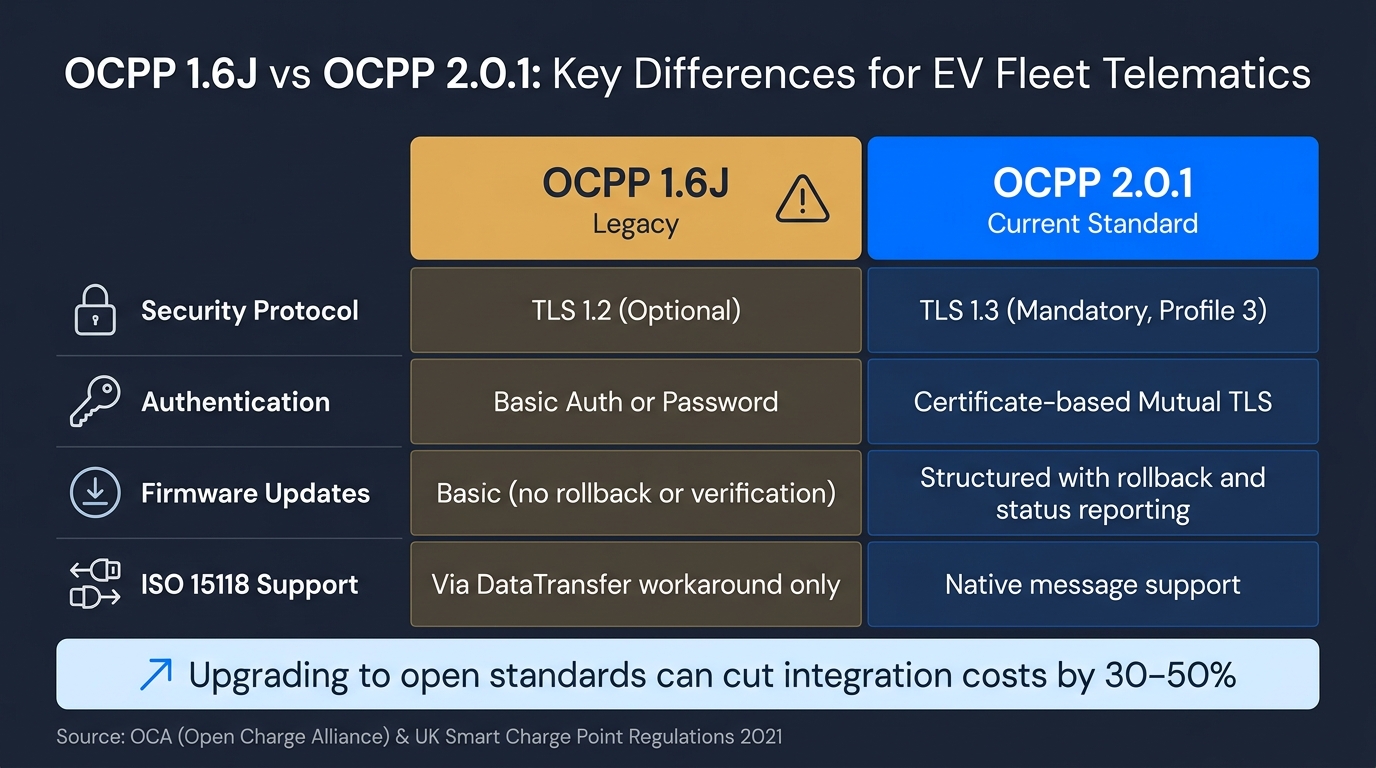
OCPP 1.6 vs OCPP 2.0.1: EV Telematics Security & Features Compared
While the advantages of interoperable EV telematics are evident, achieving seamless interoperability is far from simple. Fleet managers across various industries encounter a mix of technical, organisational, and security-related obstacles that can significantly hinder progress.
Technical and Organisational Barriers
One major issue lies in the inconsistency of data definitions across manufacturers. Fleet operators often face the burden of costly, custom integrations for each brand due to varying data models. The problem is further aggravated by legacy chargers relying on OCPP 1.6 and outdated TLS 1.2 protocols. A practical solution is the adoption of open and harmonised standards like ISO 15118-20, SAE J3072, and OCPI 2.2.1. These standards can cut integration costs by 30–50%.
When purchasing new hardware, fleet managers should be cautious about claims such as "OCPP 2.0.1 ready." Instead of accepting these at face value, they should request the specific OCA certificate number and confirm which features - like Advanced Security or Smart Charging - have been tested.
Cybersecurity Risks and Mitigation
Interoperability brings an increase in data connections, which also means more potential entry points for cyberattacks. Transitioning from OCPP 1.6 to OCPP 2.0.1 addresses many of these vulnerabilities. For instance, OCPP 2.0.1 mandates TLS 1.3 under Security Profile 3 and replaces basic passwords with certificate-based mutual authentication.
| Feature | OCPP 1.6J | OCPP 2.0.1 |
|---|---|---|
| Security Protocol | TLS 1.2 (Optional) | TLS 1.3 (Mandatory, Profile 3) |
| Authentication | Basic Auth or Password | Certificate-based mutual TLS |
| Firmware Updates | Basic (no rollback/verification) | Structured with rollback and status reporting |
| ISO 15118 Support | Via DataTransfer workaround | Native message support |
An often-overlooked risk is certificate management. As noted by Joint Tech:
"A charger with an expired certificate goes offline - completely - until the certificate is renewed. At scale, certificate expiration without automated monitoring and renewal creates the risk of synchronized mass-outage events."
In the UK, the Electric Vehicles (Smart Charge Points) Regulations 2021 require charge points to use secure boot mechanisms, remove hard-coded credentials, and alert owners to any physical tampering attempts. Before rolling out new hardware across a fleet, running a 30-day operational "soak test" can help identify firmware instabilities or certificate issues, preventing potential fleet-wide disruptions. These cybersecurity measures are essential to address before moving on to tackle broader standardisation challenges.
Gaps in Current Standards
Bridging the gaps in current standards is vital to fully unlocking the potential of interoperable EV telematics. Even with improved protocols, significant issues remain. One key concern is accuracy. Research by EPRI revealed that all tested telematics methods underreported energy usage compared to reference meters. Without clearly defined accuracy tiers - strict for billing and more flexible for managed charging - telematics data remains unreliable for applications like vehicle-to-grid (V2G) settlements or utility billing.
Another challenge is the restrictive nature of proprietary APIs. Exclusive agreements between OEMs and specific aggregators limit interoperability, fragment the market, and restrict fleet managers' options. This undermines the progress made in improving data consistency and security. As Steve Letendre, PhD, from V2G News, explains:
"The grid doesn't just need more chargers; it needs trustworthy data links between vehicles, automakers, and utilities."
Semantic interoperability, or the ability for systems across energy and mobility sectors to fully understand each other's data, is still underdeveloped. Until policymakers establish clear validation methods and accuracy standards for telematics data, these gaps will continue to hold back the reliability and effectiveness of interoperable systems.
What This Means for UK Fleets and Future Research
Priorities for UK Fleet Managers
Fleet managers in the UK face a pressing need to integrate telematics systems with the NAP TDT (National Access Point for Transport Data). This platform provides real-time updates on charge point availability, a requirement under the UK's AFIR Article 20 obligations. Relying on static data is no longer sufficient - live updates, refreshed as frequently as every 30 seconds, are now critical.
In addition to availability, systems that comply with ISO 21219-25:2024 standards are indispensable. These ensure compatibility by verifying connector types and power outputs before dispatching vehicles. Sending vehicles to incompatible charging stations results in wasted time and expenses, which can quickly add up for large fleets. With AFIR also mandating transparent pricing, tools that standardise cost calculations - whether based on kWh, time, or session fees - are vital for accurate budgeting and reporting.
Research Gaps and Emerging Areas
While operational concerns dominate the agenda, there are key research gaps that fleet managers cannot ignore. One such area is battery health. Data from Geotab highlights that EV batteries degrade at an average annual rate of 2.3%. This figure rises to 3.0% for vehicles that rely heavily on DC fast charging above 100 kW, nearly double the 1.5% rate observed with lower-power AC charging. Charlotte Argue, Senior Manager of Sustainable Mobility at Geotab, explains:
"EV battery health remains strong, even as vehicles are charged faster and deployed more intensively... What has changed is that charging behaviour now plays a much bigger role in how quickly batteries age."
Currently, there is a lack of integrated frameworks that combine battery ageing analysis with cybersecurity and operational controls. Until such models become available, fleet managers should turn to telematics systems to monitor State of Health (SOH) data in real time, rather than relying solely on manufacturers' projections.
UK and EU Policy on Data Standardisation
Policymakers in the UK and EU are introducing measures to standardise practices across the sector. In the UK, the Public Charge Point Regulations 2023 mandate the use of OCPI 2.2.1 for public chargers, ensuring that dynamic data, such as availability, is updated within 30 seconds of any status change. Meanwhile, the Smart Charge Points Regulations 2021 require private and workplace chargers to retain functionality even if the fleet switches electricity suppliers, addressing concerns over vendor lock-in.
At the EU level, Regulation 2025/656 requires all newly installed or renovated recharging points from 1 January 2027 to support ISO 15118-20. This standard facilitates smart and bidirectional charging, ensuring future compatibility. Additionally, by 31 December 2026, a unified European access point for alternative fuels data will be operational. Fleet managers should adopt ISO 15118-20 now to avoid future hardware upgrades.
| Policy / Regulation | Key Requirement | Applies To |
|---|---|---|
| UK Public Charge Point Regs 2023 | OCPI 2.2.1; dynamic data updated within 30 seconds | Public charge points |
| UK Smart Charge Point Regs 2021 | Smart functionality; supplier interoperability | Private/workplace chargers |
| EU Regulation 2025/656 | ISO 15118-20 (smart/bidirectional charging) | New/renovated points from 2027 |
| EU Regulation 2025/671 | Free sharing of static and dynamic data | Public recharging/refuelling |
FAQs
How do I check if our chargers are ready for ISO 15118-20?
To determine if your chargers align with ISO 15118-20, start by examining their communication protocol capabilities. Make sure they support essential technical features like TLS 1.3 encryption for secure data exchange and bidirectional power transfer functionality. While a universal conformity process hasn't been established yet, it's crucial to verify that your hardware includes these capabilities. Additionally, consult your provider about testing and validation processes, particularly in relation to standards like IEC 61851-23.
What’s the difference between charger data and vehicle telematics data?
The main distinction lies in the kind of information being tracked. Charger data originates from Electric Vehicle Supply Equipment, focusing on energy flow details such as session durations, power levels, and energy consumption. On the other hand, vehicle telematics data is sourced from onboard systems or OEM APIs, offering details like the state of charge (SoC), battery health, and temperature. Essentially, charger data reflects what has occurred, while telematics indicates what the vehicle requires next.
How can fleets prevent certificate expiry outages?
To avoid costly outages caused by expired certificates, fleets need to prioritise effective lifecycle management for their digital certificates. A key part of this process is implementing a Public Key Infrastructure (PKI) to manage the issuance, renewal, and revocation of certificates seamlessly.
It's also crucial to ensure that all system components - ranging from vehicles to charging stations - are equipped with valid root and contract certificates. On top of that, regular security audits are essential to identify potential vulnerabilities. Finally, make sure telematics solutions are compatible with the latest security protocols to uphold trust and prevent operational disruptions.