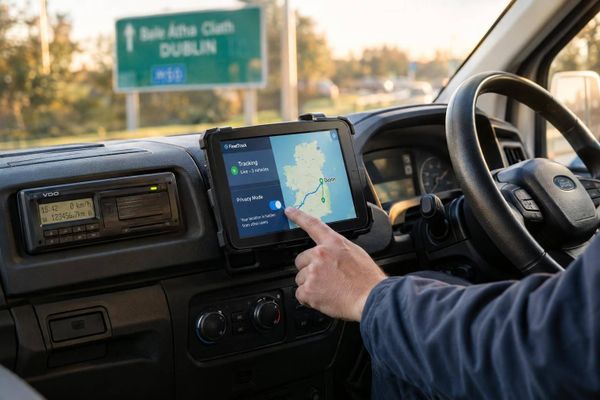
EV Fleet Compliance Checklist 2026
Six record sets, retention rules and practical steps to keep UK EV fleets audit-ready and compliant in 2026.
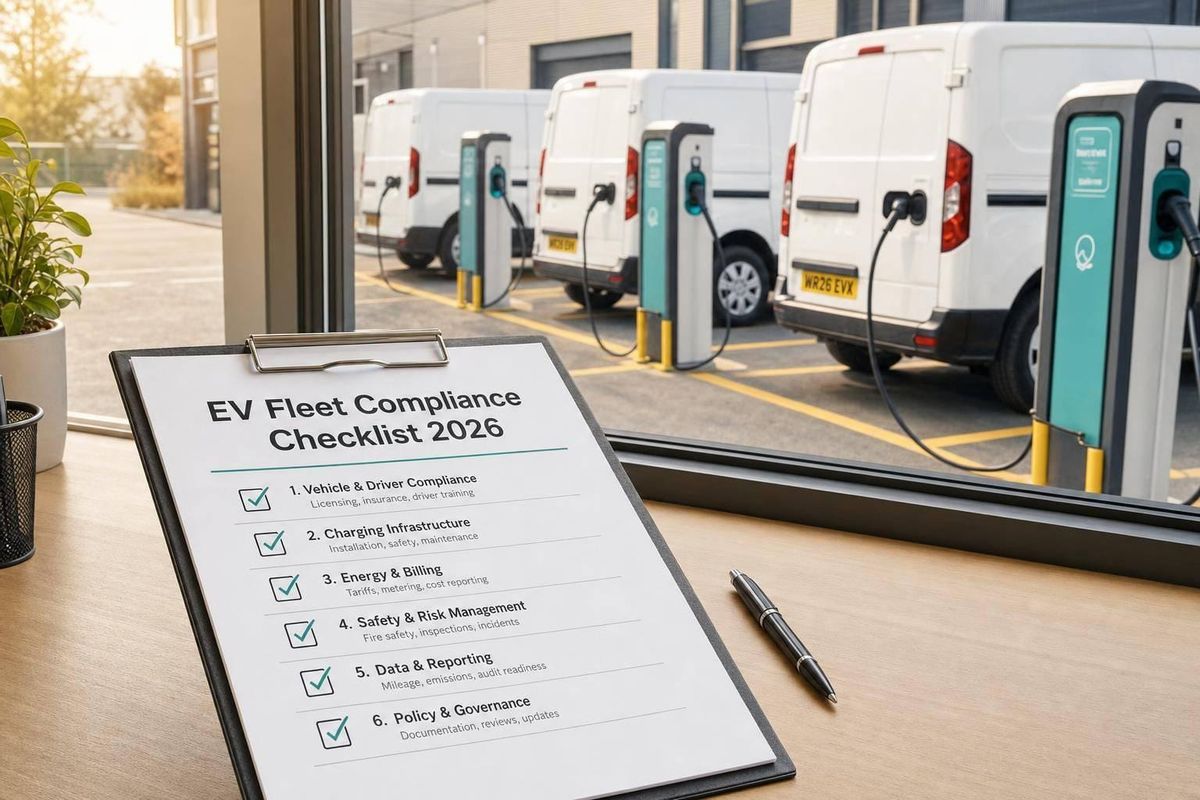
If I run an EV fleet in 2026, I need six record sets in order from day one: vehicle documents, charging logs, maintenance files, battery checks, driver training records, and incident reports. Miss one, and I risk extra cost, failed checks, and vehicles being used when the paperwork does not back them up.
Here’s the short version:
- ZEV targets now apply to new registrations: 33% of new cars and 24% of new vans must be zero-emission.
- London Congestion Charge rules changed on 02/01/2026, so vehicle status and registration records now affect daily cost.
- MOT timing matters for zero-emission vans in the 3,501 kg to 4,250 kg range.
- Charging records should show session date, time, place, kWh, vehicle ID, charge type, and cost in £.
- Maintenance and defect logs need to show what was checked, what was found, what was fixed, and when the vehicle was cleared.
- Battery records should track SoH, alerts, charging faults, and post-incident checks.
- Driver training needs dated proof for induction, refreshers, and extra training after incidents.
- Incident files should stay open until repair and sign-off are done.
What I take from the article is simple: a tick only counts if I can show the file fast. No record, no proof. And in practice, that means keeping everything central, searchable, and linked to each vehicle and driver.
A few retention points stand out:
- Charging session data: at least 12 months
- Maintenance records: at least 15 months
- Accident-related records: at least 6 years
If I wanted one way to judge whether my fleet is ready, I’d ask: can I pull up each record in minutes during an audit, DVSA check, insurer review, or internal file check? If the answer is no, there’s still work to do.
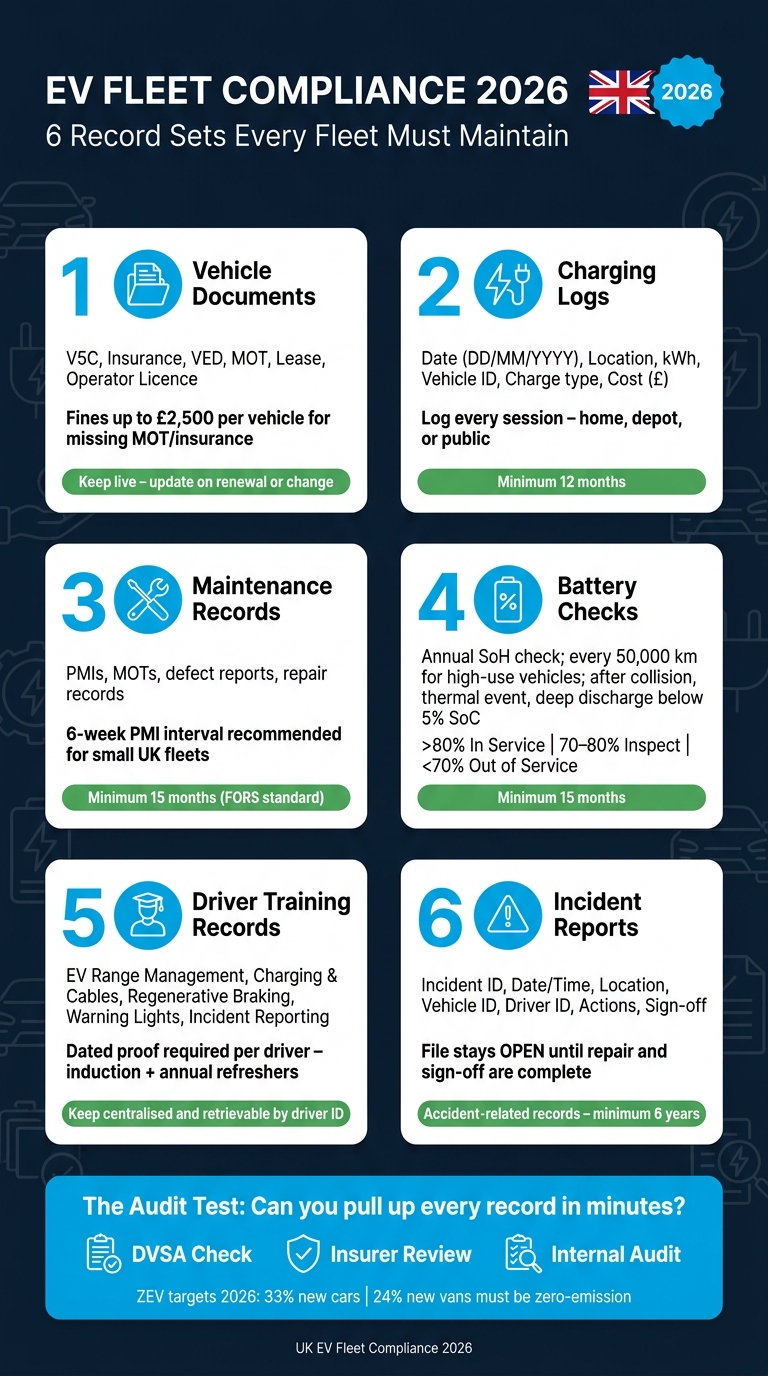
EV Fleet Compliance 2026: 6 Record Sets & Retention Rules
Fleet News@10 webinar May 2026 - Electric vans
sbb-itb-499a7f0
1. Vehicle documents and charging logs
The first two compliance areas come down to one thing: record control. You need to know what each file is, where it sits, and who is responsible for checking it. If the DVSA asks for records, or you run an internal audit, those documents should be easy to pull up straight away. Once that system is sorted, move on to charging records and usage evidence.
Vehicle documents checklist
Keep a live document pack for every EV. For zero-emission vans in the 3,501 kg to 4,250 kg band, make sure they are filed under the correct 2026 test schedule: first MOT due three years after first registration, then every year after that. This is the main 2026-specific gap. The test route is different from lighter commercial vehicles, so your records need to show the right weight band and the right test schedule.
Every document should have a named owner, a clear review date, and an automatic renewal reminder. If a vehicle is used without a valid MOT or insurance, fines can reach £2,500 per vehicle and your operator's licence may be at risk. It also helps to check current status against your fleet register every month or quarter, then log any gaps for follow-up during your annual internal compliance audit.
| Document | Named Owner | Review Trigger |
|---|---|---|
| V5C / Registration | Fleet Manager | On vehicle change |
| Insurance certificate / MID entry | Fleet Manager | At renewal / annually |
| VED (tax status) | Fleet Manager | Monthly review |
| MOT certificate | Workshop Manager | 30 days before expiry |
| Lease / ownership agreement | Fleet Manager | At contract end |
| Operator licence (if applicable) | Transport Manager | On renewal |
Charging logs checklist
Log every charging session in one record system, not across scattered email receipts. Each entry should include the vehicle registration or fleet ID, the date in DD/MM/YYYY format, location, kWh added, charging type (home, depot or public), and total cost in £. Keeping these sources separate makes employee reimbursement, internal cost allocation, and tax treatment much easier to handle.
Don’t wait until the end of the month and just glance at the totals. Run exception reports on a regular basis. Frequent rapid charging, odd locations, or repeated short top-ups can point to weak charging habits or a driver skipping lower-cost depot charging. It’s also smart to cross-check charging logs against telematics location history, which gives you a stronger audit trail.
When you line up charging logs with maintenance records, patterns start to show. You can spot faults, wasted energy, and driver behaviour that needs fixing.
2. Maintenance records and battery checks
Maintenance compliance is about more than putting EVs in for a service. You need to show that each vehicle is safe and roadworthy every time it goes back into use. The DVSA expects safety inspection records to include the vehicle details, inspection items, date, inspector, defects found, repairs carried out, and confirmation that defects were fixed before the vehicle returned to service. Check the record before release. It forms part of the safety decision. If you spot charging issues, use them as a prompt for a maintenance check, then note whether the fault was a one-off or part of a pattern.
Maintenance records checklist
Every EV in your fleet needs its own file. File records by registration and fleet number, and keep them in date order. Keep safety inspection records, driver defect reports, and repair records for at least 15 months. Keep key records for two years.
Your maintenance schedule should show at least six months of planned work, including PMIs, MOTs, and scheduled services. For most small UK fleets, a six-week PMI interval is a good fit. EVs often have longer service intervals than petrol or diesel vehicles. Many makers suggest servicing every two years or around 18,000 miles. But that does not reduce what you need to record.
Each maintenance record should include:
- tyre tread depth and condition
- brake test results
- suspension and steering checks
- charging-port condition
- software and firmware updates
- cooling system status
- warning lights or diagnostic fault codes, plus the action taken
Drivers’ daily walkaround checks also need to be recorded and kept. They are a key part of your roadworthiness evidence.
Use one status system for every defect. The DVSA uses coded outcomes such as ✓ (satisfactory), × (safety defect), R (repair required), and M (monitor) to support clear decisions. The table below shows how common EV defect types link to vehicle status:
| Component | In Service | Needs Inspection | Out of Service |
|---|---|---|---|
| Battery (SoH) | SoH >80%; no alerts | SoH 70%–80%; rapid degradation trend | SoH <70%; thermal event logged; cell imbalance |
| Charging Port | Clean; secure connection | Minor debris; stiff locking mechanism | Scorching; bent pins; failed connection |
| Cooling System | Levels normal; no leaks | Low coolant level; pump noise | Visible leaks; active overheating alerts |
| Safety Defects | No active warnings | Minor non-safety alerts | Brake, steering, or tyre defect; red dashboard warning |
Any safety-critical defect - brakes, steering, tyres, or exposed high-voltage parts - must be taken out of service at once.
Battery checks checklist
Battery checks sit alongside the service record. They do not replace it. Schedule them in advance rather than waiting for something to go wrong. Carry out a state of health (SoH) check every year, and check high-use vehicles every 50,000 km. You should also trigger an extra inspection after any of these events:
- a collision affecting the battery area or underfloor structure
- a thermal event
- a deep discharge below about 5% state of charge
- repeated dashboard battery or high-voltage warnings
- odd charging behaviour, such as very slow sessions, failed charges, or sudden range loss
Once defects and repairs are logged, battery checks help confirm whether the pack itself is ageing as expected. Each battery inspection record should include enclosure condition, charging-port condition, coolant status, dashboard warnings, and diagnostic trouble codes. Also record whether the issue was isolated or recurring. Repeat alerts often point to a deeper fault building over time.
Track SoH, charging times, fault codes, and warning frequency. A slow drop in SoH, a steady rise in thermal warnings, or repeated charging interruptions can point to battery ageing or charger incompatibility. Looking at these patterns by vehicle, route type, and charging location helps you act on the evidence instead of waiting for a breakdown. It also gives you the records needed to back planned battery replacement decisions as part of your compliance file.
3. Driver training and incident reporting
Once you’ve documented vehicle condition, the next control point is the driver. That means training, incident reporting and sign-off.
Driver training checklist
Every driver should complete a structured induction before they’re allocated an EV. That training needs to cover EV range management, correct charging steps, regenerative braking, dashboard warning lights and fault indicators, safe and energy-efficient driving, and reporting procedures.
Just as important: keep proof that the training happened. Store one dated record for each driver, whether that’s an attendance sheet, signed form or certificate. That record should show the module, assessor and renewal date, and it should be filed centrally by driver ID.
Some fleets need refreshers more often. Annual refreshers are a good fit for high-mileage or night-driving fleets, and they should also follow incidents or repeated telematics risk patterns. In practice, that means using telematics to spot issues such as harsh braking, repeated low state-of-charge events or repeated charging faults, then triggering extra training from there.
The table below shows the core EV training records your file should capture for each driver:
| Driver ID | Driver name | EV module | Status | Date completed | Assessor | Renewal due |
|---|---|---|---|---|---|---|
| - | - | EV Range Management | Complete / Overdue | DD/MM/YYYY | Name and qualifications | DD/MM/YYYY |
| - | - | Charging & Cables | Complete / Overdue | DD/MM/YYYY | Name and qualifications | DD/MM/YYYY |
| - | - | Regenerative Braking & Eco-Driving | Complete / Overdue | DD/MM/YYYY | Name and qualifications | DD/MM/YYYY |
| - | - | Warning Lights & Battery Alerts | Complete / Overdue | DD/MM/YYYY | Name and qualifications | DD/MM/YYYY |
| - | - | Incident Reporting Procedures | Complete / Overdue | DD/MM/YYYY | Name and qualifications | DD/MM/YYYY |
Drivers also need to know exactly when to report faults, and how fast they must do it.
Incident reporting checklist
Use a written incident reporting policy for every work-related road incident, including private vehicles used for work. If there’s a safety risk, the first step is to call emergency services. After that, the driver should notify the fleet contact or line manager, then record the details at the scene if it’s safe to do so.
Incidents that must be reported straight away include collisions, sudden loss of power, electrical faults, unsafe charging locations and near misses. Your policy should also state, in plain terms, that drivers must not try to repair high-voltage components. That point needs repeating in training too.
Each incident log entry should capture:
| Log field | What to record |
|---|---|
| Incident ID | Unique reference number |
| Date and time | DD/MM/YYYY, 24-hour format |
| Location | Address or postcode |
| Vehicle ID | Registration and fleet number |
| Driver name and ID | As per HR records |
| What happened | Plain description of what happened |
| Incident type | Collision / breakdown / charging fault / electrical fault / near miss / roadside safety issue |
| Immediate actions taken | Recovery called, vehicle taken out of service, emergency services notified |
| Corrective action | Maintenance job reference, parts replaced, diagnostic results |
| Return to service date | Date cleared by a qualified person, with authorising manager |
Logging the incident is only part of the job. The repair record and clearance record need to sit alongside it. No vehicle should return to service until the maintenance action has been logged and signed off.
It helps to use status fields such as Open, In Maintenance and Closed. Before a vehicle moves back to Available, a named manager or fleet engineer should sign it off. Near-miss reports should be treated as formal safety records too, because they show where the gaps are before those gaps turn into actual incidents.
4. Keeping the checklist current in daily fleet control
Once your core records are set up, the day-to-day work is what keeps them ready for an audit. The checklist needs to stay live, which means updating each record when something happens. If you only look at it once a year, it stops doing its job and stops helping you manage risk.
Give each record set one named owner, then log that person in a simple one-page matrix. That removes the usual confusion of “I thought someone else was doing it”.
Use update triggers, not just review dates:
| Checklist Area | Update Trigger | Owner |
|---|---|---|
| Charging logs | After each charging session | Duty controller |
| Defect and incident reports | Same day | Depot manager |
| Maintenance records | After each job | Workshop manager |
| Driver training completions | After onboarding and refresher training | Safety manager |
| Battery SoH | After each inspection and after any battery-related incident | EV technician |
| Vehicle documents (V5C, insurance, MOT) | At renewal or change of status | Fleet administrator |
Keep everything in one central, searchable digital system, filed by vehicle registration and driver ID. Stick to one file-naming format - for example, REG-YYYY-MM-DD-Charging.csv - so a record can be pulled up in minutes. Each file should be searchable by vehicle registration, driver ID, or incident ID. Accident-related records, including telematics extracts and repair authorisations, should be kept for at least six years.
Use telematics to support audit trails
Telematics gives you an objective, time-stamped record of each journey to sit alongside driver statements and workshop notes. That same timestamped data helps when you're sorting out collisions, near misses, and charging faults.
For EV van fleets, GRS Fleet Telematics supports this directly by giving you a verifiable history of vehicle use that can be matched to job records, mileage-triggered service schedules, and incident logs. In practice, that means the checklist isn't just a document sitting in a folder. It becomes a live control system.
Conclusion: 2026 EV fleet compliance at a glance
EV fleet compliance in 2026 comes down to five things: live vehicle documents, a log for every charging session, complete service and battery records, evidenced driver training, and incidents logged until defects are resolved and signed off.
Keep charging, maintenance and training records centralised, searchable and under your control. Smart charging rules require charging session data - start time, duration, and energy consumed - to be stored securely for at least 12 months and made available to authorities on request. FORS standards require maintenance records to be kept for at least 15 months, with documented defect reporting and prevention schedules.
Review the checklist each year and after any fleet change, such as new EV models, depots or charging policies. Spot checks help you make sure the process is active, not just sitting in a folder.
The table below sums up what each compliance area needs:
| Compliance Area | What to Record | Minimum Retention |
|---|---|---|
| Vehicle documents | Live vehicle file | Keep live; update on renewal or change |
| Charging sessions | Session log | 12 months minimum |
| Maintenance & battery | Service, repair and SoH records | 15 months (FORS standard) |
| Driver training | Induction and refresher records | Keep centralised and retrievable by driver name or employee ID |
| Incidents & defects | Incident log and sign-off | Keep open until the defect is rectified and the vehicle is released back into service |
Keep it central, current and auditable so every EV is proved fit for service.
FAQs
What records should I prioritise first?
Prioritise bringing vehicle roadworthiness records into one place first. That includes safety inspection reports, MOT certificates and proof of Vehicle Excise Duty. At the same time, set up secure digital records for drivers, including valid UK driving licences, CPC qualifications and medical fitness declarations.
Moving these core documents into digital form replaces error-prone paper trails with a system that’s ready for audits and much easier to access during DVSA inspections and day-to-day regulatory checks.
How can I prepare for a DVSA audit?
Keep a centralised digital record for both vehicle and driver compliance. Store at least 15 months of maintenance records, including four scheduled inspections, along with MOT certificates, insurance documents, and proof of VED.
Driver records need the same level of care. Keep them up to date with:
- driver working hours
- rest periods
- tachograph data
- valid UK licences
- CPC qualifications
- medical fitness declarations
Think of it as your compliance paper trail, just in digital form. If something gets checked, you want the right record there straight away, not buried in emails or spread across folders.
When should an EV be taken out of service?
An EV should be taken out of service immediately if it’s found to be defective. That covers mechanical faults, safety issues, battery risks such as possible thermal runaway, physical damage, or major diagnostic warnings.
It may also need to be removed from service if it no longer meets day-to-day operational needs. Proactive monitoring helps spot problems early and can cut down on unplanned removals.