Edge Computing vs Cloud in Fleet Telematics
Compare edge and cloud telematics: edge gives ultra-low latency and offline safety responses, while cloud offers scalable analytics, storage and compliance.
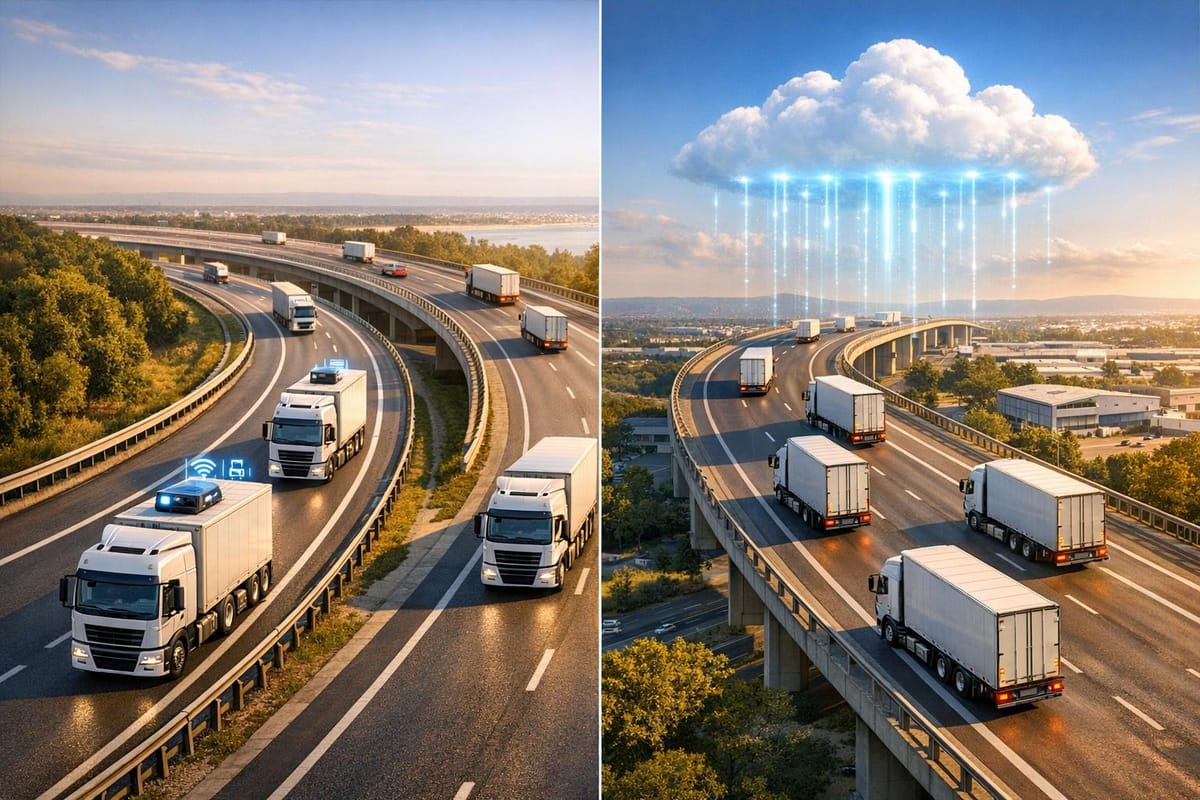
Edge computing and cloud computing are two key technologies shaping fleet telematics. Here's a quick breakdown:
- Edge Computing processes data directly on vehicles or nearby devices, offering ultra-fast response times (sub-10ms) for safety-critical tasks like collision alerts. It operates even without network connectivity, making it ideal for remote areas. However, it requires higher upfront investment in hardware and decentralised management.
- Cloud Computing relies on remote servers to handle large-scale data storage and analytics. It excels in long-term insights, such as trend analysis and compliance reporting, and offers scalable, pay-as-you-go pricing. However, it depends on constant connectivity and has higher latency compared to edge systems.
Quick Comparison:
| Feature | Edge Computing | Cloud Computing |
|---|---|---|
| Processing Location | Onboard or nearby | Remote servers |
| Latency | Sub-10ms | Seconds to minutes |
| Connectivity | Works offline | Requires constant connection |
| Initial Cost | High (hardware investment) | Lower (subscription-based) |
| Best Use Case | Real-time safety alerts | Long-term analytics |
For most fleets, a hybrid approach - combining edge for immediate actions and cloud for broader insights - offers the best balance of speed, cost, and functionality.
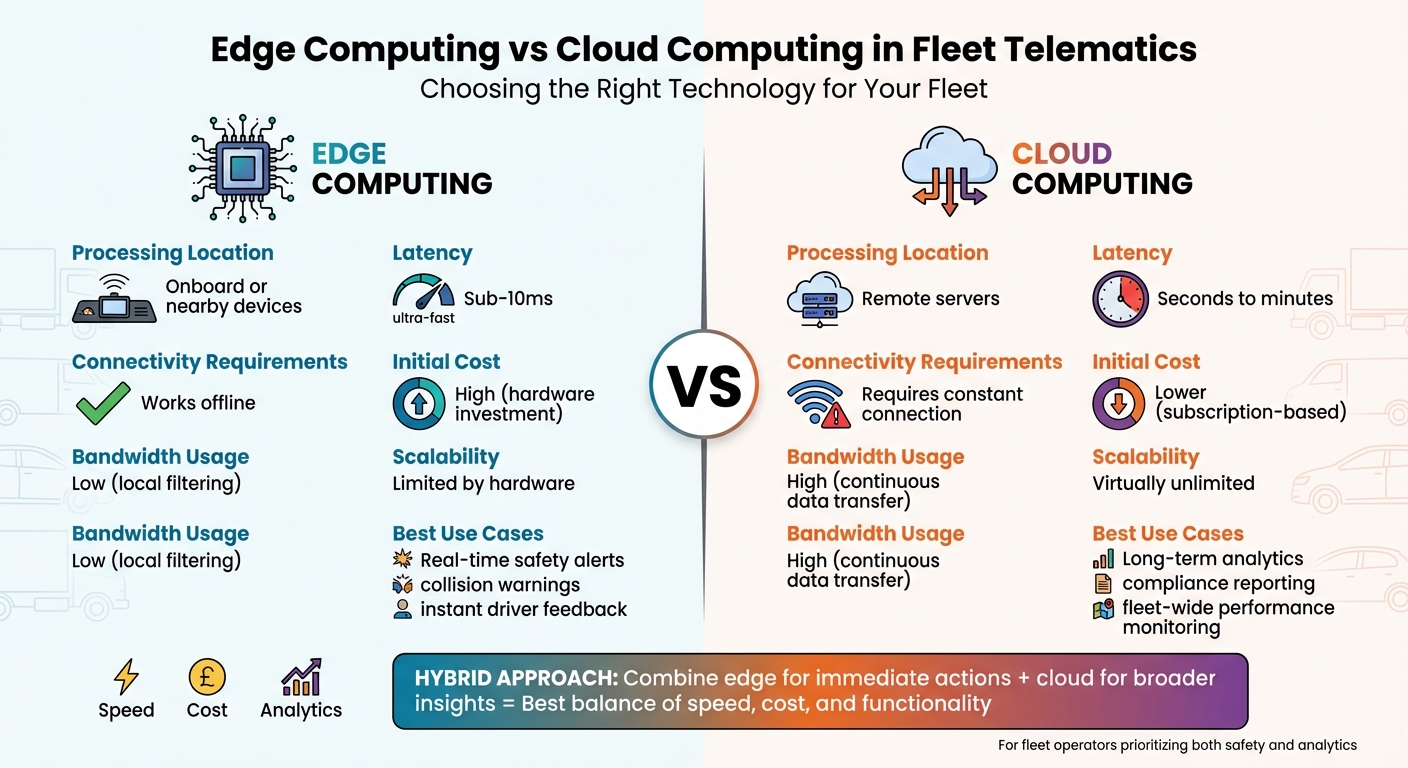
Edge Computing vs Cloud Computing in Fleet Telematics: Key Differences Comparison
How Edge Computing Powers Autonomous Vehicles
What is Edge Computing in Fleet Telematics?
Edge computing is a distributed system that processes data locally on in-vehicle telematics units or nearby servers, rather than relying entirely on remote cloud systems. This means data from devices like sensors, GPS, dashcams, and engine diagnostics is filtered and analysed directly at the source.
The system operates using a "store-and-forward" method. If a vehicle enters an area with poor connectivity, the edge device continues to process and store data locally. Once the connection is restored, only the most relevant and actionable insights are sent to the cloud. This ensures operations remain smooth and compliant with electronic logging requirements, even during network disruptions.
"Edge computing enables data collection, processing, and analysis locally, eliminating the risk of data loss." - Netradyne
Another major advantage of edge computing is its ability to manage bandwidth effectively. Tasks like high-definition video analysis are handled locally, reducing strain on networks and cutting bandwidth costs. For time-critical safety features, such as collision warnings or harsh braking alerts, edge computing delivers response times of under 50 milliseconds - far faster than the 200+ milliseconds typical of cloud-based systems.
These capabilities highlight why edge computing is a game-changer for fleet management.
Key Features of Edge Computing
Ultra-low latency ensures response times under 50 milliseconds, making it ideal for real-time interventions like geofencing alerts or sudden braking warnings. In situations where milliseconds matter, this speed can make all the difference.
Offline functionality keeps telematics systems running even when connectivity is lost. Whether a vehicle is navigating remote areas like the Scottish Highlands or passing through tunnels in central London, edge devices continue to collect, process, and store data locally. This eliminates the need for manual logs and helps maintain compliance.
Edge computing also delivers a 95% accuracy rate in detecting speed violations, outpacing traditional cloud systems, which typically achieve 85–90% accuracy.
Local data handling allows critical tasks like vehicle diagnostics and driver behaviour analysis to happen in real time. For example, AI-powered video analysis for detecting distracted or fatigued driving happens directly on the device, avoiding the need to transmit large video files. This not only saves bandwidth but also keeps sensitive data secure within the vehicle's network.
"By leveraging edge devices, real-time data processing and analysis can be achieved closer to the source, reducing latency and enhancing the responsiveness of speed monitoring mechanisms." - Nadeem Haider and Shehzana Fatima
These features enable a range of practical applications that enhance daily fleet operations.
Applications of Edge Computing in Fleet Management
The capabilities of edge computing power several real-world applications, such as geofencing alerts and instant driver feedback. Geofencing alerts are triggered immediately when a vehicle crosses a set boundary. The edge device notifies both the driver and fleet manager instantly, without waiting for cloud confirmation.
Another standout application is instant driver feedback. Systems like Netradyne's Driver•i have analysed over 350 million miles of road data, using AI to provide real-time coaching. When risky behaviours like tailgating, mobile phone use, or lane departure are detected, the system delivers immediate audio or visual alerts, allowing the driver to correct their actions on the spot.
Real-time safety monitoring is equally effective in both urban areas and remote locations. For fleets operating in regions with unreliable connectivity, edge computing ensures safety systems remain fully functional. Additionally, it supports predictive maintenance by monitoring engine health indicators locally, identifying potential failures before they lead to costly downtime. For heavy-duty vehicles, edge devices with robust IP67, IP68, or IP69K ratings are built to withstand extreme temperatures and vibrations, ensuring durability in harsh conditions.
"Edge computing and AI are the perfect match, enabling breakthroughs in industries that require real-time processing and decision-making." - Jensen Huang, CEO, Nvidia
What is Cloud Computing in Fleet Telematics?
Cloud computing in fleet telematics relies on remote servers to collect, store, and process data sent from vehicle hardware via cellular or satellite networks. These devices constantly send information - like GPS locations, engine diagnostics, and speed metrics - to cloud servers. This data is then transformed into actionable insights, such as converting engine diagnostics into fuel efficiency reports or GPS data into route suggestions and safety scores. With this centralised system, fleet managers can access real-time updates and historical data from anywhere using a Software-as-a-Service (SaaS) platform.
This approach handles complex data tasks that local systems can't manage, such as benchmarking fleet performance, identifying patterns in fuel consumption, and predicting maintenance needs before issues arise. The global automotive telematics market is projected to reach £320 billion by 2026. These capabilities form the backbone of the advanced features discussed below.
"Telematics is an invaluable tool in all areas of fleet management, making it possible for managers to know their fleets inside out."
- David Broadwater, Fleet Management Services Manager, Holman
Key Features of Cloud Computing
-
Scalability
Cloud platforms grow with your fleet, eliminating the need for extra hardware or additional IT staff. -
Centralised Data Aggregation
All vehicle data - ranging from GPS tracking to engine diagnostics - is stored in a single, secure location. This eliminates fragmented data and provides a unified source of information. -
Advanced Analytics
Cloud systems use powerful machine learning tools to analyse historical data, spot trends in driver behaviour, predict maintenance schedules, and optimise routes based on live traffic and weather conditions. In fact, UK businesses using cloud-based route optimisation often cut fuel costs by 10–20% within the first year. -
Remote Accessibility
With web dashboards and mobile apps, managers can respond to alerts - like geofencing breaches or theft notifications - in real time, no matter where they are. -
Automated Compliance
Cloud platforms simplify compliance with regulations like GDPR and DVSA by automating data collection, reporting, and encryption.
Applications of Cloud Computing in Fleet Management
Building on these features, cloud computing enables several essential applications for fleet management.
Fleet-wide Performance Monitoring:
Cloud systems analyse data from all vehicles, creating performance leaderboards that highlight top drivers and identify those who may need further training. This helps managers address issues like excessive idling, harsh braking, or poor fuel efficiency across the fleet.
Compliance Reporting:
Automated reports for driver hours, maintenance logs, and safety inspections make it easier to comply with DVSA audits or insurance requirements. Telematics systems can boost vehicle uptime by up to 25% through proactive maintenance and fewer unexpected breakdowns.
Long-term Data Storage and Trend Analysis:
Storing data over time allows fleet managers to identify seasonal trends, evaluate the effectiveness of driver training, and make informed decisions about investing in fuel-efficient vehicles - tasks that edge computing alone cannot handle effectively.
Enhanced Security:
Cloud-integrated security features, such as dual-tracker technology and theft alerts, have contributed to vehicle recovery rates as high as 91%. When theft occurs, the cloud platform works with recovery teams, providing live location updates until the vehicle is recovered.
"Functions supporting on-the-spot decision making are handled at the edge, while big data processing and analysis are done in the cloud."
Edge Computing vs Cloud Computing: Key Differences
Edge computing works by processing data locally, while cloud computing sends data to remote servers. This fundamental difference shapes how effectively and quickly fleet operations can respond in critical moments.
Latency is a major factor. Edge computing provides response times of under 10 milliseconds because decisions are made directly on the vehicle. In contrast, cloud computing introduces delays as data has to travel to and from remote data centres. For instance, when a pedestrian steps into the road, those fractions of a second can make all the difference in enabling timely autonomous braking.
"The decision of whether to stop a car before a pedestrian starts walking is certainly very time-sensitive and should be made by an onboard computer."
- Małgorzata Kruszynska, Business Researcher, Spyro-Soft
Connectivity and bandwidth also set the two apart. Edge computing thrives without constant connectivity by filtering raw data and sending only critical alerts, whereas cloud systems rely on uninterrupted connectivity and transmit full data streams. Edge systems can still monitor tyre pressure, refrigeration temperatures, or driver fatigue even when cellular signals drop - common in rural UK areas or underground car parks. By 2025, it’s estimated that 75% of enterprise-generated data will be created and processed outside traditional centralised data centres, reflecting the growing trend towards localised processing. Today, some telematics providers collect over 60 billion data points daily from 4.1 million vehicles, showcasing the massive data volumes that edge computing is designed to handle efficiently.
Comparison Table: Edge vs Cloud in Fleet Telematics
| Feature | Edge Computing | Cloud Computing |
|---|---|---|
| Processing Location | Inside the vehicle or nearby node | Remote data centres |
| Latency | Sub-10ms | Seconds to minutes |
| Bandwidth Usage | Low (local filtering) | High (continuous raw data transfer) |
| Connectivity | Operates without constant network access | Requires constant connectivity |
| Scalability | Limited by hardware | Virtually unlimited |
| Upfront Cost | High (local hardware investment) | Lower (pay-as-you-go model) |
| Best Use Case | Real-time safety alerts | Fleet-wide analytics |
| Security | Local data processing risks | Risks during data transmission |
Practical Impacts on Fleet Operations
These technical differences have a direct impact on fleet operations. Edge computing shines in safety-critical scenarios where immediate action is essential. For example, edge systems can instantly alert drivers if a refrigerated vehicle’s temperature goes above safe levels, even when there’s no network coverage. Collision warnings and lane departure alerts also depend on the ultra-fast response times that edge computing delivers.
On the other hand, cloud computing is better suited for long-term planning and strategic decision-making. Analysing historical data to identify driver training needs, predict maintenance schedules, or optimise routes benefits greatly from the cloud’s vast computational power and storage capacity.
"Edge computing also minimizes disruptions due to cellular connectivity, speeds up field challenge resolution and eliminates the need for constant cloud communication - resulting in quicker data processing."
- Grant Gardner, Senior Vice President, Solera
The cost structures between the two approaches also differ. Cloud platforms typically operate on a pay-as-you-go basis, charging for data volume and processing time, which makes them an affordable option for smaller fleets. However, costs can increase as data usage grows. Edge computing, by contrast, requires a significant initial investment in ruggedised onboard hardware and sensors, but ongoing costs are often more predictable. While cloud providers handle server maintenance, edge computing places the responsibility for hardware upkeep and lifecycle management on fleet operators.
Local data processing with edge computing also supports GDPR compliance. By keeping sensitive driver behaviour and location data within UK borders, edge systems can simplify compliance. In contrast, cloud solutions that route data through international servers may introduce complexities, requiring careful selection of vendors to meet privacy regulations.
Pros and Cons of Edge and Cloud Computing in Fleet Telematics
Edge computing enables ultra-fast responses for immediate decision-making, while cloud computing excels in handling large-scale analytics and strategic insights.
Comparison Table: Pros and Cons
| Aspect | Edge Computing | Cloud Computing |
|---|---|---|
| Advantages | Extremely low latency (sub-10ms) for critical safety decisions; operates independently in areas with weak cellular coverage; cuts bandwidth costs by filtering data locally; improves data privacy through local processing | Practically limitless scalability; centralised management simplifies deploying applications; reduced hardware maintenance responsibilities; subscription pricing minimises initial expenses |
| Disadvantages | Requires significant upfront investment in specialised hardware; managing distributed nodes is complex; limited local processing and storage capacity; necessitates staff training for decentralised maintenance | High latency limits real-time responsiveness; relies on constant connectivity, which can lead to single points of failure; bandwidth costs rise with increased data volumes; transmitting data introduces security vulnerabilities |
These factors help fleet operators decide between prioritising immediate safety or focusing on long-term analytics, as explored below.
Key Considerations for Fleet Operators
When comparing the two approaches, edge computing requires higher upfront investment and more complex management due to its decentralised nature, while cloud computing offers lower initial costs and centralised maintenance. For example, CloudFront KeyValueStore charges approximately £1,000 per 1 million operations, whereas Cloudflare KV offers the same volume for just £5. However, edge computing demands additional staff training to manage hardware across potentially thousands of vehicles.
Security is another critical factor, with each option presenting unique challenges. Edge computing’s distributed setup makes it more susceptible to physical tampering and DDoS attacks, requiring robust security protocols at every node. On the upside, it processes sensitive data locally, simplifying GDPR compliance and enhancing privacy. Cloud computing, while benefiting from advanced centralised security tools, exposes data during transmission and may route it through international servers, complicating compliance with regulations.
Fleet operators must carefully weigh their need for real-time safety measures against their goals for advanced analytics to determine the best fit.
When to Use Edge, Cloud, or Hybrid Solutions in Fleet Telematics
Choosing between edge computing, cloud computing, or a hybrid solution often comes down to your fleet's specific needs. If your priority is immediate safety - like preventing collisions, coaching drivers on harsh braking, or recovering stolen vehicles - edge computing is the way to go, thanks to its ultra-low latency capabilities. On the other hand, if you're focusing on long-term goals such as tracking fuel efficiency trends, managing compliance reports, or planning maintenance schedules, cloud computing offers the storage and analytical power necessary to handle these tasks.
Your fleet size and budget are also important factors. Smaller operators tend to favour cloud-based solutions due to their pay-as-you-go pricing, which reduces upfront costs. Larger fleets, however, often require more comprehensive systems to manage complex operations like multi-route optimisation or diverse vehicle types. These systems not only streamline operations but also minimise human error. As Mayank Sharma, Head of Global Product Management & UX at Teletrac Navman, puts it: "Companies want a system that pays for itself".
For fleets operating in rural or remote areas where cellular coverage can be unreliable, edge computing offers a practical solution. Its store-and-forward capability ensures that data is saved locally until connectivity is restored. This ability to bridge connectivity gaps makes hybrid solutions - which combine edge and cloud computing - particularly effective.
Hybrid Solutions: Combining Edge and Cloud
Hybrid models bring together the best of both worlds. Edge computing manages real-time, on-the-spot decisions, while cloud computing handles aggregated analytics and long-term storage. For example, edge devices process immediate sensor data, whereas the cloud supports tasks like compliance audits and fleet-wide reporting. This division of responsibilities ensures both improved performance and cost efficiency.
"The edge cloud will only operate on data to issue instructions in real time for controlling industrial equipment, while the remote cloud... can be used for long term storage, processing, and analysis." - Antonia Basca and Fragkiskos Sardis, KPMG
Use Case Examples
Practical examples highlight how these solutions cater to different fleet requirements.
Urban delivery fleets, for instance, benefit greatly from edge computing's real-time capabilities. Alerts about harsh braking, speeding, or unauthorised route changes allow managers to coach drivers immediately, reducing accidents and improving customer satisfaction. A great example of this is GRS Fleet Telematics' dual-tracker technology, which provides real-time theft alerts and boasts a 91% recovery rate for stolen vehicles.
For long-haul transport operators, cloud computing is indispensable for compliance and operational efficiency. Centralised storage is crucial for managing electronic logging device (ELD) data, tracking hours of service, and handling International Fuel Tax Agreement (IFTA) reporting. One fleet reduced its insurance premiums from £10,500 to £5,600 per vehicle - saving approximately £244,000 annually for a 50-truck operation - by leveraging cloud-based safety data to negotiate better rates.
Construction and plant hire companies working in remote locations often adopt hybrid models. Edge devices store critical diagnostic data locally during connectivity outages and upload it to the cloud once the connection is restored. This prevents data loss and allows managers to analyse equipment usage and schedule maintenance effectively. By doing so, they can increase vehicle uptime by as much as 25%.
Before committing to a specific solution, it’s essential to determine whether your primary focus is theft prevention, driver safety, or administrative efficiency.
"It is tempting to think, 'I want as much data as I can get... however, the reality is that many equipment owners are not yet capable of properly digesting available data and often become overwhelmed by it." - Tony Nicoletti, Director of Sales and Business Development, DPL America
To make an informed decision, consider testing free trials with borrowed hardware to evaluate the return on investment before scaling up.
Conclusion
The decision between edge and cloud computing has a direct impact on fleet safety and operational planning. The key is to align the technology with your fleet's specific requirements. Edge computing excels in delivering ultra-low latency for real-time safety measures, while cloud computing shines with its scalable storage and advanced analytics capabilities. As Eloise Smith from GovNet aptly notes:
"The future may see a harmonious integration of both models, with businesses leveraging the strengths of each to create a flexible and efficient computing ecosystem".
Hybrid solutions are becoming the go-to choice for UK fleet operators aiming to balance immediate operational control with in-depth insights. By processing critical safety data locally at the edge and forwarding summarised information to the cloud, fleets can cut bandwidth costs while retaining access to powerful analytics tools. This balanced approach addresses both short-term and long-term operational needs.
When setting goals, focus on what matters most to your business. If theft prevention and driver safety are priorities, look for edge-capable hardware that supports local data processing. For tasks like compliance management or fuel efficiency tracking, ensure your cloud platform can handle robust historical data analytics.
GRS Fleet Telematics offers solutions tailored to diverse fleet needs, with hardware ranging from the Essential tracker (£35) to the Ultimate dual-tracker with remote immobilisation (£99). Monthly pricing starts at £7.99 per vehicle. With an impressive 91% vehicle recovery rate and no hidden fees, GRS combines the security strengths of edge computing with the accessibility of cloud-based management.
Evaluate solutions carefully, considering connectivity, data volume, and the unique challenges of your operations. By doing so, you can ensure your fleet is equipped with the right tools for success.
FAQs
What are the benefits of combining edge computing and cloud solutions in fleet telematics?
A hybrid system in fleet telematics brings together the best of edge computing and cloud-based analytics, creating a balance of performance and adaptability. With edge devices installed directly in vehicles, critical data like driver behaviour, geofencing alerts, and safety interventions are processed on-site. This allows for real-time actions and ensures the system remains functional even if connectivity drops. At the same time, the cloud handles secure data storage, advanced analytics, and overall fleet insights, supporting long-term planning and regulatory compliance.
Here’s why this approach stands out:
- Immediate alerts and faster responses: Edge processing allows for instant actions, such as issuing warnings for dangerous driving or activating remote immobilisation.
- Reliable even without connectivity: Vehicles can continue to operate and record data locally, even when 4G or 5G networks are unavailable.
- Lower costs: By sending only critical data to the cloud, bandwidth usage and data transfer expenses are minimised.
- Advanced analytics at scale: The cloud enables predictive maintenance and fleet-wide improvements by leveraging its computing power.
GRS Fleet Telematics incorporates this hybrid model into its van-tracking solutions, offering UK businesses advanced technology starting at just £7.99 per month.
How does edge computing improve safety in remote areas for fleet vehicles?
Edge computing brings a new level of safety to remote areas by processing telematics data directly on the vehicle, eliminating the need to rely solely on cloud servers. This means critical events - like harsh braking, speeding, or a driver leaving a geofenced area - can be detected and addressed almost instantly. Even in places with weak or no mobile signal, drivers can receive immediate alerts, and automated responses, such as activating emergency beacons or disabling the engine, can kick in without delay.
For fleet operators, this translates into constant, real-time safety insights, no matter how challenging the location. Whether navigating rural Scottish roads or working on remote construction sites, edge-enabled devices ensure operations stay informed. These devices also enable live video streaming for driver coaching, deliver predictive maintenance alerts, and help enforce safety policies like mandatory rest breaks. Plus, by storing sensitive data locally, they align with UK privacy regulations. GRS Fleet Telematics incorporates these features into its van trackers, offering businesses a secure and cost-effective solution starting at just £7.99 per month.
What should fleet operators consider when deciding between edge and cloud computing?
When deciding between edge and cloud computing for fleet telematics, operators need to weigh factors such as performance, cost, and compliance to find the best fit for their needs.
Edge computing processes data directly within the vehicle itself. This allows for real-time decisions, like issuing driver alerts or making immediate route changes, without needing a network connection. It’s a practical choice for areas with poor connectivity or when uninterrupted operations are essential. In contrast, cloud computing is better suited for fleets that need extensive data storage and advanced analytics. Cloud solutions provide scalable, pay-as-you-go options, making them ideal for handling large volumes of information.
Cost is another major consideration. Edge devices usually require an upfront investment and ongoing maintenance, but they can save money on bandwidth since data is processed locally. Cloud solutions, while often cheaper to set up, might lead to higher costs over time due to data transfer and storage fees.
Security and compliance play a critical role as well. With edge computing, data is processed locally, which can improve privacy and help meet UK GDPR requirements by reducing the risk of data exposure. Cloud platforms, on the other hand, typically offer strong encryption and compliance tools, but it’s essential to check the provider’s certifications and data-handling policies.
For those seeking a balance, hybrid models bring together the best of both systems. For instance, GRS Fleet Telematics’ van-tracking devices utilise dual-tracker technology, enabling operators to handle urgent tasks locally while using cloud-based analytics for long-term insights. By carefully considering these factors, fleet managers can select the approach that aligns with their operational goals and regulatory responsibilities.