Edge Computing in Predictive Maintenance Explained
On-site edge computing analyses vehicle sensor data to predict failures, cut downtime and maintenance costs, and deliver real-time alerts at low‑connectivity sites.
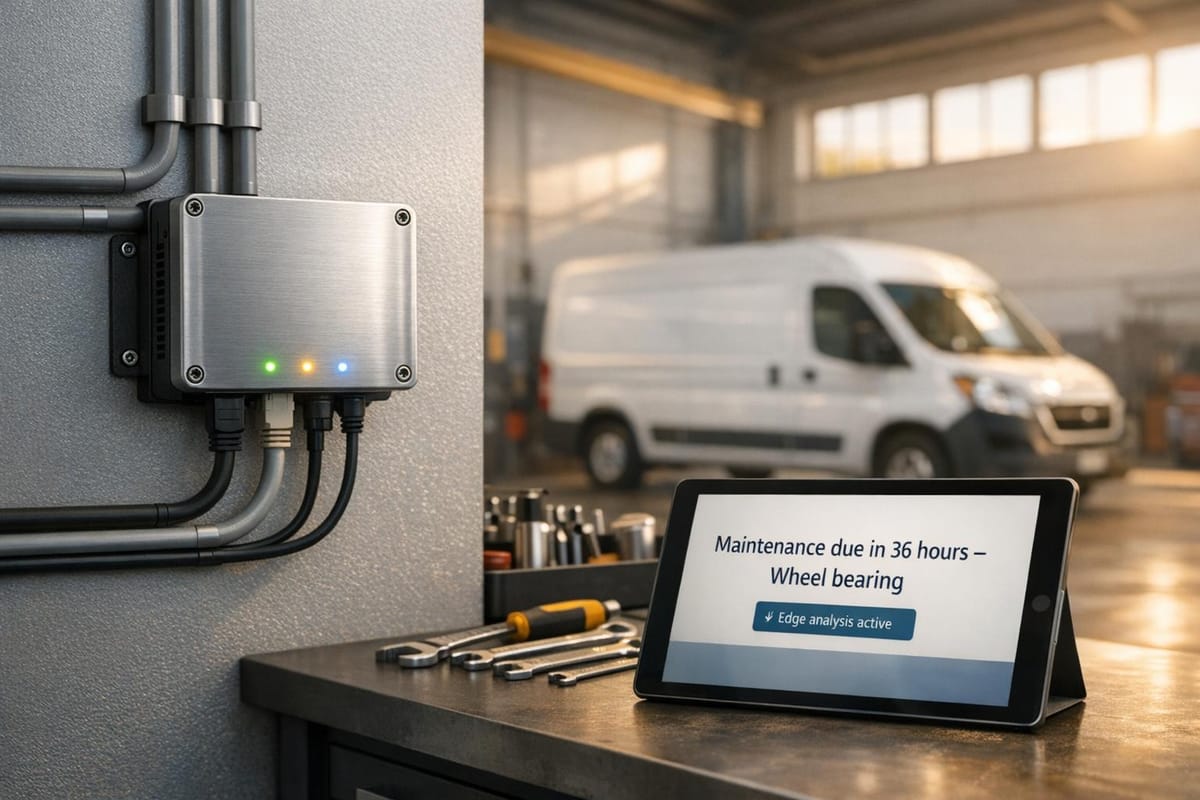
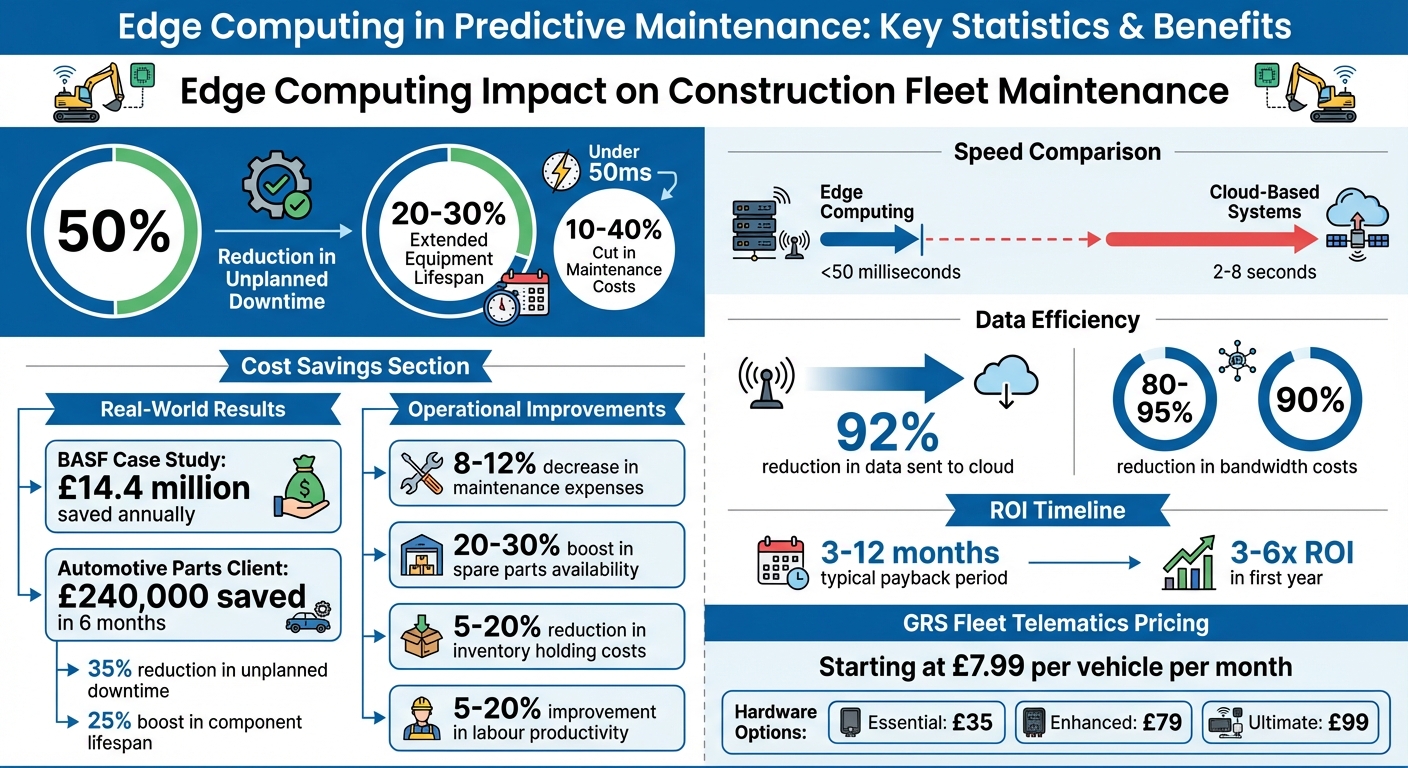
Predictive maintenance, powered by edge computing, is transforming how construction fleets manage vehicle servicing. Instead of waiting for failures or relying on rigid schedules, edge computing processes sensor data directly on-site to predict and prevent breakdowns. This approach reduces downtime by up to 50%, extends equipment lifespan by 20–30%, and cuts maintenance costs by 10–40%.
Key Takeaways:
- What It Does: Processes data locally, avoiding delays caused by cloud systems.
- Benefits: Faster issue detection, lower costs, and improved safety.
- Real-World Example: BASF saved £14.4 million annually by reducing equipment failures using edge computing.
- Cost Savings: Maintenance expenses drop by 8–12%, and unplanned downtime is significantly reduced.
Edge computing is particularly useful for construction fleets in remote areas, where connectivity is limited. It ensures continuous monitoring, faster response times (under 50ms), and fewer data transmission costs. GRS Fleet Telematics offers tailored solutions starting at £7.99 per vehicle per month, making predictive maintenance accessible and cost-effective.
Edge Computing Benefits for Construction Fleet Predictive Maintenance
Benefits of Edge Computing for Construction Vehicle Maintenance
Reducing Downtime and Maintenance Costs
Edge computing takes predictive maintenance to the next level by processing sensor data locally and almost instantly - within just 50 milliseconds. This rapid response allows systems to identify issues like bearing wear or engine overheating before they turn into full-blown failures. The result? A 30–50% drop in unplanned downtime.
Here’s a real-world example: In 2025, a company in the automotive parts sector faced repeated gearbox failures. They implemented iMaintain's edge AI solution and, within six months, saw a 35% reduction in unplanned downtime and a 25% boost in component lifespan, saving £240,000 in maintenance costs.
Edge computing also enables condition-based servicing, shifting away from rigid maintenance schedules. Parts are replaced only when sensors detect wear, reducing unnecessary work and making better use of technicians’ time. This strategy can cut overall maintenance costs by 10–40%. For construction sites in remote areas of the UK, where internet connectivity is unreliable, edge devices can operate offline, ensuring that vehicle diagnostics remain uninterrupted.
On top of cost savings, the ability to detect faults quickly contributes to a safer working environment for all.
Improving Fleet Safety and Performance
Edge computing plays a critical role in preventing accidents by detecting anomalies in real time. Whether it’s monitoring oil leaks, structural stress, or temperature spikes, these systems can trigger immediate alerts or even autonomous vehicle stops to prevent hazardous situations. This is especially valuable for construction vehicles operating near workers or in high-risk areas.
The technology also helps extend the lifespan of construction equipment. By continuously monitoring factors like vibration, temperature, and acoustics, edge systems catch minor issues - such as a slightly worn hydraulic pump - before they escalate into major problems. Studies show that predictive maintenance powered by edge computing can extend equipment lifespan by 20–30%. This means excavators, cranes, and other heavy machinery can remain operational for significantly longer compared to traditional maintenance approaches.
Cost Savings and Efficiency Gains
The benefits of edge computing extend beyond maintenance savings. By improving the efficiency of fleet tracking and management solutions, it ensures better availability of spare parts - boosting availability by 20–30% - while also reducing inventory holding costs by 5–20%. Technicians spend less time dealing with unexpected breakdowns and more time on planned, efficient repairs, which can improve labour productivity by 5–20%.
Take BASF’s ethylene cracker facility as an example. By adopting an AI-driven edge monitoring system, they managed to lower pipeline leakage rates from 12% to 2%, saving £14.4 million annually on maintenance. Most companies see their investment in edge computing pay off within just 3 to 12 months, making it one of the fastest-return technologies in fleet management.
These cost and efficiency improvements pave the way for integrating edge computing into broader fleet management strategies, unlocking even more potential for construction operations.
Achieving peak industrial efficiency with predictive maintenance
How Edge Computing Works in Construction Telematics
This section delves into how edge computing processes and interprets sensor data in construction telematics, building on the efficiency gains of predictive maintenance.
Data Collection and Processing
Construction vehicles are equipped with a network of sensors that continuously monitor their performance. For instance, vibration sensors detect bearing wear and gear damage in excavator swings, while temperature sensors keep an eye on overheating in engine blocks and hydraulic pumps. Acoustic sensors listen for grinding or cavitation in turbochargers, and electrical sensors track load changes in drive motors. Together, these sensors generate enormous volumes of raw data - terabytes every hour.
Edge devices, installed locally on-site, handle this data right where it’s generated. These devices clean and synchronise the data, then extract key metrics like Root Mean Square (RMS), kurtosis, and peak-to-peak values. This process significantly reduces the data sent to the cloud - by as much as 92% - without compromising the accuracy needed for diagnostics.
AI and Real-Time Anomaly Detection
After data cleaning and compression, AI models on the edge device get to work, analysing the information for early signs of potential issues. Long Short-Term Memory (LSTM) networks examine time-series data to predict a component’s Remaining Useful Life (RUL), while autoencoders detect anomalies by identifying deviations from normal operating behaviour. These models are tailored for edge devices using techniques like pruning and quantisation, allowing them to run efficiently on compact microcontrollers without slowing down.
Edge-based analysis is incredibly fast, with inference times typically under 50 milliseconds. In comparison, cloud-based systems take between 2 and 8 seconds. A practical example comes from August 2025, when Siemens deployed Armv9-based edge AI sensors on production lines. These sensors monitored vibration and temperature, automatically adjusting machine settings - like slowing a motor or activating cooling - when overheating was detected, all without human intervention. This kind of speed is crucial for preventing minor issues from escalating into costly failures.
Integration with Telematics Systems
Once the real-time analysis is complete, edge devices integrate seamlessly with telematics systems to turn alerts into actionable insights. Using communication protocols like MQTT or AMQP, edge processors send refined alerts and severity scores to platforms like GRS Fleet Telematics. This avoids clogging the network with raw data and ensures that only meaningful information - such as fault classifications, severity levels, and RUL estimates - reaches the system.
This integration also enables automated workflows. For example, if an edge device predicts a component failure, the telematics platform can automatically check stock levels in the ERP system and initiate a purchase request for the required part - even before it’s needed. For construction fleets operating in remote UK areas with unreliable connectivity, edge devices continue to monitor and make decisions locally. When the connection is restored, they synchronise their data, ensuring no insights are lost.
Applications of Edge Computing in Predictive Maintenance
Edge computing turns the concept of predictive maintenance into a practical, cost-saving reality for construction fleets. Here’s a closer look at how it works in three key scenarios where real-time decision-making helps prevent expensive breakdowns.
Excavator Vibration Monitoring
Excavators endure continuous mechanical stress, especially in their bearings and gearboxes. To address this, accelerometers are installed on critical components to capture vibration data. Edge gateways process this data locally using Fast Fourier Transform (FFT), isolating fault-specific frequencies. Instead of sending massive raw waveforms to the cloud, edge devices focus on extracting actionable insights like RMS, crest factor, and kurtosis.
AI models deployed on edge devices compare these vibration patterns to normal baselines, identifying even the smallest anomalies. For example, an automotive parts client used iMaintain’s edge AI platform to monitor gearbox vibrations. They detected subtle changes hours before visible damage occurred, resulting in a 35% decrease in unplanned downtime and £240,000 in maintenance savings over six months. Immediate alerts in such cases prevent minor wear from escalating into major failures.
Engine Temperature Monitoring for Lorries
Lorry engines, especially during long motorway journeys, face intense strain, often leading to overheating due to cooling system stress. Edge computing processes data from RTDs and infrared temperature sensors directly on the vehicle, avoiding the 2–8 second delays common with cloud-based systems. When temperature thresholds are breached, edge systems can autonomously slow the engine or activate cooling mechanisms without waiting for human intervention.
This localised processing is particularly useful for lorries operating in areas with unreliable connectivity. Industrial-grade SSDs in edge gateways buffer critical temperature data during signal drops and synchronise it once the connection is restored. AI models analyse temperature trends to predict potential engine failures 3 to 8 weeks in advance, achieving around 92% accuracy. For fleet operators, this predictive capability reduces maintenance costs by 30–40% through IoT-driven monitoring.
Crane Load and Structural Wear Analysis
Cranes pose unique challenges due to their size and structural complexity. Vibration sensors monitor bearing wear and grinding in rotating parts, while electrical sensors track current and voltage to identify load changes that could indicate potential failures. Edge gateways process this high-frequency data on-site, converting it into health indicators. LSTM networks then estimate the Remaining Useful Life (RUL) of critical structural components.
With technologies like Single-Pair Ethernet, edge processing boards can transmit data over distances of up to 2,000 metres, making them ideal for large crane structures. A mid-sized automotive plant in Birmingham implemented Edge AI nodes to monitor conveyor systems, identifying 12 specific failure modes with input from shop-floor engineers. This approach reduced unplanned downtime by 30% within three months. For construction fleets, such methods can extend equipment life by 20–25% while lowering inventory holding costs by 5–20%.
GRS Fleet Telematics: Edge Computing for Predictive Maintenance
Overview of GRS Fleet Telematics Solutions
GRS Fleet Telematics combines dual-tracker technology with edge analytics to deliver predictive maintenance insights and boost vehicle security. By processing data from vehicle sensors - such as vibration, temperature, and engine metrics - directly on the vehicle or a nearby gateway, the system avoids transmitting large amounts of raw data to central servers. This approach reduces bandwidth costs by 80–95% and enables response times of under 50 milliseconds for alerts.
The dual-tracker system ensures redundancy, providing continuous data streams even during connectivity disruptions. This setup improves alert accuracy by cross-checking sensor readings from both trackers and buffering data locally when the connection is lost. Once reconnected, the system synchronises seamlessly, maintaining vehicle diagnostics without interruption. This reliability makes it easier to integrate the technology into daily fleet operations.
Pricing and Scalability for Fleet Operators
GRS Fleet Telematics offers three hardware packages tailored to different operational needs:
- Essential (£35): A single wired tracker for cost-effective, real-time tracking.
- Enhanced (£79): Adds a secondary Bluetooth backup tracker for better theft protection.
- Ultimate (£99): Includes both trackers and an immobilisation feature for maximum security.
Each package comes with a software subscription priced at £7.99 per vehicle per month. This subscription covers SIM/data, access to the platform, and support from an account manager. Fleet operators can also take advantage of free installation when pairing the system with fleet branding through GRS Fleet Graphics. Additionally, the pay-per-recovery model eliminates upfront recovery fees, making it a flexible option for fleets of any size.
Integrating Predictive Maintenance into Fleet Operations
With its efficient data processing, GRS Fleet Telematics transforms alerts into actionable maintenance tasks. The system automatically generates orders for detected anomalies with over 90% confidence. By filtering out lower-priority notifications, it avoids "alert fatigue" and ensures that critical issues receive immediate attention. This streamlined approach helps fleet operators focus on what matters most - keeping their vehicles running smoothly and safely.
Conclusion
Edge computing transforms maintenance practices by shifting from reactive fixes to proactive solutions through real-time data processing. By analysing sensor data locally, fleet operators can tackle minor issues before they turn into costly failures. This approach addresses the staggering £37 billion annual cost of unplanned downtime across industries, cutting maintenance expenses by 8–12% and extending equipment lifespan by 20–25%.
The construction sector, in particular, reaps major benefits from this technology. Even in extreme conditions with unreliable connectivity, edge devices keep monitoring critical metrics like vibration, temperature, and engine performance. Once connectivity is restored, these systems synchronise data seamlessly, ensuring that urgent alerts - such as warnings for bearing wear or overheating - reach operators promptly.
A compelling example is GRS Fleet Telematics, which showcases how edge computing integrates effortlessly into fleet operations. This platform reduces data transmission by up to 92% and automates maintenance workflows. Using dual-tracker technology and localised data processing, it delivers predictive insights for just £7.99 per vehicle per month. This enables fleet managers to shift from routine servicing schedules to condition-based maintenance.
For businesses looking to adopt this technology, starting with 1–3 high-value assets is a smart move. Tracking key metrics like Mean Time Between Failures can provide valuable insights before scaling across the entire fleet. With edge-enabled predictive maintenance, construction companies can achieve a 3–6x return on investment within the first year, making it a practical and cost-effective solution.
FAQs
What data should we track first for predictive maintenance?
To kick off predictive maintenance, focus on gathering data that signals potential equipment problems early. Key metrics to monitor include vibration, temperature, and fault codes. These indicators are invaluable for spotting anomalies or wear-and-tear before they escalate into major failures.
- Vibration and Temperature Sensors: These tools pick up on subtle shifts in equipment behaviour, giving you a heads-up on potential issues.
- Fault Codes: These serve as precise alerts, pointing directly to specific problems that need attention.
For even better results, processing this data locally using edge computing ensures real-time insights. This approach not only speeds up response times but also helps keep maintenance actions efficient and well-timed.
How does edge computing keep working with poor signal on site?
Edge computing plays a key role in making predictive maintenance systems work efficiently by handling data directly within vehicles or equipment. This approach removes the need to depend on remote servers or cloud platforms, ensuring operations can continue smoothly even in areas with poor or unstable internet connections. By processing sensor data - like vibration or temperature - on-site, edge devices can detect issues in real time, cutting down delays and maintaining consistent performance, even in demanding conditions.
What’s needed to roll this out across a mixed construction fleet?
To apply edge computing for predictive maintenance in a mixed construction fleet, you’ll need to focus on a few critical steps. First, install high-quality sensors on your vehicles and equipment to gather real-time data. These sensors will monitor performance and detect potential issues before they escalate. Next, use edge gateways to process this data on-site, reducing latency and ensuring faster insights.
Equally important is training your team to interpret and act on these insights effectively. Compliance with UK regulations must also be prioritised throughout the implementation process. Finally, consider adding automated reporting features to streamline maintenance workflows and keep everything running smoothly.