Drone Certification for Fleet Operators
What UK fleet operators must do to comply with 2026 drone rules: UK class marks, Remote ID, Flyer & Operator IDs, certifications, insurance and record-keeping.
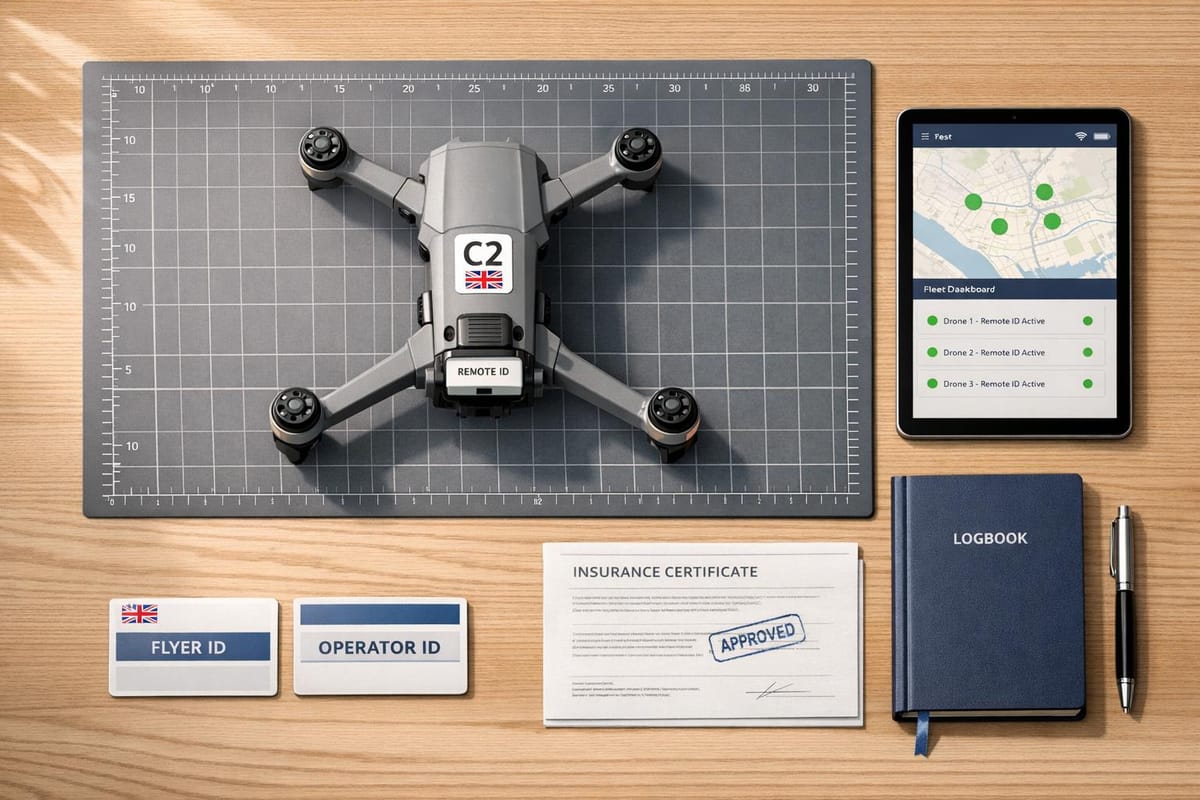
From 1 January 2026, new UK drone regulations require fleet operators to meet stricter certification rules. Here's what you need to know:
- Flyer ID Threshold: Drones weighing 100g or more now require pilots to pass a theory test for a Flyer ID (previously 250g).
- Operator ID: Mandatory for all operators, costs £11.79 annually, and must be displayed on all drones.
- UK Class Marks: All new drones must have a UK0–UK6 classification. Older European C-class marks are valid until 31 December 2027.
- Remote ID: Required for most drones (UK1–UK3) starting 1 January 2026. Legacy drones over 100g with cameras must comply by 1 January 2028.
- Specific Operations: High-risk missions (e.g., BVLOS or urban deliveries) need CAA Operational Authorisation and advanced pilot qualifications.
- Commercial Use: Requires third-party insurance and maintaining safety records for three years.
These changes aim to improve drone safety and legal compliance, especially for urban delivery and other high-risk activities. Operators must ensure proper certifications, Remote ID activation, and accurate record-keeping to avoid fines or legal action.
2026 UK Drone Rules - The Complete Guide
Regulatory Challenges in Drone Certification
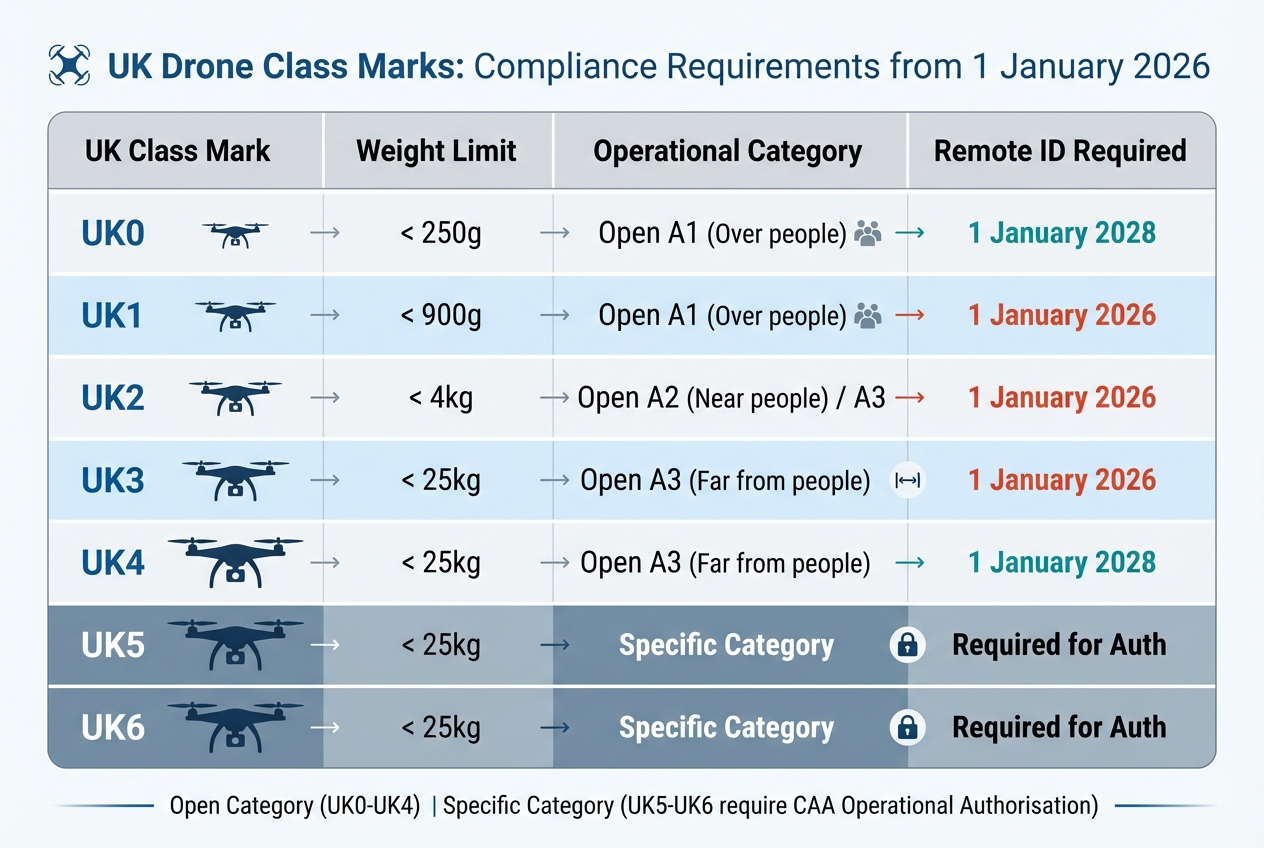
UK Drone Class Marks: Weight Limits, Operational Categories and Remote ID Requirements 2026
Fleet operators in the UK face three key compliance hurdles under the CAA's updated framework. Each presents unique operational and administrative demands, requiring careful planning to ensure adherence.
UK Class Marking System (UK0–UK6)
Starting 1 January 2026, all new drones sold in the UK must display a UK class mark (UK0–UK6). This marking dictates which operational category the drone can operate in, the pilot qualifications required, and whether Remote ID technology must be active. For drones already carrying European C-class marks, they will remain valid as UK equivalents until 31 December 2027, offering a brief transition period for older equipment.
The class system distinguishes between Open Category operations (UK0–UK4) and Specific Category operations (UK5–UK6). For instance, UK0 drones, which weigh under 250g, can fly over people without requiring Remote ID until 1 January 2028. Meanwhile, UK1 to UK3 drones - ranging from under 900g to under 25kg - must have Remote ID enabled immediately and can operate near or over people depending on their classification. UK5 and UK6 drones, however, require explicit authorisation from the CAA for any commercial use.
| UK Class Mark | Weight Limit | Operational Category | Remote ID Required |
|---|---|---|---|
| UK0 | < 250g | Open A1 (Over people) | 1 January 2028 |
| UK1 | < 900g | Open A1 (Over people) | 1 January 2026 |
| UK2 | < 4kg | Open A2 (Near people) / A3 | 1 January 2026 |
| UK3 | < 25kg | Open A3 (Far from people) | 1 January 2026 |
| UK4 | < 25kg | Open A3 (Far from people) | 1 January 2028 |
| UK5 | < 25kg | Specific Category | Required for Auth |
| UK6 | < 25kg | Specific Category | Required for Auth |
Operator and Flyer ID Requirements
From 1 January 2026, the mandatory Flyer ID threshold will drop from 250g to 100g. This change will significantly increase the number of drones requiring certified pilots, impacting commercial fleets in particular. Operators must ensure that every pilot holds a valid Flyer ID or an A2 Certificate of Competency. To assist with compliance, the CAA provides a "check someone's registration status" service, allowing organisations to verify pilot credentials before assigning flight responsibilities.
The Operator ID registration costs £11.79 per year and must be renewed annually, while Flyer IDs are valid for five years at no cost. This mismatch in renewal cycles requires fleet managers to stay vigilant, as flying with expired credentials is a prosecutable offence. Additionally, each drone must display the Operator ID in block capitals (minimum 3mm in height) on its main body. For UK1, UK2, and UK3 drones, the Operator ID must also be programmed into the Remote ID system and activated before each flight.
Legacy drones, which lack class marks, face separate compliance requirements.
Legacy Drone Compliance Issues
Drones purchased before 1 January 2026 without a UK or European C-class mark are categorised as Legacy UAS. These drones are regulated based solely on their weight, rather than specific class capabilities. Legacy drones weighing 100g or more and equipped with a camera must meet Remote ID requirements by 1 January 2028. This often necessitates retrofitting older models or replacing them entirely.
Without class marks, these drones face stricter limits under the Open Category, significantly restricting their use in urban delivery routes or flights near people. This is particularly challenging for fleet operators, as flexibility in these scenarios is often essential for their operations.
Steps to Meet Drone Certification Requirements
To navigate the regulatory requirements outlined earlier, follow these essential steps to certify your drone fleet. A structured approach focusing on three key areas - fleet audit and classification, Remote ID installation, and personnel credentials - will ensure compliance and uninterrupted operations.
Audit and Classify Your Drone Fleet
Start by inspecting every drone in your fleet for UK or European C-class labels. For drones without class marks, weigh each one carefully. Drones weighing 100g or more require a Flyer ID, while those at 250g or above need both Flyer and Operator IDs. Pay special attention to drones in the UK2 category (under 4kg), as flying these near people requires the pilot to hold an A2 Certificate of Competency.
Check the manufacturer manuals to confirm whether each drone supports Remote ID functionality. Drones in the UK1, UK2, and UK3 classes must have Remote ID enabled by 1 January 2026. Meanwhile, UK0 and UK4 drones, along with legacy drones over 100g that have cameras, face a compliance deadline of 1 January 2028. If your drones lack built-in Remote ID capability, retrofitting may be necessary.
Once this step is complete, move on to installing the required Remote ID technology.
Install Remote ID Technology
Remote ID systems broadcast critical information such as Operator ID, serial number, location, altitude, and flight path. Activate the Remote ID using your Operator ID credentials, which include a 3-digit private key. This key is to be entered into the drone's software but must never be written on the drone or shared publicly. If the key is compromised, contact the Civil Aviation Authority (CAA) immediately for a replacement.
Keep the drone’s firmware updated to ensure Remote ID remains functional. Operating UK1, UK2, or UK3 drones without an active Remote ID after 1 January 2026 could result in legal penalties. Make it a habit to verify that the system is enabled before every flight.
The final step involves completing all necessary registrations and certifications.
Complete Required Registrations and Certifications
Register with the CAA to obtain an Operator ID, and clearly label each drone with this ID in block capitals (minimum 3mm high) on the main body.
Ensure that all pilots in your team hold the correct credentials. Depending on the drone’s classification, this could mean a valid Flyer ID or an A2 Certificate of Competency. Use the CAA's "check someone's registration status" service to confirm pilot credentials before assigning flight duties. Set reminders to renew Operator IDs annually.
For drones in the UK5 or UK6 categories, additional steps are required. You’ll need to secure Operational Authorisation from the CAA, and pilots must hold either a General Visual Line of Sight Certificate or another relevant Remote Pilot Certificate. These requirements apply to Specific Category operations and involve stricter regulatory oversight.
Combining Certified Drones with Fleet Telematics
Pairing certified drones with fleet telematics creates a powerful combination, merging GPS and onboard diagnostics to provide real-time insights into location, speed, and performance. Meeting certification standards ensures seamless integration, improving operational efficiency and compliance. This setup is particularly effective for last-mile delivery and bolstering security measures.
Better Last-Mile Delivery Performance
When drones equipped with telematics are used for deliveries, the cost savings are impressive. For instance, drone delivery costs around £0.92 for a four-mile trip, compared to approximately £3.97 for an electric van, while using 94% less energy per parcel than traditional delivery vehicles.
Telematics platforms enhance delivery performance by providing full airspace awareness and accurate ETA updates for customers. Trials with NHS drone deliveries have shown a 70% reduction in delivery times for critical items like surgical implants.
With AI and machine learning integrated into telematics systems, delivery routes can be optimised in real time. These systems consider factors such as payload weight and battery life, making operations more efficient. The cost of drone delivery is also expected to drop significantly, from $60 per package in 2020 to an estimated $4 by 2030.
Stronger Security and Tracking
Drones equipped with telematics offer advanced security features, including high-resolution 4K video, 360-degree PTZ cameras, and thermal imaging, which allow for monitoring in areas that are difficult to access by ground vehicles. Real-time GPS tracking ensures stolen assets can be quickly located, while telematics systems send alerts if drones are used outside of authorised hours.
GRS Fleet Telematics offers a dual-tracker system with a 91% recovery rate for stolen vehicles, starting at just £7.99 per month. Their Enhanced hardware package (£79) includes a secondary Bluetooth tracker, while the Ultimate package (£99) adds immobilisation capabilities for maximum security. Geo-fencing technology further enhances security by creating virtual boundaries, sending alerts if a drone or vehicle crosses into restricted zones.
For detecting unauthorised "dark drones", telematics systems combine RF sensors with radar to track their movements and altitude. In hybrid fleets, telematics provides a unified view, allowing dispatchers to coordinate aerial drones and ground vehicles, ensuring quicker emergency responses.
Managing Hybrid Fleets of Drones and Vehicles
Telematics systems also simplify the management of mixed fleets by consolidating data from drones and vehicles into a single web-based portal. This includes flight logs, equipment status (like drones, batteries, and payloads), and real-time updates. Automated data synchronisation reduces manual input by 90%, ensuring flight data, battery health, and maintenance logs are effortlessly stored in the cloud.
"DroneControl is now a total drone software solution... designed to empower pilots, streamline operations, minimise admin, and ensure the utmost security and regulatory compliance."
– Thomas Ingold, CEO and Founder, DroneControl
Predictive maintenance features in telematics systems help monitor engine performance and battery health, allowing for timely repairs before issues arise. These platforms also track behaviours like harsh braking or risky manoeuvres, enabling targeted training for both drivers and drone pilots. Role-based access controls within telematics systems ensure secure collaboration and data accuracy.
The UK commercial drone market, valued at approximately £1.2 billion in 2021, is expected to grow at a CAGR of 25% through 2026. Additionally, 64% of UK construction firms with over 50 employees now use drones for tasks like site security and asset management.
Conclusion
In the UK, obtaining drone certification isn't just a formality - it's a legal requirement that shields you from potential fines or even imprisonment. Starting from 1 January 2026, anyone operating a drone weighing 100g or more must possess a valid Flyer ID. Meeting these requirements involves ensuring certified operators, proper oversight, and well-maintained technical records.
Integrating certified drones with fleet telematics can simplify compliance and enhance operational efficiency. Tools like automated digital logbooks help meet CAA oversight standards while cutting down on paperwork. Plus, real-time tracking ensures your fleet stays within authorised zones, offering both compliance and peace of mind. This approach not only reduces administrative hassles but also bolsters security for your operations.
For added protection, GRS Fleet Telematics provides a comprehensive solution. Their dual-tracker system boasts a 91% recovery rate and starts at just £7.99 per month. Upgrading to their Enhanced package at £79 introduces Bluetooth tracking, while the Ultimate package at £99 includes immobilisation features - keeping your drones and vehicles secure and compliant.
FAQs
What do the upcoming UK drone regulations mean for fleet operators in 2026?
Starting from 1 January 2026, the UK is introducing updated regulations for drone operators. Here’s what you need to know:
- Flyer ID Requirement: If your drone weighs over 100g, it must be operated by someone holding a valid Flyer ID.
- Remote ID Functionality: All drones, regardless of weight, will need to have Remote ID enabled.
- UK Class Mark: Drones must display a UK class mark, which will align with European C-marked drones. This change is designed to provide greater operational flexibility.
These updates are focused on improving safety and creating consistent standards across the industry. If you operate a fleet, it’s critical to start preparing now to ensure compliance. By staying ahead of these requirements and updating your equipment as needed, you can avoid potential disruptions to your operations.
What is the UK Class Marking System, and how does it impact drone operators?
The UK Class Marking System establishes safety and performance standards for drones, ensuring they meet regulatory requirements. Starting from 1 January 2026, every new drone sold in the UK must display a class mark. This mark provides important details about the drone's technical specifications, safety features, and operational limits. It’s a handy way for operators to determine what their drone is capable of and whether they need any additional certifications to fly it.
The system categorises drones into several classes, ranging from UK0 to UK6, each with its own set of requirements. These include features like geo-awareness, remote identification (ID), and safety lights. For drones bought before 2026 that lack a class mark, operators can still use them, but they must follow rules based on the drone's weight and capabilities.
By aligning with international standards, this system not only enhances safety but also ensures drones can operate smoothly within UK airspace.
How can fleet operators ensure they comply with the latest UK drone certification rules?
To meet the latest UK drone certification rules, fleet operators must register with the Civil Aviation Authority (CAA) as an operator if they oversee drones or model aircraft. On top of this, all remote pilots working within the organisation need to hold the appropriate qualifications, such as a Flyer ID, and prove they have the skills to carry out operations safely.
Operators should also start preparing for the new class marking and Remote ID rules, which will take effect on 1 January 2026. This means ensuring every drone in the fleet has the correct UK class marking that complies with safety and technical standards. Other essential steps include maintaining an up-to-date operations manual, keeping detailed flight logs, and strictly following the conditions set out in any Operational Authorisation.
Staying on top of regulation updates and providing regular training for staff are crucial steps to ensure compliance with the changing certification requirements in the UK.