Dash Cams vs Driver Monitoring Systems
Weigh dash cams' evidence benefits against DMS real-time prevention, privacy and costs to choose the best fleet safety solution.
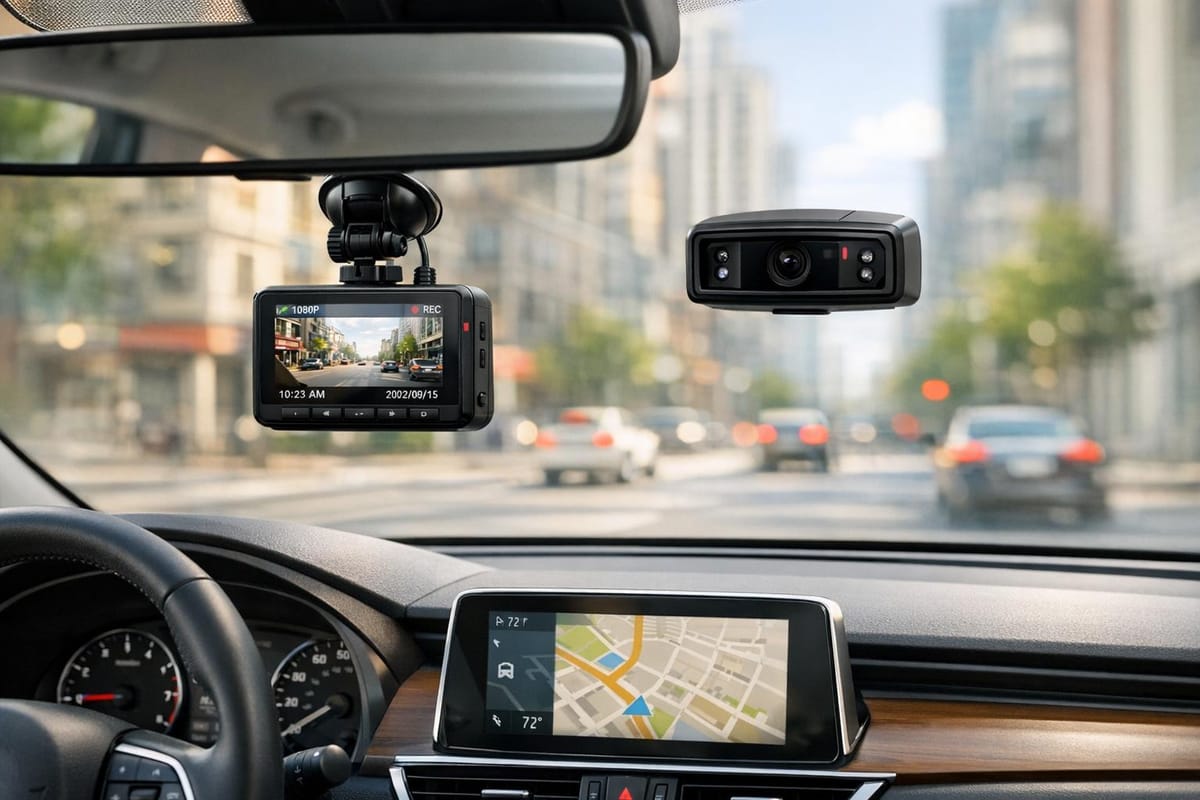
Fleet operators in the UK often face a choice between dash cams and driver monitoring systems (DMS) to improve safety and reduce costs. Both technologies serve different purposes:
- Dash cams record road events, offering evidence for insurance claims and protecting drivers from false accusations. They are widely adopted, with 88% of UK fleets using them as of 2020. Benefits include faster insurance claim processing and discounts on premiums. However, they are reactive tools, only useful after incidents occur.
- Driver monitoring systems focus on the driver, using AI to detect fatigue, distraction, or risky behaviours in real time. These systems alert drivers instantly, helping prevent accidents. UK fleets using DMS have reported a 95% reduction in risky driving behaviours and lower accident-related costs. However, privacy concerns and "alert fatigue" remain challenges.
Quick Comparison
| Feature | Dash Cams | Driver Monitoring Systems |
|---|---|---|
| Focus | Road events | Driver behaviour |
| Primary Benefit | Evidence for claims | Accident prevention |
| Technology | External cameras, G-sensors | AI, inward-facing cameras |
| Adoption | 88% of UK fleets (2020) | Growing, driven by AI capabilities |
| Challenges | Reactive only, theft risk | Privacy concerns, higher cost |
For maximum safety and efficiency, many fleets combine both systems, leveraging dash cams for evidence and DMS for prevention. Your choice depends on your priorities - whether it's protecting drivers from false claims or addressing risky behaviours proactively.
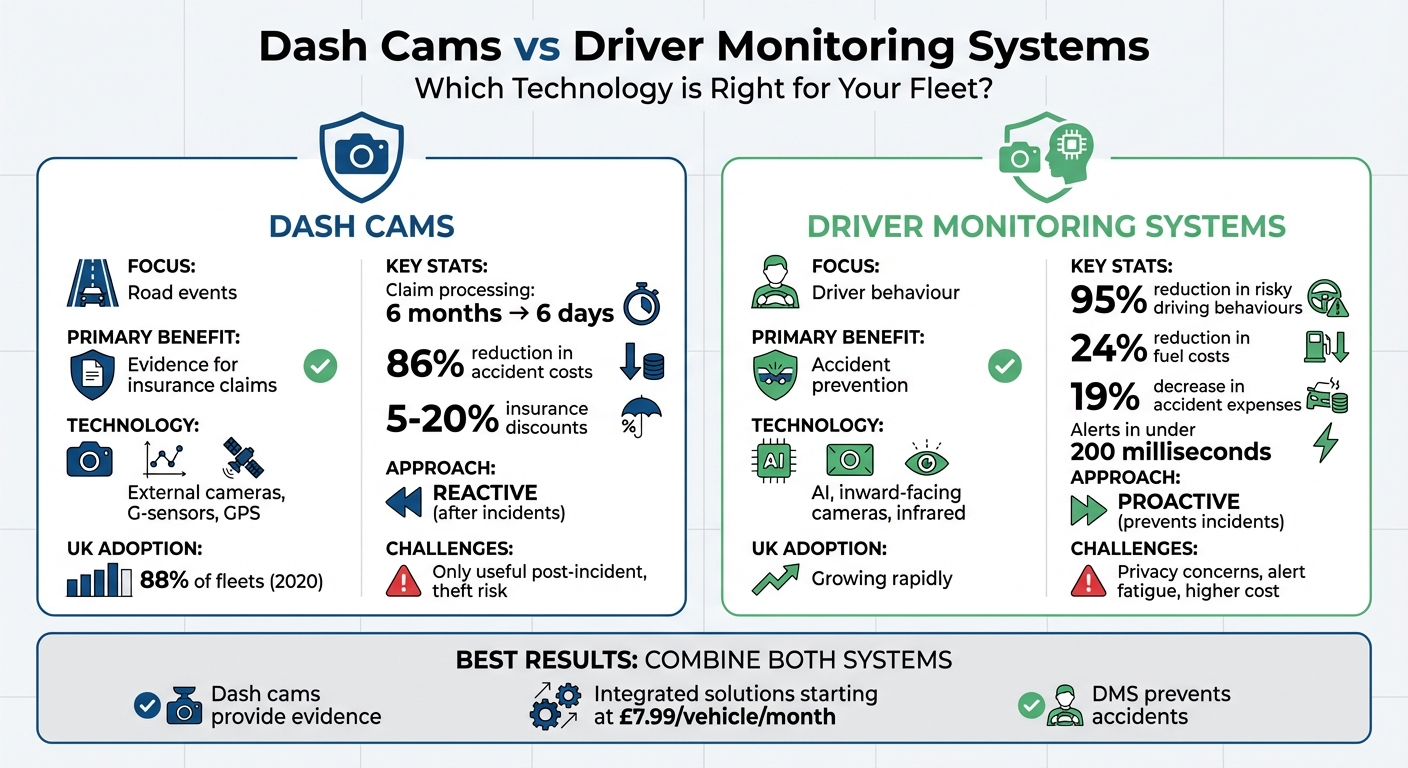
Dash Cams vs Driver Monitoring Systems: Complete Feature Comparison for UK Fleets
AI Dashcam Driver Monitoring System Overview - Safety & Efficiency for Fleets
What Are Dash Cams?
Dash cams are compact cameras mounted on a vehicle's dashboard or windscreen, designed to record the road ahead - and sometimes the rear or interior. These devices act as an impartial witness, providing credible footage in the event of an incident. For fleet operators, dash cams are particularly useful, helping protect drivers from false claims and speeding up insurance processes.
Most dash cams use loop recording, capturing short clips (usually around a minute each) that are overwritten when the storage fills up. However, a built-in G-sensor ensures that footage from impacts or sudden movements is automatically saved and protected. Many models also include GPS functionality, embedding location, speed, and timestamps into the recordings. This additional data is invaluable for investigations and insurance claims, offering a clearer picture of events.
Dash cam footage can significantly reduce insurance claim processing times, cutting them down from six months to just six days. Their popularity is evident - according to a 2020 survey of over 400 UK fleet managers, 88% of fleets had adopted dash cams.
Justin Toole, Fleet Manager at M&Y Maintenance and Construction, highlights their impact: "Our drivers feel more confident on the road knowing that they have a reliable witness in case of an incident. The dashcam's high-quality video and features have helped us mitigate risk and minimise downtime due to accidents".
Modern dash cams come with advanced features like 4G connectivity for automatic cloud uploads, real-time alerts, and route map access. They also offer parking mode to capture stationary incidents and infrared night vision for clear footage in low-light conditions. These technologies make dash cams an indispensable tool for both individual drivers and fleet operators.
What Are Driver Monitoring Systems?
Driver Monitoring Systems (DMS) stand apart from dash cams by focusing inward. Using cameras paired with AI software, these systems assess whether a driver is alert, attentive, and fit to be behind the wheel. Let’s break down how they work and what they bring to the table.
The hardware involves cameras - typically equipped with infrared or LEDs - mounted on the dashboard. These cameras monitor the driver’s face and upper body, tracking features like eye movements and facial expressions even in challenging lighting conditions. AI algorithms then analyse this data, creating a baseline for normal behaviour and flagging anything out of the ordinary.
When risky behaviour is detected, such as closing your eyes for too long, excessive yawning, or looking away from the road, the system steps in immediately. Alerts can come in various forms: a sound warning, visual cues on the dashboard (like a coffee cup icon suggesting drowsiness), or even haptic feedback like seat vibrations to grab the driver’s attention.
Today’s systems are incredibly advanced, recognising up to 70 different signs of driver behaviour, including blinking patterns and head movements. They also factor in external conditions - like traffic, weather, and vehicle load - to minimise false alarms.
In Europe, regulations now require all new cars and light commercial vehicles to include driver monitoring systems. The UK has seen impressive results, with fleets using AI-driven video telematics reporting up to a 30% drop in accident rates. Considering that drowsy driving is linked to around 6,400 road deaths annually and that fatigue contributes to 13% of commercial vehicle crashes, DMS are proving to be a game-changer for safety-conscious fleet operators.
Feature Comparison
Dash cams focus on capturing the road ahead, while driver monitoring systems keep an eye on the driver’s behaviour. Dash cams use basic AI and sensors to record external events, whereas driver monitoring systems rely on inward-facing infrared cameras and facial recognition to monitor eye movements, head position, and signs of fatigue or distraction.
Dual-facing AI systems take things a step further by combining both functions. They record road events and driver behaviour simultaneously, providing a fuller picture that’s invaluable for analysing incidents.
With real-time AI analytics, alerts and notifications are delivered in under 200 milliseconds. While standard dash cams detect harsh braking through G-force sensors, driver monitoring systems identify behavioural signals like fatigue or inattentiveness. Fleet operators in the UK using these advanced systems have seen a 95% drop in risky driving behaviours.
Telematics integration transforms basic dash cams into robust fleet safety tools. Advanced systems merge video footage with GPS data, accelerometers, and engine diagnostics (OBD), creating a cohesive data stream accessible via cloud-based dashboards. For example, if speeding or sudden acceleration is detected, the system automatically records the event and uploads the footage for immediate review - eliminating the need for manual retrieval. The table below highlights the key differences between these systems.
Comparison Table
| Feature | Standard Dash Cams | Driver Monitoring Systems | Integrated AI Video Telematics |
|---|---|---|---|
| Video Direction | Forward or rear-facing | Inward (driver's face) | Dual-facing (road + cabin) |
| Primary Focus | Road conditions, traffic, liability | Driver alertness, fatigue, distraction | Comprehensive risk management |
| Event Triggers | G-force sensors, GPS speed alerts | Signs of drowsiness, fatigue, distraction | Multi-sensor fusion (GPS, radar, AI) |
| AI Analytics | Basic (collision detection) | Advanced (detecting drowsiness, fatigue and distraction) | Comprehensive (ADAS + DMS) |
| Cloud Upload | Manual or event-triggered | Real-time behavioural logging | Automatic, instant uploads |
| Telematics Integration | Limited (GPS tracking) | Driver ID, fatigue alerts | Full GPS, OBD, accelerometer sync |
| Alert Speed | Varies | Real-time in-cab warnings | Under 200 milliseconds |
| Primary Benefit | Insurance exoneration | Proactive accident prevention | Total fleet visibility & coaching |
These distinctions are crucial when shaping your fleet’s safety strategy to match operational needs. The combination of these features ensures seamless integration with broader fleet telematics systems.
Use Cases for Fleet Operators
Dash Cams
Dash cams record high-definition footage, offering a reliable way to establish what really happened during incidents. Fleet operators can use this footage to work with police and insurers, helping to resolve disputes faster. It also serves as a safeguard for drivers, protecting them from false accusations or "crash-for-cash" scams by proving when another driver is at fault. For professional drivers, this can be a lifeline, as their careers often depend on maintaining spotless driving records.
Bryn Brooker, Head of Marketing at Nextbase, highlights this by saying: "For a driver that is relying on driving as their job and their main income, that's where a dashcam can save your livelihood".
Dash cams with GPS integration take things a step further by enabling route tracking and performance checks. Managers can monitor for unauthorised stops, excessive idling, or even vehicle misuse. The simple presence of these cameras often encourages better compliance with company policies, with some fleets reporting an 86% drop in accident-related costs. On top of that, many UK insurers now offer discounts of 5% to 20% on premiums for fleets equipped with dash cams.
Driver Monitoring Systems
While dash cams focus on external events, driver monitoring systems are all about proactive safety inside the vehicle. Using AI and computer vision, these systems can identify risky behaviours like mobile phone use, drowsiness, or failing to wear a seatbelt. They issue warnings - delivered in under 200 milliseconds - giving drivers the chance to correct their actions before something goes wrong.
These systems do more than just alert drivers; they also contribute to cost savings. For example, fleets using driver monitoring systems have reported a 24% reduction in fuel expenses and a 19% drop in accident-related costs. In 2025, UK fleets equipped with the Geotab GO Focus Plus AI dashcam saw a 95% decrease in risky driving behaviours thanks to real-time voice alerts and automated event detection. The data collected from these systems feeds into coaching programmes, allowing managers to create tailored training plans using driver scorecards.
Pros and Cons
Let’s break down the advantages and drawbacks of dash cams and driver monitoring systems, building on the features and use cases already discussed. Each system brings something unique to the table, but they also come with their own challenges.
Dash cams are excellent for recording clear, indisputable evidence. They’re invaluable when it comes to resolving insurance disputes or protecting drivers from false claims. Plus, many drivers appreciate them as a protective tool rather than a form of surveillance. However, they require manual review of footage and can be a target for theft due to their visible placement.
Driver monitoring systems, on the other hand, take a more proactive role. Using AI, they can detect signs of fatigue or distraction and issue alerts in under 200 milliseconds. This real-time intervention has led to impressive results, such as a 95% reduction in risky driving behaviours for some UK fleets. Yet, these systems often face resistance from drivers who worry about privacy or feel uneasy about constant monitoring.
One significant challenge with monitoring systems is "alert fatigue" - drivers may start ignoring frequent alerts, reducing their effectiveness. IMPROVLearning highlights this issue:
"A dash cam that shouts 'Eyes on the road' 200 times a week is technically advanced - but educationally primitive".
The key to overcoming this lies in pairing alerts with coaching. As IMPROVLearning explains:
"The magic was in the coaching conversation... alerts by themselves didn't move the needle in a meaningful way".
To help you weigh your options, here’s a comparison of the strengths and drawbacks of both systems:
Comparison Table
| Aspect | Dash Cams | Driver Monitoring Systems |
|---|---|---|
| Primary Strength | Reliable video evidence for insurance claims and exoneration | Real-time detection and prevention of risky behaviours |
| Cost Impact | 86% reduction in accident-related costs; 5–20% insurance discounts | 24% reduction in fuel costs; 19% decrease in accident expenses |
| Driver Acceptance | Generally high - seen as a protection tool | Lower - privacy concerns and alert fatigue common |
| Data Management | Manual review of SD cards required | Automated event classification and cloud storage |
| Installation | Often plug-and-play or simple hardwire | Professionally hardwired and integrated systems |
| Main Drawback | Reactive only - no accident prevention; theft risk for visible models | Higher upfront cost; requires ongoing coaching to be effective |
This table highlights how each system serves a different purpose. Dash cams are more reactive, offering evidence after an incident, while driver monitoring systems focus on preventing accidents before they happen. Both can be valuable depending on your specific needs and priorities.
Integration with Fleet Telematics
Bringing telematics platforms and dash cams together creates a powerful tool for fleet management. This integration combines video footage, GPS tracking, accelerometer data, and vehicle diagnostics, offering a detailed view of fleet operations.
One standout feature is event-triggered recording. When telematics sensors detect incidents like harsh braking, speeding, or sudden acceleration, the dash cam automatically records and uploads the relevant footage. This eliminates the need to sift through hours of video manually. Using AI, these platforms can categorise all driving time, providing a full picture of driver activity.
The benefits don’t stop there. Integrating telematics with video systems takes fleet management to the next level. For example, GRS Fleet Telematics employs dual-tracker technology, which pairs a hardwired primary tracker with a hidden Bluetooth backup. This ensures uninterrupted monitoring, even if the main tracker is tampered with, and contributes to a 91% recovery rate for stolen vehicles. The system also supports geofencing, sending instant alerts if a vehicle exits a designated area, enhancing security through constant monitoring.
Driver scoring is another major advantage. Telematics data monitors behaviours like speeding and harsh acceleration, while AI dash cams provide additional context, such as identifying mobile phone use or other distractions. This combined data allows fleet managers to create tailored coaching programmes, moving away from generic safety training. Phillip Morton from Aon highlights the value of this approach:
"The combination of real-time driver coaching and comprehensive video insights not only enhances driver behaviour but also provides invaluable data for incident analysis".
These operational improvements lead to tangible savings. In the UK, integrating AI-powered telematics and dash cams has reduced fuel costs by 24% and accident-related expenses by 19%. Across Europe, 78% of fleet managers now use real-time GPS tracking and analytics, reflecting the growing adoption of video telematics. GRS Fleet Telematics offers these capabilities starting at £7.99 per vehicle per month, with hardware options for essential real-time tracking available from £35.
Which System to Choose for Your Fleet?
When deciding between dash cams and driver monitoring systems, it’s important to weigh your fleet’s specific needs. Dash cams are excellent for providing clear evidence in disputes or incidents. For instance, a 2020 survey of over 400 UK fleet managers revealed that 88% use dash cameras, mainly to shield drivers from false claims and "crash-for-cash" scams. If your priority is resolving insurance claims quickly and protecting drivers, a high-definition front-facing dash cam is a solid choice.
On the other hand, if your focus is on addressing driver fatigue, mobile phone use, or distractions, a Driver Monitoring System (DMS) offers more proactive safety measures. These AI-driven systems deliver real-time in-cab alerts, helping to prevent accidents before they happen. For example, UK fleets using the Geotab GO Focus Plus AI dashcam in 2025 reported a 95% decrease in risky driving behaviours, thanks to instant voice alerts. However, privacy concerns remain a challenge. As Mark Rose, Managing Director for Tracker, explains:
"Privacy concerns and the worry of data being used to penalise drivers can outweigh the safety benefits for many".
To address this, consider using driver data to reward safe behaviour instead of punishing mistakes. Offering bonuses or extra leave for safe driving can encourage adoption and foster trust.
Fleet Size and Compliance Matter
Your fleet size and regulatory requirements also play a role in choosing the right system. Smaller fleets can save significantly with basic dash cams, while larger fleets may find integrated telematics systems more beneficial. These systems not only enhance safety but also reduce administrative tasks. Whichever option you choose, ensure compliance with GDPR and DVSA standards when installing and using these technologies.
Combining Systems for Maximum Impact
For the best results, consider integrating both systems. Businesses using monitoring technology have reported an 86% reduction in accident-related costs, while video evidence can cut claim resolution times from six months to just six days. Building on the advantages of telematics, GRS Fleet Telematics offers solutions starting at £7.99 per vehicle per month. Their package includes AI dash cameras and dual-tracker technology, providing a comprehensive approach to fleet management.
Consult Your Insurer
Don’t forget to check with your insurer. Many UK insurers provide premium discounts or risk bursaries for fleets that install approved telematics or dash cam systems. These incentives can help offset the initial costs while boosting overall fleet safety.
Conclusion
Dash cams and driver monitoring systems play unique yet complementary roles in fleet management. Dash cams focus on recording external events, providing crucial video evidence that can drastically shorten insurance claim processes - cutting the timeline from six months to just six days. On the other hand, driver monitoring systems leverage AI to spot risky behaviours like fatigue or mobile phone use, delivering alerts in under 200 milliseconds to help prevent incidents before they occur.
When used together, these technologies create a powerful safety net. Dash cams document incidents, while AI-driven monitoring actively works to stop them from happening. This combination has shown impressive results, including an 86% reduction in accident-related costs and a 95% drop in risky driving behaviours. As IMPROVLearning aptly puts it: "Data + feedback + coaching = measurable, durable risk reduction". The key to maximising safety outcomes lies in integrating these systems with a strong driver coaching programme.
Your decision ultimately hinges on your fleet’s priorities. If combating false claims or "crash-for-cash" scams is a primary concern, dash cams provide solid evidence to protect your drivers. If reducing dangerous driving habits is more critical, AI-powered monitoring offers the real-time insights needed to address those behaviours.
For fleets seeking the best of both worlds, integrated solutions combine proactive monitoring with dependable dash cam footage. GRS Fleet Telematics offers such a solution, pairing AI dash cameras with dual-tracker technology for comprehensive fleet protection. Starting at just £7.99 per vehicle per month, this system not only enhances safety but also ensures compliance with GDPR regulations.
FAQs
What privacy concerns do driver monitoring systems raise?
Driver monitoring systems (DMS) rely on in-cab cameras and artificial intelligence to spot signs of fatigue, distraction, or potentially risky behaviour. While their primary goal is to enhance safety, many drivers find these systems intrusive, often perceiving them as a form of constant surveillance. This perception can raise concerns about personal autonomy and workplace privacy.
A key issue revolves around how video and biometric data are managed. Drivers often question who has access to the footage, how long it is stored, and whether it could be misused or shared without their consent. Trust can also take a hit when false alerts occur - for instance, when a simple glance at a mirror is flagged as risky behaviour. In the UK, such concerns are addressed under GDPR regulations, which demand clear policies, lawful data usage, and transparency to safeguard employees' rights.
What are the benefits of combining dash cams with driver monitoring systems for fleet safety?
Combining dash cams with driver monitoring systems offers fleet operators a well-rounded approach to safety. Dash cams provide video evidence of incidents, while driver monitoring systems keep an eye on behaviours like speeding, harsh braking, or sudden acceleration. Together, they help pinpoint risks, enhance driver training, and cut down on false claims. The result? Fewer accidents and reduced insurance expenses.
These monitoring systems also produce real-time performance scores and detailed reports, linking driving habits to fuel consumption and vehicle wear and tear. When integrated with AI-powered dash cams, fleet managers can match alerts with video footage, allowing for faster decision-making and insights to help prevent future issues. This combination not only boosts safety but also reduces collisions and delivers noticeable savings on fuel and maintenance costs.
What should fleet operators consider when choosing between dash cams and driver monitoring systems?
When choosing between dash cams and driver monitoring systems, it's crucial to evaluate what your fleet specifically requires and what you aim to achieve.
Dash cams are excellent for providing video evidence in cases like collisions or fraudulent claims. Many models include features such as GPS tracking and AI analytics to identify risky driving behaviours. If your primary focus is on documenting incidents and analysing events after they occur, dash cams are a strong option. On the other hand, driver monitoring systems use in-cab sensors - like eye-tracking or seatbelt detection - to track driver attentiveness. These systems offer real-time alerts and behavioural feedback, making them ideal for proactive coaching and improving driver habits.
When deciding, you should also weigh factors like ease of installation, ongoing costs, and compliance with UK regulations, such as GDPR. Dash cams generally involve a one-time hardware setup, while driver monitoring systems may require extra sensors and come with higher subscription fees. Addressing privacy concerns through open communication with drivers is key to ensuring a smooth implementation. By matching these factors to your safety goals and budget, you can determine the best solution - or even opt to combine both technologies for a more comprehensive approach.