5 Common Problems Solved by Real-Time Van Tracking
Real‑time van tracking reduces theft, cuts fuel and admin costs, boosts driver safety and improves ETA accuracy for UK fleets.
Managing a van fleet in the UK is challenging. Theft, rising fuel costs, driver safety, and customer service issues are just a few of the daily headaches. Real-time van tracking provides practical solutions to these problems. Here's how:
- Theft Prevention: Advanced GPS systems with dual trackers and geofencing increase recovery rates to 91%, compared to 39% without tracking.
- Fuel Efficiency: Smarter routing cuts fuel consumption by 10–20%, saving money and reducing unnecessary mileage.
- Workforce Productivity: Automated logs and real-time job tracking eliminate manual timesheets, saving admin time and improving accountability.
- Driver Safety: Monitoring driving behaviour reduces accidents by up to 45% and lowers insurance costs.
- Customer Service: Accurate ETAs and live updates reduce delivery complaints by 30–50%.
With UK businesses losing millions annually to van theft and inefficiencies, real-time tracking offers an affordable, effective way to protect assets, cut costs, and improve operations. Subscriptions start at £7.99 per month, making it accessible for fleets of all sizes.
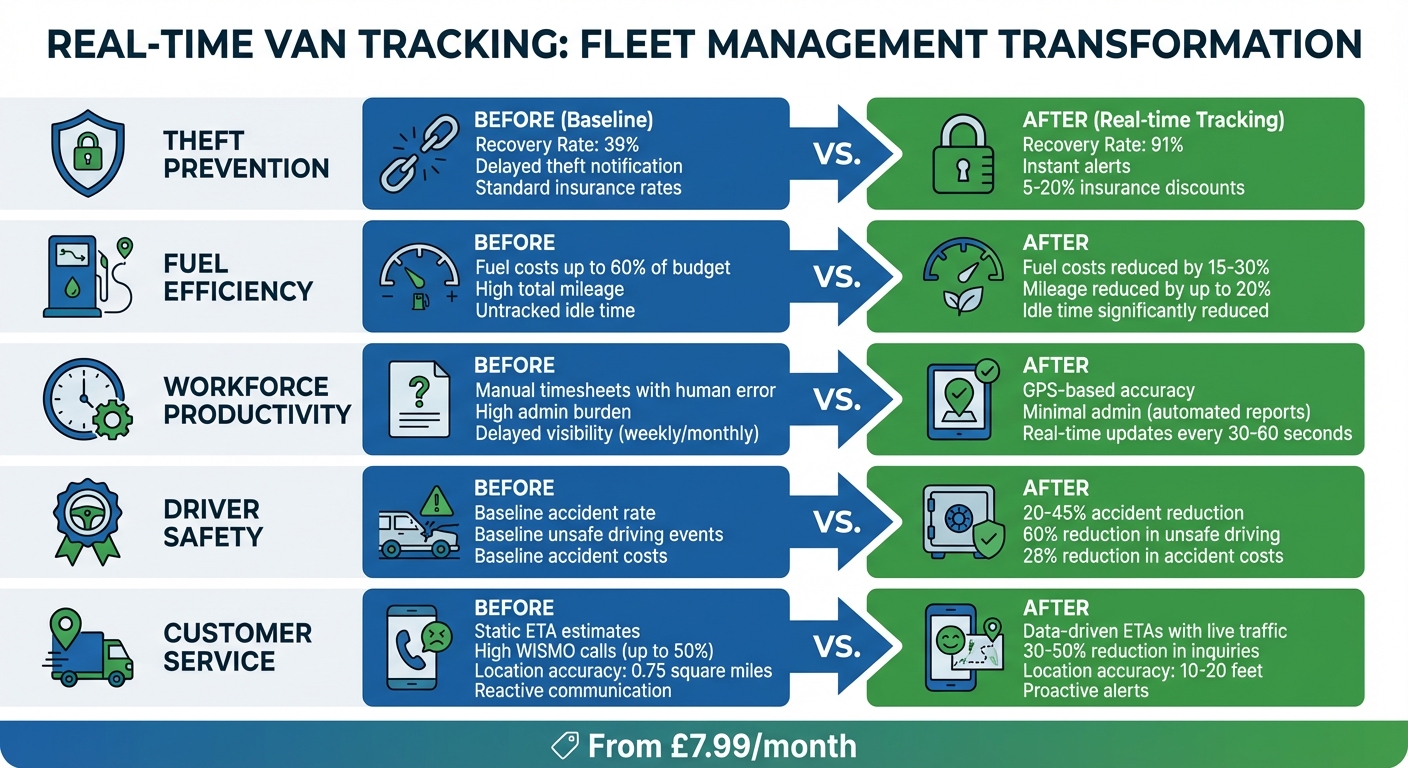
5 Problems Solved by Real-Time Van Tracking: Before vs After Comparison
1. Preventing Theft and Unauthorised Vehicle Use
The Problem: High Theft Risks in UK Fleets
Van theft continues to be a major headache for UK businesses. In the past year alone, an alarming 11,273 vans were reported stolen across the country - that’s an average of 31 vans disappearing daily. London remains the hardest-hit area, with a staggering 14,529 van-related crimes recorded in 2023. Among the most targeted models was the Mercedes-Benz Sprinter 313 CDI, which accounted for 938 thefts.
Since 2016, these thefts have cost UK businesses a jaw-dropping £61.9 million. The financial blow doesn’t stop there - when you factor in operational downtime and replacement costs, the total losses can soar to six times the value of the stolen cargo. To make matters worse, only 39% of stolen vans are recovered without tracking systems, leaving businesses to shoulder the burden.
The Solution: Real-Time Tracking for Security
Modern GPS tracking systems have revolutionised fleet security, providing businesses with powerful tools to combat theft. Dual-tracker technology is a game-changer. By combining a hardwired unit with a hidden Bluetooth backup, fleets remain protected even if thieves attempt to disable or jam the primary device. Features like geofencing add another layer of security, creating virtual boundaries around depots or job sites and sending instant alerts if a vehicle crosses these zones. On top of that, remote immobilisation allows managers to disable a vehicle’s engine as soon as a theft is detected, preventing further movement.
For businesses looking to upgrade their security, GRS Fleet Telematics offers tailored packages starting at just £7.99 per month. They even throw in professional installation at no extra cost when paired with fleet branding services.
The results speak for themselves: advanced dual-tracker systems boast a 91% recovery rate for stolen vehicles - far surpassing the national average. As Nitesh Goel, an industry expert, explains:
"Real-time tracking makes theft nearly impossible because managers always know a vehicle's exact location."
These tools not only make theft harder but also bring tangible advantages to businesses.
Business Impact
The contrast between fleets with and without real-time tracking is striking:
| Metric | Without Real-Time Tracking | With Real-Time Tracking |
|---|---|---|
| Recovery Rate | ~39% | ~91% |
| Theft Notification | Often delayed by hours or days | Instant alerts |
| Insurance Premiums | Standard rates | Potential 5%–20% discounts |
| Unauthorised Use Detection | Hard to verify | Geofence logs and time-based alerts |
| Engine Control | None | Remote immobilisation available |
But the benefits don’t stop at theft prevention. Real-time tracking can help businesses meet Thatcham S5 or S7 certification requirements, now commonly required by insurers for high-value commercial vehicles. These certifications can lead to lower insurance premiums, offsetting the cost of tracking subscriptions. Plus, with remote immobilisation reducing vehicle theft by 80%, fleet managers gain peace of mind knowing their assets are well-protected.
2. Reducing Fuel Costs Through Better Routing
The Problem: Inefficient Routes and Rising Fuel Costs
Fuel expenses can account for as much as 60% of operating costs when routes aren’t optimised. Poorly planned routes lead to unnecessary mileage, excessive idling, and wasted resources. This not only drains revenue but also causes delays in daily operations. On top of that, unauthorised vehicle use during off-hours, like evenings and weekends, further drives up fuel bills.
Fleet expert Brian Antonellis highlights the issue succinctly:
"It's understanding where you're running and your valuable miles versus invaluable miles."
Clearly, there’s a pressing need for smarter, more dynamic routing solutions.
The Solution: Live Mapping and Analytic Insights
Modern GPS tracking systems are transforming how fleets manage routes, offering real-time control and smarter decision-making. Powered by AI, these systems analyse live traffic conditions, weather updates, and road closures to reroute drivers on the go. This approach can cut total mileage by up to 20% and lower fuel costs by an average of 24%.
Key features include:
- Idling detection: Alerts managers when a vehicle idles unnecessarily for over five minutes, helping to curb fuel wastage.
- Journey replay: Allows managers to review past trips and identify deviations from optimal routes.
- Nearest vehicle search: Enables dispatchers to assign jobs to the closest available vehicle, reducing redundant travel.
Take Healthy Tots, a food delivery service based in Scotland, as an example. By adopting advanced fleet visibility tools, they slashed fuel consumption by 15–20% and increased vehicle utilisation by 30%.
Business Impact
The benefits extend beyond fuel savings. A modest 10% reduction in fuel consumption can increase profitability by 31%. AI-driven systems also allow fleets to handle 20–25% more deliveries each day without adding extra staff. Delivery accuracy improves as well, with some platforms achieving an impressive 95% punctuality within 15-minute delivery windows.
| Metric | Before Tracking | After Tracking |
|---|---|---|
| Fuel Costs | High (up to 60% of budget) | Reduced by 15%–30% |
| Total Mileage | High | Reduced by up to 20% |
| Daily Job Capacity | Limited | Increased by 20%–25% |
| Delivery Accuracy | Inconsistent | 95% within 15-min windows |
| Idle Time | Untracked | Significantly reduced |
For example, a UK-based builders merchant saw a 25% boost in delivery capacity and a 15% improvement in on-time-in-full (OTIF) rates after adopting AI-powered routing.
If you’re considering a switch, GRS Fleet Telematics offers subscription plans starting at £7.99 per vehicle per month, with hardware options ranging from £35 to £99, depending on security requirements.
3. Increasing Workforce Productivity and Accountability
The Problem: Limited Visibility into Workforce Activity
When managers lack real-time tracking tools, they face a frustrating challenge: no clear way to verify where their team is during the workday. Relying on manual timesheets often results in inaccurate data, leading to endless phone calls, billing disputes, and unnecessary administrative work.
The Solution: Automated Logs and Real-Time Job Status
Modern tracking systems solve these issues by using GPS technology to record exact journeys. Geofencing adds another layer by creating virtual boundaries around job sites, automatically logging when employees enter and leave. This eliminates the need for manual clock-ins and gives managers a clear picture of team movements.
Driver ID key fobs enhance accountability by uniquely linking activities to specific individuals. Meanwhile, mobile apps let drivers update job statuses in real time, marking tasks as "arrived," "in progress," or "completed." This instant visibility reduces the need for constant phone updates and improves communication across the board.
Time-stamped logs also serve as undeniable proof of service, making it easier to resolve billing disputes without back-and-forth arguments. These automated tools streamline processes, reducing administrative workloads and boosting productivity.
Business Impact
Automated systems significantly cut down on time-consuming admin tasks. Timesheets generate themselves, and managers can access detailed reports showing precise journey times and mileage. A great example comes from Moove Cars, which implemented an advanced fleet telematics solution in February 2025. This upgrade resulted in operational savings of over £3,000,000 annually due to improved efficiency and reduced costs.
| Feature | Manual Timesheets | Real-Time Van Tracking |
|---|---|---|
| Accuracy | Susceptible to human error and "rounding" | GPS-based and highly precise |
| Verification | Requires follow-up calls | Instant via live tracking |
| Billing Disputes | Often unresolved due to lack of evidence | Quickly settled with time-stamped logs |
| Admin Burden | High (manual entry and filing) | Minimal (automated reports) |
| Visibility | Delayed (weekly or monthly) | Real-time updates every 30–60 seconds |
Real-time tracking also allows for smarter resource allocation. For instance, when an urgent job request comes in, you can instantly pinpoint the closest available vehicle. This reduces unnecessary mileage, speeds up response times, and increases the number of jobs completed each day.
4. Improving Driver Safety and Compliance
The Problem: Unsafe Driving Behaviour and Compliance Gaps
Unsafe driving habits not only endanger your team but also contribute to higher accident rates and rising insurance costs. Without effective monitoring, it’s tough to pinpoint which drivers need guidance or prove that you’re fulfilling your duty-of-care obligations under UK health and safety laws. Additionally, relying on manual logbooks to track working hours under the Working Time Directive increases the risk of driver fatigue. These challenges call for robust solutions, which modern tracking systems are designed to address.
The Solution: Driver Monitoring and Alerts
Modern tracking systems collect detailed telemetry data, such as speed, harsh braking, rapid acceleration, and sharp cornering. In-vehicle buzzers provide real-time alerts for overspeeding or abrupt actions, while performance data is used to create driver scorecards, encouraging a culture of safety and accountability . These systems not only protect drivers but also improve overall fleet safety. Additionally, advanced technologies monitor driver alertness and ensure compliance with the Working Time Directive, significantly reducing risks linked to fatigue.
Business Impact
Adopting advanced tracking systems can lead to tangible safety and financial benefits. Fleets using these systems have seen accident rates drop by up to 20% within the first year, with some achieving reductions as high as 45%. Monitoring unsafe behaviours has led to a 60% decrease in such incidents within six months. On average, British companies have reported a 28% reduction in accident-related costs.
Take Elis UK Ltd as an example. Managing a fleet of 480 HGVs and 270 LCVs, they saved £1.2 million on insurance claim handling and £1.8 million on fuel costs by improving driver behaviour and operational efficiency. Similarly, the Welsh Ambulance Service cut administration costs by 60% by automating compliance and tracking through fleet management technology.
| Metric | Before Tracking | After Tracking (12 Months) | Improvement |
|---|---|---|---|
| Accident Rate | Baseline | 20%–45% Reduction | Up to 45% |
| Unsafe Driving Events | Baseline | 60% Reduction | 60% |
| Accident Costs | Baseline | 28% Reduction | 28% |
Additionally, many UK insurers now require Thatcham-approved trackers for commercial vehicles. Fleets using active driver monitoring often benefit from premium discounts ranging from 10% to 20%.
5. Improving Customer Service and ETA Accuracy
The Problem: Unreliable ETAs and Customer Dissatisfaction
When customers are left in the dark about their delivery's location or arrival time, frustration can escalate quickly. Static delivery estimates fail to account for real-world factors like roadworks, traffic congestion, or last-minute route changes. Without access to real-time updates, businesses can’t proactively inform customers about delays. This often results in poor service experiences, and the consequences are significant - 68% of shoppers say they won’t return to a brand after a single negative delivery experience. Not only does this lack of transparency irritate customers, but it also places extra strain on support teams, creating a cycle of inefficiency that real-time tracking is specifically designed to break.
The Solution: Precise Location Data and Real-Time Updates
Modern GPS tracking technology has advanced to the point where it can pinpoint vehicle locations within 10 to 20 feet. This level of accuracy enables dynamic rerouting, allowing drivers to bypass traffic jams, accidents, or road closures, ensuring ETAs remain realistic even as conditions change. AI-driven predictive analytics take this a step further by analysing historical traffic trends, weather conditions, and live data to deliver highly accurate arrival times, removing the guesswork.
Proximity-based dispatching is another game-changer. By using postcode searches, businesses can instantly identify the closest vehicle to a new job site, dramatically reducing response times. Experts highlight that assigning jobs based on live postcode data minimises downtime and ensures efficient operations.
Automated updates further enhance the customer experience. Geofencing technology triggers instant SMS or email notifications when a driver reaches specific checkpoints or enters an area near the destination. This eliminates the need for customers to call for updates, reducing frustration and improving communication.
By leveraging accurate, real-time location data, fleets not only improve service delivery but also strengthen the security and efficiency measures already in place.
Business Impact
Just like theft prevention and route optimisation, precise tracking can turn the customer experience into a competitive edge. Real-time tracking has been shown to reduce customer complaints by 30% to 50%. It also cuts down on "Where Is My Order" (WISMO) inquiries, which account for over 30% of e-commerce live chat conversations and 50% of inbound customer service calls. A great example of this in action is DHL's Smart Truck Initiative. Launched in 2010, the programme used advanced algorithms and real-time telematics to dynamically reroute trucks, cutting total miles driven by over 15% while significantly improving on-time delivery rates.
| Metric | Before Real-Time Tracking | After Real-Time Tracking |
|---|---|---|
| ETA Accuracy | Static estimates | Data-driven, factoring in live traffic |
| Customer Inquiries | High WISMO call volume (up to 50%) | Reduced by 30–50% through self-service |
| Location Precision | Up to 0.75 square miles margin | Accurate within 10–20 feet |
| Communication | Reactive | Proactive alerts |
To get the most out of these tools, include live tracking links in your dispatch notifications so customers can monitor their delivery in real time. Additionally, use historical data to set realistic delivery windows, accounting for typical UK traffic patterns and distances.
GRS Fleet Telematics offers these advanced tracking features for as little as £7.99 per month, making professional-grade customer service tools affordable for fleets of all sizes.
Motive Fleet View | Advanced GPS system for live and historical fleet tracking.
Conclusion
Managing a fleet in the UK comes with its fair share of challenges - rising fuel costs, theft, driver accountability, safety concerns, and customer service demands. But real-time van tracking solutions offer a way to tackle these issues head-on. By optimising routes and monitoring driver behaviour, fuel consumption can drop by 10% to 20%. Targeted driver coaching helps reduce accident rates by up to 30%, while dual-tracker technology ensures an impressive 91% recovery rate for stolen vehicles.
For many UK businesses, the financial benefits are immediate. Some fleets see a return on investment in as little as 0.3 months, saving up to £14,694.25 per vehicle annually. Beyond the cost savings, features like automated mileage logs, live location tracking, and geofencing alerts simplify operations, reduce admin work, and ensure compliance with DVSA and HMRC regulations. These advantages make real-time tracking an essential tool for fleet managers, no matter the size of the operation.
GRS Fleet Telematics makes it easy to adopt this technology, with subscriptions starting at just £7.99 per month and hardware packages from £35. Professional installation is included when paired with fleet branding services, and there are no long-term contracts to worry about. With over 70% of UK fleet operators expected to implement GPS tracking by 2025, now is the time to equip your business with these tools and start seeing real, measurable results.
FAQs
How does real-time van tracking help recover stolen vehicles?
Real-time van tracking offers constant location updates, immediate alerts for geofence violations, and even the option to remotely immobilise vehicles. These capabilities allow for quick responses to locate and recover stolen vans, dramatically boosting recovery success.
Using advanced tracking systems like those provided by GRS Fleet Telematics, businesses across the UK have reached an outstanding 91% recovery rate for stolen vehicles. This heightened level of security safeguards valuable assets while also reducing downtime and cutting financial losses.
How does route optimisation help reduce costs for fleet operators?
Effective route optimisation holds the potential to drastically reduce operating costs for fleet operators. By cutting down on unnecessary mileage and enhancing fuel efficiency, businesses could see fuel expenses drop by as much as 30%. For fleets across the UK, this could mean annual savings reaching up to £320 million.
Beyond just saving on fuel, streamlined routes also help decrease vehicle wear and tear, leading to lower maintenance costs. On top of that, improved delivery times make operations not only more cost-effective but also more dependable.
How does monitoring drivers improve safety and lower insurance costs?
Driver monitoring plays a key role in improving safety by keeping an eye on critical driving behaviours like speed, acceleration, braking, and cornering. When unsafe actions, such as harsh manoeuvres or speeding, are detected, alerts are sent in real time. This allows managers to step in quickly and address potential issues. Additionally, detailed reports and driver scoring systems help spot recurring patterns, making it easier to implement targeted training or offer incentives that encourage safer driving practices across the fleet. The result? Fewer accidents, reduced vehicle wear and tear, and lower fuel consumption.
On top of that, insurers often offer reduced premiums to fleets equipped with telematics systems, as the data proves effective risk management. In the UK, telematics devices that meet Thatcham S5 or S7 standards - like those provided by GRS Fleet Telematics - are widely recognised by insurers. This not only helps businesses cut insurance costs but also boosts security, with an impressive 91% recovery rate for stolen vehicles.