Biometric vs RFID Driver Authentication: Comparison
Biometric vs RFID for fleet driver authentication — compare security, cost, reliability, GDPR implications and when a hybrid solution makes sense.
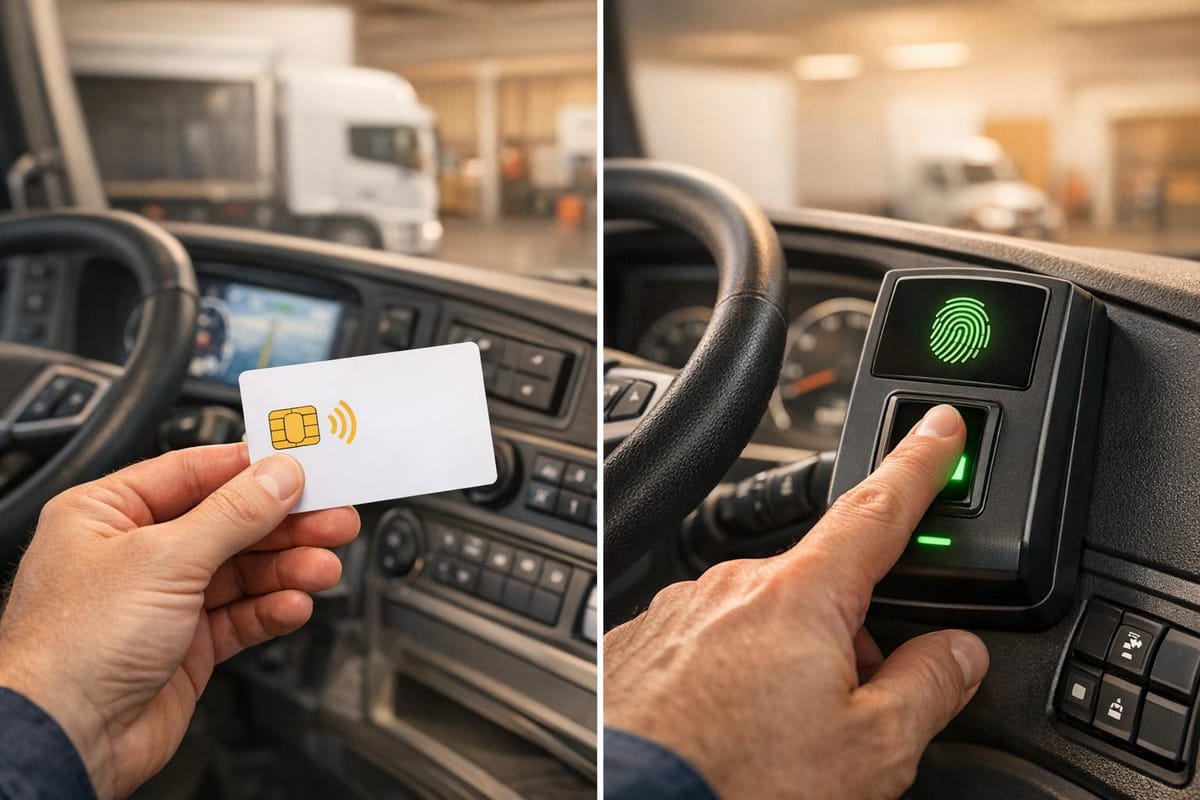
Which is better for your fleet: biometric or RFID driver authentication? It depends on your priorities. Both systems enhance vehicle security and improve driver accountability, but they work differently:
- Biometric authentication uses physical traits (e.g., fingerprints, facial recognition) for identity verification. It’s highly secure but can be costly and less reliable in harsh conditions (e.g., dirty hands, poor lighting).
- RFID authentication relies on fobs or cards to grant access. It’s affordable, quick, and ideal for large fleets, but physical tokens can be lost or cloned.
Quick Overview:
- Biometric pros: High security, no physical tokens needed, prevents misuse.
- Biometric cons: Expensive, requires GDPR compliance, can fail in tough environments.
- RFID pros: Cost-effective, easy to deploy, works well in challenging conditions.
- RFID cons: Moderate security, tokens can be shared or stolen.
For many fleets, combining both technologies offers the best balance of security, cost, and reliability.
Quick Comparison
| Feature | Biometric Authentication | RFID Authentication |
|---|---|---|
| Security | High (personal traits are unique) | Moderate to high (token-based) |
| Fraud Risk | Low (prevents misuse) | Moderate (tokens can be shared/lost) |
| Cost | High (requires advanced hardware) | Low (fobs/cards are inexpensive) |
| Reliability | Can struggle in tough conditions | Performs well in challenging settings |
| Ease of Use | No tokens required, but setup is complex | Simple setup, requires physical tokens |
| GDPR Compliance | Strict (special category data) | Less complex (general personal data) |
Conclusion: Choose biometrics for high-security needs or RFID for affordability and ease of use. A hybrid system combining both can maximise benefits while addressing limitations.
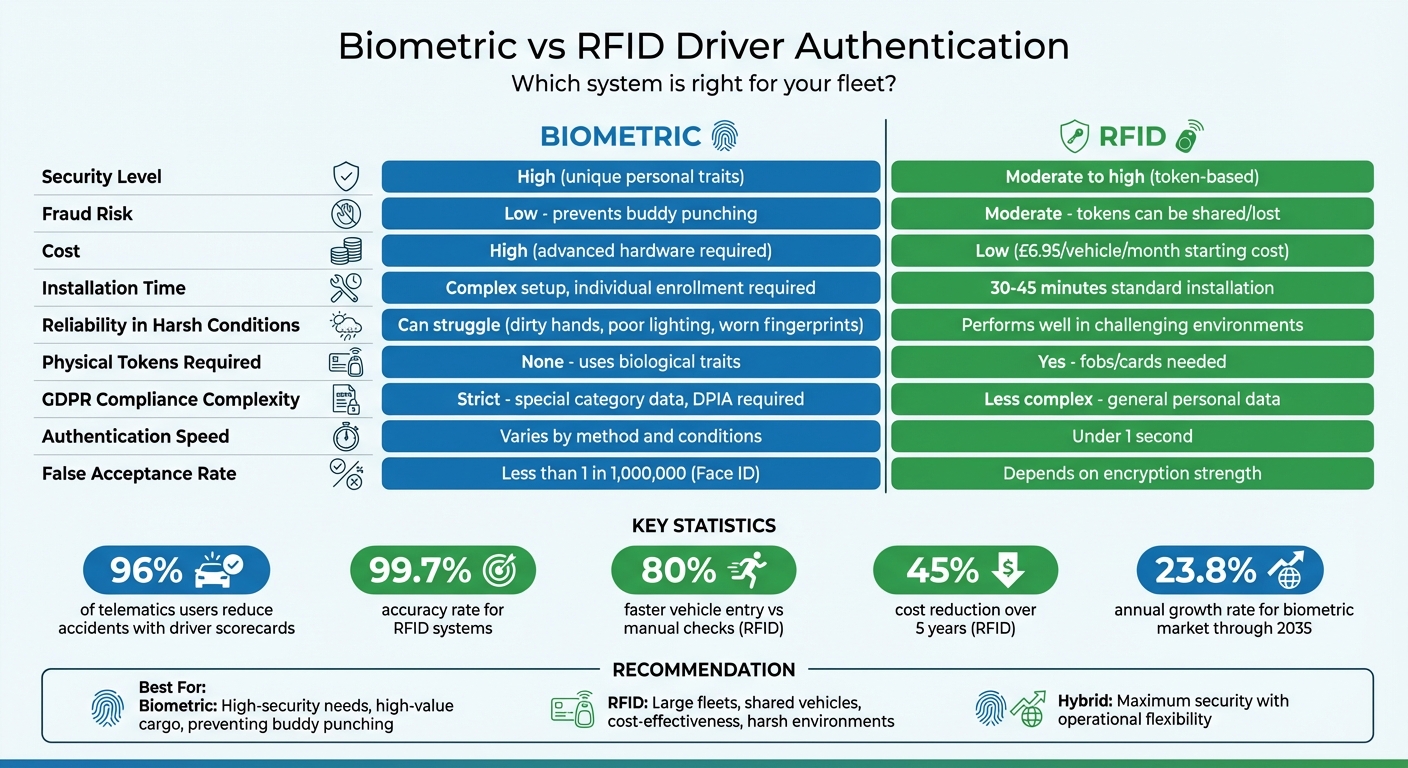
Biometric vs RFID Driver Authentication: Complete Feature Comparison
How Biometric Driver Authentication Works
Biometric authentication relies on a driver’s unique physical traits to verify their identity. When setting up the system, the driver’s data - such as a fingerprint or facial scan - is captured and transformed into a secure digital template. This template is then stored on a telematics unit or smartphone. Later, when the driver tries to access a vehicle, a fresh sample is taken and compared against the stored template to confirm their identity.
Devices like fingerprint scanners, facial recognition cameras, iris scanners, and voice recognition microphones translate biological inputs into digital codes for comparison. Advanced systems also include liveness detection, requiring actions like blinking or head movements to prevent spoofing attempts. To ensure smooth operations, fallback options like PINs are available for situations where biometric sensors may not work as expected.
Types of Biometric Identification Methods
Fingerprint recognition is the most commonly used method due to its familiarity and cost-effectiveness. However, its reliability can decrease if the driver’s fingers are dirty, wet, or injured. Facial recognition offers a contactless solution, using 2D or 3D imaging to identify facial features. However, its accuracy can be affected by poor lighting or when the driver is wearing sunglasses or a mask.
Iris scanning is highly accurate, with near-zero false acceptance rates. For example, the chance of someone else unlocking an iPhone or iPad using Face ID is reported to be less than 1 in 1,000,000. However, it requires specialised hardware and controlled lighting. Voice recognition, while convenient for hands-free use, can be disrupted by background noise or health issues affecting the voice.
A newer method, behavioural biometrics, tracks patterns such as typing rhythm, swipe pressure, or driving habits. This enables continuous authentication throughout a journey. In 2019, researchers Bruno Crispo and Sandeep Gupta developed "DriverAuth", a system that combines facial, voice, and swipe gesture recognition. Tested on 10,320 samples from 86 users, it achieved a True Acceptance Rate of 96.48% and a False Acceptance Rate of just 0.02%.
Multimodal systems combine multiple biometric methods, such as fingerprint and facial recognition, to improve security and provide backups if one method fails. These systems are particularly useful in fleet environments where conditions vary widely. They also integrate seamlessly with fleet telematics, improving both security and data accuracy.
Connecting Biometric Systems to Fleet Telematics
Biometric systems become even more effective when paired with fleet telematics, offering enhanced vehicle security and better operational insights. Beyond managing vehicle access, biometric data can directly link driver behaviour to fleet performance metrics.
Integration between biometric authentication and telematics is achieved through Bluetooth or hard-wired connections. Once connected, telematics data - such as speeding, harsh braking, or idling - is linked to the authenticated driver’s profile rather than just the vehicle. This driver-specific data simplifies tasks like timesheet verification, supports HMRC-compliant mileage claims, and helps resolve disputes over speeding fines or customer complaints.
For added security, biometric systems can work with vehicle immobilisers, ensuring the engine remains locked until the system confirms a match. Unlike RFID cards or key fobs, biometric traits are tied to the individual and cannot be easily lost, stolen, or shared. Approximately 96% of telematics users rely on driver performance scorecards and league tables to reduce accident rates, and biometric integration enhances the accuracy of this data.
GRS Fleet Telematics combines biometric authentication with traditional tracking to improve both security and efficiency. When choosing a biometric method, it’s essential to consider the working environment - fingerprint scanners may not suit manual labourers with worn prints, while voice recognition might struggle in noisy settings. Additionally, ensure the system complies with UK GDPR regulations, as biometric data is classified as Personally Identifiable Information and requires explicit consent.
How RFID Driver Authentication Works
RFID driver authentication ensures that only authorised individuals can access and operate a vehicle. Each driver is assigned a unique RFID tag, which is often embedded in a smart card, ID badge, or key fob. When the tag is scanned by a vehicle’s reader, the system captures the driver’s identification data. This information is then sent to the telematics unit, which forwards it - along with GPS and other vehicle data - to a central server for real-time monitoring.
The system can use passive or active RFID tags. Passive tags are cost-effective and don’t require batteries, as they draw power from the reader’s electromagnetic field. However, they have a shorter range. Active tags, on the other hand, are battery-powered, allowing for longer read distances but come with a higher price tag. Additionally, NFC technology, operating on the 13.56MHz frequency, allows drivers to use digital ID cards stored in apps like Apple Wallet instead of physical tags.
For added security, RFID systems can be programmed to immobilise the vehicle unless a valid tag is detected. This means the ignition circuit remains disabled until the system verifies the driver, effectively preventing unauthorised use or theft. As ELATEC Inc. explains:
At their simplest, RFID readers ensure that the right driver is accessing the right vehicle or equipment.
These systems can also work alongside biometric methods, offering an additional layer of security for fleet operations.
RFID System Components and How They Work
An RFID driver authentication setup includes several key components. These are:
- RFID tag: Stores the driver’s unique identification.
- In-cab reader: Scans the tag quickly, eliminating the need for manual input.
- Telematics unit: Sends data to the cloud for monitoring and analysis.
- Immobiliser: Prevents the vehicle from starting until driver verification is complete.
- Management software: Visualises data and enforces access rules.
In specific UK logistics applications, RFID tags have an additional use: they transmit freezer temperatures to the tracking system every 60 seconds, with an accuracy of ±1°C. This ensures the integrity of refrigerated cargo. Together, these components integrate seamlessly with vehicle tracking systems, enhancing both security and operational efficiency.
RFID Integration with Vehicle Tracking Systems
Once in place, RFID systems integrate smoothly with broader vehicle tracking platforms, delivering real-time insights into fleet operations. The RFID reader connects to the vehicle’s telematics unit, linking driver identity to specific driving behaviours such as speeding, harsh braking, or extended idling. This allows fleet managers to monitor individual performance and ensure accountability.
The system also simplifies administrative processes. For example, RFID data can validate manual timesheets and highlight discrepancies in reported working hours. It can automatically track Hours of Service (HOS) compliance, ensuring drivers adhere to legal requirements and that licences are up to date. Some advanced systems even pair RFID driver IDs with fuel card data, confirming that the driver and vehicle were present during refuelling.
Another advantage is the ability to remotely update access permissions via software. This feature is particularly useful for shared fleets or situations requiring last-minute driver assignments. By replacing physical keys - which can be lost or duplicated - with digital access, the system reduces administrative hassle. Most commercial RFID systems in the UK operate on a Software as a Service (SaaS) model, with monthly fees per device. Additionally, fleets should account for one-time costs like installation, which averages around £65 per vehicle, as well as activation fees and optional feature upgrades.
Biometric vs RFID: Side-by-Side Comparison
Deciding between biometric and RFID authentication comes down to what your fleet values most. These systems differ in terms of security, cost, ease of use, and compliance. Understanding these distinctions is key to making the right choice for your UK-based operation.
Security Levels and Fraud Prevention
Biometric systems use unique biological traits to verify a driver’s identity, while RFID relies on physical tokens like smart cards or key fobs. Biometrics are particularly effective at preventing "buddy punching" - where one driver clocks in for another - because biological traits can’t be shared or misplaced. For instance, Apple’s Face ID boasts a false acceptance rate of less than 1 in 1,000,000, compared to the 1 in 1,000 rate of many standard mobile biometric systems. Additionally, liveness checks in biometric systems help thwart spoofing attempts, such as using photos or moulds. The National Cyber Security Centre (NCSC) explains:
Because no two captures of biometric data will produce truly 'identical' images, a biometric system must make an estimation as to whether two biometric samples come from the same individual.
RFID tokens, on the other hand, can be lost, stolen, or even cloned if not protected by strong encryption like AES-256. For heightened security, RFID can be paired with a secondary method, such as a PIN or biometric check, to ensure that a stolen card alone won’t grant access.
| Feature | Biometric Authentication | RFID Authentication |
|---|---|---|
| Security Level | High (unique to individual) | Moderate to high (token-dependent) |
| Fraud Risk | Low (prevents buddy punching) | Moderate (badges can be shared/lost) |
| Spoofing Vulnerability | Presentation/replay attacks (mitigated by liveness checks) | Cloning/eavesdropping (requires encryption) |
| Fallback Weakness | Weak fallback (PIN/password can reduce security) | Tokens can be duplicated |
Costs and Installation Requirements
RFID systems are generally more budget-friendly and simpler to set up. Subscription costs for UK fleet operators start at around £6.95 per vehicle per month. Installation is quick, often taking 30–45 minutes, though more advanced setups like remote immobilisation may take up to two hours. Transferring a hardwired tracker to a new vehicle costs approximately £90 for the same location or £65 per visit.
Biometric systems, however, involve higher upfront costs due to the need for advanced sensors, real-time processing, and secure data storage. The global biometric driver identification market is projected to grow significantly, with an annual growth rate of 23.8% through 2035, reflecting rising interest despite the cost. Around 33% of security leaders cite high implementation costs as a major barrier. Maintenance also differs: while RFID systems may require occasional replacement of lost fobs, biometric systems need regular upkeep, such as cleaning fingerprint sensors to maintain accuracy. Despite the initial expense, many UK fleet operators report a return on investment within 90 days, with annual savings of £1,000–£2,000 per vehicle due to improved efficiency and reduced fuel waste.
Ease of Use and Reliability
RFID systems are fast and reliable, authenticating users in under a second. They’re also less affected by environmental factors, making them a practical choice for drivers dealing with dirt, grease, or wet hands. Biometric systems, however, can face challenges in similar conditions. For example, fingerprint scanners might struggle with moisture, dirt, or worn skin - common issues for drivers performing manual tasks. Facial recognition systems, though touchless, can be affected by lighting, humidity, or obstructions like hats or masks. In such cases, touchless facial recognition can be a more reliable alternative.
Matthew Harper, a Senior Security and Risk Consultant at Jensen Hughes, notes:
Biometric scanners are more costly than legacy technologies, but [I] expect them to increasingly replace older devices over time.
From a management perspective, RFID systems are easier to scale and integrate into existing tracking platforms. While biometric systems require individual enrolment for each driver, they eliminate the need for physical tokens, reducing the risk of lost or forgotten credentials.
Data Privacy and UK GDPR Compliance
For fleets prioritising security and compliance, understanding data handling is critical. Biometric data, used for unique identification, is classified as "special category data" under UK GDPR, requiring stricter protections. Fleet operators must complete a Data Protection Impact Assessment (DPIA) before deploying biometric systems, secure explicit consent from drivers, and use robust encryption to protect biometric templates. The NCSC highlights:
Biometric data is always considered Personally Identifiable Information (PII). Legal requirements must, therefore, be taken into account in the overall design of a biometric system.
RFID data, while still considered personal information, doesn’t usually fall under the "special category" unless linked to sensitive details like health data. This makes RFID systems less complex in terms of compliance, though they still require proper data protection measures. The Information Commissioner’s Office (ICO) recommends on-device verification for biometric systems - storing templates locally rather than in a central database - to enhance both security and privacy. UK fleet operators should carefully plan data storage methods and ensure clear communication with drivers about how their information is handled.
When to Use Biometric vs RFID Authentication
Selecting the right authentication method depends on your fleet's security requirements, budget constraints, and operational goals. Biometrics deliver secure, individual verification, while RFID offers a cost-effective and scalable solution.
When Biometric Authentication Works Best
Biometric systems shine in scenarios where high security and accountability are essential. For fleets transporting high-value goods, biometrics provide a strong layer of protection, as biological traits like fingerprints or facial features cannot be transferred or duplicated by unauthorised individuals. This creates a direct and secure link between the driver and the vehicle.
One major advantage of biometrics is the elimination of physical tokens or credentials. Only enrolled drivers can access and operate the vehicle, streamlining operations. However, this does require initial enrolment of drivers into the system. As the National Cyber Security Centre (NCSC) points out:
For systems requiring the highest levels of security, biometrics should be augmented by additional factors.
That said, fingerprint-based systems may not be ideal for drivers involved in heavy manual labour, as worn or damaged fingerprints can lead to false rejections. In such cases, touchless facial recognition, paired with a reliable fallback process, offers a more dependable alternative.
For fleets aiming to balance efficiency with security, combining biometric systems with other methods can offer a more comprehensive solution.
When RFID Authentication Works Best
RFID systems are particularly suited to fast-paced, dynamic fleet environments. They are ideal for large or mixed fleets where vehicles are shared among multiple drivers. RFID credentials, such as key fobs or cards, are easy to reassign, making them perfect for operations involving rotating shifts, shared vehicles, or high staff turnover. Issuing and revoking credentials is quick and straightforward, eliminating the need for complex enrolment processes.
RFID systems are also highly effective in challenging conditions. Whether it’s a construction site, an industrial zone, or an outdoor delivery route, RFID performs reliably where dirt, grease, or gloves might interfere with biometric scanners. With a broader range and the ability to read multiple tags simultaneously, RFID is particularly useful in busy depots or complex access scenarios.
For UK fleet managers, RFID integration with fuel cards provides an added layer of fraud prevention. By verifying both the driver and vehicle during refuelling, it ensures only authorised transactions are processed. Additionally, RFID simplifies compliance with HMRC regulations by enabling drivers to easily switch between "private" and "professional" mileage modes, ensuring accurate expense tracking. Beyond vehicle access, RFID fobs can also be used for building entry and gated parking, offering a streamlined security solution.
Combining Both Technologies
A hybrid system that merges RFID’s speed with biometrics’ security offers the best of both worlds. If one method fails, the other serves as a backup, ensuring uninterrupted protection. This dual-layered approach is particularly valuable in high-security settings, such as research facilities or fleets carrying sensitive or high-value cargo. The combination addresses the shortcomings of each technology. For instance, if a biometric scan fails due to environmental factors, RFID can provide secondary verification. Conversely, if an RFID credential is lost or stolen, biometric authentication prevents unauthorised access.
Jennifer Lee, a Security Systems Consultant, highlights the benefits of this approach:
We recommend a multi-factor approach combining RFID with LPR (License Plate Recognition) and sometimes biometric verification for critical areas. The layered approach significantly reduces vulnerability to any single point of failure.
Modern systems are also evolving toward mobile integration, replacing physical RFID tags with virtual credentials stored on smartphones. These virtual credentials are secured by the phone’s own biometric features, such as Face ID or Touch ID. This not only reduces the risk of lost or stolen tokens but also retains the convenience and speed of RFID. However, implementing a hybrid system requires careful planning, including a detailed assessment of your fleet’s needs, seamless integration with existing telematics systems, and consistent maintenance of both biometric and RFID technologies.
Conclusion
When it comes to fleet security and access control, the choice often boils down to biometric systems or RFID technology, each serving distinct needs. Biometric systems rely on unique biological traits, making them ideal for safeguarding high-value cargo or sensitive operations. However, they require strict compliance with UK GDPR regulations and can be less effective in certain conditions, such as when fingerprints are dirty or damaged.
On the other hand, RFID technology offers a practical mix of affordability, speed, and reliability. With a 45% cost reduction over five years, 99.7% accuracy, and the ability to process vehicle entries up to 80% faster than manual checks, RFID is particularly well-suited for large fleets, shared vehicles, and environments where biometric scanners might face challenges.
For many fleets, the best solution isn’t an either-or decision. A hybrid approach - combining RFID’s efficiency with biometric verification for high-security needs - creates a layered defence strategy. Modern telematics platforms make it easy to integrate both technologies, enabling features like centralised driver reporting, automated compliance checks, and real-time security alerts.
Take GRS Fleet Telematics, for example. It seamlessly integrates both RFID and biometric authentication into its advanced tracking system. Starting at just £7.99 per vehicle per month, with hardware costs from £35, it offers comprehensive fleet visibility. Additional benefits include 24/7 recovery support and an impressive 91% stolen vehicle recovery rate, ensuring your fleet remains protected even if access controls are bypassed. Moreover, 96% of telematics users report successfully using driver performance data to lower accident rates. By pairing the right authentication system with a robust telematics solution, you can enhance both security and operational efficiency across your fleet.
FAQs
How does combining biometric and RFID authentication enhance fleet security?
Combining biometric authentication (like fingerprint or facial recognition) with RFID technology offers a strong multi-layered security solution for fleet management. The RFID tag acts as the first checkpoint, verifying the authorised cardholder, while the biometric scan ensures the driver’s identity matches. This two-step process helps minimise risks like tag theft, cloning, or unauthorised access.
This setup also boosts operational efficiency by recording both the time of vehicle access and the driver’s identity, creating a dependable audit trail. The data easily integrates with telematics systems, enabling real-time alerts for unauthorised access attempts. Additionally, lost RFID tags can be remotely deactivated without affecting the biometric security layer. For fleets in the UK, this approach not only strengthens vehicle security but also improves asset management and supports monitoring of driver behaviour, making operations smoother and safer.
What should fleet operators know about GDPR compliance when using biometric data?
Biometric data, like fingerprints or facial recognition templates, falls under special-category personal data as defined by UK GDPR. This classification means it demands the highest level of protection. Fleet operators must have a lawful basis for processing such data, with explicit consent from drivers being the most common route - unless a valid exemption is applicable. Additionally, operators are required to complete a Data Protection Impact Assessment (DPIA) beforehand, as handling biometric data poses a heightened risk to individuals' rights.
To meet GDPR requirements, operators must adhere to several key principles. These include data minimisation (collecting only what’s absolutely necessary), purpose limitation (restricting data use solely to driver authentication), and security measures such as encryption and access controls. Once biometric data is no longer needed, it must be securely destroyed. Drivers also have rights, including access to their data, the ability to correct or delete it, and the option to withdraw consent at any time. Operators must have clear and efficient procedures in place to address these requests promptly and within the required statutory timeframes.
When is RFID driver authentication a better choice than biometric systems?
RFID driver authentication is a great choice when speed, convenience, and scalability are priorities. The process is straightforward: drivers just hold a card or badge near a reader. It's quick, entirely contactless, and ideal for fleets dealing with high vehicle turnover, tight schedules, or a large number of users. Plus, RFID systems handle tough conditions like poor lighting, rain, or dust with ease, making them a solid option for outdoor depots, construction sites, or other challenging environments.
Another advantage is cost and simplicity. RFID readers and cards are generally less expensive and easier to maintain compared to biometric systems. They also integrate effortlessly with existing telematics setups, meaning fleet managers can roll out authentication across multiple vehicles without needing major hardware changes. This makes RFID especially useful for operations involving temporary drivers, contract workers, or any situation where fast, reliable verification is essential.