Best Practices for API Integration in Fleet Systems
Practical guide to fleet API integration covering planning, OAuth security, UK GDPR compliance, real-time telemetry, buffering, rate limits and scaling.

Integrating APIs into fleet management systems is all about connecting tools like vehicle trackers, management software, and back-office systems to streamline operations. Here's the bottom line: API integration saves time, reduces costs, and improves efficiency for fleet operators. Whether you're automating payroll, tracking vehicles in real time, or managing maintenance, APIs provide the backbone for smooth data exchange.
Key takeaways from this guide:
- What APIs Do: They connect systems like telematics devices, payroll software, and maintenance tools to share data automatically.
- Why It Matters: Helps prevent breakdowns, optimise routes, improve fuel efficiency, and enhance security.
- How to Start: Plan your integration by identifying goals (e.g., cutting fuel costs, automating mileage claims) and choosing compatible systems.
- Security Focus: Use strong authentication (OAuth 2.0), encrypt data, and follow GDPR rules to protect sensitive information.
- Performance Tips: Use real-time data streams, handle connectivity issues with local buffering, and design systems to scale as your fleet grows.
For UK fleets, platforms like GRS Fleet Telematics offer real-time tracking, theft recovery, and compliance-ready features starting at £7.99 per vehicle per month. With a 91% recovery rate for stolen vehicles, they show how APIs can deliver real results.
Bottom line: A well-planned API strategy ensures your fleet runs efficiently, remains secure, and grows seamlessly with your business needs.
Fleet Stack REST API Guide - Leveraging Powerful Integrations for Fleet Management
Planning Your API Integration Strategy
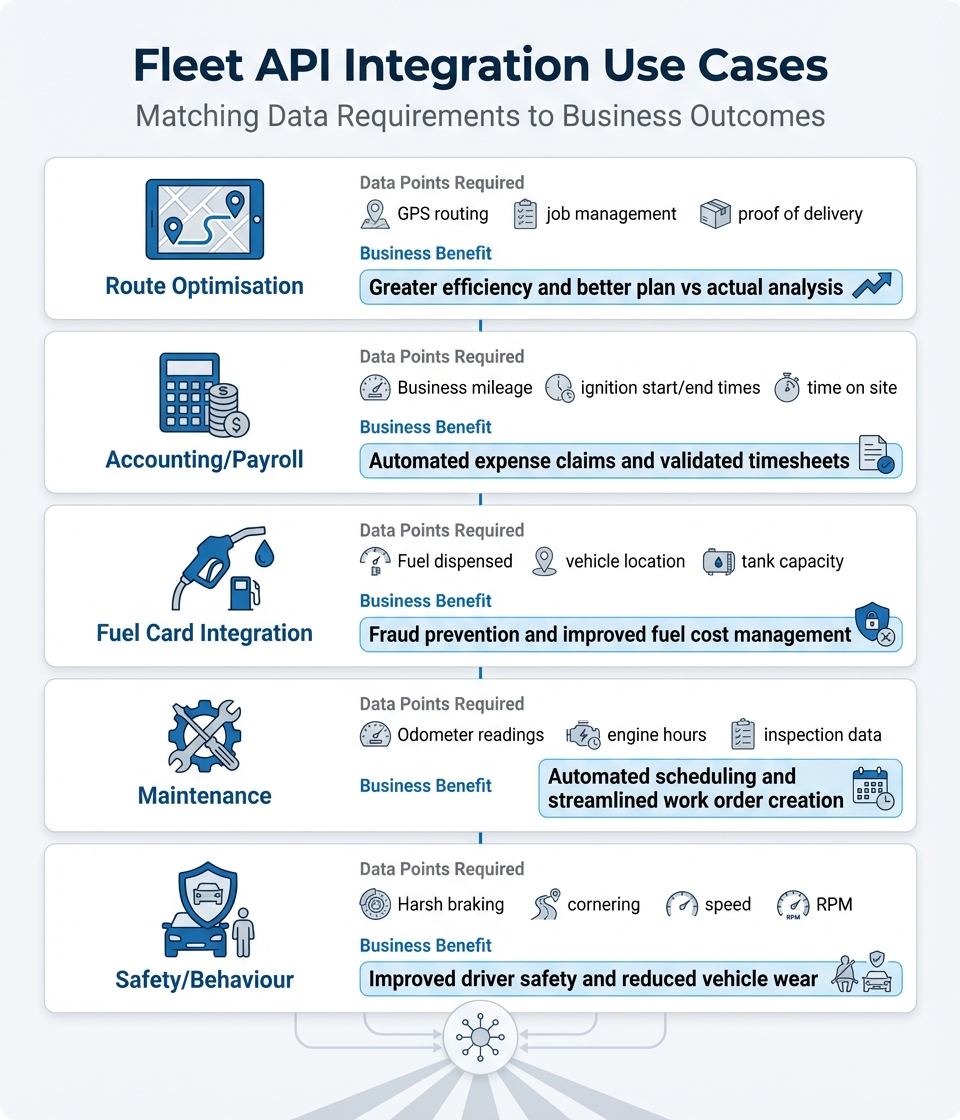
Fleet API Integration Use Cases: Data Requirements and Business Benefits
To make your API integration effective, start with a solid plan that aligns your fleet's operational goals with the right technical solutions. Define clear business outcomes, such as cutting fuel expenses, streamlining payroll, or reducing recovery times. As noted, "The key reason to integrate fleet management software is to bring all information into one place to create a more comprehensive overview of business operations". Focusing on outcomes ensures your integration adds value without introducing unnecessary complications.
Identifying Integration Needs and Use Cases
Link your goals to specific API use cases to create a targeted strategy. For instance, you might monitor temperatures in refrigerated vans or automate mileage claims. Below is a breakdown of common use cases and their benefits:
| Integration Use Case | Key Data Points Required | Business Benefit |
|---|---|---|
| Route Optimisation | GPS routing, job management, proof of delivery | Greater efficiency and better plan vs actual analysis |
| Accounting/Payroll | Business mileage, ignition start/end times, time on site | Automated expense claims and validated timesheets |
| Fuel Card Integration | Fuel dispensed, vehicle location, tank capacity | Fraud prevention and improved fuel cost management |
| Maintenance | Odometer readings, engine hours, inspection data | Automated scheduling and streamlined work order creation |
| Safety/Behaviour | Harsh braking, cornering, speed, RPM | Improved driver safety and reduced vehicle wear |
Once you've mapped out use cases, evaluate your existing systems to ensure compatibility.
System Discovery and Compatibility
Start by listing the systems you currently use, such as TMS, HR software, or accounting platforms, and determine whether they offer built-in integrations or require custom REST/SOAP development. Standardising data is critical to ensure smooth mapping between systems. The Government Digital Service advises, "When making decisions about API management, you must meet user needs as well as organisational goals". Work closely with developers and fleet managers to streamline interfaces by removing unnecessary features. Before going live, test the integration in a sandbox environment using synthetic data to minimise risks.
UK-Specific Planning Considerations
After confirming system compatibility, address requirements specific to the UK. Set up systems to handle GBP (£) transactions and use the ISO 8601 date format (YYYY-MM-DD). For location data, adopt GeoJSON encoding and consult the UK Geospatial Data Standards Register for appropriate coordinate reference systems. Ensure your integration supports both metric and imperial units as needed. UK fleets can also benefit from the DVLA API Developer Portal, which provides secure access to vehicle and driver licensing data. Finally, ensure all API activity is logged to comply with UK GDPR regulations.
Implementing Secure and Compliant API Integrations
Once you've planned your integration, the next critical step is protecting sensitive fleet data. This section dives into the measures needed to secure data and comply with UK GDPR regulations. Fleet APIs often handle sensitive information like driver locations, vehicle IDs, and journey histories, making robust security practices essential. Without them, you could face data breaches, hefty fines, and operational setbacks.
Core API Security Practices
Start by focusing on strong authentication and authorisation. Use standards like OAuth 2.0 and OpenID Connect (OIDC) to control access. The NCSC cautions:
"Don't use weak authentication methods such as basic authentication or API keys... Both these methods can be easily compromised, often due to poor secrets management".
Ensure all data transmitted between systems is encrypted with TLS 1.2 or higher. Follow the principle of least privilege - only grant users and services the minimum access they need. Role-Based Access Control (RBAC) is key here. For instance, sensitive actions like accessing vehicle immobilisation commands or historical location data should be restricted to authorised personnel.
To prevent injection attacks, enforce strict input validation by verifying both format and context. Use parameterised queries for database interactions to block malicious actors. Store credentials securely in tools like Hardware Security Modules or cloud-based Key Management Services, and automate credential rotation to reduce risks.
An API gateway can centralise security functions such as rate limiting, throttling, and authentication. By enforcing a "deny by default" policy, the gateway ensures that only explicitly authorised entities can access APIs, reducing your microservices' vulnerability [9, 15].
Ensuring Compliance with UK GDPR

Beyond security, your integration must meet UK GDPR requirements. Article 5(1)(f) of UK GDPR mandates:
"processed in a manner that ensures appropriate security of the personal data, including protection against unauthorised or unlawful processing and against accidental loss, destruction or damage, using appropriate technical or organisational measures".
For fleet operators, this means conducting a thorough risk assessment of data processing activities and implementing safeguards accordingly.
When working with third-party telematics providers, ensure contracts specify compliance with Article 32 security requirements. These providers must guarantee the confidentiality, integrity, and availability of driver and vehicle data. This involves limiting access to authorised users, maintaining data accuracy, and ensuring recovery mechanisms are in place for incidents like system failures.
The Government Digital Service advises:
"If your API provides personal or sensitive data, you must log when the data is provided and who you provide it to. This will help you follow UK GDPR".
These logs are crucial for responding to Data Subject Access Requests and identifying unauthorised access.
Regular vulnerability scans and penetration tests are essential. But security isn't just about systems - train staff to spot phishing attempts and understand their GDPR responsibilities. Implement a "3-2-1" backup strategy (three copies of data, stored on two different devices, with one copy off-site) to ensure recovery from incidents like ransomware attacks.
Monitoring and Auditing API Activity
Securing your API is only the beginning - continuous monitoring is vital for maintaining compliance and performance. Consolidate all application logs in a central aggregation service. This creates a single source of truth for tracing activity and evaluating API health. Pay special attention to high-risk actions like immobilisation commands, real-time vehicle tracking, and access to driver location histories [9, 15]. Use real-time metrics and set up alerts for unusual activity.
As the NCSC highlights:
"Credential use should be part of any monitoring strategy and any misuse should be alerted".
Monitor API credentials, such as JWTs or certificates, and immediately flag any signs of misuse or replay attacks.
API gateways can simplify audit processes by offering built-in tools for logging, reporting, and access control. For UK fleets, integrating monitoring systems with live data feeds from Transport for London or National Highways can add valuable context to route-based activity logs.
Automate compliance record-keeping by tracking driving times, rest periods, and breaks, making regulatory audits easier. Use API analytics to identify underused versions and follow a structured deprecation process with headers like "Sunset" or "Deprecated" to avoid breaking integrations.
Optimising Performance and Scalability of Fleet API Integrations
After ensuring robust security and compliance, the next step is to fine-tune your API integration for real-time responsiveness and scalability. Poorly optimised performance can result in delayed updates, missed alerts, and dissatisfied users. Let’s explore practical ways to keep your integration running smoothly as your fleet grows.
Real-Time Data Performance Considerations
Instead of relying on frequent polling, take advantage of telemetry or streaming endpoints to minimise resource overhead. When API requests are necessary, implement eager loading to gather related data in a single call. For instance, you can combine driver and vehicle data into one request, reducing the number of HTTP calls required. Filtering, sorting, and pagination are also key techniques for managing payload sizes. A common pagination setup limits responses to 20 resources per page, ensuring response times remain efficient.
Rate limiting plays a critical role in maintaining system stability. Many fleet APIs enforce limits, such as one request per second for individual clients or a global cap of 20 requests per second [4, 6]. If you encounter a 429 error (indicating too many requests), implement exponential backoff in your retry logic to avoid overwhelming the system.
Before sending commands, always verify the device's connectivity to avoid unnecessary data charges or failed requests. For example, ensure the vehicle is online to prevent wasted calls that result in 408 errors (request timeout). Even after a timeout, double-check the vehicle’s state to confirm whether the action was completed, avoiding duplicate operations. Next, let’s address how to manage connectivity challenges in areas with limited network coverage.
Handling Intermittent Vehicle Connectivity
Vehicles often traverse areas with poor mobile coverage, leading to interruptions in data transmission. To handle this, design your backend to support store-and-forward mechanisms. This allows vehicles to buffer data locally and send it once connectivity improves. Positional queues with automatic de-duplication can filter out redundant data points when vehicles reconnect.
When sending a "wake" request to a vehicle in sleep mode, allow 10–60 seconds for the device to establish a stable connection before issuing further commands. However, even after confirming a vehicle is online, success isn't guaranteed. As industry guidelines caution:
"Confirming the vehicle is online does not guarantee a request will be successful. Vehicles with poor connectivity may still return status code 408 (vehicle unavailable)".
Your application should be designed to handle such failures gracefully, retrying requests as needed. Avoid modifying default DNS TTL settings or overusing caching, as fleet APIs often rely on dynamic IPs for high availability. Using stale DNS data can lead to connection issues during network changes. Additionally, a stateless architecture ensures your backend can scale horizontally, enabling it to handle sudden spikes in data when multiple vehicles reconnect simultaneously. Now, let’s move on to scaling effectively for growing fleet sizes.
Scalability for Growing Fleet Sizes
As your fleet expands, your API integration must handle increased demand without compromising performance. Horizontal scaling - adding more instances of your API service - helps distribute the load evenly and prevents bottlenecks. A stateless design is especially important here. As the UK Home Office explains:
"A stateless API means that the client is responsible for providing information about authentication etc. In turn, this means an application can then scale easily horizontally, as it doesn't matter which instance a client connects to".
Switch to event-driven models using telemetry streams instead of polling to reduce costs and improve efficiency. Asynchronous processing and multithreading can handle large volumes of real-time data without blocking your system. Observability is also key - consolidate logs, set up real-time alerts, and monitor API health continuously to detect and resolve performance issues quickly. Automating credential rotation ensures security at scale, eliminating the need for manual updates. Finally, standardise data formats with protocols like JSON:API to maintain consistency in querying and pagination across systems.
With the global commercial telematics market expected to surpass US$84 billion by 2032 and over 100 million telematics units already installed worldwide as of 2022, building scalable and efficient integrations is no longer optional - it’s essential to support the future of fleet operations.
Applying Best Practices with GRS Fleet Telematics
GRS Fleet Telematics as a Central Telematics Platform
GRS Fleet Telematics serves as a centralised platform for real-time van tracking and security, aligning perfectly with best practices for API integration in fleet management systems. The platform’s Enhanced (£79) and Ultimate (£99) tiers feature dual-tracker technology, combining a primary GPS tracker with a secondary Bluetooth backup. This setup delivers a 91% recovery rate for stolen vehicles, even if the primary tracker is tampered with.
One standout feature is its white-label branding capability, enabling businesses to either maintain their brand identity or resell tracking services under their own name. This is particularly useful for fleet operators looking to integrate telematics into their customer-facing platforms. The system also provides driver behaviour analytics, geofencing alerts, and eco-driving metrics - all accessible through the same API endpoints. These features allow you to create custom dashboards that consolidate operational data, streamlining your fleet management processes.
Integrating GRS Fleet Telematics with Back-Office Systems
The platform can handle up to 1,000 records per call, with optimal performance achieved at 200–500 records. This capacity makes it easy to integrate with tools like maintenance platforms, dispatch software, and finance systems. For instance, diagnostic data can be fed directly into service systems, reducing unplanned repairs by up to 25%.
For troubleshooting, the /invalidrecords endpoint provides a valuable feedback loop. By querying it hourly, you can identify and fix rejected records before they expire, typically within 48 hours. This ensures data accuracy and prevents disruptions in your operations. Businesses leveraging these integrations often see fuel cost savings of 10–20% within the first year, with some achieving an ROI as high as 2,965% and payback periods as short as 0.3 months.
In addition to back-office efficiencies, the platform also strengthens security and compliance.
Using GRS Fleet Telematics for Theft Recovery and Compliance
GRS Fleet Telematics plays a crucial role in theft recovery and regulatory compliance. For example, a UK courier recovered two stolen vans within 24 hours, avoiding losses exceeding £40,000. The Ultimate tier includes a remote immobilisation feature, allowing you to disable a vehicle remotely. Paired with 24/7 recovery support, the system works seamlessly with authorities to recover stolen assets.
The platform’s Thatcham and TASSA approvals can also help businesses qualify for insurance premium discounts, further reducing operational costs. By integrating telemetry and security data into your back-office systems, you can establish a comprehensive compliance framework that grows alongside your fleet. These features ensure that security, recovery, and compliance are fully integrated into your operations.
Conclusion
Integrating APIs into fleet management systems requires careful planning, strong security measures, and a design that can grow with your needs. By focusing on key principles like authorisation controls, centralised API management, and telemetry-driven data collection, fleet operators can create systems that safeguard data while adapting to expansion. A well-executed API management strategy not only ensures reliability but also helps build trust among users and stakeholders.
Security is a critical focus throughout the entire integration process. Best practices like securely storing credentials, automating credential rotation, and conducting sandbox testing can minimise risks and streamline development. The National Cyber Security Centre highlights the importance of limiting permissions, warning:
"granting excessive permissions to tokens increases the risk of data leakage or misuse of services".
GRS Fleet Telematics serves as a strong example of how to implement these principles effectively. Its platform, featuring dual-tracker technology and an impressive 91% recovery rate, demonstrates how well-designed APIs can achieve tangible security benefits. Beyond security, many UK fleet operators have reported fuel cost savings of 10–20% within the first year, alongside noteworthy reductions in accident costs (28%), maintenance expenses (21%), and labour costs (22%).
The platform also showcases how thoughtful API architecture can turn telematics data into actionable insights. Features like white-label branding and smooth integration with back-office systems highlight the transformative potential of APIs. Whether you're managing a small fleet or scaling up to hundreds of vehicles, having clear protocols for connectivity and a well-planned API lifecycle ensures your system remains dependable and efficient.
Finally, ensure all data sources are fully integrated and verified. This crucial step ties together the security, scalability, and integration strategies discussed, enabling long-term operational success for your fleet systems.
FAQs
How does API integration improve security in fleet management systems?
API integration plays a crucial role in bolstering security within fleet management. It ensures encrypted and controlled data exchange between telematics devices, back-office systems, and authorised third-party services. By leveraging modern protocols like HTTPS and secure authentication methods such as API keys or OAuth tokens, access is restricted to only authorised users and applications. Additional safeguards, including regular monitoring and rate-limiting, help identify and address suspicious activity swiftly.
These integrations also enable real-time security measures, such as geofence alerts, notifications for unauthorised vehicle movements, and the ability to revoke access immediately if a device is compromised. For example, when paired with GRS Fleet Telematics’ dual-tracker technology, APIs can trigger instant alerts and even issue lockdown commands, contributing to an impressive 91% recovery rate for stolen vans. By adopting practices like encrypting data traffic and auditing API usage, fleet operators in the UK can safeguard their vehicles, sensitive information, and compliance standards while maintaining smooth operations.
How can I ensure API integration in fleet systems complies with UK GDPR?
To align your API integration with UK GDPR, begin by identifying a lawful basis for processing personal data - this could be legitimate interest or contract performance. Make sure to record this in a data-processing register. If the API deals with large-scale or sensitive data, carry out a Data Protection Impact Assessment (DPIA) to pinpoint risks and outline mitigation strategies. Build the API around data minimisation principles by collecting only the essential data and defining clear retention periods.
Implement security-by-design features to protect data. Use strong authentication protocols like OAuth 2.0, encrypt data in transit with TLS 1.2 or higher, and apply rate-limiting to prevent unauthorised access. Provide detailed API documentation that explains data schemas, consent mechanisms, and procedures for handling data subject requests, such as access or erasure. Additionally, prepare a solid incident response plan to comply with GDPR’s 72-hour breach notification rule and ensure any third-party providers meet GDPR standards.
Taking these steps helps GRS Fleet Telematics create API integrations that are secure, GDPR-compliant, and capable of supporting reliable fleet management services.
How do APIs enhance real-time data in fleet management systems?
APIs act as powerful tools for linking vehicles to fleet management platforms, ensuring smooth and instant data sharing. They deliver updates on crucial metrics like vehicle location, fuel usage, and driver behaviour - often within seconds.
This immediate access to data helps cut down delays, enabling businesses to make swift decisions, adjust routes, and address problems as they arise. By using APIs, fleet operators can streamline their operations and boost the effectiveness of their systems.