Best Practices for AI Route Optimisation
AI route optimisation guidance for UK fleets: data prep, adaptive algorithms, telematics integration, real-time reoptimisation and ROI benchmarks.
AI route optimisation is transforming fleet management in the UK by improving delivery efficiency, reducing costs, and addressing unique challenges like traffic congestion, ULEZ compliance, and driver hour regulations. Here’s a quick summary of its benefits and implementation steps:
- Efficiency Gains: Tesco reduced delivery times by 18%, while Sainsbury's achieved a 96% on-time delivery rate. Fuel costs dropped by 10–15%, with maintenance costs cut by 12–18%.
- Key Features: Systems consider constraints like vehicle capacity, traffic, and delivery windows. They also integrate real-time data sources like GPS tracking, weather updates, and traffic feeds.
- Implementation Steps:
- Data Preparation: Ensure accuracy, completeness, and relevance (e.g., vehicle specs, traffic patterns).
- Algorithm Configuration: Choose systems that handle multiple priorities and adjust routes dynamically.
- System Integration: Connect AI tools with existing platforms (ERP, CRM, TMS) and enable real-time tracking.
- Testing & Improvement: Start with a small pilot, track metrics (e.g., fuel savings, on-time rates), and refine based on results.
AI-powered systems typically pay for themselves within 8–12 months, with some fleets reporting a ROI in as little as 0.3 months. This technology not only optimises routes but also ensures compliance with UK-specific regulations, making it an essential tool for modern fleet management.
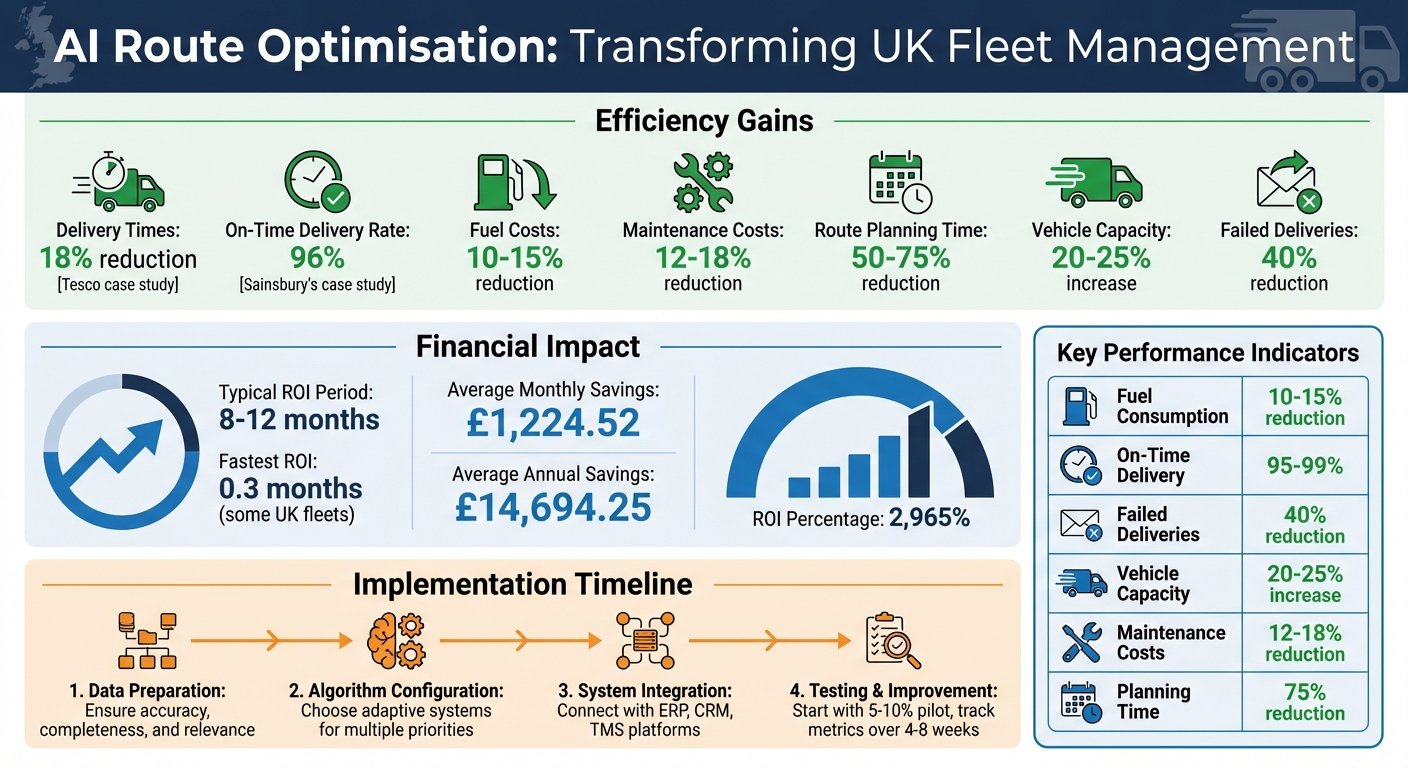
AI Route Optimisation Benefits and ROI for UK Fleet Management
AI-Powered Route Optimization | NextBillion.ai
Checklist: Preparing Data for AI Route Optimisation
AI route optimisation systems are only as effective as the quality of the data they process. The UK Government's guidance on AI implementation highlights that "training an AI system on error-prone data can result in poor results due to the dataset not containing clear patterns for the model to explore". For fleet managers, ensuring data meets specific quality standards is essential before deploying any AI routing solution. Here’s how to validate your data effectively.
Ensure Data Accuracy and Completeness
Begin by creating a data factsheet to document accuracy and uncover any biases. This record should include every data source used in your AI system, such as delivery addresses, time windows, vehicle specifications, and historical traffic patterns. Don’t overlook real-world insights - engage drivers and dispatchers to capture on-the-ground conditions often missed in spreadsheets.
Pay extra attention to vehicle-specific constraints. Unlike standard navigation apps, fleet AI systems must consider factors like bridge heights, weight restrictions, vehicle capacity, and fuel types. A route suitable for a small van may not work for a 7.5-tonne lorry. To ensure your AI system performs reliably, split your data into training, validation, and test sets to analyse its accuracy with new inputs.
Integrate Real-Time Data Sources
Fleet operations are dynamic, so integrating real-time data is a must. Use reliable APIs to pull live updates from sources like Transport for London’s traffic feeds, Met Office weather forecasts, and local roadworks notifications. Equip vehicles with GPS tracking and Onboard Diagnostic (OBD) devices to continuously collect data on location, speed, fuel usage, and engine health.
For larger fleets, cloud-based systems with distributed and edge computing can handle vast amounts of data without delays. Ensure your AI integrates with existing platforms like ERP, CRM, TMS, and WMS systems so it can account for real-time customer needs, vehicle capacity, and delivery windows. Two-way communication between drivers and managers is equally important, enabling instant route adjustments and automated customer notifications.
Pair this real-time data with direct input from drivers to fine-tune AI performance even further.
Gather Driver Feedback for Continuous Improvement
Drivers may initially be sceptical of AI-generated routes. To build trust, share real-time performance metrics with them. Alex Osaki, Product Marketing Manager at HERE, explains:
"The more information you have, the more accurate your route predictions can be. And the more information you have, the more you can optimise those routes".
Monitor driver behaviour, such as acceleration, braking, and speed patterns, to refine the AI’s predictions and proactively address safety risks. These insights can also lead to cost savings - fuel expenses can drop by 10–15%, while maintenance costs may decrease by 12–18%. To measure the impact of these driver-informed changes, track metrics over a 4–8 week period before and after implementation. Additionally, using platforms that facilitate real-time communication allows managers to capture immediate feedback on route disruptions, potentially cutting failed delivery attempts by up to 40%.
Checklist: Configuring AI Algorithms for Optimal Routing
Once your data is ready, the next step is fine-tuning algorithms to handle multiple priorities and adjust routes in real time. The goal isn’t just finding the shortest path but managing competing demands while responding to constant changes on the road. This step builds on solid data practices, ensuring advanced algorithms can handle large-scale operations effectively.
Choose Algorithms That Adapt to Real-World Changes
Rigid, rules-based routing systems are outdated. Instead, opt for machine learning algorithms that can adapt dynamically. These algorithms use historical data to learn and make adjustments. For example, if a specific customer location consistently causes 15-minute delays due to limited parking, the system will automatically factor this into future estimated arrival times .
Consider solutions that combine genetic algorithms or swarm intelligence with intelligent geocoding. These technologies can clean up messy or incomplete address data, reducing fuel waste and minimising missed deliveries . Additionally, predictive analytics can help forecast variables like weather conditions, demand spikes, and maintenance requirements.
Incorporate Multi-Objective Optimisation
Routing isn’t a one-dimensional problem. Effective algorithms must juggle multiple factors, such as delivery time windows, vehicle capacity, driver schedules, environmental regulations, and customer-specific needs. To illustrate the complexity, a single van delivering to 24 stops has 620 sextillion potential routes - making manual planning unfeasible.
Modern AI tools account for real-world constraints like shift patterns, travel speeds, order weight, and even "time-at-door" metrics. They also integrate Low Emission Zones (LEZ) and Ultra Low Emission Zones (ULEZ), helping fleets avoid fines while supporting sustainability efforts . Some systems even include slot cost prediction, estimating delivery costs based on demand and environmental data. This feature can optimise fleet utilisation and influence customer choices. The benefits are clear: AI-powered route optimisation can cut delivery times by up to 18%, boost vehicle capacity by 20–25%, and achieve on-time delivery rates as high as 95–99%.
Enable Real-Time Re-Optimisation
Static routes are no match for the unpredictability of real-world logistics. Real-time re-optimisation ensures your system can adapt instantly to unexpected events like traffic jams, accidents, road closures, or sudden weather changes. It also allows for last-minute pickups without derailing the entire schedule.
Your algorithm should process live traffic data, vehicle capacity, driver hours, and delivery time windows simultaneously. Integrating it with real-time vehicle tracking (telematics) and business systems like ERP or CRM provides a comprehensive view of operations. To further streamline processes, enable two-way communication so updated routes can be sent directly to drivers via mobile apps. This reduces stress caused by mid-day changes and can lower failed delivery attempts by up to 40%, while cutting route planning time by 50–70% .
Checklist: Integrating AI Route Optimisation into Fleet Systems
Once your algorithms are up and running, the next step is to integrate AI tools into your existing systems. The goal? A seamless flow of data across platforms, all while ensuring security and scalability.
Integration with Existing Platforms
Your AI route optimisation tools must work hand-in-hand with platforms like Transport Management Systems (TMS), Warehouse Management Systems (WMS), and ERP or CRM solutions. This is where open APIs and pre-configured integrations come into play - they help connect these systems, avoiding situations where data gets stuck in silos, unable to assist with routing decisions.
Start with a pilot programme involving just 5–10% of your fleet. This phased rollout helps identify and resolve compatibility issues, like adapting APIs for older IT systems, without disrupting daily operations. To ensure smooth data exchange, standardise formats using tools like JSON/HTTPS payloads, TCP connectors, or webhooks.
Once integration is running smoothly, the focus shifts to improving vehicle tracking.
Use Advanced Tracking Systems
With systems fully connected, tracking your vehicles becomes the next priority. Equip your fleet with GPS tracking devices for location data and Onboard Diagnostic (OBD) devices to monitor fuel usage, engine health, and performance metrics. Even older vehicles can be upgraded with aftermarket OBD and GPS devices.
For example, GRS Fleet Telematics offers three hardware options, each with enhanced tracking and security features. Packages start at £35 and include dual-tracker technology and immobilisation for better vehicle recovery. Their plans also include software subscriptions from £7.99 per vehicle per month, covering SIM/data, account management support, and full platform access. Features like geofencing can send alerts for unauthorised vehicle movement or automate entry and exit logs at job sites.
Use Scalable Cloud-Based Processing
Once live tracking is in place, scalable cloud processing ensures your system can handle vast amounts of data and make quick route recalculations. Cloud platforms are ideal for managing data from hundreds - or even thousands - of vehicles at once. Unlike older systems that struggle to keep up, cloud solutions offer pay-as-you-go pricing, eliminating the need for costly on-premises servers. They also support distributed and edge computing, which speeds up localised data processing and reduces delays when recalculating routes.
When selecting a platform, look for modular architectures that can grow with your fleet. For larger fleets managing 200+ vehicles, initial setup costs typically range from £7,000 to £15,000+, with ongoing monthly expenses of £1,600 to £5,000+ per vehicle. Despite the investment, most businesses see a full return within 8–12 months, with some achieving payback in as little as 0.3 months. Companies using AI route optimisation tools report impressive results: at least a 50% reduction in time spent planning routes, along with 10–15% savings on fuel and 12–18% lower maintenance costs.
Checklist: Testing and Continuous Improvement
Start by establishing a baseline over 4–8 weeks, tracking metrics like fuel costs, delivery times, maintenance expenses, and planning hours. This baseline is essential for gauging whether the AI system is genuinely improving operations or simply shifting issues elsewhere. These benchmarks will guide a controlled pilot phase.
Conduct Pilot Testing
Begin by piloting the AI system with a small portion of your fleet - around 5–10% - or within a single region. This phased rollout helps uncover potential challenges, such as compatibility with older ERP systems or unexpected resistance from drivers. During this stage, ensure the system accommodates UK-specific factors like congestion charges and ULEZ (Ultra Low Emission Zone) restrictions.
Monitor Key Metrics During Testing
Throughout the pilot phase, keep a close eye on operational and financial performance indicators. Look for measurable improvements such as:
- Delivery time reductions of up to 18%.
- Fuel consumption drops, typically in the range of 10–15%.
- On-time delivery rates hitting 95–99%.
- Significant cuts in route planning times - some businesses report reductions of 50–75%.
Also, track driver behaviour metrics like harsh braking or idling, as these can affect vehicle wear and overall safety.
| KPI to Monitor | Target Improvement |
|---|---|
| Fuel Consumption | 10–15% reduction |
| On-Time Delivery Rate | 95–99% |
| Failed Delivery Attempts | 40% reduction |
| Vehicle Capacity | 20–25% increase |
| Maintenance Costs | 12–18% reduction |
| Planning Time | 75% reduction |
These metrics will provide actionable insights for refining the system.
Continuously Refine Based on Results
Leverage the pilot results to fine-tune the AI algorithms. Compare actual trips to planned routes, and use "time-at-door" analysis - combining telematics with building and product data - to optimise scheduling further. To address driver resistance, share real-time performance data that demonstrates how the system reduces navigation stress and workload.
Integrating GRS Fleet Telematics for Better AI Route Optimisation
Once you've completed pilot testing, the next step is to integrate your AI system with a telematics platform like GRS Fleet Telematics. This platform provides highly accurate, real-time data that enhances your system's ability to respond to changes effectively. Designed with the unique challenges of UK fleets in mind, it tackles issues such as navigating busy urban areas, adhering to Ultra Low Emission Zone (ULEZ) regulations, and managing driver hours under DVSA guidelines. Below, we explore the key features that make GRS Fleet Telematics a strong partner for your AI system.
Real-Time Tracking and Security Features
GRS Fleet Telematics offers location updates every 60 seconds, supplying your AI system with a constant stream of data. This allows for immediate route recalculations when unexpected events arise. The platform uses dual-tracker technology, combining a hardwired GPS with a hidden Bluetooth backup. This setup ensures uninterrupted data flow, even in cases of tampering, and has contributed to an impressive 91% recovery rate for stolen vehicles.
Geofencing adds another layer of functionality, sending alerts if drivers stray from AI-optimised routes or enter restricted zones like London's ULEZ. The system also supports two-way communication between managers and drivers, making it simple to adjust delivery schedules in real time and provide customers with updated ETAs.
Cost-Effective, Scalable Solutions
GRS Fleet Telematics is designed to be both affordable and adaptable, making it accessible for fleets of any size. Pricing starts at just £7.99 per vehicle per month, offering an economical entry point. Hardware options include the Essential package at £35 (single wired tracker) and the Ultimate package at £99, which features dual trackers and remote immobilisation capabilities. On average, users save £1,224.52 monthly, adding up to approximately £14,694.25 annually. The system delivers an extraordinary return on investment of 2,965%, with a payback period as short as 0.3 months.
As a cloud-based SaaS platform, it supports seamless fleet expansion without the need for significant infrastructure investment. Whether you're managing a small fleet or scaling up to cover the entire country, the system grows with you.
Fleet Branding and Support Options
GRS Fleet Telematics also offers features to enhance your fleet's overall management and branding. Installation costs are waived when paired with GRS Fleet Graphics, and the platform uses a pay-per-recovery model, eliminating fixed recovery fees. For larger businesses or resellers, the white-label branding option allows you to integrate telematics functionality into your existing systems, ensuring a unified brand experience for your customers.
These features not only streamline operations but also tie back to broader goals of improving fleet cohesion and efficiency.
Conclusion
Integrating AI route optimisation into fleet management turns operations into a data-driven powerhouse that responds to real-time conditions effortlessly. Success hinges on four key factors: ensuring your data is accurate and comprehensive, using algorithms that adapt to changing conditions, integrating smoothly with your existing systems, and committing to ongoing improvements through testing and performance tracking.
For UK fleets, the advantages are clear. Reduced fuel and maintenance costs, faster route planning, and enhanced compliance with regulations are just the beginning. Adhering to rules around driver hours, ULEZ zones, and DVSA guidelines is no longer a logistical headache - AI systems handle these complexities automatically, minimising risks of fines while boosting overall efficiency. Impressively, many systems deliver a full return on investment within 8 to 12 months, with some UK operators reporting payback in as little as 0.3 months.
GRS Fleet Telematics enhances AI optimisation with features like real-time tracking, dual-tracker security, and scalable solutions starting at just £7.99 per vehicle per month, making it an affordable choice for fleets of all sizes.
To stay ahead, continuous refinement is key. Regularly update your system with fresh data, monitor metrics such as fuel costs per mile and failed delivery rates, and include driver feedback to address challenges that data alone might overlook. By focusing on high-quality data, adaptable algorithms, seamless system integration, and ongoing improvements, AI route optimisation equips fleet managers to tackle operational demands and regulatory requirements with confidence.
FAQs
How does AI route optimisation help reduce fuel and maintenance costs?
AI-powered route planning can be a game-changer for fleet managers looking to trim expenses. By eliminating extra miles, it can slash fuel use by around 10–15%, delivering savings on costs and conserving resources.
On top of that, optimised routes and predictive maintenance tools help minimise vehicle wear and tear. This can lead to a 12–18% drop in maintenance expenses. These benefits not only boost cost efficiency but also support a greener approach to managing fleets.
What are the essential steps for implementing AI-powered route optimisation in fleet management?
Implementing AI-powered route planning effectively starts with a well-thought-out plan tailored specifically to your fleet's operations. Begin by setting clear goals and considering important factors like the size of your fleet, delivery schedules, vehicle capacities, and UK-specific requirements such as ULEZ zones and driver working hours. Accurate, up-to-date data is crucial - review inputs like GPS information, traffic trends, weather conditions, and delivery specifics, as the AI's performance depends heavily on the quality of this data.
Select a platform that works smoothly with your existing telematics setup. For instance, GRS Fleet Telematics provides dual-tracker devices that offer precise, real-time location updates - critical for accurate route planning. Once you've chosen and implemented the system, integrate it with your dispatch tools and driver applications. To ensure everything runs smoothly, launch a pilot programme, train your team thoroughly, and fine-tune the system based on your goals, whether that's cutting fuel costs or ensuring deliveries arrive on time.
Keep an eye on key performance indicators like reduced mileage, fuel savings, and improved on-time delivery rates to gauge the system's success. Continuously update the model with new data to refine its efficiency and achieve lasting cost reductions.
How does driver feedback improve AI route optimisation?
Driver feedback is essential for fine-tuning the precision of AI-driven route planning. When drivers share their on-the-ground experiences - like unplanned roadworks, unexpected parking restrictions, or specific delivery requirements from customers - they provide critical details that help the AI adjust and improve. This dynamic approach ensures the system stays responsive to real-world changes, cutting down delays and keeping deliveries on schedule.
Using a telematics platform to gather driver input creates an efficient feedback loop. For instance, updates made through a van tracker or mobile app feed directly into the AI system, allowing it to refine future route suggestions. This process not only boosts operational efficiency but also builds trust among drivers, as their insights are visibly incorporated into the planning. Fleets that harness this collaborative approach often experience tangible benefits, such as lower fuel usage and the ability to handle more deliveries. By blending cutting-edge AI with the practical knowledge of drivers, businesses can optimise routes in ways that align with the unique challenges of UK roads.