How Battery Thermal Management Extends EV Battery Life
Controlling EV battery temperature (15–35°C) reduces degradation, enables faster safe charging and cuts fleet running costs.
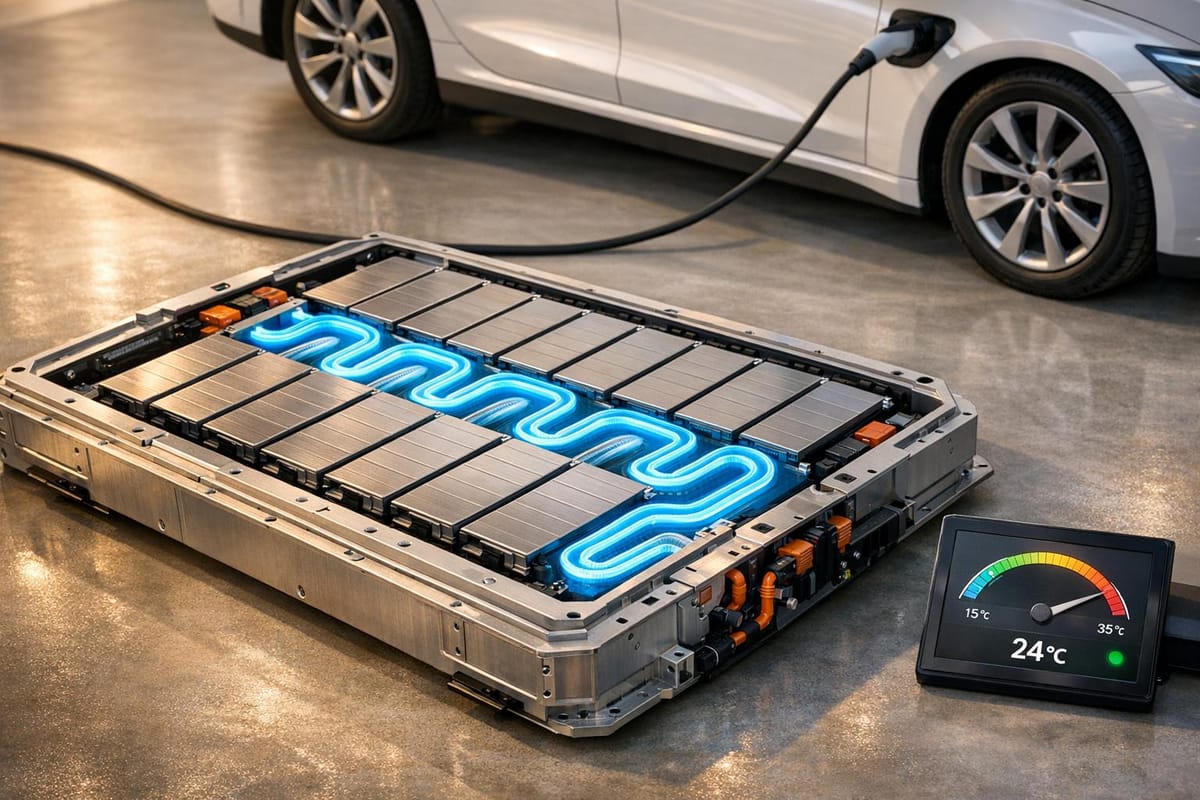
EV batteries last longer when their temperature is managed effectively. Keeping them within the ideal range of 15–35°C prevents damage from extreme heat or cold, which can accelerate degradation and reduce efficiency. Without proper management, batteries degrade faster, lose capacity, and consume more energy during heating or cooling.
Key takeaways:
- Heat harms batteries: High temperatures weaken internal components, causing faster capacity loss.
- Cold reduces efficiency: Low temperatures slow performance and can cause irreversible damage if not preconditioned.
- Thermal management slows degradation: Systems like liquid cooling reduce annual battery wear from 2.3% to 1.4%.
- Improves charging and safety: Advanced systems enable faster, safer charging while preventing overheating.
For fleet operators in the UK, thermal management is crucial for maintaining battery health, reducing costs, and ensuring reliable performance in varying weather conditions.
Battery Thermal Management System for Electric Vehicles | BTMS
How Temperature Affects EV Battery Performance and Lifespan
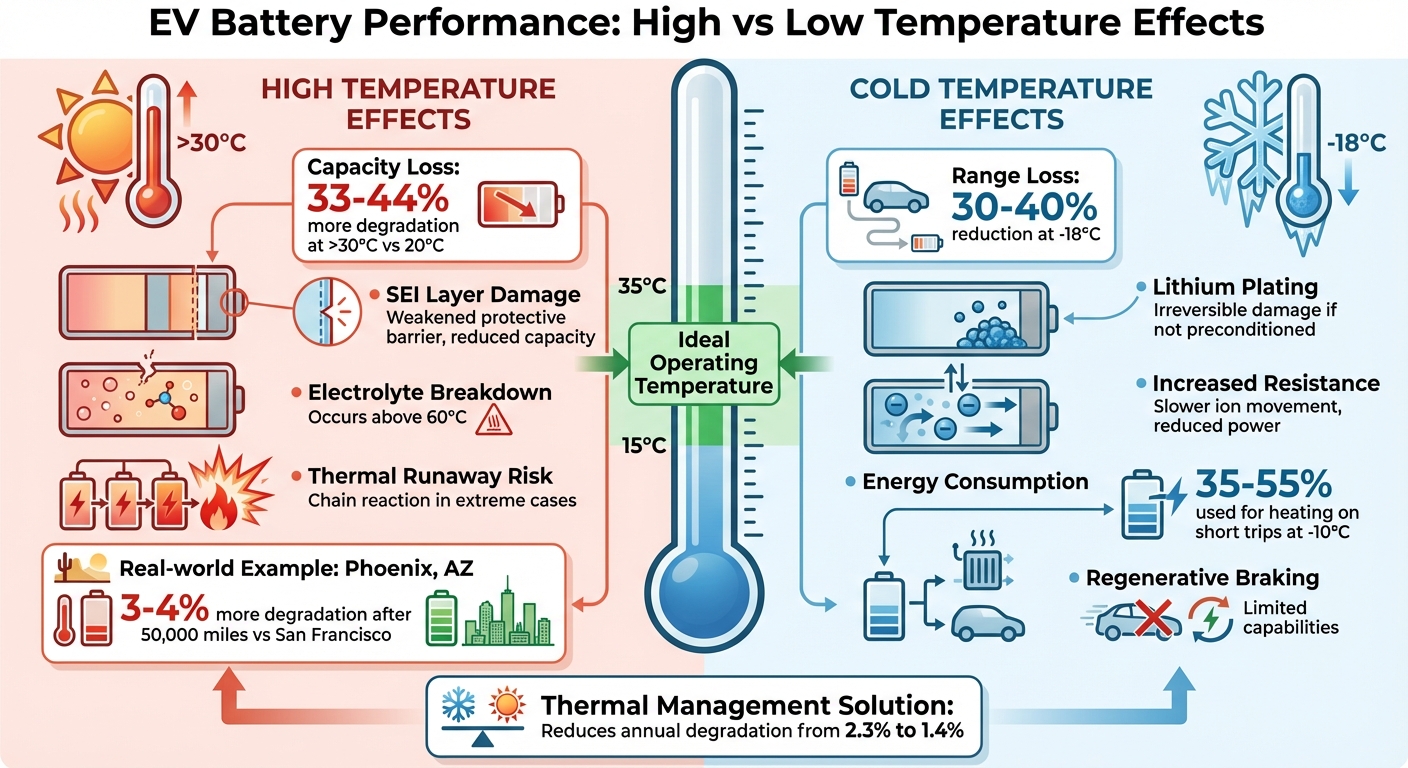
How Temperature Affects EV Battery Performance: Heat vs Cold Impact Comparison
Lithium-ion batteries work best within a specific temperature range - between 15°C and 35°C. Straying outside this comfort zone can either speed up damaging chemical reactions or slow down performance, leading to distinct problems. Let’s take a closer look at how both high and low temperatures affect battery health and efficiency.
High Temperature Effects on Battery Health
When temperatures rise, chemical reactions inside the battery intensify, which can lead to harmful side effects that permanently damage its internal structure. One critical component at risk is the Solid Electrolyte Interphase (SEI) layer, a protective barrier on the anode. Excessive heat weakens this layer, forcing the battery to use up energy and lithium to repair the damage, ultimately reducing its capacity.
Operating consistently above 30°C can lead to 33% to 44% more capacity loss compared to usage at 20°C. If temperatures climb above 60°C, the liquid electrolyte - key for ion movement between the anode and cathode - starts to break down. In extreme cases, this can cause a dangerous chain reaction known as thermal runaway, where overheating in one cell triggers failures in neighbouring cells. For example, data from April 2025 showed that Tesla vehicles in Phoenix, Arizona, experienced 3% to 4% more degradation after 50,000 miles compared to identical models in San Francisco, California, due to the impact of sustained high temperatures.
While heat can be destructive, cold conditions bring an entirely different set of hurdles.
Cold Temperature Effects on Battery Efficiency
Cold weather slows things down - literally. Lower temperatures increase the viscosity of the electrolyte, which slows ion movement and raises internal resistance. This results in reduced power output and limits regenerative braking capabilities. At -18°C, electric vehicles (EVs) can lose as much as 30% to 40% of their range.
Charging in freezing conditions can also cause lithium plating if the battery isn’t preconditioned, leading to irreversible capacity loss. Additionally, during short trips at -10°C, energy used for cabin and battery heating can account for 35% to 55% of total consumption. While the UK’s climate is generally milder than Nordic regions, winter cold snaps can still challenge EVs, especially for fleet vehicles using van tracking solutions for light commercial vans. These vans often face higher energy demands due to their large frontal areas and frequent door openings during deliveries.
Recognising how temperature impacts EV batteries is crucial for understanding the importance of thermal management systems, which play a key role in preserving battery life and performance.
Thermal Management Systems: Strategies and Technologies
Keeping batteries within the ideal 15–35°C range is essential for performance and safety. To achieve this, three main approaches are employed: passive, active, and hybrid thermal management systems. Each method offers a different way to regulate temperature, balancing cost, complexity, and cooling efficiency.
Passive Thermal Management Systems
Passive systems rely on Phase Change Materials (PCMs) to manage heat. These materials absorb excess heat by melting, helping to stabilise battery temperatures without the need for external energy. For instance, during fast charging or heavy acceleration, the PCM absorbs the heat generated, preventing dangerous temperature spikes.
However, standard PCMs have a low thermal conductivity of just 0.2 W/mK, which limits how quickly they can transfer heat. By incorporating expanded graphite, researchers have managed to boost this conductivity to 16.6 W/mK, which can lower battery temperatures by as much as 28%. While passive systems are excellent at maintaining uniform temperatures across battery cells, they struggle with sustained high-power heat dissipation. As a result, they are best suited for smaller, more affordable electric vehicles (EVs).
For situations requiring more robust heat management, active systems step in.
Active Thermal Management Systems
Active systems use mechanical components like pumps, fans, or compressors to circulate air or liquid coolant around the battery. Among these, liquid cooling has become the go-to choice for modern EVs. It’s far more effective at transferring heat than air, enabling support for fast charging speeds of 150 kW or higher. Typically, water-glycol mixtures are circulated through aluminium cold plates or channels, drawing heat away from the battery and dispersing it via a radiator.
"An EV's battery thermal management system is the plumbing and software that keep the pack in its happy temperature window... so it can deliver power, accept fast charges, and age gracefully instead of cooking itself to death." - Recharged
Many active systems also include preconditioning software, which uses navigation data to prepare the battery for fast charging by pre-heating or pre-cooling it. While this process consumes 5–7 kW of energy, it can significantly improve charging performance - turning a capped 50–70 kW session into one that exceeds 200 kW. The trade-off is added complexity and energy use, but the benefits in terms of charging speed and battery longevity are well worth it.
When both rapid response and continuous operation are required, hybrid systems step in as a middle ground.
Hybrid Thermal Management Systems
Hybrid systems combine the strengths of both passive and active approaches. PCMs ensure excellent temperature uniformity and buffer sudden heat spikes, while active cooling systems manage sustained heat removal during extended high-power operations. For example, integrating nano-enhanced PCMs with liquid cooling has been shown to reduce battery temperatures by up to 50%.
"Multi-component hybrid cooling technologies... are expected to become a major focus in the next stage of lithium-ion battery thermal management development." - Zhang Qianqiana et al., RSC Advances
The downside of hybrid systems lies in their complexity and cost. They require advanced control algorithms and additional components, making them more expensive to implement. However, they are increasingly being adopted in high-performance EVs and next-generation platforms, where managing extreme thermal loads - such as during rapid charging or extended motorway driving - justifies the investment.
Research Findings: Benefits of Thermal Management
Degradation Rate Reduction with Thermal Management
Research highlights that controlling battery temperatures effectively can significantly slow down degradation. By managing heat generated from overpotential, ohmic losses, and charge transfer, thermal management systems help protect battery materials from wear and tear. Batteries function best within a temperature range of 15–35°C. Operating outside this range can lead to excessive heat, which speeds up material breakdown, causes electrolyte decomposition, and thickens the solid electrolyte interphase (SEI) layer. Advanced systems minimise these risks by maintaining temperature differences within 5°C across the battery pack, preventing uneven ageing.
"Improper thermal management can lead to capacity degradation, reduced efficiency, accelerated aging, and, in extreme cases, catastrophic safety hazards such as thermal runaway." – Kenza Maher, Qatar Environment and Energy Research Institute
Recent tests have shown promising results. For instance, in July 2025, BYD's phase change material (PCM) cooling system reduced peak battery temperatures by 17.7°C, offering a cost-effective alternative to pure liquid cooling systems. Tesla’s glycol–water microchannel technology also maintained temperature uniformity (ΔT < 5°C) at high discharge rates, significantly reducing cell wear. Cold weather performance is another area where thermal management shines. Testing in December 2024 on a 2023 electric vehicle with a 360V, 236Ah battery revealed that advanced heat pump systems prevented the usual 36% driving range loss at -7°C.
Effective thermal management doesn’t just slow battery degradation - it also improves charging efficiency and enhances safety.
Improved Charging Efficiency and Safety
Thermal management plays a crucial role in making fast charging safer and more efficient. Without proper cooling, DC fast charging at rates above 150 kW can increase internal battery temperatures by 10–15°C. Over time, this can accelerate capacity loss by up to 25% during regular charging cycles. Advanced systems help control these temperature spikes, enabling charging speeds to surpass 200 kW without compromising battery health.
Pre-arrival conditioning, which adjusts the battery temperature before charging, further improves efficiency and reduces stress on the system. For example, heat pipe systems have achieved 95% efficiency in controlling temperature rise during high-power charging sessions. Similarly, immersion cooling using dielectric fluids has demonstrated a 28% reduction in peak battery temperatures.
Safety is another critical benefit. By keeping batteries within the ideal 20–30°C range, thermal management prevents the chain reactions that can lead to thermal runaway. Integration with Battery Management Systems has reduced the occurrence of hotspots by 20%, while nano-enhanced phase change materials have boosted thermal conductivity by 42%. These advancements are particularly important for fleet vehicles in the UK, which often face fluctuating weather conditions. With DC fast charging now accounting for 25% of all charging events - up from 10% in recent years - fleet operators can rely on these systems to maintain long-term battery health and safety.
Implications for Fleet Operations in the UK
Extending Battery Lifespan for Fleet Vehicles
For fleet operators, keeping vehicles on the road longer while cutting overall costs is a key priority. One way to achieve this is through effective thermal management, which prevents rapid battery capacity loss and extends service life. On average, EV batteries degrade at a rate of 2.3% annually. However, with proper thermal management and smart charging practices, this can drop to just 1.4% per year.
Liquid-cooling systems play a major role in maintaining battery health and increasing resale value. For fleets that typically replace vehicles every five to eight years, these systems can translate into savings of thousands of pounds per vehicle. As Charlotte Argue, Senior Manager of Fleet Electrification at Geotab, points out:
"The average battery is projected to have 81.6% of its original capacity (state of health or SOH) after eight years".
Managing the UK Climate
Beyond battery lifespan, dealing with seasonal temperature changes is another challenge for fleet operators. While the UK's mild climate generally supports EV operations, seasonal extremes still require attention. During winter, heating the battery is essential to avoid lithium plating during charging. Conversely, in summer, high temperatures and motorway speeds can cause overheating, which must be controlled. Modern heat pump systems, now standard in many EVs, tackle these issues by redistributing waste heat between the motor, battery, and cabin.
Simple practices like parking in shaded areas during summer or keeping vehicles plugged in during winter can also help minimise strain on the battery.
Integration with Fleet Telematics Solutions
Temperature management becomes significantly easier with the help of telematics systems. These platforms provide data-driven insights that allow fleet managers to stay ahead of potential issues. Since temperature extremes accelerate battery wear, telematics systems help by enabling proactive management. For example, they track battery health by monitoring energy usage during both charging and driving. This data helps identify high-wear behaviours, such as frequent use of high-power DC charging, which can double degradation rates to 3.0% annually.
GRS Fleet Telematics offers a practical solution for UK fleet operators, providing real-time monitoring and diagnostics for electric van fleets. Starting at just £7.99 per vehicle per month, this software allows managers to optimise charging schedules, track vehicle usage, and find ways to extend battery life. With 24/7 support, the platform ensures that any thermal management flags are addressed promptly, preventing small issues from turning into expensive repairs.
Conclusion
For fleet operators, managing the temperature of EV batteries is a crucial step in extending battery life and safeguarding their investment. Proper thermal control, combined with smart charging strategies, can significantly reduce battery degradation. For instance, the difference between 88% and 76% capacity retention over eight years often comes down to effective temperature management.
This is particularly important in the UK's unpredictable weather conditions. Fleet operators face unique challenges across different sectors, such as the impact of high-power DC fast charging, which now accounts for 25% of charging sessions and can increase degradation by up to 3.0% annually. Additionally, seasonal temperature fluctuations demand active measures, like heating during winter to prevent lithium plating and cooling in summer to avoid heat-related damage. Adopting charging speeds that align with operational needs, rather than always opting for the fastest option, is critical.
Telematics platforms offer a practical way to implement these strategies. By monitoring the State of Health (SOH), identifying wear-inducing behaviours, and optimising charging schedules, telematics ensures data-driven decision-making. As Charlotte Argue from Geotab highlights:
"For the best long-term battery health, the best practice is to use the lowest power level that still meets your operational schedule".
GRS Fleet Telematics supports this approach with real-time monitoring, 24/7 assistance, and actionable insights, all for £7.99 per vehicle per month. By leveraging tools like these, fleets can reduce long-term costs, extend battery life, and maintain vehicle value, especially when replacement cycles span five to eight years.
FAQs
How can I tell if my EV battery is overheating?
If your EV battery is overheating, you might notice dashboard warning lights, a drop in vehicle performance, or even feel excessive heat coming from the battery area. When these signs appear, it's important to act quickly - refer to your vehicle's manual or consult a professional to resolve the problem safely.
Does fast charging always shorten battery life?
Fast charging doesn’t necessarily shorten a battery’s lifespan. The effect it has largely depends on factors like temperature control and the frequency of its use. With good thermal regulation in place, occasional use of fast charging is unlikely to cause any major damage to the battery.
What simple habits help protect EV batteries in UK weather?
To safeguard EV batteries against the UK's varying weather conditions, it's essential to take a few precautions. During hot weather, park in shaded or sheltered areas to avoid overheating. In colder conditions, preconditioning the battery before driving or charging can make a big difference. Maintaining the battery within its ideal temperature range - typically between 15°C and 35°C - is key to prolonging its lifespan and ensuring optimal performance.