
AIS 140 Certification for Fleet IoT Devices
AIS 140 requirements for fleet IoT: GNSS/NavIC, panic buttons, dual-server/SMS fallback, IP-rated hardware, testing and state registration for legal compliance.

AIS 140 certification is mandatory for IoT devices in public service vehicles across India since April 2018. It ensures compliance with safety and tracking standards, requiring features such as GNSS support (including NavIC), emergency buttons, dual-server data transmission, and robust hardware. The certification process involves testing by ARAI or ICAT and registration with state transport departments.
Key Features Required for AIS 140 Certification:
- Tracking: GNSS, NavIC, GAGAN compatibility.
- Emergency Response: Panic buttons for passengers and drivers.
- Data Transmission: Dual-IP communication and SMS fallback.
- Hardware Durability: IP65/IP67 protection, 4-hour battery backup.
- Driver Monitoring: Sensors for harsh braking, acceleration, and sharp turns.
Why It Matters: AIS 140-certified devices improve fleet safety, enable real-time tracking, and meet legal requirements for public transport. They also help optimise routes and monitor driver behaviour, reducing operational costs. Certification is crucial for obtaining fitness certificates and operating legally.
Fleet operators must carefully choose certified devices, ensure proper installation, and maintain compliance through regular diagnostics and firmware updates.
AIS-140 GPS Tracker with NIC & VAHAN Integration | Full Guide | Atlanta Systems
AIS 140 Requirements for IoT Devices
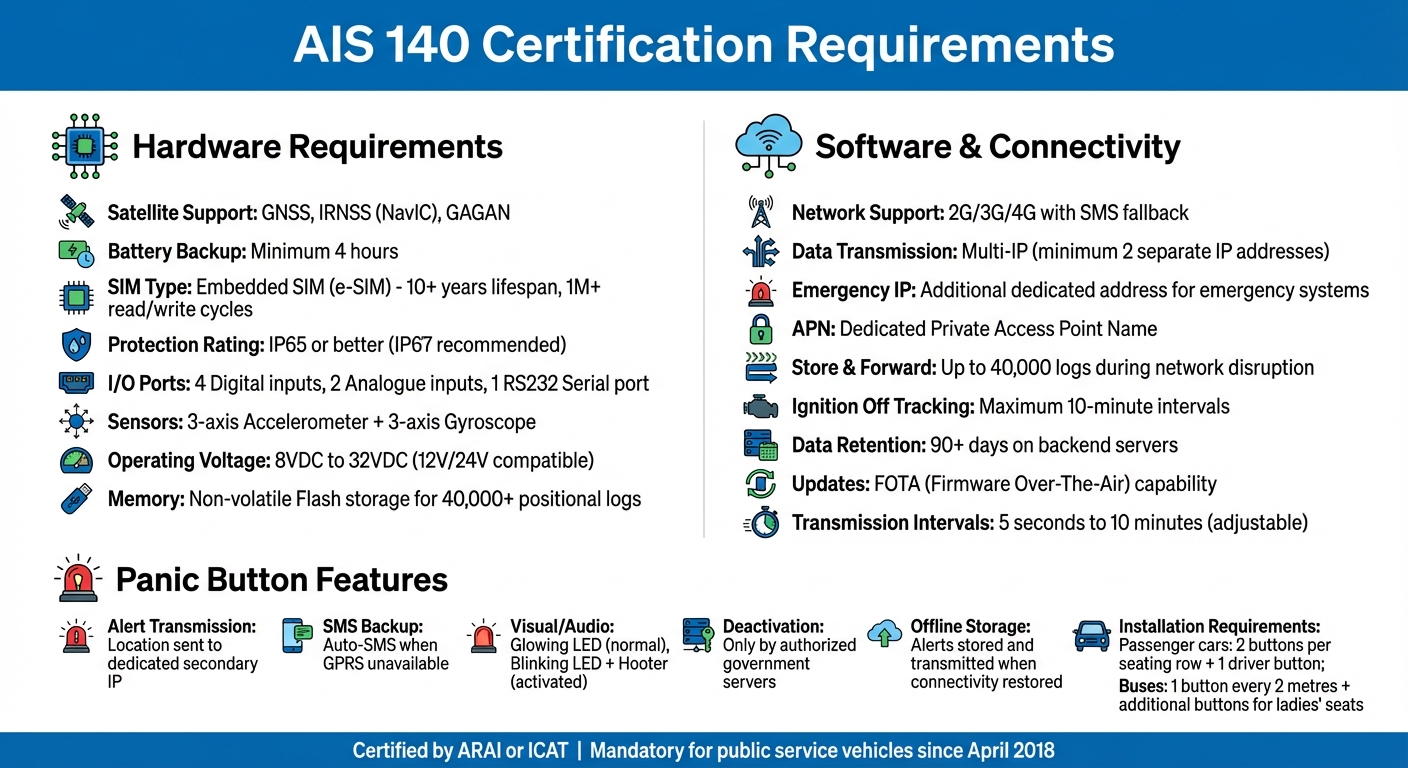
AIS 140 Certification Hardware and Software Requirements for Fleet IoT Devices
AIS 140 certification sets out strict technical guidelines for IoT devices, covering hardware, software, and safety features. These standards ensure the devices can handle tough environments while maintaining dependable connectivity and quick emergency responses. Below is a breakdown of the key hardware and software specifications required.
Required Hardware Features
AIS 140-certified devices must meet high durability and performance benchmarks. They need to support Global Navigation Satellite Systems (GNSS), including India's NavIC (IRNSS) and GAGAN systems, along with standard GPS. The devices must be equipped with a quad-band GSM/GPRS modem and an embedded SIM (e-SIM) that lasts a minimum of 10 years and supports over 1 million read/write cycles.
To monitor driving behaviour, the hardware must include a 3-axis accelerometer and a 3-axis gyroscope, which can detect events like harsh braking, sudden acceleration, and sharp turns. The devices also need to feature at least 4 digital inputs, 2 analogue inputs, and 1 RS232 serial port to connect with other peripherals. They should operate within a voltage range of 8VDC to 32VDC, making them compatible with both 12V and 24V vehicle systems, and include an internal battery backup capable of at least 4 hours of continuous operation.
While an IP65 protection rating is the minimum standard, devices exposed to heavy rain or pressure washing often benefit from an IP67-rated casing for added durability.
| Feature | AIS 140 Mandatory Requirement |
|---|---|
| Satellite Support | GNSS, IRNSS (NavIC), GAGAN |
| Battery Backup | Minimum 4 hours |
| SIM Type | Embedded SIM (e-SIM) |
| Protection Rating | IP65 or better |
| I/O Ports | 4 Digital, 2 Analogue, 1 Serial (RS232) |
| Sensors | 3-axis Accelerometer, 3-axis Gyroscope |
| Operating Voltage | 8VDC to 32VDC |
| Memory | Non-volatile (Flash) for offline storage |
Software and Connectivity Standards
For connectivity, AIS 140 devices must support 2G/3G/4G networks and include an SMS fallback option to ensure data transfer in areas with poor coverage. They must also use multi-IP transmission, sending Position, Velocity, and Time (PVT) data to at least two separate IP addresses for regulatory compliance, with an additional address reserved for emergency response systems. All data must be transmitted securely via a dedicated Private Access Point Name (APN).
To manage network disruptions, the devices need a "store and forward" system. This allows non-volatile memory to store up to 40,000 positional logs, which are prioritised for upload once connectivity is restored. Even when the vehicle ignition is off, devices must transmit location data at intervals no greater than 10 minutes. Backend servers are required to retain tracking data for at least 90 days. Additionally, Firmware Over-The-Air (FOTA) updates are essential for remote configuration and timely security updates. Data transmission intervals can be adjusted, ranging from every 5 seconds to every 10 minutes in power-saving mode. These measures ensure the devices remain functional and responsive under all conditions, particularly during emergencies.
Panic Button Requirements
The panic button is a critical safety feature, designed to provide immediate alerts during emergencies. When pressed, it sends the vehicle's location to a dedicated secondary IP address reserved for emergency systems. If GPRS connectivity is unavailable, the system automatically sends an SMS with the location data to designated control centre numbers.
The button is equipped with a glowing LED during normal operation. When activated, the LED blinks, and a hooter emits an alarm sound. Only authorised government servers can deactivate an emergency alert once triggered. In cases where there is no network coverage, the alert is stored on the device and transmitted as soon as connectivity is restored.
Installation requirements differ based on vehicle type. In passenger cars, two panic buttons are required per seating row, along with one for the driver. In buses, buttons must be installed every 2 metres, with additional buttons specifically for ladies' seats, ensuring accessibility during emergencies. The design of the button must prevent accidental activation while remaining easy to use in genuine emergencies. Alerts are monitored by state-level command centres, which coordinate with Emergency Response Support Systems (ERSS) to provide assistance.
How to Obtain AIS 140 Certification
Getting AIS 140 certification involves two main steps: first, testing the device at an authorised agency, and then registering it with state transport authorities. Manufacturers need to submit their IoT devices to either the Automotive Research Association of India (ARAI) or the International Centre for Automotive Technology (ICAT). These agencies conduct thorough evaluations to ensure the devices meet AIS 140 technical standards and requirements.
Once a device passes the testing phase, ARAI or ICAT issues a compliance certificate. However, this certificate alone doesn’t grant permission for the device to be used in commercial vehicles. Fleet operators must also register the certified device with their respective State Transport Department and integrate it with the Vehicle Location Tracking System (VLTS) or the national Vahan portal. Without this registration step, Regional Transport Offices (RTOs) won’t issue Fitness Certificates, which are critical for vehicles to operate legally in commercial settings. This two-step process ensures that devices meet both technical standards and the legal requirements for fleet operations.
Testing and Certification by ARAI and ICAT
ARAI, which originally published the AIS 140 standard under the Ministry of Road Transport and Highways (MoRTH), performs comprehensive testing on vehicle tracking units and emergency buttons. Similarly, ICAT evaluates devices for durability (such as confirming an IP67 rating), connectivity protocols, and navigation accuracy. Both agencies verify key features like required inputs and outputs, sensors, and battery backup performance. These tests ensure that certified devices are reliable and suitable for use in demanding fleet environments.
By September 2018, only 23 vendors had successfully met AIS 140 certification standards - a testament to the rigorous nature of the process. In 2019, the Fleetly Bharat-101 became the first vehicle tracking device in India to receive AIS 140 certification from ICAT. This device featured a robust IP67-rated casing, an embedded SIM for triple IP data transmission, and an 8-hour battery backup, setting a high standard for compliance. Certified devices generally cost between ₹4,200 and ₹7,600, depending on features like 4G support and IRNSS compatibility.
State Transport Department Approval
After passing certification, devices must also gain approval from state authorities to ensure seamless integration with Vehicle Location Tracking Systems. Once certified by ARAI or ICAT, fleet operators need to register their devices with the relevant State Transport Departments. Each state operates its own VLTS and may have specific integration protocols. For example, Uttar Pradesh requires National Permit commercial vehicles to send data directly to the UP VLTS platform at vlts.up.gov.in.
Because of these state-specific requirements, fleet operators must confirm that their devices are fully compatible with the respective backend systems and monitoring platforms. Skipping this step can result in RTOs refusing to issue or renew Fitness Certificates. This final approval is crucial for ensuring legal compliance and making certain that certified devices perform effectively within the larger fleet management system.
Benefits of AIS 140 Certified Devices
AIS 140 certification brings a host of advantages for fleet operators, stemming from its strict technical requirements. These standards ensure devices are durable, reliable, and capable of secure data transmission. Together, they support efficient, compliant fleet operations, as detailed in the following sections.
Improved Safety and Security
AIS 140-certified devices significantly enhance fleet safety by combining real-time tracking with robust emergency response systems. Each device leverages Global Navigation Satellite Systems (GNSS) and supports GAGAN - India's satellite-based augmentation system - to deliver location accuracy within 5 metres. This precision is critical for coordinating emergency responses with transport departments and law enforcement.
Emergency readiness is further bolstered by mandatory panic buttons. For instance, in Kerala, distress alerts are immediately routed to government portals, ensuring swift action during emergencies.
Another key feature is driver behaviour monitoring. Equipped with a three-axis accelerometer and gyroscope, these devices detect critical incidents like harsh braking, sudden acceleration, and sharp turns. Even in cases of power or connectivity issues, robust battery backups and sensor integrations ensure uninterrupted monitoring. This comprehensive safety framework not only protects assets but also contributes to the operational efficiencies discussed below.
Better Efficiency and Lower Costs
Beyond safety, AIS 140-certified devices improve operational efficiency and reduce costs. Real-time tracking allows for route optimisation, fuel savings, and proactive vehicle maintenance by monitoring engine performance and driving patterns. For example, continuous monitoring highlights inefficiencies like idling, speeding, or harsh acceleration, leading to reduced fuel consumption.
Additionally, tracking driving behaviours such as harsh braking and sharp cornering helps minimise wear and tear on tyres and other vehicle components, extending their lifespan. In cases of theft, live tracking with 30-second updates aids in rapid asset recovery, significantly lowering the financial impact of vehicle loss. Features like run-hour monitoring and odometer data also enable fleet managers to better allocate resources and optimise fleet size.
Meeting Legal Requirements
Compliance with AIS 140 is mandatory for all public service vehicles in India, including buses, taxis, and school transport. This certification is required to obtain or renew national permits and vehicle registrations for commercial and public transport vehicles.
Certified devices transmit real-time data to authorised servers, enabling authorities to monitor traffic and ensure public safety. Regular system health checks are crucial, as authorities can flag prolonged data outages. The uniform safety infrastructure provided by AIS 140 ensures consistent standards across the industry. Support for GAGAN and IRNSS (NavIC) further enhances positioning accuracy while maintaining data sovereignty for regulatory purposes. By meeting these legal standards, AIS 140 certification upholds operational integrity and builds public trust.
At GRS Fleet Telematics, we prioritise advanced fleet tracking solutions that adhere to AIS 140 standards, ensuring top-tier safety, operational efficiency, and full regulatory compliance.
Common Certification Challenges
Achieving and maintaining AIS 140 compliance isn’t without its hurdles. For fleet operators, challenges range from verifying device legitimacy to addressing connectivity issues. By understanding these obstacles, fleet managers can plan effectively and implement solutions to stay compliant.
Choosing and Installing Devices
The market is flooded with devices labelled as "AIS 140 ready", but not all carry official ARAI or ICAT certification. Fleet operators must confirm that chosen devices meet all the required standards, such as dual IP transmission and NavIC support. Opting for hardware compatible with both GPS and NavIC ensures readiness for any potential shift to a homegrown positioning system.
Installing these devices in larger vehicles, like buses, can be particularly demanding. For instance, buses require multiple emergency buttons - one every 2 metres - and dedicated buttons for seats reserved for women. This adds complexity to the wiring and installation process. Additionally, devices must meet an IP65 rating or higher to withstand dust, water, and temperature changes while being tamper-proof. Another critical requirement is an internal battery backup capable of at least 4 hours of operation, which presents long-term maintenance challenges. These difficulties are further exacerbated by connectivity issues during use.
Connectivity and Data Issues
Maintaining uninterrupted data transmission can be tricky in areas with poor network coverage. To comply with regulations, devices must store up to 40,000 positional logs in non-volatile memory, ensuring data is preserved even in areas without network availability. Once connectivity is restored, these devices automatically transmit stored alerts.
"The device must have the ability to utilise the GSM/GPRS signals and in case of no availability of the network, it must store all the alerts to be transmitted on the reception of the network." – LocoNav
SMS fallback is another critical feature, ensuring emergency alerts reach control centres even in areas with weak network signals. Devices equipped with embedded SIMs that can switch between telecom providers offer an added advantage, enabling consistent connectivity across regions. The embedded SIMs must also meet specific durability standards, including a lifespan of at least 10 years and support for over 1 million read/write cycles.
Maintenance and Compliance Audits
Ongoing maintenance is another significant challenge for fleet operators. Regular diagnostics are essential to ensure devices remain compliant. Firmware Over The Air (FOTA) updates allow for remote bug fixes and compliance updates, reducing the need to take vehicles out of service. Backend systems can also send SMS alerts to fleet managers if a device stops functioning or fails to send data for over 24 hours.
"The device will need to have an internal power backup of at least four hours. It needs to be capable of transmitting data alerts to the backend server; and support for over-the-air (OTA) software and configuration update." – Autocar Professional Bureau
Durability is another key consideration. Devices must maintain their IP65 rating throughout their lifespan, ensuring resistance to dust, water splashes, vibrations, and temperature fluctuations. Panic buttons also need to be configured so that only authorised government servers can deactivate them, a vital aspect of compliance checks. Setting maintenance alerts based on mileage or engine hours can help minimise downtime and ensure devices are inspected before they fail compliance audits.
For fleet operators in the UK, companies like GRS Fleet Telematics offer tailored solutions to tackle these certification challenges, ensuring all devices meet strict AIS 140 standards.
Maintaining AIS 140 Compliance
Staying compliant with AIS 140 regulations requires consistent monitoring and proactive maintenance. Neglecting regular checks can lead to devices falling out of compliance, which may result in blacklisting by state transport departments or fines.
Regular Health Checks and Renewals
Routine diagnostics play a key role in ensuring devices function properly without disrupting vehicle operations. Remote diagnostics, accessible via SMS or web platforms, allow fleet operators to monitor critical components like GPS, GSM, and sensors. This method saves time and minimises operational downtime.
It's also essential to periodically test the device's battery backup to confirm it can operate for at least 4 hours during power outages. Fleet operators should conduct power disconnect tests to verify this standard. Devices such as the BHARAT-101, for instance, can store up to 400,000 data records during network disruptions.
To keep devices up to date, Over-the-Air (OTA) firmware updates are crucial for applying bug fixes and protocol updates remotely. Scheduling regular firmware audits ensures devices run on compliant software. Additionally, performing visual inspections to check the integrity of IP67-rated casings can prevent internal damage that might lead to non-compliance. These steps help maintain seamless and compliant operations without interruptions.
Integration with Fleet Telematics Systems
Beyond maintenance, integrating AIS 140 devices with fleet telematics systems unlocks their full potential. These systems must support dual-server polling, which allows data to be sent simultaneously to the government’s central server and the fleet operator’s private backend. This setup ensures regulatory compliance while providing valuable insights for route optimisation, fuel usage, and driver behaviour analysis.
When integrated with vehicle sensors, the device's 3-axis accelerometer and gyroscope data can track events like harsh braking, over-speeding, and sharp turns, all accessible through the telematics dashboard. Emergency button alerts should also be configured to notify both the government’s emergency response system and the fleet’s internal dispatch centre promptly.
For operators in the UK, GRS Fleet Telematics offers seamless integration solutions with AIS 140 certified devices. These integrated systems improve tracking, enhance driver safety, and boost operational efficiency – all starting at just £7.99 per vehicle per month.
Conclusion
AIS 140 certification establishes a high standard for reliable and durable fleet IoT hardware. Its strict technical requirements ensure devices are dependable, even in demanding commercial settings. These specifications form the backbone of the operational, safety, and compliance benefits outlined here.
For fleet operators, the advantages go well beyond meeting regulatory demands. Features like advanced driver behaviour monitoring, real-time tracking, and route planning not only enhance safety but also help cut costs and boost efficiency. Emergency response functions add an extra layer of security, which is especially crucial for passenger transport and high-risk freight operations.
To sustain these benefits, regular maintenance and updates are essential. This includes health checks, firmware updates delivered over-the-air (OTA), and integration with telematics platforms that support dual-server polling - ensuring both regulatory data requirements and actionable insights are met.
For fleet operators in the UK, GRS Fleet Telematics provides AIS 140-compliant solutions that combine advanced tracking capabilities with a 91% vehicle recovery rate for theft cases, all starting at just £7.99 per month. This offering seamlessly merges compliance with practical, data-driven fleet management.
Investing in certified telematics solutions ensures your fleet stays ahead in safety, efficiency, and overall operational performance.
FAQs
What are the advantages of using AIS 140-certified devices in fleet management?
AIS 140-certified devices bring a host of advantages to fleet management, ensuring businesses stay compliant with government transport regulations while streamlining their operations. These devices offer real-time GPS/IRNSS tracking, enabling precise vehicle location and route monitoring. They also provide detailed telemetry data, such as insights into route adherence, fuel consumption, and driver behaviour, helping companies fine-tune their operations and cut down on unnecessary costs.
Safety is another key feature, with these devices including a government-approved panic button that allows for quicker emergency responses. Built to endure tough conditions, the hardware boasts rugged, IP67-rated designs, embedded eSIMs, and dual-server data transmission, ensuring consistent connectivity even in demanding environments. With these capabilities, AIS 140-certified devices have become an indispensable asset for modern fleet management.
What is the AIS 140 certification process for IoT fleet devices?
The AIS 140 certification guarantees that IoT tracking devices meet stringent technical and safety requirements before being deployed in commercial vehicles. These devices must feature GNSS positioning, dual-network cellular connectivity, and essential functionalities like a panic button and the ability to transmit diagnostic data. These standards are defined by the Automotive Research Association of India (ARAI).
To achieve certification, devices undergo type-approval testing in an ARAI-approved laboratory. This testing evaluates critical aspects such as performance, accuracy, and durability. For instance, devices are required to have IP67-rated casings and IRNSS compatibility. Once a device passes these tests, it is registered with the central ITS control centre and assigned a unique identifier. To remain certified, annual testing is mandatory.
For businesses, this ensures that any fleet management device - such as those provided by GRS Fleet Telematics - meets these rigorous standards, offering both reliability and compliance.
What are the main challenges for fleet operators in staying AIS 140 compliant?
Maintaining AIS 140 compliance can be a tough job for fleet operators, thanks to the strict technical and regulatory requirements involved. Every vehicle in the fleet needs to be fitted with a certified Vehicle Location Tracking (VLT) device that includes GNSS support, an embedded SIM with multi-network capability, a panic button, and ensures secure data transmission to government systems. These devices don’t just need to be installed - they must pass type-approval testing and go through annual re-certification. This means operators have to juggle testing schedules and maintain detailed records for each vehicle. Falling short of compliance could lead to fines, vehicle impoundment, or even the loss of operating licences.
On top of that, the operational side of things can get expensive and time-consuming. Operators may need to replace outdated trackers, which comes with significant upfront costs, and then deal with ongoing expenses like firmware updates, SIM management, and battery upkeep. Integrating these devices with existing telematics systems while ensuring continuous, encrypted data transfer to government servers can be a real strain on IT teams. To make matters even trickier, AIS 140 standards are updated periodically, meaning fleets might need to retrofit or re-certify devices to keep up.
For operators in the UK, GRS Fleet Telematics offers a practical solution. Their AIS 140-compliant tracking devices come with features like dual-tracker technology and built-in panic buttons, making compliance easier while reducing the need for frequent hardware upgrades.