AI Route Planning: 3 Use Cases for Fleets
AI route planning cuts fuel and emissions, improves on‑time deliveries and predictive maintenance across logistics, delivery and construction fleets.
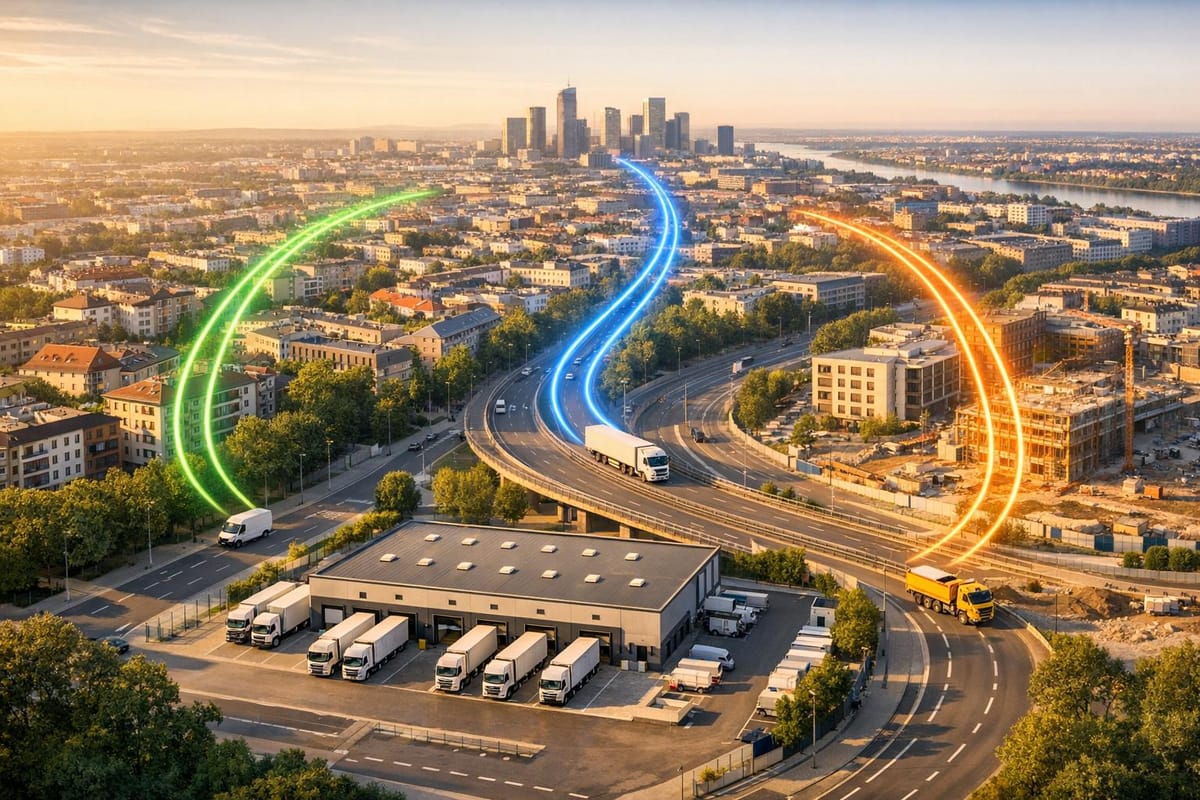
AI-powered route planning is transforming fleet operations by using live traffic data and historical trends to create efficient routes. This approach helps reduce fuel costs, vehicle wear, and emissions using van tracking solutions while improving delivery times and customer satisfaction. Here's how it's applied across logistics, delivery, and construction fleets:
- Logistics: Optimises multi-stop routes, saving up to 11% on fuel and cutting planning time significantly.
- Delivery: Increases on-time deliveries (up to 99.2%) and reduces failed attempts by 40%.
- Construction: Handles complex route restrictions and recalculates paths instantly when disruptions occur.
These systems also support predictive maintenance and better vehicle use, making them a practical choice for fleets of all sizes.
AI-Powered Route Optimization | NextBillion.ai
1. Logistics Fleet Optimisation
Managing logistics fleets means juggling countless stops, tight delivery schedules, and unpredictable traffic. AI-driven route planning steps in to tackle these challenges by streamlining delivery sequences, reducing mileage, and improving overall efficiency.
Fuel Savings (%)
Amazon demonstrated the power of AI in logistics by using route optimisation to consolidate deliveries, slashing travel distances by 10% and cutting fuel consumption by 11%. Similarly, in May 2025, Wheelz Up, under CEO Jeb Lopez, adopted AI to monitor harsh driving and minimise excessive idling, resulting in improved fuel efficiency.
For electric vehicle fleets, this technology becomes even more impactful. By prioritising delivery sequences that reduce vehicle weight earlier in the route, energy efficiency improves, directly extending the vehicle's range.
Sector-Specific Challenges Addressed
Logistics fleets often face the daunting task of managing upwards of 50 stops in a single day. AI route planning simplifies this by calculating the optimal stop sequence, taking into account delivery time windows, vehicle capacity, and live traffic conditions.
A smart way to integrate this technology is through a phased rollout. Start with a small group of vehicles to test connectivity and fine-tune algorithms. This approach helps minimise risks and resolve potential issues early on.
2. Delivery Fleet Efficiency
AI-driven optimisation is transforming how delivery fleets operate, making them faster, smarter, and more efficient.
Delivery fleets are constantly battling against the clock. Late deliveries not only annoy customers but also waste fuel and driver hours. AI-powered route planning is changing the game by adapting routes in real time to current conditions, ensuring parcels arrive as expected. This isn't just theory - fleets across the UK are already seeing measurable results.
On-Time Delivery Improvement (OTIF)
Take the example of a mid-sized 3PL provider. Between 2024 and 2025, they used APPIT Software's AI tools to increase on-time deliveries from 84% to an impressive 99.2%. At the same time, they cut route costs by 31%, saving a staggering £3.3 million annually. How? AI systems juggle multiple variables - like customer time slots, vehicle capacity, driver hours, and priority deliveries - to create efficient, realistic plans.
These systems also provide dynamic ETAs with 15-minute accuracy. This precision has reduced failed delivery attempts by 40%, significantly cutting down on expensive re-deliveries.
Sector-Specific Challenges Addressed
Urban deliveries, especially in cities like London, bring their own set of headaches. With over 12,000 traffic hotspots and Low Emission Zones to navigate, planning routes can be a logistical nightmare. AI simplifies this by constantly monitoring live traffic, weather conditions, and road closures, recalculating routes instantly to avoid delays. What once took planners over four hours now takes just 30 minutes, allowing managers to focus on strategic tasks instead of getting bogged down in route details.
"AI-powered route optimization is emerging as a game-changer... enhancing vehicle utilization, minimizing fuel consumption, and improving last-mile delivery efficiency." - Joel Paul, Senior Researcher, Stanford University
To fully benefit from AI route planning, start with a data readiness assessment. Ensure your telematics system can provide real-time GPS and driver behaviour data. Including drivers in the process is also key - showing them how optimised routes reduce stress can help build trust in the technology. Advanced telematics solutions, like those from GRS Fleet Telematics (https://grsft.com), offer the real-time data needed to unlock the full potential of AI-driven planning.
3. Construction Fleet Management
Managing construction fleets comes with its own set of challenges. Heavy vehicles require routes that consider axle weight, bridge restrictions, and legal road limits. AI-powered systems handle these complexities automatically, helping heavy equipment steer clear of unsuitable roads.
Tackling Sector-Specific Challenges
AI goes beyond weight restrictions by factoring in real-world conditions like road surfaces, elevation changes, and obstacles such as tunnels or rivers. This proactive approach helps fleets avoid costly delays caused by unexpected diversions.
It also addresses the unique demands of construction projects, such as narrow delivery windows and specific site access requirements. For instance, AI can coordinate access to service lifts or designated gates while ensuring drivers meet necessary qualifications.
When unexpected road closures, delays, or site changes occur, AI recalculates routes instantly, ensuring disruptions don't cascade across the fleet. By accounting for dwell times - the loading and unloading durations at busy sites - AI can also provide more precise ETAs.
"AI-powered route planning can create a triple-win situation: it strengthens customer loyalty, reduces operating costs due to greater efficiency, and reduces the ecological footprint." – DHL Freight
To get the most from AI, integrate it with existing telematics systems. This allows real-time vehicle and site data to enhance route planning. For instance, GRS Fleet Telematics offers advanced tracking tools that complement AI systems effectively. Mixed fleets also benefit, as AI plans routes suited to specific powertrains - like avoiding steep inclines for EVs or strategically placing charging stops.
Benefits Across All Use Cases
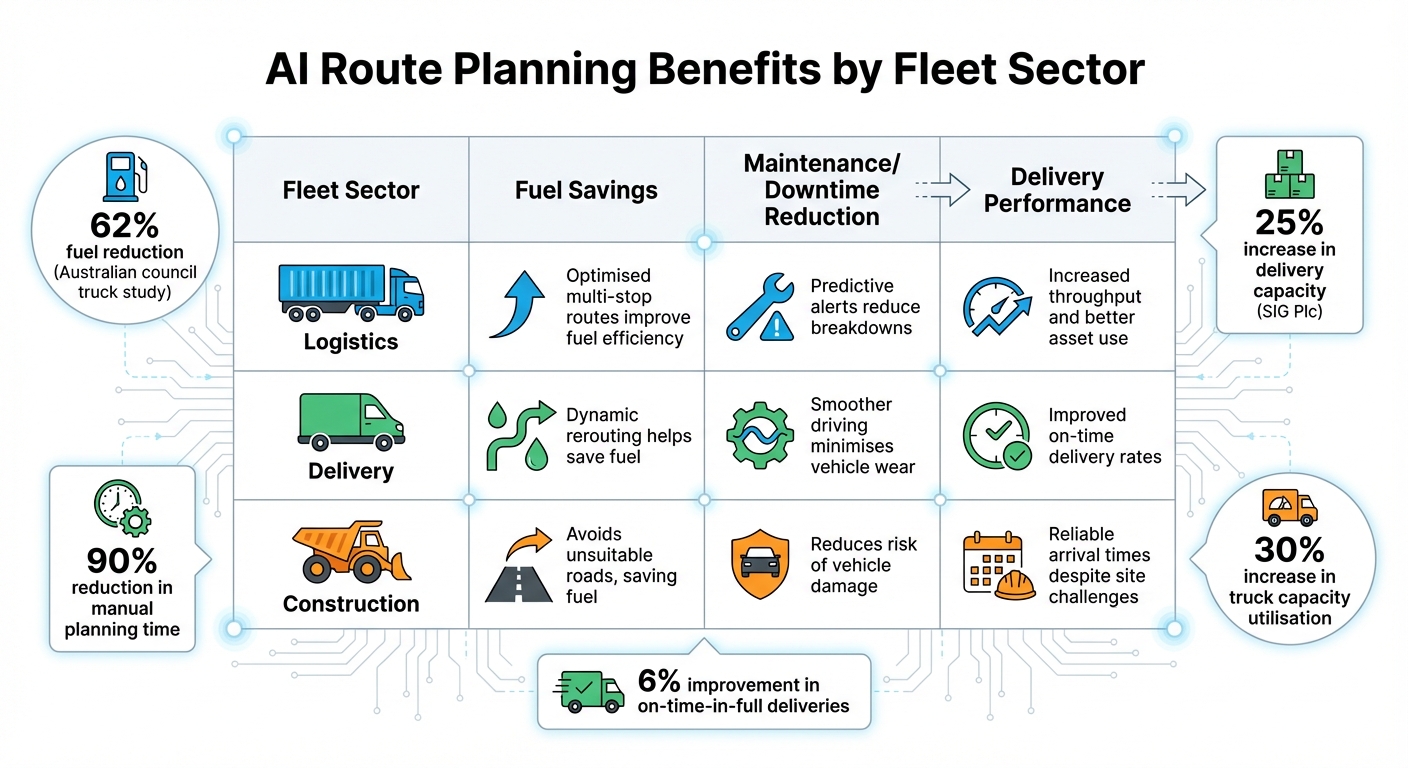
AI Route Planning Benefits Across Fleet Types: Fuel Savings, Maintenance & Delivery Performance
AI route planning delivers distinct advantages across logistics, delivery, and construction fleets while also offering shared benefits that transform operations.
One of the standout advantages is fuel savings. Take, for example, an Australian study where a council truck using an AI-optimised route cut its fuel consumption by an impressive 62% in just one month. These savings not only reduce operating expenses but also contribute to lowering carbon emissions - a win for both businesses and the environment.
Another game-changer is predictive maintenance. AI algorithms can anticipate when components are likely to fail, enabling fleets to schedule repairs before breakdowns occur. This approach minimises unexpected downtime and helps extend the lifespan of vehicles.
AI also improves asset utilisation by identifying underused vehicles. This allows fleets to handle increased demand without needing to expand their resources unnecessarily. Additionally, AI-powered dash cams provide real-time coaching to drivers, reducing fuel waste and limiting vehicle wear and tear.
Here's how these benefits play out across different sectors:
| Fleet Sector | Fuel Savings | Maintenance/Downtime Reduction | Delivery Performance |
|---|---|---|---|
| Logistics | Optimised multi-stop routes improve fuel efficiency | Predictive alerts reduce breakdowns | Increased throughput and better asset use |
| Delivery | Dynamic rerouting helps save fuel | Smoother driving minimises vehicle wear | Improved on-time delivery rates |
| Construction | Avoids unsuitable roads, saving fuel | Reduces risk of vehicle damage | Reliable arrival times despite site challenges |
"The Fleet Optimization package is designed to streamline and enhance fleet management processes, helping customers manage their fleets more efficiently and at a reduced cost." – Remco Timmer, Vice President of Product and Portfolio Management, HERE Technologies
In the UK, fleets can amplify these benefits by integrating AI route planning with cutting-edge tracking solutions from GRS Fleet Telematics. This combination ensures operations remain both efficient and sustainable.
Together, these advantages provide a solid foundation for improving overall fleet performance, which leads us into the next discussion.
Conclusion
AI route planning is proving to be a game-changer for UK fleets navigating the challenges of congested motorways, ULEZ zones, and unpredictable weather. Whether in logistics, delivery, or construction, this technology is delivering measurable benefits across all fleet types.
The impact is far-reaching. For instance, SIG Plc, a builders' merchant based in the UK, saw a 25% increase in delivery capacity, reduced fuel costs, and a 15% boost in on-time-in-full deliveries after adopting an AI-driven routing system. Similarly, another logistics company reported a 75% reduction in planning time alongside a 12% increase in delivery capacity, all while cutting emissions.
With rising fuel costs and stricter regulations, UK businesses are leveraging AI-powered solutions to stay ahead. Tools like GRS Fleet Telematics’ advanced tracking system, which offers dual-tracker security with a 91% recovery rate for stolen vehicles starting at just £7.99 per month, enable fleets to integrate AI benefits seamlessly. These systems address the unique challenges of operating in the UK, from M25 gridlock to navigating rural roads, while ensuring compliance with regulations.
The results are hard to ignore: fleets using AI route optimisation report a 90% reduction in manual planning time, a 30% increase in truck capacity utilisation, and a 6% improvement in on-time-in-full deliveries. These gains don’t just enhance operational efficiency - they also improve customer satisfaction and directly impact profitability.
FAQs
What data do I need to start using AI route planning?
To make the most of AI route planning in fleet management, you’ll need access to real-time and historical data. This data set should include traffic updates, weather conditions, vehicle status, and even driver behaviour. Telematics data such as vehicle location, speed, and performance metrics also play a critical role.
By analysing this information, AI can fine-tune routes, cut operating costs, and enhance delivery times. It achieves this by dynamically adjusting routes based on changes in traffic, weather, or vehicle performance.
How does AI rerouting work when traffic or site access changes?
AI rerouting leverages real-time data - like traffic patterns, weather updates, and road conditions - to adjust routes on the fly. By responding to these changing factors, fleets can dodge delays, cut down on fuel usage, and ensure quicker delivery times. This adaptability keeps operations running smoothly, even when the unexpected happens.
Can AI route planning support mixed fleets, including EVs?
AI route planning can handle mixed fleets, including electric vehicles (EVs). By analysing data, it optimises routes, reduces empty miles, and ensures compliance with emission zones. This helps improve efficiency and cut operational costs.