AI Route Optimisation for Multi-Vehicle Fleets
AI route optimisation cuts fuel and planning time, boosts deliveries and on-time rates, and manages ULEZ compliance for UK multi-vehicle fleets.
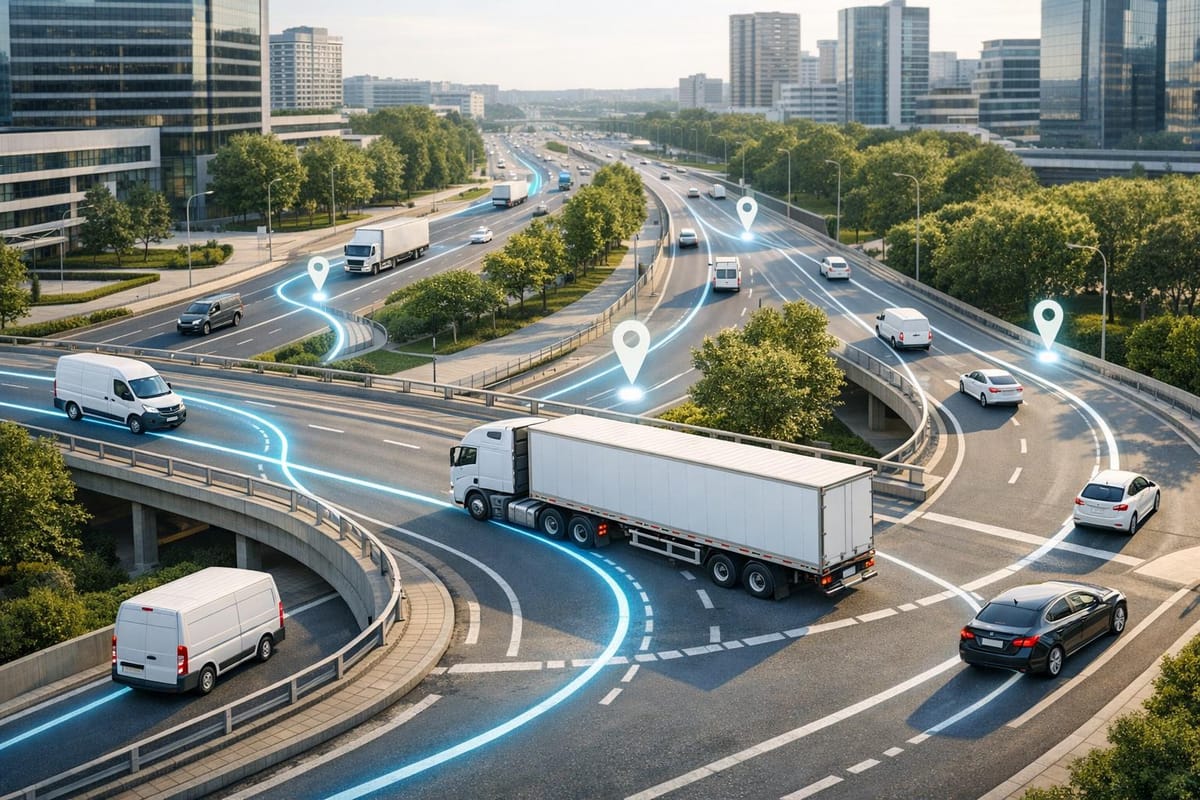
AI route optimisation is transforming how UK fleets operate. It replaces outdated manual planning with intelligent, real-time systems that cut costs, improve delivery times, and boost efficiency. Here’s what it offers:
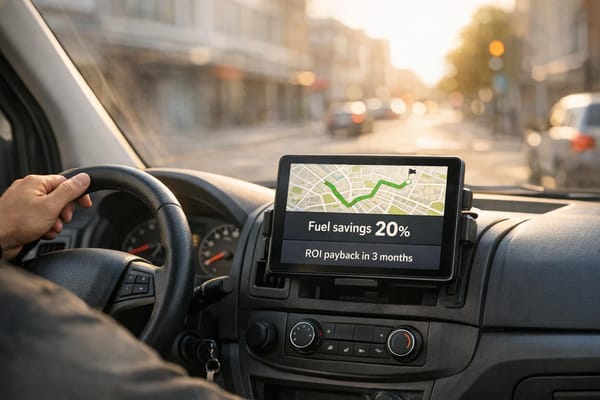
- Fuel Savings: Up to 20%, reducing costs by around £0.42 per mile.
- Increased Capacity: Up to 25% more deliveries per vehicle.
- Faster Planning: Time spent on manual routing drops by 75%.
- On-Time Deliveries: Achieves 95–99% reliability, reducing failed attempts by 40%.
- ULEZ Compliance: Automatically avoids zones to prevent fines (£12.50/day in London).
AI systems use advanced algorithms like genetic and reinforcement learning to handle challenges such as traffic, weather, and regulatory constraints. Tools like GRS Fleet Telematics enhance these capabilities with real-time tracking, theft prevention, and eco-driving analytics, starting at just £7.99 per vehicle per month.
For UK fleets, this means lower costs, happier customers, and easier compliance with complex regulations. Whether you manage a small or large fleet, AI-powered route optimisation delivers measurable results - often paying for itself within months.
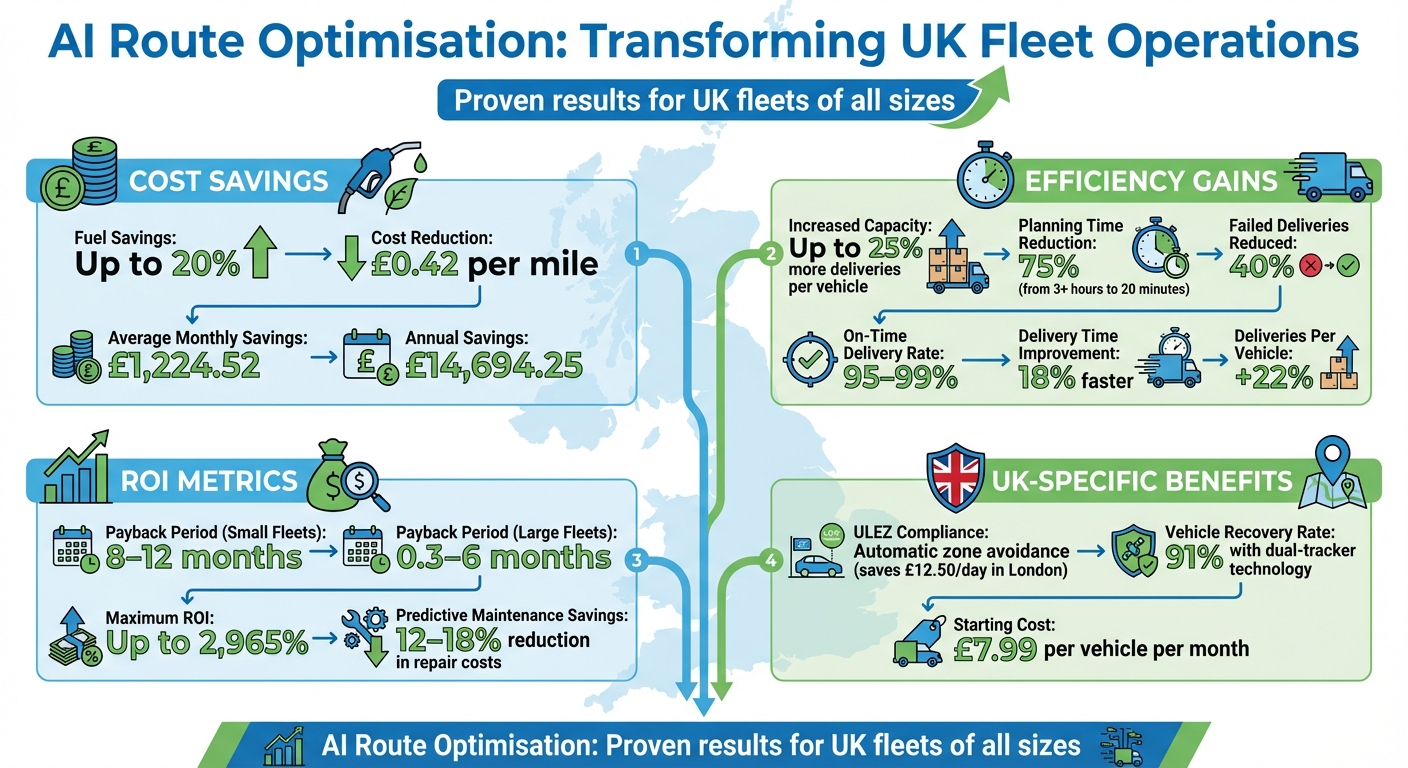
AI Route Optimisation Benefits for UK Fleets: Key Statistics and ROI
Challenges in Multi-Vehicle Fleet Routing
Route Planning Complexity
Managing routes with multiple stops becomes a logistical nightmare without automation. A single delay can throw off the entire schedule, forcing planners to reshuffle every subsequent stop. Now imagine handling over 20 deliveries per vehicle, each tied to strict two-hour delivery slots - it’s a recipe for chaos.
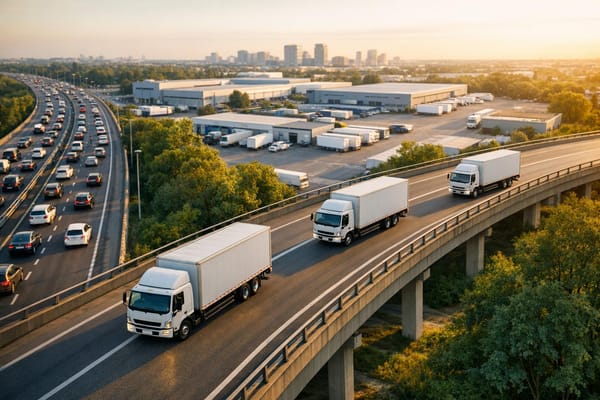
Fleet managers in the UK face even tougher hurdles. Think of the unpredictable nature of the M25, sudden shifts in weather, or customers altering their availability at the last minute. These real-time disruptions demand constant monitoring and adaptation. Unfortunately, manual systems just can't keep up with these dynamic challenges, leaving planners constantly scrambling to react. It’s easy to see why traditional routing methods often fall short.
Limitations of Manual Routing Methods
The old-school approach - relying on static maps, spreadsheets, and gut instinct - has its flaws. It completely disregards live traffic conditions or unexpected road closures. The result? Manual route planning takes 50–70% longer compared to AI-driven systems. Fleet managers spend hours piecing together schedules, only to have them unravel at the first sign of trouble.
The financial toll is equally concerning. In congested UK cities, manual routing can add an extra 42p per mile in fuel costs compared to optimised routes. And when disruptions occur - like a breakdown or a driver calling in sick - manual re-planning can take hours. In contrast, AI-powered systems can recalculate routes in seconds. One logistics company shared that switching to AI saved them 90 minutes a day, or 7.5 hours per week.
How Constraints Affect Fleet Performance
Beyond the inefficiencies of manual routing, additional constraints make fleet management even tougher. Planners must juggle vehicle capacity, driver schedules, and local regulations. For instance, they need to factor in load limits, weight restrictions, and urban emissions standards. In London, sending a non-compliant vehicle into the ULEZ can cost £12.50 a day in fines.
Driver compliance adds yet another layer of complexity. Legal limits on driving hours and mandatory rest breaks must be carefully woven into every route. A traffic jam on the M25 can push a driver dangerously close to their legal limit, forcing last-minute job reassignments. For large fleets, managing this manually becomes an impossible task. The fallout? Overworked drivers, missed deliveries, and mounting overtime costs.
| Feature | Manual/Rule-Based Routing | AI Route Optimisation |
|---|---|---|
| Data Inputs | Static schedules, postcodes, intuition | Real-time traffic, weather, and predictive data |
| Flexibility | Rigid; hard to adapt mid-route | Highly adaptable; recalculates in seconds |
| Planning Time | Over 10 hours weekly | Cut by up to 75% |
| Compliance | Manual checks; risk of ULEZ/LEZ fines | Automatically avoids restricted zones |
| Failed Deliveries | 40% higher than optimised systems | Reduced significantly with real-time rerouting |
AI-Powered Route Optimization | NextBillion.ai
AI Algorithms for Multi-Vehicle Route Optimisation
When it comes to managing multi-vehicle fleets, AI-powered route optimisation relies on three primary algorithms to navigate the complex challenges of routing. Genetic algorithms explore multiple route possibilities while factoring in constraints like vehicle capacity, delivery time windows, driver work-hour regulations, and road restrictions such as Low Emission Zones. Reinforcement learning steps in to handle real-time changes, using a parameterised decision policy to quickly adapt to evolving conditions like traffic congestion, bad weather, or unexpected incidents. Finally, machine learning uses historical data to refine travel time predictions, improving the reliability and efficiency of routes over time. Let’s dive into how these algorithms work in practical scenarios.
Genetic Algorithms for Route Combinations
Inspired by the process of natural evolution, genetic algorithms are designed to solve intricate routing puzzles. They create a variety of potential routes and assess each one against real-world constraints. The best-performing routes are then combined and refined to produce even more efficient solutions. This method also enables seamless coordination across an entire fleet. For instance, one vehicle might take on a slightly longer route if it allows others to operate more efficiently - a level of strategic planning that's almost impossible to achieve manually, especially with large fleets.
Reinforcement Learning for Real-Time Changes
Reinforcement learning approaches route planning as a series of decisions that can be adjusted on the fly. Instead of requiring a complete retraining for every new situation, these models rely on a parameterised decision policy to deliver near-optimal solutions in real time. Whether it's a traffic jam, adverse weather, or an unexpected breakdown on the M6, reinforcement learning allows fleets to adapt swiftly. For UK-based operations dealing with unpredictable conditions, this flexibility is key to ensuring timely deliveries and reducing costly delays.
Machine Learning for Route Prediction
Machine learning focuses on improving route predictions by analysing historical data, including past journey times, traffic trends, and delivery outcomes. Over time, it identifies patterns and refines its travel time estimates. In fact, machine learning-based forecasting has reached accuracy rates of up to 98% and has been credited with cutting failed delivery attempts by as much as 40%. Beyond just estimating travel durations, these systems can flag potential challenges - like tight delivery schedules or vehicles nearing their legal driving limits - before they cause disruptions to operations.
Key Features of AI-Powered Fleet Systems
AI route optimisation shines through its ability to process and integrate vast amounts of data, far beyond human capability. With the ability to evaluate over 100 factors, these systems revolutionise how fleets manage challenges like unexpected traffic or complex delivery schedules. The most effective AI-powered fleet systems focus on three standout features that significantly enhance daily operations: live traffic and weather integration, multi-stop scheduling with time windows, and intelligent vehicle capacity management. These elements form the backbone of the operational improvements explored in the following sections.
Live Traffic and Weather Data
AI systems leverage live traffic and weather updates to dynamically adjust routes, saving an average of 12 minutes per delivery. Imagine a lorry stuck in a traffic jam on the M25 or slowed by heavy rain on the M6 - AI recalculates the best route in real time, ensuring minimal delays. This adaptability reduces failed delivery attempts by up to 40%. Additionally, by avoiding stop-start traffic and choosing smoother-flowing routes, fleets can cut fuel costs by as much as 20%. This efficiency helps on-time delivery rates consistently reach an impressive 95% to 99%.
Multi-Stop Scheduling and Time Windows
Handling multiple stops while adhering to strict time windows - like a delivery scheduled between 14:00 and 16:00 - becomes increasingly challenging as fleet sizes grow. AI simplifies this by evaluating countless route combinations to sequence stops efficiently, all while considering driver regulations. This optimisation increases deliveries per vehicle by 22% and reduces delivery times by 18%. For instance, Tesco adopted AI-powered route planning to achieve these results. Similarly, Sainsbury's reached a 96% on-time delivery rate while lowering last-mile costs by 15%. The technology also slashes planning time by 75%, enabling fleet managers to focus on strategic tasks rather than day-to-day logistics.
Vehicle Capacity and Load Management
AI systems excel at managing vehicle loads, ensuring optimal use of space while avoiding overloading. They account for factors like weight limits, height restrictions, refrigeration needs, and even sequencing for Last-In, First-Out (LIFO) loading when required. This precision boosts fleet capacity by up to 25%. For example, Metro Cash and Carry reduced delivery expenses by 13% through AI-driven logistics. In electric vehicle fleets, AI considers battery range and charging station availability, strategically sequencing loads to reduce weight earlier in the journey, thereby extending range and efficiency.
How GRS Fleet Telematics Supports Route Optimisation
While AI algorithms handle the heavy lifting of route optimisation, their practical application needs a solid tracking system to work effectively. That’s where GRS Fleet Telematics steps in. By transforming AI-generated insights into tangible results, this platform offers UK fleets a well-rounded solution. With features like real-time tracking, eco-driving analytics, and flexible pricing plans, GRS Fleet Telematics ensures fleets of all sizes can improve efficiency and performance.
Real-Time Tracking and Theft Prevention
GRS Fleet Telematics builds on AI-generated data by analysing live traffic conditions, delivery schedules, and vehicle health to create dynamic, real-time routes suited to UK roads. Operators can track their vehicles at all times, enabling them to respond swiftly to delays caused by roadworks, accidents, or bad weather. If congestion or unexpected closures occur, the system recalculates routes to minimise idling time and save fuel.
The platform also boosts security with dual-tracker technology, which has achieved an impressive 91% recovery rate for stolen vehicles. Geofencing adds another layer of protection by setting up virtual boundaries. If a vehicle strays from its designated route or enters restricted zones such as Low Emission Zones (LEZ) or Ultra Low Emission Zones (ULEZ), the system sends instant alerts.
Eco-Driving Analytics for Lower Costs
Driver behaviour plays a huge role in operational efficiency, and GRS Fleet Telematics helps monitor key habits like idling and harsh acceleration. With this data, businesses can provide targeted coaching to improve driving practices. For instance, eco-driving reports alone can cut fuel consumption by up to 10%, while AI-powered route adjustments and fuel-efficient planning can lead to a 15% reduction in fuel costs.
"Key to reducing carbon emissions is, of course, reducing fuel consumption... it's a matter of driving smarter and maximising efficiency wherever possible." – Adam Partington, Teletrac Navman UK
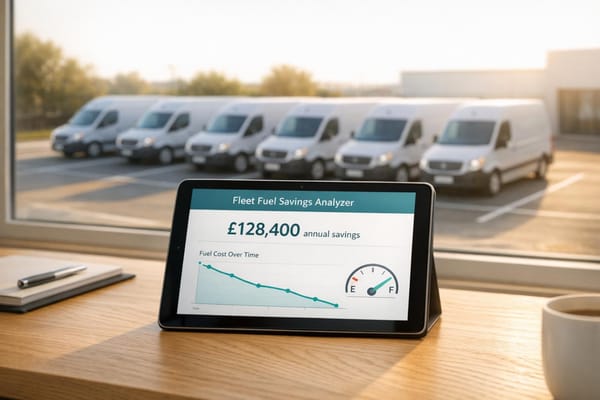
On average, businesses using this platform save £1,224.52 per month, which adds up to an annual saving of about £14,694.25. Additionally, reducing vehicle idling can save approximately £116 per vehicle annually.
Flexible Plans for Any Fleet Size
GRS Fleet Telematics offers three hardware options tailored to different security and operational needs, with subscription costs starting at just £7.99 per vehicle per month.
- The Essential Package (£35) includes a single wired GPS tracker for real-time tracking.
- The Enhanced Package (£79) adds a Bluetooth backup tracker for better theft prevention.
- The Ultimate Package (£99) features dual trackers along with remote engine immobilisation for maximum security.
| GRS Package | Hardware Cost | Key Features |
|---|---|---|
| Essential | £35 | Real-time GPS tracking, AI route optimisation |
| Enhanced | £79 | Dual-tracker system (wired tracker + Bluetooth backup) |
| Ultimate | £99 | Dual trackers plus remote engine immobilisation |
Installation is free when bundled with fleet branding. The platform’s cloud-based infrastructure makes it easy for businesses to scale up or down, accommodating fleets of any size. For larger organisations, GRS even offers white-label branding to integrate telematics directly into internal systems. With a staggering return on investment of 2,965% and a payback period of just 0.3 months, this system proves its worth for fleets big and small.
Steps to Implement AI Route Optimisation
Switching from manual to AI-powered routing can transform how your fleet operates, but it’s not as simple as flipping a switch. Careful planning, the right tools, and thorough training are essential to ensure a seamless transition and to fully harness the potential of this technology.
Assess Your Fleet Needs and Goals
Before diving into AI solutions, take a close look at your current routing processes. Are you relying on spreadsheets, outdated software, or manual, experience-based planning? These methods often consume too much time and leave room for inefficiencies.
Start by gathering 3–6 months of historical performance data. This should include metrics like on-time delivery rates, average journey durations, fuel usage, and failed delivery instances. Analysing this data helps establish a baseline to measure improvements and identify key pain points. For instance, fuel costs are a major concern for 69% of fleet managers, and AI-powered real-time rerouting can cut failed deliveries by up to 40%.
Set clear goals for what you want to achieve. Are you aiming for a 25% increase in capacity, a 75% reduction in planning time, or a 95% on-time delivery rate? These benchmarks will guide your implementation strategy and help you measure success.
Also, consider the nature of your operations. Do you need static routing for recurring stops, dynamic routing for unpredictable customer visits, or a mix of both? This decision will influence which AI solution is best suited for your needs.
Select the Right Tools and Partners
Once you’ve assessed your requirements, it’s time to choose a solution that aligns with your operational needs and complies with UK-specific regulations. Your system should handle Low Emission Zones (LEZ), Ultra Low Emission Zones (ULEZ), and driver hours regulations. It should also integrate real-time traffic data, such as feeds from Transport for London, to adjust routes dynamically instead of relying solely on static plans.
Scalability matters too. For example, GRS Fleet Telematics offers flexible solutions starting at just £7.99 per vehicle per month. To test the waters, consider a 4–8 week pilot programme with a small portion of your fleet. This trial allows you to compare AI-generated routes with your current methods, assessing improvements in fuel efficiency, delivery times, and overall performance.
It’s also wise to partner with providers who offer clear return-on-investment (ROI) timelines. Many systems are designed to pay for themselves within 8–12 months.
Train Drivers and Staff
Even the best AI system won’t deliver results without proper training. Drivers need to learn how to use in-cab terminals or smartphone apps for real-time navigation, job updates, and digital proof of delivery. It’s important to explain that tracking data is used to enhance routing efficiency, not to monitor employees unnecessarily.
"The shift is from manual route creation to exception-based management." – GRS Fleet Telematics
For planning staff, the focus shifts from manually building routes to refining AI-generated plans and managing exceptions. They’ll need to understand how to input operational rules - such as delivery time windows, driver skill levels, vehicle weight limits, and ULEZ compliance - so the AI can create practical routes. Flexibility is key; staff must be able to adjust these rules as new challenges arise, like seasonal demand spikes or newly introduced delivery zones.
Encourage drivers to report issues like road closures or inaccurate delivery addresses. This feedback helps improve the AI’s accuracy over time. Pair route optimisation training with eco-driving techniques, such as minimising idling and avoiding harsh acceleration, to maximise fuel savings.
With the right preparation and training, your team can cut planning time by up to 75% while keeping daily operations running smoothly.
Measurable Benefits of AI Route Optimisation
Cost Savings and Efficiency Improvements
AI-powered route optimisation is transforming fleet operations across the UK, delivering clear financial benefits. For example, fleets typically achieve 10–20% fuel savings. In busy cities like London, Manchester, and Birmingham, optimised routes reduce stop-start driving and idle time, which significantly lowers fuel consumption and operating costs.
The time spent on route planning also sees a dramatic reduction - from over three hours manually to just 20 minutes with AI. This allows dispatchers to focus on more pressing tasks, such as handling unexpected issues. For a mid-sized fleet with an annual fuel budget of £50,000, a 12% fuel saving translates to approximately £6,000 per year. Predictive maintenance further enhances cost efficiency, cutting repair expenses by 12–18% by identifying potential mechanical issues before they escalate into costly breakdowns.
| Feature | Traditional Planning | AI-Powered Planning |
|---|---|---|
| Planning Time | 3+ hours (Manual) | 20 minutes (Automated) |
| Daily Mileage | ~120 miles/day | ~96 miles/day (20% reduction) |
| Traffic Handling | Static/Reactive | Real-time/Predictive (TfL/National Highways) |
| Compliance | Manual checks for ULEZ/LEZ | Automated geofencing and rerouting |
These cost efficiencies naturally improve operational performance, paving the way for better delivery outcomes.
Better Delivery Times and Customer Satisfaction
Lower operational costs directly contribute to improved delivery reliability. AI tools provide highly accurate ETAs based on real-time data, replacing vague delivery windows like "morning or afternoon" with precise arrival times. As a result, on-time delivery rates climb to 95–99%, while failed delivery attempts decrease by up to 40%.
Leading UK retailers showcase these benefits. Sainsbury's achieved a 96% on-time delivery rate while cutting last-mile costs by 15%. Tesco reduced delivery times by 18% and increased deliveries per vehicle by 22%. At a Greater Manchester depot with 150 drivers, fuel savings of £1,200 per week were coupled with an improved on-time delivery rate, rising from 78% to 95% - achieving full ROI in just six weeks.
AI-optimised routing also enhances fleet capacity, enabling businesses to handle 20–25% more deliveries without adding vehicles or staff. Customers benefit too, with fewer "Where's my delivery?" calls, thanks to real-time tracking updates that provide accurate delivery information.
ROI Data for UK Fleets
The return on investment (ROI) for AI route optimisation is clear and compelling. Larger fleets, in particular, enjoy faster payback periods due to economies of scale. For instance, a Fortune 500 supply chain achieved a 250% ROI in two years, alongside a 25% reduction in delivery times and a 20% boost in on-time deliveries.
| Metric | Small Fleet (<50) | Large Fleet (200+) |
|---|---|---|
| Payback Period | 8–12 months | 0.3–6 months |
| Typical ROI | Positive within 1st year | Up to 2,965% |
| Primary Benefit | Fuel savings and security | Capacity boost |
| Planning Efficiency | Minimal impact on overhead | 75% reduction in dispatcher hours |
| GRS Monthly Cost | £7.99 per month | £7.99 per month (Scalable) |
GRS Fleet Telematics offers cost-effective solutions, starting at just £7.99 per vehicle per month. Hardware options range from £35 for basic tracking to £99 for advanced dual-tracker systems with immobilisation. With a 91% recovery rate for stolen vehicles, these tools provide not only routing efficiency but also added security, making AI route optimisation a smart choice for fleets of all sizes.
Conclusion
AI-driven route optimisation is revolutionising fleet operations across the UK. Gone are the days of manually planning fixed routes - today, dynamic systems respond in real time to factors like traffic, weather, and customer needs. The result? Fewer delivery failures, reduced fuel consumption, and more reliable arrival times.
UK fleets are seeing tangible results: fuel savings of 10–15%, a 75% reduction in planning time, and on-time delivery rates of 95–99%. Impressively, these systems often pay for themselves within 8–12 months, with some achieving ROI in as little as 0.3 months.
Take GRS Fleet Telematics, for example. Their platform offers real-time tracking, eco-driving insights, and dual-tracker security, which boasts a 91% vehicle recovery rate. At just £7.99 per vehicle per month, it’s an affordable solution that scales effortlessly for fleets of all sizes. These immediate gains set the stage for even more advancements in fleet management.
The Future of AI in Fleet Management
With these proven benefits as a foundation, fleet management is now shifting towards continuous optimisation. Instead of relying on static, pre-planned routes, AI-powered systems adapt on the fly as new orders come in. This real-time approach, supported by edge computing, processes data directly on vehicles, ensuring ultra-fast responses, enhanced safety, and reliable offline capabilities.
For UK fleet operators, starting with a pilot programme involving a small subset of vehicles over 4–8 weeks can help establish baseline metrics. Engaging drivers with training that highlights how AI reduces navigation stress and creates manageable schedules - not just as a monitoring tool - can ease the transition. With 67% of UK fleet managers expecting telematics to significantly boost productivity by 2025, early adopters are well-positioned to gain a competitive edge in efficiency, cost savings, and customer satisfaction.
FAQs
How does AI route optimisation manage real-time issues like traffic and bad weather?
AI-powered route optimisation leverages real-time data like traffic updates, weather conditions, and vehicle locations to adjust routes dynamically. By processing this information, it can redirect vehicles to bypass delays caused by traffic jams, road closures, or poor weather, keeping deliveries on schedule.
This technology doesn't just streamline operations - it also cuts fuel usage and lowers operational expenses, enabling businesses to stick to dependable schedules while meeting customer demands.
What are the costs and savings associated with using AI for fleet route optimisation?
AI-powered route optimisation can deliver substantial savings for fleet operators, though it does come with upfront and recurring costs. For UK fleets, fuel expenditure can often be reduced by 10–20%, equating to savings of about £0.42 per mile in urban settings. For a mid-sized fleet, this could result in annual fuel savings of roughly £6,000. Beyond fuel, AI systems can also lower maintenance costs by 12–18%, cut planning times by as much as 75%, and boost vehicle utilisation rates by 20–25%.
The main ongoing expense is the telematics subscription, which provides the real-time data essential for AI systems. For example, GRS Fleet Telematics offers van tracking services starting at £7.99 per month per vehicle, including advanced security features and compatibility with optimisation platforms. Thanks to these efficiencies, many operators see their investment paid back within 8–12 months, with some achieving returns even faster. For most UK fleets, the long-term savings and operational improvements make the initial outlay well worth it.
How does AI route optimisation enhance delivery times and customer satisfaction?
AI-powered route optimisation leverages real-time data - like traffic updates, GPS tracking, weather conditions, and vehicle statuses - to calculate the most efficient routes for your fleet. By steering clear of congestion, low-emission zones, and restricted roads, it can boost vehicle usage by 20–25%, slash planning time by up to 75%, and cut down on fuel consumption and mileage.
These enhancements translate into quicker, more dependable deliveries. Real-time route adjustments can trim delivery times by up to 18%, improve on-time arrivals to an impressive 95–99%, and reduce failed delivery attempts by around 40%. For customers, this means shorter waiting times, more precise delivery windows, and fewer missed deliveries - key factors in building trust and satisfaction in the highly competitive UK logistics sector.