AI Route Optimisation for Large Fleets
AI-driven route optimisation for UK fleets reduces fuel use, planning time and late deliveries with live telematics, real‑time rerouting and compliance.
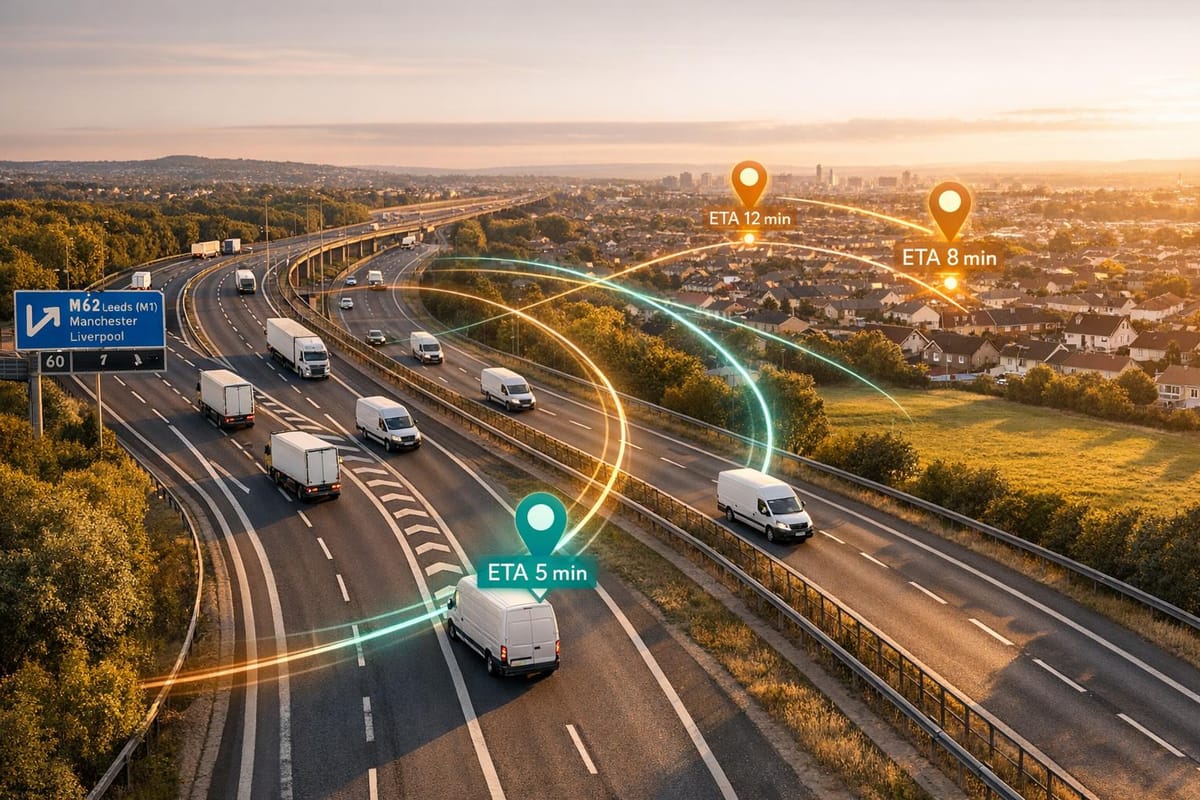
Managing a fleet in the UK is complex. Rising fuel costs, driver shortages, and strict regulations make route planning harder. AI route optimisation simplifies this by creating efficient, real-time routes using data like traffic, weather, and vehicle performance. The result? Lower costs, fewer delays, and better delivery performance.
Key Takeaways:
- What It Does: AI analyses traffic, driver hours, vehicle capacity, and road conditions to plan smarter routes.
- Why It Matters: Large fleets face challenges like congestion charges, emission zones, and delivery deadlines. AI handles these efficiently.
- Benefits: Save fuel (10–15%), reduce planning time (up to 75%), and improve on-time deliveries (95–99% success rates).
- How It Works: Combines live data, machine learning, and predictive algorithms to adjust routes dynamically.
AI systems like GRS Fleet Telematics offer tools to simplify compliance, cut costs, and improve fleet efficiency. Start with a small pilot programme to test and scale across your fleet.
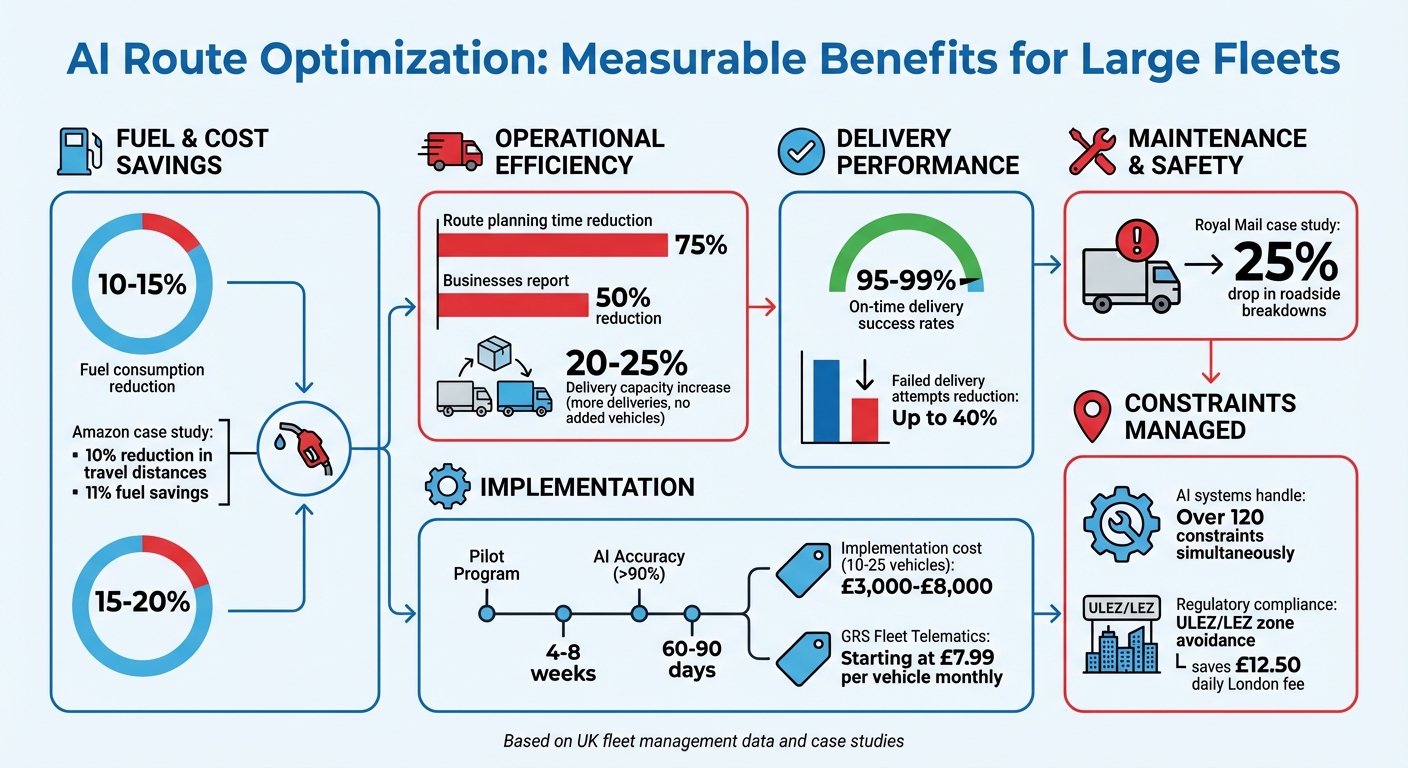
AI Route Optimization Benefits for UK Fleets: Key Statistics and Savings
AI-Powered Route Optimization | NextBillion.ai
How AI Route Optimisation Works
To grasp the impact of AI route planning, it helps to understand how it operates. AI route optimisation functions as a continuous loop - it collects data from various sources, processes it in real time, and dynamically adjusts routes throughout the day. This adaptability ensures routes evolve as conditions shift. Let’s break down how data collection, algorithmic processing, and real-time adjustments work together.
Data Collection and Analysis
AI systems rely on a constant flow of accurate data. They gather information from vehicle telematics, GPS devices, traffic sensors, weather reports, customer databases, and driver schedules. For UK fleets, this includes details like Low Emission Zone (LEZ) boundaries, congestion charge areas, road weight limits, and low bridge restrictions - factors that can significantly affect certain vehicles.
The system’s performance hinges on the quality of this data. It’s essential to review historical records for inconsistencies and ensure data uses standard UK formats, such as metric measurements and the 24-hour clock. Providers like GRS Fleet Telematics use dual-tracker setups (a primary hardwired tracker with a hidden Bluetooth backup) to prevent data interruptions, which could disrupt AI processes. This steady data stream allows the system to track driver behaviour, fuel consumption, and engine diagnostics, improving journey time predictions with every trip.
Armed with this accurate data, the system can then tackle complex constraints using advanced algorithms.
AI Algorithms and Decision-Making
Once the data is collected, AI algorithms take over, handling a web of variables. These systems juggle over 120 constraints simultaneously, including vehicle capacity, delivery deadlines, driver work-hour limits, weather conditions, and road restrictions. The foundation of this process lies in VRP (Vehicle Routing Problem) frameworks, enhanced by machine learning models that improve with experience.
Different analytical tools serve specific purposes. Time series forecasting, for example, predicts peak traffic times based on historical data, while clustering algorithms group delivery stops to minimise unnecessary mileage. Neural networks manage complex datasets to anticipate customer needs, and anomaly detection identifies issues like sudden spikes in fuel consumption. These algorithms deliver tangible benefits, such as reducing fuel usage by 10–15% and cutting planning time for large fleets by up to 75%. This efficiency enables rapid route adjustments when needed.
Real-Time Route Adjustments
Pre-planned routes often fall apart when faced with real-world challenges like traffic jams, road closures, vehicle issues, or last-minute changes. AI systems don’t just respond - they predict disruptions before they happen. By analysing live traffic data and weather updates, they can reroute vehicles to avoid delays before drivers even encounter them.
This proactive strategy yields measurable improvements. Real-time rerouting can lower failed delivery attempts by up to 40%, and AI-powered systems achieve on-time delivery rates of 95–99%. For instance, Royal Mail reported a 25% drop in roadside breakdowns by using AI-enabled predictive maintenance to monitor vehicle health in real time. Geofencing technology ensures compliance with LEZ and ULEZ regulations by automatically redirecting vehicles, helping fleets avoid hefty fines.
"The adoption of AI in fleet management is set to become much more than just a technological upgrade. It will prove a strategic necessity as the world of business enters a new data-driven era".
This responsive and forward-thinking approach is key to the efficiency gains and cost savings discussed earlier.
Benefits of AI Route Optimisation for Large Fleets
AI-powered route planning offers far more than just improved efficiency. For UK fleet operators managing large numbers of vehicles, these systems deliver measurable improvements in costs, service quality, and compliance. Here's a closer look at how these benefits translate into practical advantages:
Lower Costs and Fuel Consumption
Fuel is one of the largest expenses for fleets, and even small efficiency improvements can lead to substantial savings. AI systems optimise routes by calculating the most efficient paths, grouping delivery stops, and identifying wasteful driving habits. For instance, Amazon used AI to streamline deliveries, cutting total travel distances by 10% and reducing fuel consumption by 11%. Additionally, these systems monitor behaviours like harsh braking, excessive idling, and rapid acceleration, providing real-time coaching to drivers. This can improve fuel efficiency by 15–20%, making a noticeable dent in operating costs.
Better Delivery Performance
Beyond saving fuel, AI enhances delivery performance by improving journey time predictions and addressing potential issues before they arise. With growing customer demands for precise delivery windows, punctuality is more crucial than ever. AI systems ensure vehicles leave warehouses with efficiently organised loads, aligning routing with warehouse operations. This coordination not only increases delivery success rates but also boosts customer satisfaction by meeting or exceeding expectations.
Regulatory Compliance and Driver Safety
Navigating complex regulations is a significant challenge for UK fleet operators. From driver working hours to vehicle weight limits, emission zones, and road safety rules, compliance is non-negotiable. AI route optimisation helps fleets stay within legal boundaries by tracking driver hours and preventing scheduling conflicts. It also improves safety by reducing driver fatigue through more realistic scheduling. Well-planned routes mean fewer delays and less stress for drivers, creating a safer working environment. To measure the impact of these systems, operators can establish baseline metrics - like fuel costs per mile and delivery failure rates - over a 4–8 week period before implementation. This approach ensures clear insights into compliance improvements and return on investment.
Common Challenges and Solutions
While AI route optimisation brings clear advantages, several challenges can hinder its adoption or performance. Tackling these issues head-on is crucial for a seamless transition and to maximise its benefits.
Data Integration and Quality Problems
One major hurdle is consolidating data from various sources. Often, data is scattered across spreadsheets, outdated software, and isolated systems, creating inefficiencies known as "Gray Work", where valuable information remains out of reach. Without a unified data source, AI struggles to generate accurate routes.
The issue worsens with poor-quality data. For instance, if drivers fail to log deliveries correctly or disable tracking devices, the system lacks the feedback it needs to improve. Regular data audits can address these inaccuracies. For UK-based fleets, integrating live feeds from Transport for London (TfL) and National Highways is essential to account for congestion and motorway conditions.
GRS Fleet Telematics offers a practical solution with its dual-tracker system. This includes a primary hardwired tracker and a backup Bluetooth device to ensure continuous data flow, even if one tracker fails. To refine processes, a 4–8 week pilot programme on a small group of vehicles can help test GPS alignment and fine-tune constraints before a full rollout.
Once data integrity is established, the next challenge is managing the complexity of operational constraints.
Managing Complex Constraints
Large fleets face a variety of constraints, such as delivery time slots, vehicle capacity, weight limits, emissions regulations, and compliance with zones like ULEZ and LEZ. Advanced AI algorithms can sequence deliveries to meet customer requirements while improving route efficiency. These systems also account for vehicle-specific needs, such as keeping heavy lorries out of narrow streets or ensuring non-compliant vehicles avoid London's Ultra Low Emission Zone.
| Constraint Type | AI Solution | Operational Benefit |
|---|---|---|
| Regulatory (ULEZ/LEZ) | Geofencing and automatic zone avoidance | Avoids charges like London's £12.50 daily fee |
Telematics integration ensures constraints are managed dynamically, based on real-time conditions rather than static plans. Businesses using AI tools report a 50% reduction in route planning time, as the system handles the complex balancing act. This shift allows planners to focus on exceptions flagged by the AI rather than managing every detail manually.
User Adoption and Training
Technical challenges aside, human factors play a significant role in the success of AI implementation. Experienced drivers and planners may initially resist AI-generated routes, preferring their own local knowledge. To overcome this, it’s important to position AI as a tool to enhance planning, not as a means of micromanagement.
"AI functions best as a partner, providing insights and automating repetitive tasks while managers focus on strategy and problem-solving." - Shreya Patro, Quickbase
Demonstrating AI’s effectiveness through comparisons with historical routes can help build trust. Additionally, allowing dispatchers to override AI decisions ensures human expertise remains part of the process in complex situations. Over time, AI systems improve significantly, often achieving over 90% accuracy within 60–90 days as they learn from human corrections. Establishing feedback loops, where drivers can report issues like map errors or road closures, is essential for maintaining high data quality.
How to Implement AI Route Optimisation
Implementing AI route optimisation involves blending technical solutions with the realities of fleet operations. It starts with evaluating your current systems, choosing tools tailored to UK-specific requirements, and scaling up from a small pilot programme to full deployment. This step-by-step approach connects your existing operations to the potential benefits of AI optimisation.
Assess Your Fleet Requirements
Start by documenting how you currently plan routes. This creates a baseline for comparison. Analyse historical data to pinpoint inefficiencies, such as late deliveries, average journey times, fuel usage, and missed deliveries.
Next, conduct a data quality check. Review at least 100 past delivery records to confirm that times, distances, and fuel usage match actual performance. Inaccurate data can undermine AI effectiveness, so resolve any inconsistencies before proceeding. Be sure to account for UK-specific challenges like Ultra Low Emission Zones (ULEZ), weight restrictions, and Working Time regulations.
For fleets of 10–25 vehicles, expect implementation costs to fall between £3,000 and £8,000. Involve experienced drivers early in the process - they can highlight issues like tight parking spaces or restricted access roads that data alone won’t reveal.
Select the Right AI Tools
Choose AI tools that integrate seamlessly with your existing systems, such as ERP, CRM, and telematics platforms. UK road networks come with their own challenges, so ensure the tool can handle local traffic patterns, motorway conditions, and regulatory zones effectively.
Exception-based routing is becoming more popular among fleet operators. This approach lets planners review and approve AI-generated routes instead of manually planning every trip. To evaluate a tool’s effectiveness, run a 4–8 week pilot programme with a small group of vehicles or a specific region. Compare the AI’s performance against your current manual processes.
Training is a critical part of adoption. Show drivers how AI can ease navigation and create more realistic schedules, addressing any concerns about excessive monitoring. Regularly update addresses and vehicle details to maintain data quality, as the AI’s performance depends on accurate inputs. With the right system in place, you can confidently move forward to testing and scaling.
Test, Optimise, and Scale
During the 4–8 week pilot phase, compare AI-generated routes with your current methods. Measure time and fuel savings, and gather feedback from drivers. This phase is essential for building trust among planners and drivers, who may initially prefer their own local knowledge. It also validates the improvements AI can bring, as discussed earlier.
Keep monitoring data quality throughout the testing phase. Outdated information about road restrictions or vehicle specs can negatively impact route planning. Train planners to focus on managing exceptions rather than creating routes manually - this allows them to concentrate on strategic decisions while the AI handles routine tasks. Engage drivers by using in-cab terminals and providing training.
Once the pilot results are positive, scale the solution gradually across your fleet. Maintain open feedback channels so drivers can report map errors or unexpected road closures. This ongoing feedback ensures the AI adapts to real-world conditions, delivering consistent improvements over time.
Conclusion
AI-powered route optimisation is reshaping fleet management by shifting from reactive to proactive strategies. It simplifies compliance with UK regulations, such as ULEZ zones and driver hours, while adeptly managing real-time challenges like M25 traffic. The results speak for themselves - fleets can achieve 20–25% more deliveries without increasing vehicles or staff, all while cutting fuel expenses and improving punctuality.
To unlock these benefits, start by setting clear benchmarks. Gather 3–6 months of baseline data on metrics like fuel consumption, delivery times, and planning hours to assess AI's effectiveness. A pilot programme, lasting 4–8 weeks with a subset of vehicles, can help refine constraints and foster trust among drivers and planners. Remember, data accuracy is critical - outdated road restrictions or incorrect vehicle details can derail even the most advanced AI systems.
For optimal results, balance AI's computational power with the local knowledge of your drivers. Equip your team to focus on handling exceptions rather than manually creating routes. Let AI handle routine optimisation, freeing planners to make strategic decisions.
Reliable telematics are key to successful implementation. GRS Fleet Telematics provides advanced dual-tracker systems, real-time visibility, and affordable plans starting at £7.99 per vehicle monthly, with free installation included when bundled with fleet branding.
Adopting AI-driven route optimisation sets the stage for efficient, forward-thinking operations. This approach not only meets today's demands but also prepares fleets for future challenges like EV integration and shifting regulations. It’s a step towards smarter, more sustainable fleet management.
FAQs
What data do I need for AI route optimisation to work well?
To make AI route optimisation work well, you need precise data from multiple sources. Some of the most important inputs include real-time traffic updates, information about weather conditions, and vehicle-specific details such as location, speed, and current status. You also need to factor in delivery schedules, vehicle capacity, and compliance requirements for areas like ULEZ (Ultra Low Emission Zones). By integrating all this information, AI can calculate routes that are both efficient and cost-effective. It can also adjust to changes on the fly, helping to boost performance while keeping costs down.
How does AI handle ULEZ/LEZ, driver hours and vehicle restrictions?
AI-powered route optimisation systems help fleets navigate the complexities of ULEZ (Ultra Low Emission Zone) and LEZ (Low Emission Zone) compliance, manage driver hours, and respect vehicle restrictions. By analysing real-time data - such as traffic conditions, weather updates, and vehicle status - these systems can dynamically adjust routes to steer clear of restricted zones, ensure drivers stick to legal working hours, and comply with rules like weight limits or emissions standards. This not only keeps fleets aligned with UK regulations but also boosts efficiency and minimises the risk of costly violations.
How quickly will I see ROI after a pilot programme?
The return on investment (ROI) from an AI-driven route optimisation pilot usually becomes evident within 8 to 12 months. Fleet operators often notice savings in fuel costs - as much as 10–15% - alongside reduced maintenance expenses. For smaller fleets, the benefits may appear sooner, while larger or more complex operations might take closer to a year. However, the majority of fleets manage to recover their investment within a year.