AI in Last-Mile Delivery: Exception Handling
AI telematics and predictive analytics resolve traffic, address and vehicle exceptions in real time to cut costs and boost on‑time delivery.
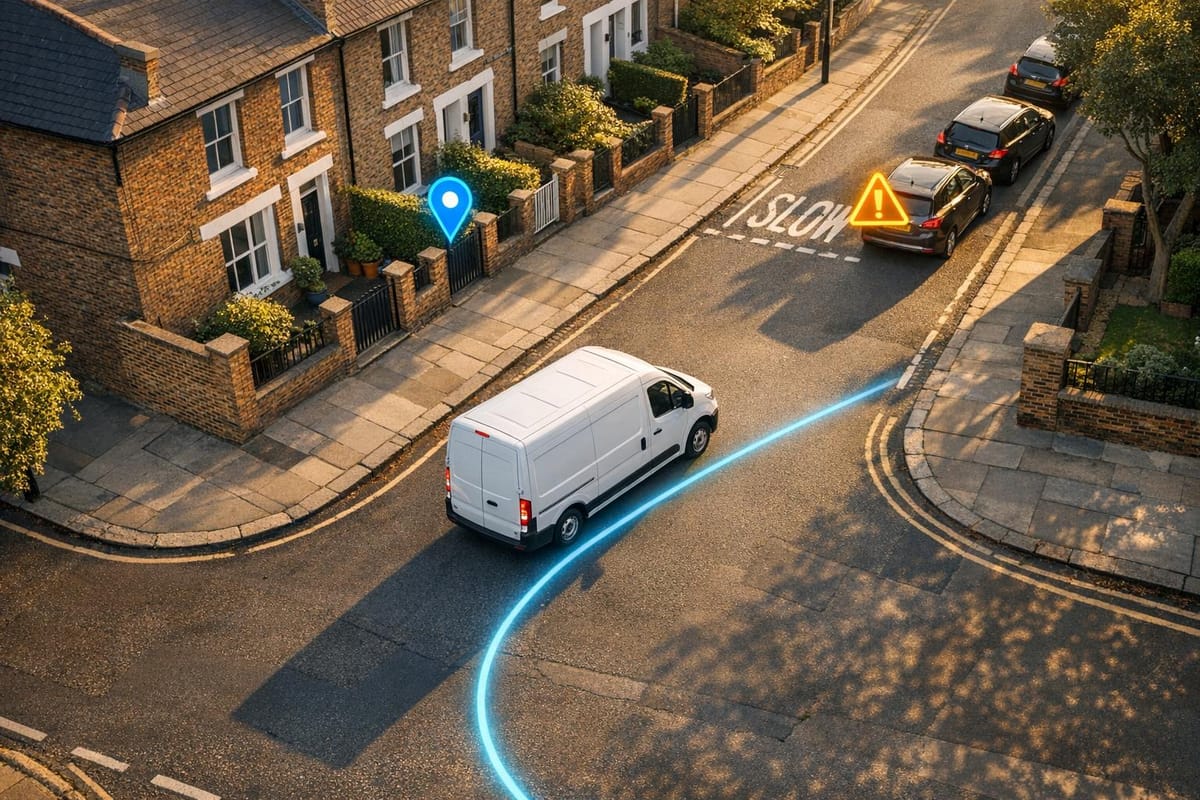
AI is transforming last-mile delivery by solving costly and unpredictable challenges like traffic delays, incorrect addresses, and vehicle breakdowns. This part of logistics now accounts for 53% of shipping costs, with 25% of delivery failures caused by address errors. Rising customer demands - 88% expect same-day or next-day delivery - further complicate operations.
AI tackles these issues in real time by using GPS, telematics, and historical data to:
- Reroute vehicles during traffic disruptions.
- Correct address mistakes before dispatch.
- Predict and prevent breakdowns via IoT sensors.
- Monitor driver behaviour to reduce inefficiencies.
For example, DHL’s AI-powered Greenplan cut costs by 20% across 50+ countries. UK fleets using similar tools save 42p per mile on fuel and reduce delivery times by 12 minutes per stop.
Adopting AI involves:
- Installing telematics systems like GRS Fleet (starting at £7.99/month).
- Defining exception thresholds (e.g., delays >15 mins).
- Running a 4–8 week pilot to refine processes.
AI’s impact goes beyond cost savings - it improves delivery accuracy, customer experience, and compliance with UK regulations, such as avoiding fines in Low Emission Zones (ULEZ). By addressing exceptions proactively, fleets can stay competitive in a fast-changing market.
AI in Supply Chain: Last Mile Delivery, Logistics and Supply Chain Management | Richard Savoie
Common Delivery Exceptions and How AI Addresses Them
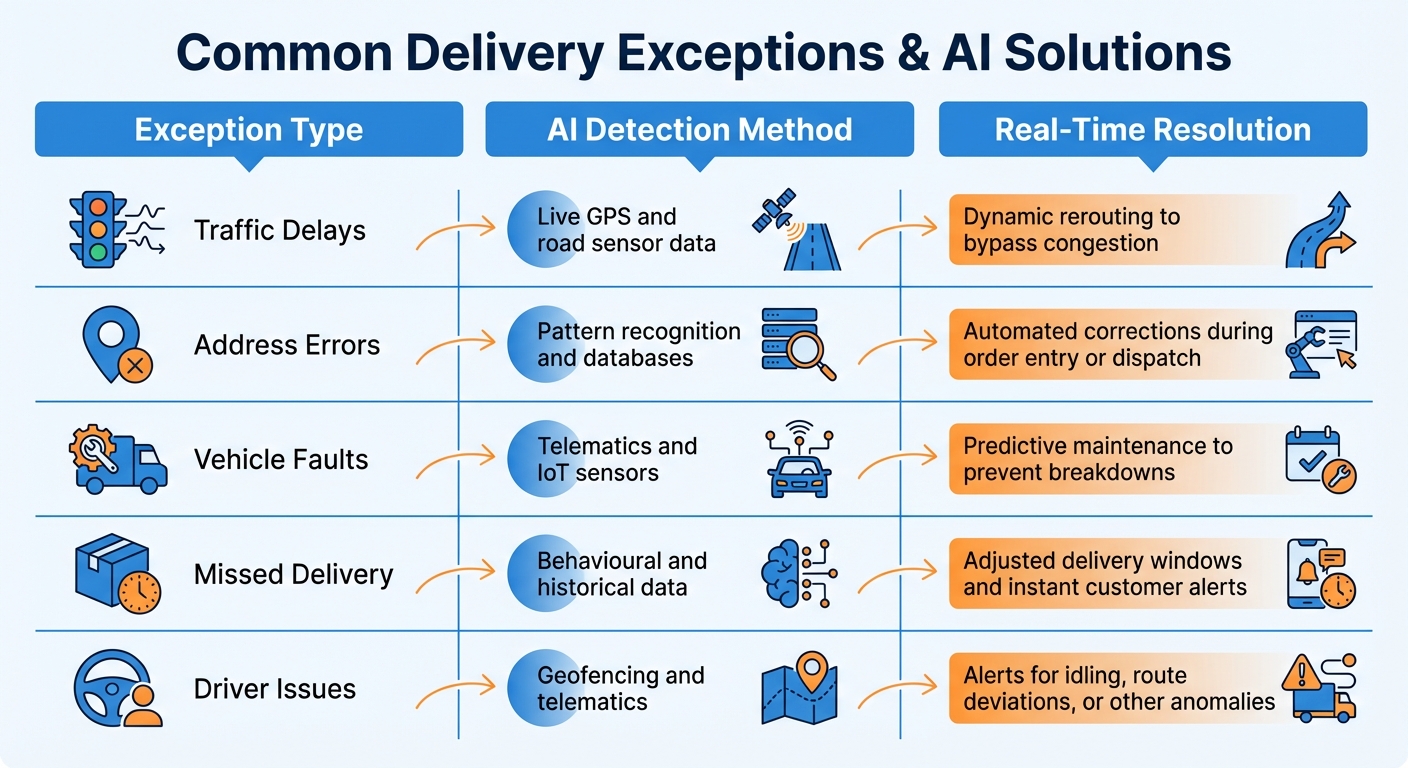
How AI Detects and Resolves Common Last-Mile Delivery Exceptions
Delivery exceptions can arise from a range of issues: traffic delays, vehicle breakdowns, address mistakes, missed deliveries, or driver-related challenges. AI steps in by leveraging live GPS data, telematics, and historical trends to make real-time adjustments. Here's a breakdown of how AI detects and resolves these common delivery issues:
| Exception Type | AI Detection Method | Real-Time Resolution |
|---|---|---|
| Traffic Delays | Live GPS and road sensor data | Dynamic rerouting to bypass congestion |
| Address Errors | Pattern recognition and databases | Automated corrections during order entry or dispatch |
| Vehicle Faults | Telematics and IoT sensors | Predictive maintenance to prevent breakdowns |
| Missed Delivery | Behavioural and historical data | Adjusted delivery windows and instant customer alerts |
| Driver Issues | Geofencing and telematics | Alerts for idling, route deviations, or other anomalies |
Traffic Delays and Dynamic Rerouting
Unexpected road closures or accidents can disrupt even the most carefully planned routes. AI systems go beyond reactive tracking by actively analysing live data from sources like Transport for London (TfL) and National Highways. When an incident occurs, these systems instantly reroute vehicles to minimise delays.
For example, in 2023, DHL Express adopted AI-powered software from Wise Systems to manage routes with up to 120 stops. This tool dynamically adjusts delivery sequences based on priority time windows (e.g., "before 9 am") and real-time traffic updates. Oliver Facey, Senior Vice President of Global Network Operations Programs at DHL Express, highlighted its impact:
"AI is enabling possibilities for smarter route planning which means we can deliver faster – with less fuel wasted. Meanwhile, our customers receive a more accurate time window for their delivery."
UK fleets using AI for route optimisation have reported significant benefits, including saving 42p per mile in fuel costs and shaving off an average of 12 minutes per delivery in cities like London, Manchester, and Birmingham. These systems also account for Low Emission Zones (LEZ) and Ultra Low Emission Zones (ULEZ), helping companies avoid costly fines.
Vehicle Breakdowns and Predictive Maintenance
Breakdowns can derail operations and come with hefty costs - ranging from £370 to £585 per day. AI helps fleet managers stay ahead of these issues by analysing telematics and IoT sensor data that monitor engine health, tyre wear, and battery performance. Machine learning models detect early warning signs of mechanical failure, enabling timely repairs.
AI-driven maintenance programmes have been shown to reduce unplanned downtime by 40% and cut repair costs by 25%. Additionally, alerts sent during off-peak hours allow managers to schedule maintenance without disrupting delivery schedules.
Address Errors and Automated Corrections
Address inaccuracies are a leading cause of delivery failures, with 74% of businesses identifying this as a key issue. AI tackles this problem by validating addresses during the order process, cross-referencing them with verified postal records and past delivery data. Errors like transposed numbers or misspelled street names are flagged and corrected before dispatch.
In 2023, Domino's used AI predictive analytics to provide customers with precise delivery ETAs. By factoring in kitchen workload, weather, and live traffic, they reduced customer inquiries and improved first-attempt delivery success rates. AI systems can even interpret informal descriptions (e.g., "the blue house on Oak Street") and translate What3words or GPS coordinates into standardised addresses, cutting delivery errors by up to 90%.
Driver Behaviour and Operational Issues
AI also monitors driver behaviour to address issues such as idling, unauthorised vehicle use, and route deviations. Geofencing triggers alerts when vehicles enter or exit restricted zones, while behavioural analytics flag risky patterns like harsh braking or speeding. These insights allow managers to intervene only when necessary, reducing manual oversight.
For instance, if a driver strays from their designated delivery zone for an extended period, AI sends an alert to the fleet manager and recalculates the remaining stops to minimise delays. This ensures smoother operations without constant micromanagement.
These solutions demonstrate how AI transforms delivery exception management, paving the way for further exploration of the tools enabling these real-time capabilities.
AI Tools for Managing Delivery Exceptions
AI tools are stepping up to tackle delivery challenges by offering real-time solutions to identify and manage exceptions before they escalate.
Telematics platforms keep a close watch on GPS data, route progress, and vehicle status, flagging issues as they arise. For instance, if a driver veers off a planned route, idles for more than 10 minutes, or misses a scheduled scan, the system can immediately alert fleet managers.
Real-Time Vehicle Tracking and Telematics
GRS Fleet Telematics provides an affordable solution for real-time anomaly detection, starting at just £7.99 per vehicle each month. This platform incorporates live updates from sources like TfL and National Highways, enabling instant rerouting to avoid traffic jams or road closures, which helps reduce fuel expenses.
Geofencing is another key feature, automatically identifying when vehicles approach Low Emission Zones (LEZ) or Ultra Low Emission Zones (ULEZ). Non-compliant vehicles are rerouted to avoid fines, saving businesses both time and money. Additionally, linking tracking data with messaging apps allows for "Follow My Parcel" features, reducing the number of customer calls asking, "Where’s my delivery?".
Predictive Analytics for Resource Planning
While real-time tracking handles immediate concerns, predictive analytics works to prevent problems before they arise. By analysing historical delivery data, seasonal trends, and real-time signals, AI tools can predict potential disruptions with impressive accuracy.
In September 2023, DHL Express revealed that its AI-powered forecasting could predict shipment volumes arriving at specific facilities with 90%–95% accuracy. This precision allows for optimised courier routes and resource allocation. Oliver Facey, Senior Vice President of Global Network Operations Programs at DHL Express, highlighted the broader benefits:
"AI is opening up exciting opportunities for our network... it's also having a transformative effect further up the supply chain – on predictive forecasting, parcel sorting, customer service, the overall ability of a business to adapt to challenges."
Predictive maintenance is another valuable application. By monitoring engine health, tyre wear, and battery performance, AI can forecast part failures before they lead to breakdowns. These systems have reduced unplanned downtime by around 40% and repair costs by 25%. Scheduling maintenance during slower periods further minimises fleet downtime costs. Additionally, AI-driven demand forecasting allows managers to anticipate delivery volume changes, enabling better resource allocation. For instance, more drivers can be scheduled during peak times, or routes can be adjusted for lighter traffic, improving efficiency by up to 20%.
These preventative measures pave the way for enhanced security features discussed below.
Dual-Tracker Technology for Security
Security is a top priority in last-mile delivery, especially with risks like vehicle theft and GPS tampering. GRS Fleet Telematics addresses these concerns with dual-tracker systems. These systems combine a primary wired tracker with a secondary Bluetooth backup device. If the main tracker is disabled or removed, the backup ensures continuous location monitoring.
This approach has achieved a 91% recovery rate for stolen vehicles across the UK. GRS offers an Enhanced package (£79), which includes both trackers, and an Ultimate package (£99), which adds remote immobilisation capabilities, allowing fleet managers to disable vehicles if theft is detected. Many businesses benefit from free installation when these systems are bundled with fleet branding services. Moreover, the secondary tracker maintains connectivity in areas where the primary tracker might lose signal, such as underground car parks or dense urban zones. This ensures uninterrupted tracking and reduces false alerts caused by signal drops.
How to Implement AI for Exception Handling
Bringing AI into your last-mile delivery operations doesn't have to be a daunting task. You can break it down into three straightforward steps: setting up the hardware and software, defining exception thresholds, and running tests before scaling up.
Installing Hardware and Software
Start by installing GRS Fleet Telematics trackers in your vehicles. The basic Essential package costs £35 and offers real-time tracking. For more advanced features, the Enhanced package with dual-tracker technology is priced at £79, while the Ultimate package - which includes remote immobilisation - costs £99. Once the hardware is in place, you'll need a £7.99 monthly software subscription, covering the SIM card, data, platform access, and an account manager to assist you.
Next, integrate the software with your existing systems like TMS, WMS, ERPs, and CRMs. Equip your drivers with in-cab terminals or apps to keep them updated dynamically during deliveries. Before diving into AI implementation, collect 3–6 months of baseline data on metrics like fuel consumption, on-time deliveries, and failed deliveries. This data will act as a benchmark to measure how AI improves your operations. Once the setup is complete, move on to defining operational thresholds for AI alerts.
Setting Exception Thresholds
With the hardware and software installed, the next step is to define what qualifies as an "exception" in your delivery workflow. For example, set alerts for ETA delays of more than 15–20 minutes. This allows you to send proactive notifications to customers, cutting down on "Where Is My Order?" calls. You can also use geofencing to create virtual boundaries around restricted areas like London’s ULEZ or LEZ. This ensures non-compliant vehicles are rerouted automatically, avoiding daily charges of around £12.50.
Driver behaviour is another key area to monitor. GRS Fleet Telematics tracks activities like harsh braking, speeding, cornering, and idling, so you can set limits that trigger safety and efficiency alerts. Additionally, configure alerts to ensure compliance with UK Working Time regulations by monitoring driving hour limits. Real-time traffic data can further streamline operations, saving an average of 12 minutes per delivery and reducing fuel costs by 42p per mile in congested urban areas.
Automated workflows also play a vital role. If a driver marks a delivery as "failed to complete", the system can automatically notify the next customer or adjust the route sequence. Once you've established these thresholds, test them in a controlled environment before rolling them out on a larger scale.
Testing and Scaling
Start with a 4–8 week pilot programme, using a small portion of your fleet or targeting a specific region, ideally one with challenging delivery routes. This trial will help you compare AI-driven results with your manual benchmarks and fine-tune your exception thresholds. Train your drivers on the new in-cab apps, focusing on how the technology can provide realistic schedules and help them avoid traffic delays.
When you're confident in the results, expand the system across your entire fleet. Keep feedback loops open to continually adjust and retrain the AI models as traffic patterns and delivery demands change. Use telematics API endpoints like /invalidrecords to identify and fix rejected data records within 48 hours, ensuring consistent accuracy for your AI triggers.
One real-world example: a UK courier service recovered two stolen vans in just 24 hours using dual-tracker technology, saving over £40,000 in potential losses. This highlights the tangible benefits of a well-implemented AI system for exception handling.
Benefits of AI Exception Handling for UK Fleets
Cost Reduction and Efficiency Gains
AI-driven exception handling is transforming the way UK fleets operate by slashing costs and improving efficiency. For instance, automating route planning can reduce manual planning time by an impressive 75%, while also increasing delivery capacity by 25%. On top of that, fleets see up to a 40% rise in first-attempt delivery success rates. These systems also help avoid costly errors, such as routing non-compliant vehicles through London's Ultra Low Emission Zone (ULEZ), which carries a daily charge of £12.50 per vehicle. By minimising empty miles and idling, AI further cuts fuel and operational expenses, making fleet operations leaner and more effective.
Meeting UK Regulatory Requirements
AI systems are also a game-changer when it comes to navigating the UK's complex regulatory landscape. For example, GRS Fleet Telematics ensures compliance with the daily 9-hour driving limit by monitoring driver hours and issuing alerts when needed. Jobs can even be reassigned automatically to prevent breaches. Geofencing technology adds another layer of compliance by guiding vehicles around Low Emission Zones (LEZ), ULEZ, and Clean Air Zones in cities like Birmingham, Manchester, and Bath. These virtual boundaries ensure that only compliant vehicles enter restricted areas. Additionally, AI-generated digital records simplify DVSA inspections by providing ready-made audit trails for driving hours, rest periods, and vehicle diagnostics. This not only reduces administrative burdens but also supports the UK's push towards its net-zero emissions target by 2050.
Improved Customer Experience
AI exception handling doesn't just benefit fleet operators; it also elevates the customer experience. For example, if traffic builds up on major motorways like the M25 or M6, AI systems proactively send updates to customers, turning potential frustrations into opportunities for transparency. Real-time tracking allows fleets to provide precise delivery windows - accurate to within 15–20 minutes - rather than vague time slots. Some systems even offer last-minute adjustments, like rerouting parcels to neighbours or rescheduling deliveries while the courier is en route, which significantly reduces failed delivery attempts. One Fortune 500 automotive company leveraged real-time sensor data and AI to cut delivery times by 25% and improve on-time deliveries by 20%, achieving a 250% return on investment within just two years.
Conclusion
AI-driven exception handling is revolutionising last-mile delivery by shifting from reactive problem-solving to proactive management. Instead of scrambling to deal with unexpected M25 traffic jams or mid-route breakdowns, AI systems detect disruptions in real time and automatically adjust routes to find the best alternatives. This not only cuts down on failed deliveries and fuel expenses but also keeps customers informed with precise updates.
The benefits extend beyond smoother operations. Tools like GRS Fleet Telematics make it easy to adopt AI solutions with features like real-time vehicle tracking, automated alerts, and geofencing to avoid ULEZ charges. Their dual-tracker technology boasts a 91% recovery rate for stolen vehicles, while predictive analytics can lower vehicle repair costs by 12–18% through timely maintenance alerts.
To get started, focus on these key steps: gather your delivery data, integrate telematics systems via APIs, define exception thresholds (e.g., a 15-minute delay trigger), and run a 3–6 month pilot programme with a smaller fleet. This phased approach helps you fine-tune the system before rolling it out fleet-wide, ensuring maximum efficiency and compliance.
AI doesn't just optimise efficiency through predictive analytics and proactive rerouting - it also ensures compliance with regulations like UK driving hour limits and helps navigate Low Emission Zones automatically. The result? Happier customers and a more reliable delivery network.
As Oliver Facey from DHL Express explains:
"AI is opening up exciting opportunities for our network... we are now being presented with opportunities to optimise processes for us – and our customers – that weren't available even a year ago".
FAQs
How does AI improve accuracy and efficiency in last-mile delivery?
AI is reshaping last-mile delivery by making it more precise and efficient. Through real-time route optimisation, predictive analytics, and smart dispatching, AI can adjust delivery routes on the fly. It takes into account factors like traffic patterns and delivery demand, which helps cut down travel time, fuel usage, and delays. The result? More dependable, on-time deliveries - something that's crucial for meeting customer expectations across the UK.
Another key benefit of AI is its ability to handle exceptions automatically. It can quickly spot and resolve issues such as incorrect addresses or unexpected delivery obstacles, reducing disruptions and keeping operations running smoothly. For instance, AI tools can validate addresses automatically, which lowers the chances of failed deliveries and boosts overall efficiency. By adopting AI, businesses not only save time and money but also ensure customers remain satisfied with faster and more reliable delivery services.
How can AI be implemented to handle exceptions in last-mile delivery operations?
Implementing AI for handling exceptions in last-mile delivery involves a structured approach to ensure seamless integration and effective outcomes. The first step is to pinpoint specific challenges where AI can make a difference. These might include managing missed deliveries, addressing incorrect addresses, or tackling unexpected delays.
Next, focus on collecting and integrating reliable data. This could involve real-time tracking information, delivery schedules, and customer details, all of which enable AI systems to identify and address issues more effectively.
With the data in place, set up AI tools to automate key exception-handling tasks. These tasks might include rerouting deliveries, sending timely notifications to customers, or escalating complex issues to human team members when necessary. Equally important is to train your staff on how to use these systems and establish clear protocols for managing exceptions efficiently.
Finally, keep a close eye on the system's performance. Regular monitoring and adjustments will help improve its accuracy, adapt to any operational changes, and ultimately enhance the overall customer experience.
How does AI help businesses comply with UK Low Emission Zone regulations?
AI helps businesses stay in line with the UK's Low Emission Zone (LEZ) and Ultra Low Emission Zone (ULEZ) rules by adjusting delivery routes in real-time. It pinpoints restricted zones and reroutes vehicles to steer clear of them, reducing the risk of fines and cutting emissions.
By improving delivery efficiency and encouraging greener practices, AI not only ensures businesses meet regulations but also supports more environmentally conscious last-mile delivery methods.