AI Integration with Delivery Management Systems
AI-driven delivery platforms transform route planning, real-time tracking and fleet security to cut costs and improve on-time performance.
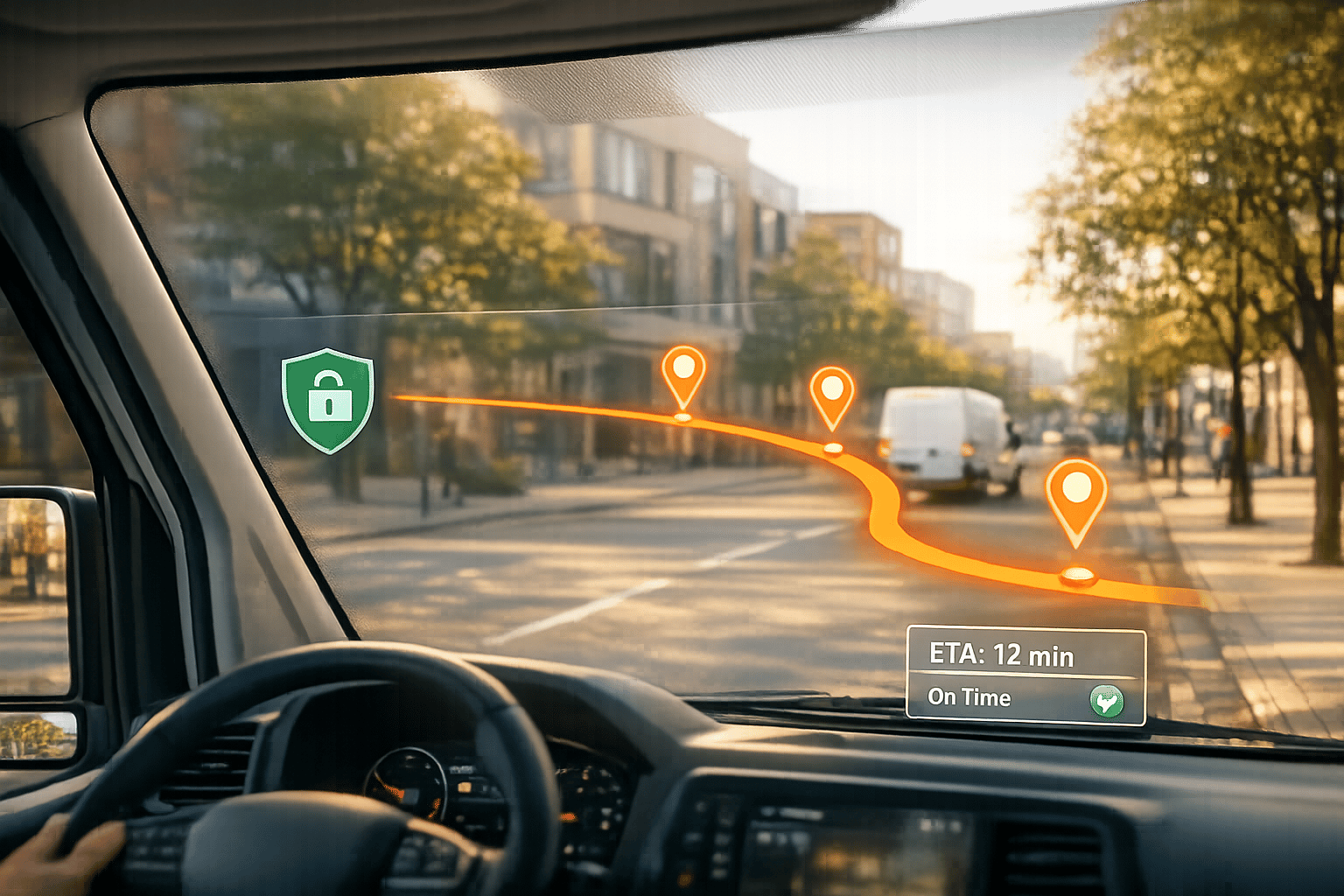
AI is transforming delivery management in the UK, helping businesses optimise routes, improve tracking, and enhance fleet security. Tools like real-time GPS, predictive analytics, and digital twin technology are enabling faster deliveries, lower costs, and better efficiency. Here's what you need to know:
- Route Optimisation: AI-driven systems adjust delivery routes in real-time based on traffic, weather, and delivery volumes, cutting fuel consumption and improving delivery times.
- Real-Time Tracking: Platforms provide live GPS updates, accurate ETAs, and instant alerts for disruptions, ensuring better visibility and customer communication.
- Fleet Security: Advanced tracking technologies, like dual-trackers and engine immobilisation, protect vehicles and cargo, with recovery rates as high as 91% for some services.
- Cost-Effectiveness: Solutions like GRS Fleet Telematics start at £7.99/month, offering affordable options for small and medium-sized fleets.
The article reviews four major platforms - GRS Fleet Telematics, Locus, LogiNext, and Onfleet - each offering unique features for tracking, route planning, and cost savings. Whether you're tackling last-mile delivery challenges or improving fleet security, AI-powered tools can address your specific needs and scale with your business.
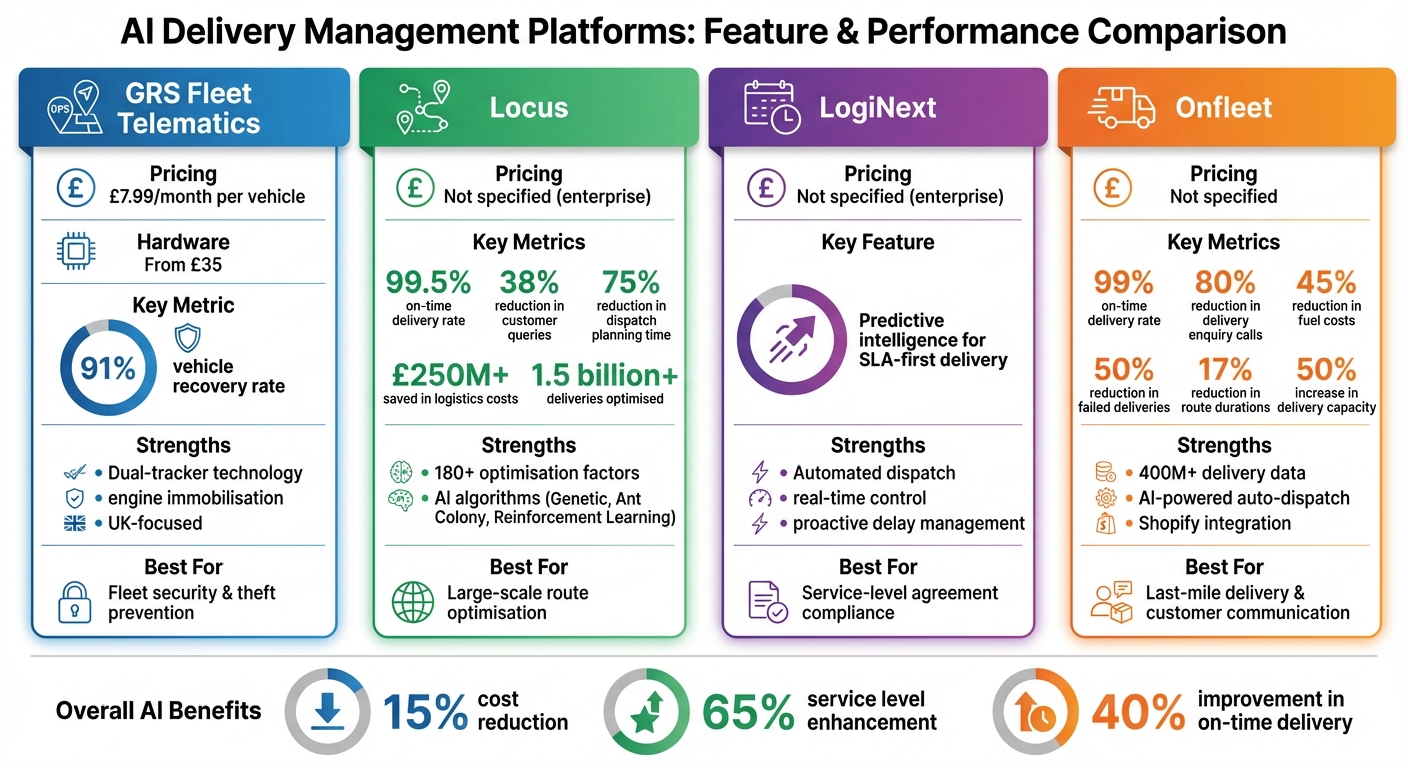
AI Delivery Management Platform Comparison: Features, Pricing and Performance Metrics
1. GRS Fleet Telematics
Real-Time Tracking
GRS Fleet Telematics provides live GPS updates through both web and mobile apps, giving fleet managers complete visibility over their operations. With AI-driven predictive analytics, the system estimates arrival times and flags potential delays caused by traffic or weather conditions, aligning with the latest trends in UK logistics operations.
By continuously monitoring vehicle speed, status, and location, the platform feeds real-time data into dashboards designed for quick decision-making. This allows fleet managers to monitor deliveries closely and respond swiftly to any disruptions.
Route Optimisation
Beyond tracking, the system dynamically adjusts routes in response to real-time data. By analysing factors like traffic, weather, and delivery volumes, the AI-powered platform creates efficient routes that help reduce fuel consumption and travel time. This capability is particularly effective for last-mile delivery planning, ensuring deliveries are faster and more reliable - key priorities in UK logistics.
Security Features
GRS Fleet Telematics employs dual-tracker technology, combining a hardwired GPS tracker with a hidden Bluetooth backup. This setup ensures constant visibility and has achieved a 91% vehicle recovery rate for UK businesses. Additionally, AI monitors driver behaviour to detect theft, sending real-time alerts to authorities. Features like remote engine immobilisation further enhance security by preventing unauthorised vehicle starts. These measures are essential for protecting assets and improving overall operational efficiency.
Cost Effectiveness
With pricing starting at just £7.99 per month per vehicle, GRS Fleet Telematics offers an affordable option for small to medium-sized UK fleets. Hardware costs begin at £35 per device, and free installation is available when paired with GRS Fleet Graphics branding services. The AI-driven platform delivers tangible savings by reducing fuel and labour costs while benefiting from a strong recovery rate - making it a smart investment for UK fleets.
2. Locus
Real-Time Tracking
Locus simplifies supply chain management by offering a single platform for real-time tracking, removing the hassle of juggling multiple spreadsheets. As Thitiphun Chailert, Data Analyst, highlights:
We use Locus to enable end-to-end visibility in our in-transit transport. We now have one platform to track everything.
The AI-powered system provides precise, turn-by-turn updates and keeps customers informed throughout the delivery process. With advanced analytics, it identifies inefficiencies and detects disruptions in real time. Plus, the platform integrates seamlessly with systems like TMS, OMS, WMS, and ERP through APIs, creating a reliable central hub for tracking data. These features have led to impressive results, including a 99.5% on-time delivery rate and a 38% drop in customer queries about order status.
This robust tracking framework also supports dynamic, data-driven route planning.
Route Optimisation
Locus doesn’t just track deliveries - it ensures they’re completed in the most efficient way possible. Using advanced AI, it optimises routes by analysing over 180 factors, including fuel usage, time, distance, vehicle capacity, and service-level agreements. It employs cutting-edge techniques like Genetic Algorithms to handle complex delivery schedules, Ant Colony Optimisation to balance workloads, and Reinforcement Learning to refine plans based on historical driver performance.
Unlike traditional systems, Locus dynamically adjusts routes in real time to account for changing conditions. To date, it has optimised over 1.5 billion deliveries across 30+ countries, saving clients more than £250 million in logistics costs. Juan Pablo Díaz Rodríguez, Head of Last-mile at Jüsto, shares:
Thanks to Locus, we've improved our order visibility, optimised our delivery routes, enhanced our communication with rider personnel.
The platform’s impact is clear: businesses report a 75% reduction in dispatch planning time, a 95% improvement in meeting service-level agreements, and a 20% boost in tasks completed per agent . Beyond operational efficiency, Locus has also made strides in sustainability, cutting greenhouse gas emissions by over 17 million kilograms through better route density.
Cost Effectiveness
On top of operational improvements, Locus delivers noticeable cost savings. Its automated carrier selection ensures businesses get the best pricing and service levels for outsourced fleets. The platform also simplifies invoice calculations and reconciliation, helping companies recover lost revenue. So far, clients have recouped £225 million in revenue leakage and achieved 20% savings on ground resources.
3. LogiNext
Real-Time Tracking
LogiNext leverages predictive intelligence to keep service-level agreements at the forefront throughout the delivery process. By anticipating potential delays before they arise, the platform empowers operations teams to manage customer expectations proactively. This means offering precise ETAs and real-time updates, rather than generic delivery windows.
Customers benefit from accurate notifications at every stage of the journey. As highlighted by the VP of Supply Chain at a consumer goods company with revenues surpassing £400 million:
Streamlined logistics with smarter real-time control.
LogiNext has been recognised as a leader in Vehicle Routing and Scheduling as well as Last-Mile Technologies. Users frequently commend its ability to replace outdated dispatch methods with modern, efficient solutions.
This focus on real-time tracking serves as the backbone for the platform's route optimisation capabilities.
Route Optimisation
Building on its tracking features, LogiNext enhances delivery efficiency through automated dispatch and route planning. These tools not only reduce delays but also ensure service commitments are upheld. By integrating fleet and driver management, businesses can offer flexible delivery timeframes tailored to optimised routes.
The platform's effectiveness has earned praise from industry leaders. The Director of Operations & Supply Chain at a transportation services firm with revenues exceeding £800 million notes:
Predictive intelligence driving SLA-first delivery performance.
In the dynamic UK logistics sector, LogiNext's predictive intelligence sets it apart. Its AI-driven approach delivers tangible improvements in operational efficiency while maintaining a strong focus on meeting service-level agreements, a critical demand in modern delivery management.
4. Onfleet
Real-Time Tracking
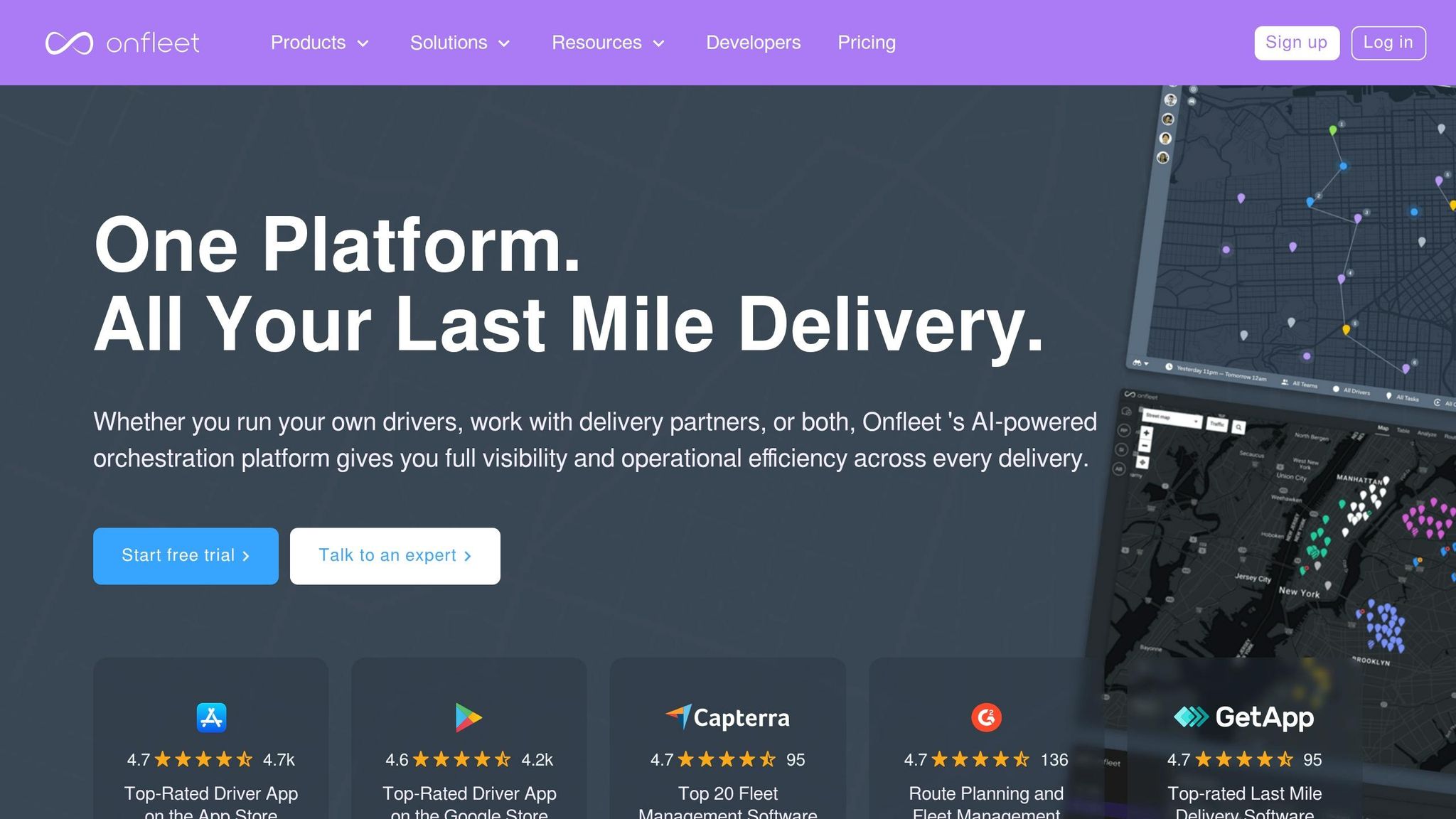
Onfleet uses an AI engine powered by data from over 400 million deliveries to deliver predictive ETAs. These ETAs take into account real-time traffic and driver capacity, offering a smarter alternative to traditional static delivery windows. The system proactively identifies potential delays and notifies customers immediately, cutting down on the number of "where is my order?" calls.
A great example of its impact comes from Dulux Decorator Centre, which rolled out Onfleet across 230+ stores in the UK back in February 2026. The result? An 80% drop in delivery-related enquiry calls from customers. This shows how AI-powered tracking can streamline communication while easing operational workloads.
Onfleet also provides live GPS tracking for fleets and branded tracking pages that include two-way chat and automated proof of delivery features like photos, signatures, and timestamps. This level of transparency keeps both customers and businesses in the loop.
This advanced tracking system perfectly complements Onfleet's powerful route optimisation capabilities.
Route Optimisation
Onfleet’s AI-Powered Auto-Dispatch takes the guesswork out of route planning. It dynamically assigns on-demand orders to active drivers, seamlessly integrating new tasks into existing schedules. The system adapts in real-time to traffic, driver availability, and specific time constraints, eliminating the inefficiencies of manual dispatching.
The results speak for themselves. Umer Jamshaid, Senior Director of Operations at The Rounds, highlighted a 17% reduction in route durations for the same number of tasks using Onfleet’s optimisation engine. Similarly, Emily Ehrlich, eCommerce Coordinator at The United Family, shared:
Onfleet is a no-brainer for any serious delivery operation. We were able not only to increase our delivery capacity by 50% using their route optimisation engine but also to improve on-time rates and customer satisfaction through accurate ETAs and real-time visibility.
Users have reported impressive metrics, including a 99% on-time delivery rate, a 45% cut in fuel costs, and a 50% reduction in failed deliveries. These improvements highlight how AI-driven route planning enhances efficiency, reduces costs, and boosts customer satisfaction - all while easing the pressure on operational teams.
Cost Effectiveness
Onfleet helps businesses cut costs by automating manual dispatch processes. Its seamless integrations with platforms like Shopify allow UK businesses to avoid the expense of custom development or lengthy implementation timelines. By enabling companies to expand delivery capacity without adding staff, Onfleet provides a competitive edge across various UK logistics industries. It’s a win-win: scale your operations while keeping costs under control.
AI Delivery Optimization Explained | Smart Logistics Systems for Beginners
Strengths and Weaknesses
After reviewing AI integration methods, GRS Fleet Telematics stands out for its ability to combine real-time tracking with advanced security features, all while keeping costs manageable for UK delivery operations.
Key Features
GRS Fleet Telematics provides a robust fleet management solution with the following features:
- Real-Time Tracking: Offers live GPS updates via web and mobile apps, enhanced with AI-driven predictive analytics for estimating arrival times and alerting delays.
- Dynamic Route Optimisation: Uses AI to adjust routes based on traffic, weather conditions, and delivery volumes, cutting down fuel use and travel time.
- Advanced Security: Includes dual-tracker technology and remote engine immobilisation for added protection.
- Affordable Pricing: Starts at £7.99 per month per vehicle, with hardware available from £35.
Strengths
GRS Fleet Telematics brings several benefits to UK fleets:
- High-level theft protection: Boasts a 91% vehicle recovery rate, addressing concerns around urban van theft effectively.
- Budget-friendly options: Makes advanced telematics accessible for smaller fleets without stretching budgets.
- Years of UK expertise: Offers solutions tailored to the unique needs of local logistics operations.
- Enhanced visibility: Provides constant monitoring of vehicle speed, status, and location for better oversight.
- Cost savings: Reduces fuel and labour costs while maintaining strong recovery rates.
Areas for Future Improvement
While the platform excels in tracking and security, there’s room to refine its AI-powered predictive analytics. Expanding these capabilities could enable more advanced dynamic rerouting, aligning GRS Fleet Telematics with the latest trends in autonomous route adjustments within the UK logistics industry.
The combination of affordability, real-time operational visibility, and data-driven decision-making makes GRS Fleet Telematics a practical choice for businesses aiming to modernise their delivery management systems and quickly adapt to challenges. These strengths position it as a valuable tool for improving efficiency in UK delivery operations.
Conclusion
Our analysis highlights that the best approach to integrating AI into your operations lies in addressing your primary challenges. Selecting the right AI-powered delivery solution begins with pinpointing what your business needs most. For instance, if fleet security is a priority, robust theft prevention measures are essential. On the other hand, businesses prioritising last-mile delivery efficiency should look for tools that offer real-time route optimisation.
Before diving in, it’s critical to evaluate your organisation’s data readiness. As Synetec aptly puts it, "AI is full of possibilities, but the real question is: where will it generate measurable results for your business? Without a clear focus, AI projects risk becoming expensive experiments". Start by mapping out your existing data and running pilot tests with your chosen solution to ensure it delivers a strong return on investment.
Research shows that AI integration can lead to significant improvements, such as cutting costs by 15%, enhancing service levels by 65%, and increasing on-time delivery performance by up to 40%. For fleet security, combining real-time tracking with AI-driven image recognition can provide instant proof-of-delivery verification and actionable driver feedback.
These benefits demonstrate the importance of choosing a solution that addresses your immediate needs while being scalable for future growth. For example, GRS Fleet Telematics offers a UK-focused solution with dual-tracker technology, a 91% vehicle recovery rate, and affordable pricing starting at £7.99 per month. This makes advanced telematics accessible to smaller fleets, providing enhanced security and visibility - critical for tackling urban van theft and managing operational costs.
Ultimately, aligning AI capabilities with your everyday operational challenges, while keeping an eye on scalability, is the key to success. Opt for solutions that integrate smoothly with your current systems and offer flexibility to handle real-time disruptions effectively.
FAQs
What data do I need before adding AI to my delivery system?
To bring AI into your delivery system, start by collecting precise and relevant data. This includes details about your vehicles - such as specifications, locations, and current status - along with traffic updates, weather forecasts, and any road restrictions. Additionally, data on past delivery performance, driver behaviour, and vehicle capacity plays a key role. When this information is accurate and comprehensive, AI can effectively optimise routes, respond to real-time changes, and improve efficiency, leading to cost savings and better service quality.
How can AI reroute drivers in real time without disrupting deliveries?
AI leverages live data like traffic conditions, weather updates, and vehicle performance to adjust routes in real time. By making instant changes, it ensures smoother journeys, reduces disruptions, and keeps delivery schedules on track. This ability to respond quickly to unforeseen issues allows fleets to manage delays effectively, boosting both delivery precision and customer satisfaction.
How do dual-trackers and engine immobilisation reduce van theft risk?
Dual-trackers provide an added level of security by ensuring the vehicle can still be tracked even if the main tracker is tampered with or disabled. On top of that, engine immobilisation offers another safeguard by allowing the vehicle to be remotely disabled. This prevents any unauthorised movement. When combined, these features create a powerful defence against theft.