AI Dash Cams: How They Improve Fleet Safety
AI dash cams cut accidents and insurance claims by spotting risky driving in real time, issuing in‑cab alerts and feeding telematics data for targeted driver coaching.
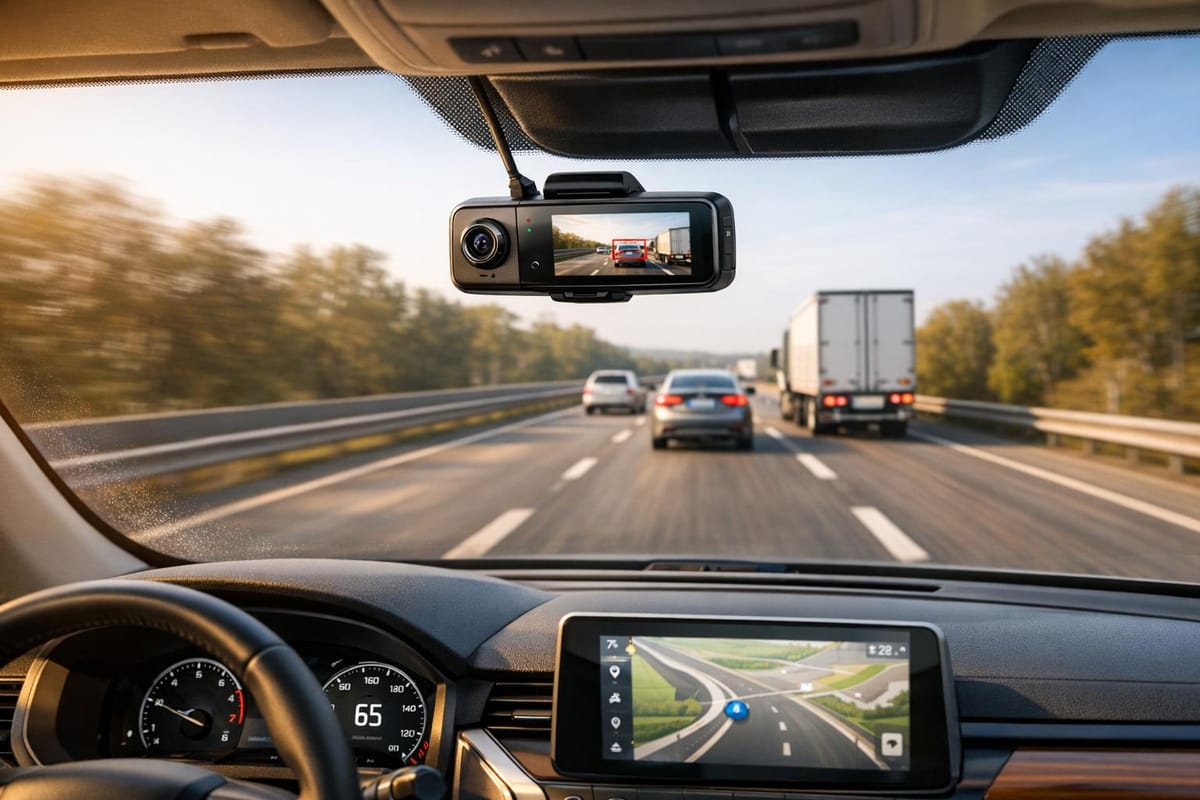
AI dash cams are reshaping fleet safety in the UK by actively preventing accidents, not just recording them. Unlike traditional dash cams, these systems use artificial intelligence to monitor driver behaviour and road conditions in real time, issuing instant alerts to help drivers correct risky actions.
Key highlights:
- Reduced accidents: Accident rates have dropped by up to 30% where AI dash cams are used.
- Lower insurance costs: 58% of fleets report reduced premiums after adopting the technology.
- Real-time alerts: Warnings for risks like mobile phone use, drowsiness, and tailgating are delivered in under 200 milliseconds.
- Data-driven insights: Fleet managers get detailed dashboards to track trends and improve driver training.
- Adoption rates: 80% of UK van fleets now use AI video telematics.
With work-related road accidents costing UK businesses £2.7 billion annually, AI dash cams offer a practical way to improve safety, save money, and streamline fleet management.
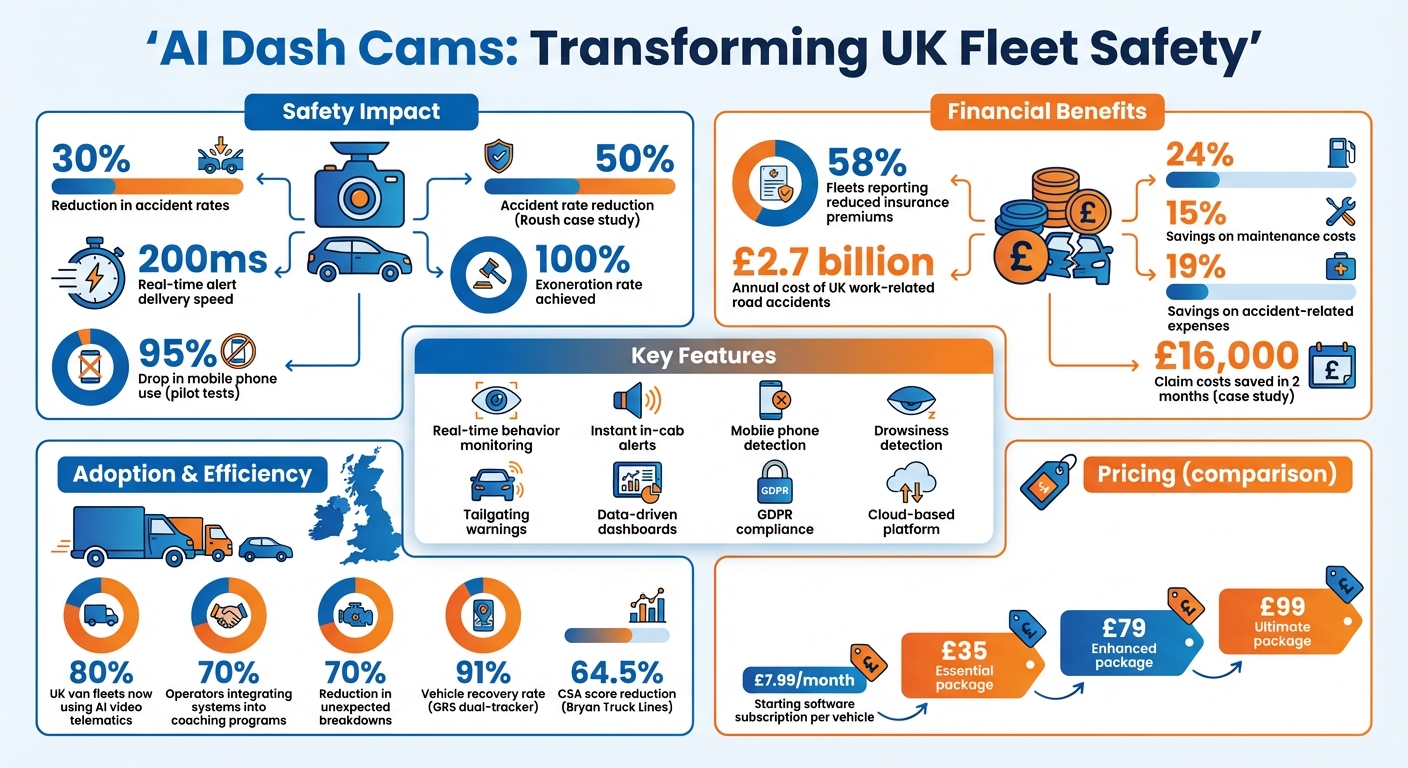
AI Dash Cam Impact on UK Fleet Safety: Key Statistics and Benefits
What Are AI Dash Cams?
Basic Definition and Core Features
AI dash cams are not just your standard vehicle cameras. They combine artificial intelligence, machine learning, and computer vision to analyse driver behaviour and road conditions in real time. Unlike traditional dash cams, which simply record footage for later use, AI dash cams actively monitor the environment and take action as needed.
While traditional dash cams focus on recording events, AI dash cams aim to prevent accidents. They constantly assess risks like mobile phone usage, drowsy driving, tailgating, and lane departures. When a potential danger is detected, they provide real-time alerts to help drivers correct their actions before it’s too late.
Using edge computing, these devices process data locally, delivering near-instant alerts that are crucial for avoiding accidents. They also integrate information from GPS, accelerometers, radar, and gyroscopes, giving a comprehensive view of the vehicle’s movements and surroundings.
These features highlight how AI is reshaping dash cam technology, making it more proactive and responsive.
How AI Improves Dash Cam Performance
AI doesn’t just enhance the hardware - it transforms how dash cams interpret and respond to data.
Using computer vision, these devices analyse video frames in real time to identify critical details, like a driver holding a mobile phone or signs of fatigue, such as closing eyes. Machine learning models take it a step further by distinguishing between normal driving behaviours and hazardous events. For example, they can differentiate between emergency braking and aggressive driving, making it easier to coach drivers and improve overall safety.
When a risk is detected, the system doesn't just record everything - it selects and uploads only the relevant clips to cloud-based dashboards. This eliminates the need for manual reviews and saves time.
"If your AI dash cam isn't detecting risky behaviour in real time and coaching drivers as the danger unfolds... it's just another eye on the dashboard." – Geotab Team
AI also minimises false alarms by taking into account factors like road conditions, weather, traffic, and even the vehicle’s load. This added context ensures drivers are alerted only to genuine risks, preventing them from being bombarded with unnecessary notifications.
How AI Dash Cams Improve Fleet Safety
Detecting and Preventing Dangerous Driving
AI dash cams are designed to spot risky driving habits. They can identify behaviours like using a mobile phone, smoking, or not wearing a seatbelt while driving. These systems also detect signs of fatigue and unsafe driving actions, such as tailgating or harsh braking, by analysing data from GPS, accelerometers, and gyroscopes.
One standout feature is edge computing, which processes video data directly within the device, enabling alerts to be delivered in under 200 milliseconds. Drivers receive real-time voice alerts in the cab, such as “Maintain distance” or “Mobile phone detected,” prompting immediate action. In pilot tests, this approach led to a 95% drop in mobile phone use, significantly cutting down on risky behaviours. These proactive measures are a step forward in reducing accidents and insurance claims.
Reducing Accidents and Insurance Claims
AI dash cams do more than document incidents - they actively help prevent them. Studies show they can reduce accident rates by up to 30%. For example, in 2025, Titan Freight Systems adopted the Netradyne Driver•i system and reported no deductible incidents over an entire year. Keith Wilson, the company’s president, noted:
"We had zero deductible events in the last year, and we feel confident that it's because of the driver behavior that we were able to show them through the AI. The amount we lowered our insurance was more than the amount we paid for the Netradyne Driver•i system."
High-definition video footage also protects drivers from false claims or staged accidents. Under the leadership of DOT Compliance Manager ReShonda Spears, Roush reduced its accident rate by 50% and achieved a 100% exoneration rate in just one year. Additionally, 58% of fleets benefit from lower insurance premiums simply by using dash cams. These systems also allow for targeted driver training, further boosting overall safety.
Using Data for Driver Training
The data collected by AI dash cams revolutionises driver training. Real-time alerts are just the start - this information helps fleet managers develop training sessions tailored to specific behaviours. Instead of generic safety meetings, managers now use trend reports and driver scorecards to address key issues, such as frequent harsh braking or repeated mobile phone use. The AI categorises incidents by severity, allowing managers to focus on critical risks without sifting through hours of footage manually.
Video clips provide clear, actionable examples during training sessions, ensuring feedback is both accurate and measurable. For instance, a family-owned trucking company operating over 100 vehicles across the UK and Ireland introduced an AI dash cam system and saved more than £16,000 in claim costs within just two months. They also achieved an 85% positive driver approval rating. Driver scorecards encourage positive habits through gamification, offering incentives for safe driving. Bryan Truck Lines, for example, used AI-driven coaching and detailed driving analysis to lower its CSA (Compliance, Safety, Accountability) score by 64.5%. With 70% of fleet operators now integrating AI dash cam systems into their coaching programmes, these tools have become essential for creating safer, more responsible fleets.
Installing AI Dash Cams in Your Fleet
Evaluating Your Fleet's Needs
Before diving into the installation of AI dash cams, it’s crucial to determine your fleet’s specific safety objectives. Are you aiming to reduce mobile phone use, minimise tailgating, or gather evidence for insurance claims? Each of these goals requires different detection features. For instance, if driver fatigue is a recurring issue, look for systems equipped with drowsiness detection sensors. On the other hand, if theft prevention is your priority, consider solutions that offer dual-tracker technology paired with immobilisation capabilities.
Take stock of your vehicle types. The needs of a fleet of HGVs differ significantly from those of a van or car fleet, and not all hardware is universally compatible. Additionally, check if the system integrates seamlessly with your existing fleet management software. A unified dashboard can streamline operations and cut down on errors. Don’t overlook UK GDPR compliance - opt for features like data anonymisation and configurable privacy settings to protect both your drivers and your business.
To ensure the system meets your needs, run a trial with a small selection of vehicles. This will help you assess the AI’s accuracy and alert rates before committing to a full rollout. Engaging drivers early in the process is equally important. By explaining how the technology protects them - such as safeguarding against false claims - you can build trust and encourage adoption.
Once your requirements are clear, the next step is integrating the AI dash cams with a reliable telematics platform.
Connecting with GRS Fleet Telematics
The true value of AI dash cams comes to life when paired with a telematics platform like GRS Fleet Telematics. This integration combines video footage with data such as GPS tracking, accelerometer readings, and engine diagnostics, giving you a complete picture of your fleet’s activity.
GRS Fleet Telematics offers three service tiers: Essential at £35 for real-time GPS tracking, Enhanced at £79, which includes a secondary Bluetooth backup, and Ultimate at £99 with immobilisation capabilities. Software subscriptions start at £7.99 per vehicle per month and include SIM/data, platform access, and a dedicated account manager. For existing GRS Fleet Graphics users, installation is free.
The system is designed with flexibility in mind. You can configure privacy settings and set GDPR-compliant recording periods, ensuring drivers are aware of when and how their data is being captured. Customisable alert thresholds - such as adjusting braking parameters based on whether a van is fully loaded or empty - allow the system to adapt to your specific operational needs, rather than forcing you to conform to a rigid setup.
Training Drivers and Tracking Progress
Once the hardware is installed, the real work begins: making sure drivers know how to use it effectively. Even the most advanced AI dash cam won’t improve safety if drivers don’t understand its features or benefits. Start by explaining what data the system collects, how it’s used, and who has access to it. Being upfront fosters trust, especially when you highlight how the technology can protect drivers from false claims. Real-time in-cab alerts, such as “Maintain distance” or “Mobile phone detected,” act as immediate reminders, helping drivers correct their behaviour on the spot.
For ongoing issues, use recorded footage during one-on-one coaching sessions to provide clear, data-driven feedback. Introducing gamified elements like driver scorecards or safety leaderboards can also motivate drivers by rewarding safe driving habits.
Establish clear policies regarding data retention, access rights, and how incident data impacts driver records. Create an escalation process that begins with automated warnings, moves to managerial reviews for repeated offences, and ends with mandatory training for persistent problems. Sharing examples during safety meetings - such as footage that exonerated drivers - reinforces the idea that AI dash cams are there to protect, not punish. With 70% of operators now pairing these systems with formal coaching programmes, this approach is quickly becoming the norm.
Using AI Dash Cams with Telematics Systems
Better Tracking and Safety Data
Integrating AI dash cams with telematics systems takes fleet management to a whole new level. By combining video footage with GPS data, accelerometer readings, and engine diagnostics, these systems provide a complete picture of vehicle operations. Instead of juggling fragmented data, fleet managers can access everything they need on a single cloud-based dashboard, offering a streamlined and efficient way to monitor their fleets.
One of the standout features is how these systems handle critical events. The AI tags incidents with precise time and location data and uploads them instantly, removing the hassle of manually retrieving SD cards or reviewing hours of footage. Aaron Jarvis, Associate Vice President at Geotab, highlights this advantage:
"By seamlessly combining telematics data and video footage, fleet operators gain a holistic view of vehicle operations in real-time from one cloud-based platform".
What sets this system apart is its ability to provide context. Instead of flagging every sharp turn or sudden stop, the AI analyses driving metrics alongside external factors like traffic and weather. This means it can tell the difference between a necessary emergency manoeuvre and genuinely reckless driving. UK fleets using this approach have seen accident rates drop by as much as 30%.
Protecting Vehicles from Theft
GRS Fleet Telematics has introduced a dual-tracker system to protect vehicles from theft. It combines a hardwired primary tracker with a hidden Bluetooth backup, offering a robust layer of security. This approach has delivered impressive results, with GRS reporting a 91% recovery rate for stolen vehicles.
GRS offers three hardware options to cater to different security needs:
- Essential package (£35): Includes real-time tracking.
- Enhanced package (£79): Adds a secondary Bluetooth backup.
- Ultimate package (£99): Features vehicle immobilisation capabilities.
Additionally, software subscriptions start at £7.99 per vehicle per month, covering SIM data, platform access, and dedicated support.
This comprehensive security setup not only safeguards vehicles but also contributes to lowering operational costs.
Improving Efficiency and Reducing Costs
The advantages of integrating AI dash cams with telematics systems go far beyond theft prevention. Fleets using these systems have cut fuel costs by 24% thanks to behaviour coaching and smarter route planning. The technology identifies costly habits like excessive idling, aggressive acceleration, and inefficient routes, helping drivers make more economical choices.
Another major perk is predictive maintenance. By analysing engine data, the system can spot potential issues early, preventing breakdowns before they happen. This has led to a 70% reduction in unexpected failures, along with savings of up to 15% on maintenance costs and 19% on accident-related expenses.
How AI Dash Cams Prevent Accidents and Protect Fleet Drivers | The Best Fleet Dash Cam
Conclusion
AI dash cams, combined with integrated telematics, are transforming fleet safety. These systems can detect risky driving behaviours in real time and issue in-cab alerts within just 200 milliseconds, giving drivers the chance to correct their actions instantly. As a result, fleets using this technology have reported a 30% reduction in accident rates. When paired with GRS Fleet Telematics, the benefits extend further, with unified dashboards that merge video footage, GPS data, and engine diagnostics to enhance both safety and operational efficiency.
For UK fleet managers, the financial benefits are hard to ignore. With 58% of fleets reporting lower insurance premiums after adopting dash cam systems, and work-related road accidents costing UK businesses an estimated £2.7 billion annually, the potential savings are substantial. GRS Fleet Telematics offers these advanced solutions at a starting price of just £7.99 per vehicle per month, making it a practical option for fleets of any size.
With 80% of UK van fleets already using AI video telematics, this technology is no longer a luxury - it’s a necessity for staying ahead. Adopting it not only protects your fleet but also streamlines your operations, ensuring you remain competitive in an evolving industry.
FAQs
How do AI dash cams help reduce accidents in vehicle fleets?
AI-powered dash cams are transforming fleet safety by keeping a close watch on driver behaviour and spotting risks as they happen. Using sophisticated algorithms, these cameras analyse actions like speeding, harsh braking, tailgating, mobile phone use, and even signs of driver fatigue. When any risky behaviour is detected, drivers receive immediate in-cab alerts, giving them the chance to adjust their actions and potentially avoid accidents.
Beyond just alerts, the system streams data to a central platform, where predictive analytics can highlight high-risk drivers or routes. This gives fleet managers the tools to provide focused coaching or adjust routes to minimise risks. In the UK, where work-related road incidents cost businesses an estimated £2.7 billion each year, such technology helps reduce collisions, cut insurance expenses, and create safer roads. GRS Fleet Telematics incorporates these AI dash-cam capabilities into its van-tracking solutions, offering a complete package to track location, monitor driver performance, and enhance safety in real-time.
What key features should I consider when choosing AI dash cams for my fleet?
When choosing AI-powered dash cams for your UK fleet, prioritise features that improve safety, ensure compliance, and boost efficiency. Look for cameras equipped with real-time AI alerts to spot risky behaviours like speeding, harsh braking, or driver fatigue. These alerts provide instant feedback to drivers while notifying managers, helping to address issues as they happen. Opt for dual-camera systems with high-definition lenses to capture both the road ahead and driver actions, offering a thorough perspective for incident analysis.
Key features to consider include multi-sensor integration, which combines GPS and accelerometer data with video for a more detailed understanding of events, and secure cloud storage for automatic footage uploads, ensuring remote access when needed. Systems with predictive analytics are also valuable, as they can flag potential problems such as maintenance needs or fuel inefficiencies before they become bigger issues.
GRS Fleet Telematics provides AI dash cams with these features, integrating them seamlessly with van tracking solutions. This setup delivers real-time video, driver behaviour insights, and telematics data through a single platform - all starting at just £7.99 per month. Investing in a system with these capabilities can enhance driver safety, cut costs, and help your fleet stay compliant with UK regulations.
How do AI-powered dash cams and telematics work together to enhance fleet safety?
AI-powered dash cams are equipped with advanced processors that analyse video footage in real time, picking up on risky behaviours such as distracted driving, sudden braking, speeding, or signs of driver fatigue. These incidents are then paired with telematics data - like GPS location, speed, and vehicle diagnostics - to give fleet managers a comprehensive view of each journey. For example, if a driver brakes sharply, the system logs the event along with its precise location and speed, offering valuable context for making safer decisions.
This combination of AI and telematics brings features like in-cab alerts, automated driver coaching, and cloud-stored video for reviewing incidents or handling insurance claims. By leveraging these insights, fleet managers can identify safety patterns, focus on targeted training, and take proactive steps to minimise accidents. GRS Fleet Telematics provides dependable tracking solutions that seamlessly integrate these technologies, helping UK businesses enhance safety, cut costs, and keep drivers efficient on the road.